 Add to Chrome
 Add to Firefox
 Add to Edge
Mask-guided BERT for Few Shot Text Classification
Mar 09, 2023
Transformer-based language models have achieved significant success in various domains. However, the data-intensive nature of the transformer architecture requires much labeled data, which is challenging in low-resource scenarios (i.e., few-shot learning (FSL)). The main challenge of FSL is the difficulty of training robust models on small amounts of samples, which frequently leads to overfitting. Here we present Mask-BERT, a simple and modular framework to help BERT-based architectures tackle FSL. The proposed approach fundamentally differs from existing FSL strategies such as prompt tuning and meta-learning. The core idea is to selectively apply masks on text inputs and filter out irrelevant information, which guides the model to focus on discriminative tokens that influence prediction results. In addition, to make the text representations from different categories more separable and the text representations from the same category more compact, we introduce a contrastive learning loss function. Experimental results on public-domain benchmark datasets demonstrate the effectiveness of Mask-BERT.

OmniForce: On Human-Centered, Large Model Empowered and Cloud-Edge Collaborative AutoML System
Mar 01, 2023
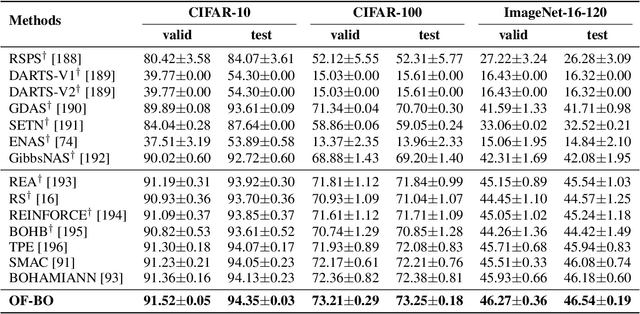


Automated machine learning (AutoML) seeks to build ML models with minimal human effort. While considerable research has been conducted in the area of AutoML in general, aiming to take humans out of the loop when building artificial intelligence (AI) applications, scant literature has focused on how AutoML works well in open-environment scenarios such as the process of training and updating large models, industrial supply chains or the industrial metaverse, where people often face open-loop problems during the search process: they must continuously collect data, update data and models, satisfy the requirements of the development and deployment environment, support massive devices, modify evaluation metrics, etc. Addressing the open-environment issue with pure data-driven approaches requires considerable data, computing resources, and effort from dedicated data engineers, making current AutoML systems and platforms inefficient and computationally intractable. Human-computer interaction is a practical and feasible way to tackle the problem of open-environment AI. In this paper, we introduce OmniForce, a human-centered AutoML (HAML) system that yields both human-assisted ML and ML-assisted human techniques, to put an AutoML system into practice and build adaptive AI in open-environment scenarios. Specifically, we present OmniForce in terms of ML version management; pipeline-driven development and deployment collaborations; a flexible search strategy framework; and widely provisioned and crowdsourced application algorithms, including large models. Furthermore, the (large) models constructed by OmniForce can be automatically turned into remote services in a few minutes; this process is dubbed model as a service (MaaS). Experimental results obtained in multiple search spaces and real-world use cases demonstrate the efficacy and efficiency of OmniForce.
Frauds Bargain Attack: Generating Adversarial Text Samples via Word Manipulation Process
Mar 01, 2023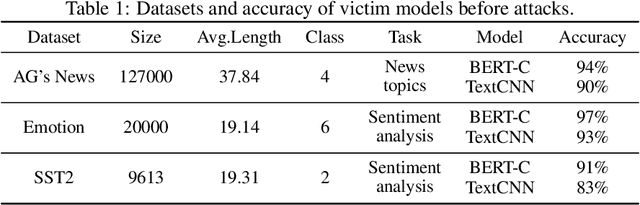
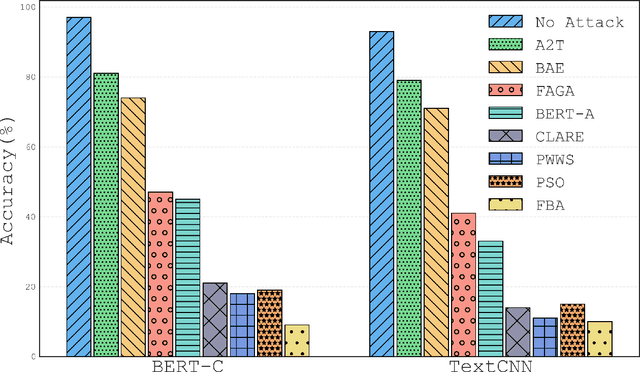
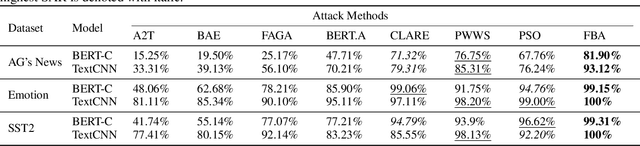
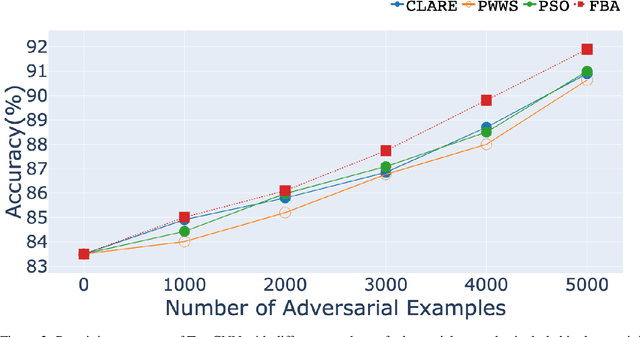
Recent studies on adversarial examples expose vulnerabilities of natural language processing (NLP) models. Existing techniques for generating adversarial examples are typically driven by deterministic heuristic rules that are agnostic to the optimal adversarial examples, a strategy that often results in attack failures. To this end, this research proposes Fraud's Bargain Attack (FBA) which utilizes a novel randomization mechanism to enlarge the search space and enables high-quality adversarial examples to be generated with high probabilities. FBA applies the Metropolis-Hasting sampler, a member of Markov Chain Monte Carlo samplers, to enhance the selection of adversarial examples from all candidates proposed by a customized stochastic process that we call the Word Manipulation Process (WMP). WMP perturbs one word at a time via insertion, removal or substitution in a contextual-aware manner. Extensive experiments demonstrate that FBA outperforms the state-of-the-art methods in terms of both attack success rate and imperceptibility.
Q-Cogni: An Integrated Causal Reinforcement Learning Framework
Feb 26, 2023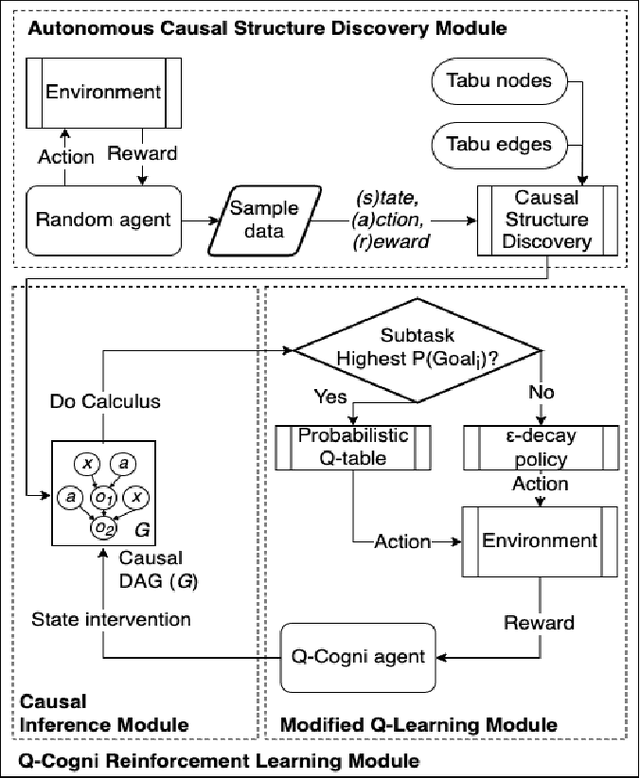
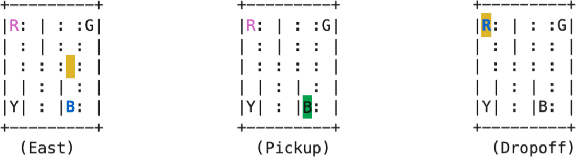
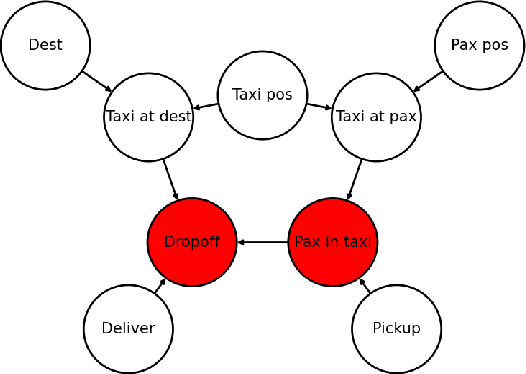
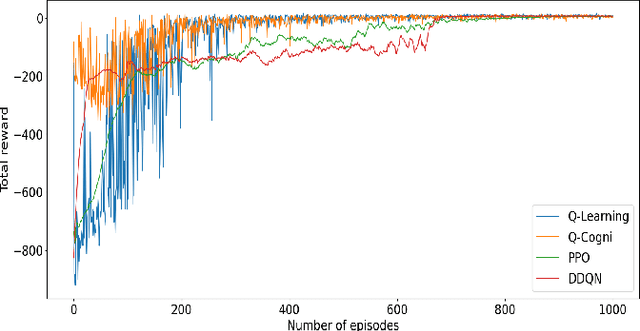
We present Q-Cogni, an algorithmically integrated causal reinforcement learning framework that redesigns Q-Learning with an autonomous causal structure discovery method to improve the learning process with causal inference. Q-Cogni achieves optimal learning with a pre-learned structural causal model of the environment that can be queried during the learning process to infer cause-and-effect relationships embedded in a state-action space. We leverage on the sample efficient techniques of reinforcement learning, enable reasoning about a broader set of policies and bring higher degrees of interpretability to decisions made by the reinforcement learning agent. We apply Q-Cogni on the Vehicle Routing Problem (VRP) and compare against state-of-the-art reinforcement learning algorithms. We report results that demonstrate better policies, improved learning efficiency and superior interpretability of the agent's decision making. We also compare this approach with traditional shortest-path search algorithms and demonstrate the benefits of our causal reinforcement learning framework to high dimensional problems. Finally, we apply Q-Cogni to derive optimal routing decisions for taxis in New York City using the Taxi & Limousine Commission trip record data and compare with shortest-path search, reporting results that show 85% of the cases with an equal or better policy derived from Q-Cogni in a real-world domain.
Design Booster: A Text-Guided Diffusion Model for Image Translation with Spatial Layout Preservation
Feb 05, 2023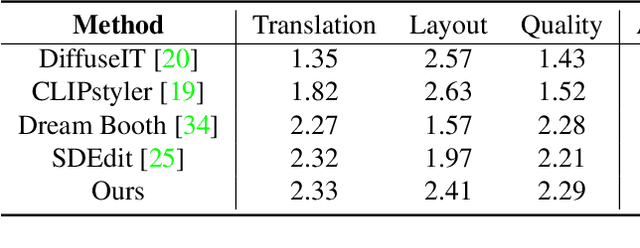
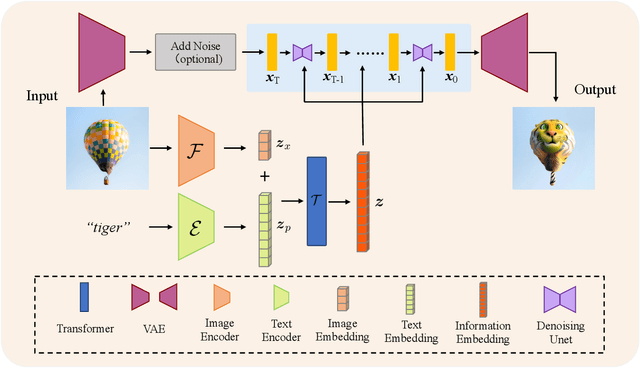
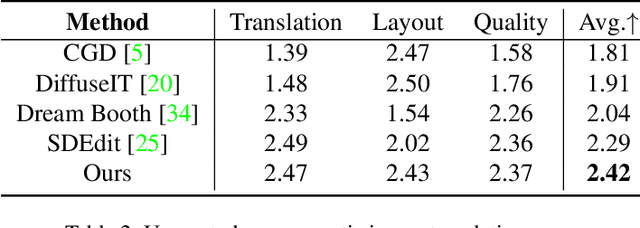
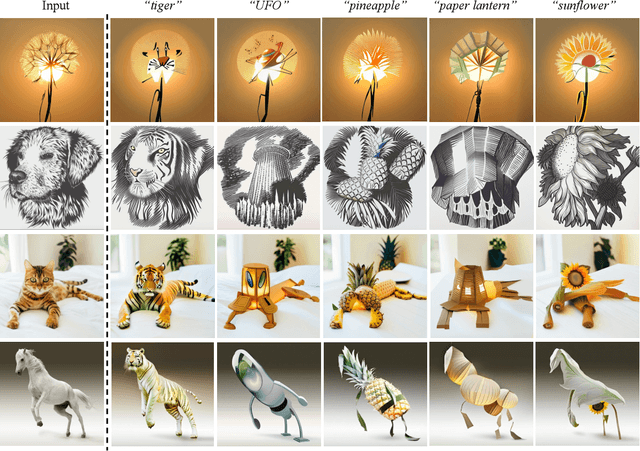
Diffusion models are able to generate photorealistic images in arbitrary scenes. However, when applying diffusion models to image translation, there exists a trade-off between maintaining spatial structure and high-quality content. Besides, existing methods are mainly based on test-time optimization or fine-tuning model for each input image, which are extremely time-consuming for practical applications. To address these issues, we propose a new approach for flexible image translation by learning a layout-aware image condition together with a text condition. Specifically, our method co-encodes images and text into a new domain during the training phase. In the inference stage, we can choose images/text or both as the conditions for each time step, which gives users more flexible control over layout and content. Experimental comparisons of our method with state-of-the-art methods demonstrate our model performs best in both style image translation and semantic image translation and took the shortest time.
Sample Dropout: A Simple yet Effective Variance Reduction Technique in Deep Policy Optimization
Feb 05, 2023Recent success in Deep Reinforcement Learning (DRL) methods has shown that policy optimization with respect to an off-policy distribution via importance sampling is effective for sample reuse. In this paper, we show that the use of importance sampling could introduce high variance in the objective estimate. Specifically, we show in a principled way that the variance of importance sampling estimate grows quadratically with importance ratios and the large ratios could consequently jeopardize the effectiveness of surrogate objective optimization. We then propose a technique called sample dropout to bound the estimation variance by dropping out samples when their ratio deviation is too high. We instantiate this sample dropout technique on representative policy optimization algorithms, including TRPO, PPO, and ESPO, and demonstrate that it consistently boosts the performance of those DRL algorithms on both continuous and discrete action controls, including MuJoCo, DMControl and Atari video games. Our code is open-sourced at \url{https://github.com/LinZichuan/sdpo.git}.
HDFormer: High-order Directed Transformer for 3D Human Pose Estimation
Feb 03, 2023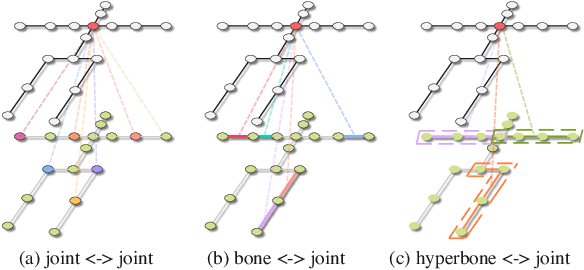
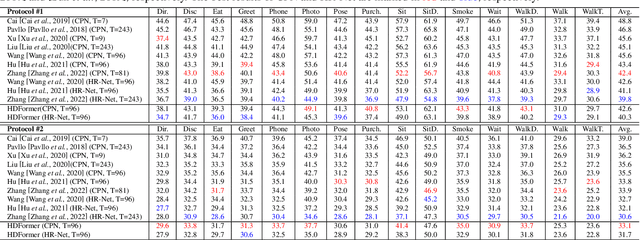
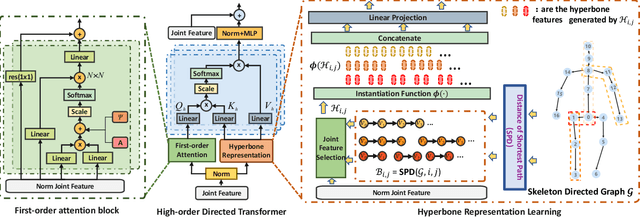
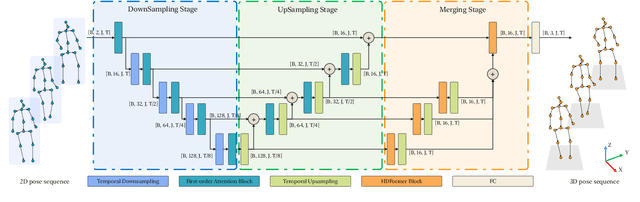
Human pose estimation is a complicated structured data sequence modeling task. Most existing methods only consider the pair-wise interaction of human body joints in model learning. Unfortunately, this causes 3D pose estimation to fail in difficult cases such as $\textit{joints overlapping}$, and pose $\textit{fast-changing}$, as pair-wise relations cannot exploit fine-grained human body priors in pose estimation. To this end, we revamped the 3D pose estimation framework with a $\textit{High-order}$ $\textit{Directed}$ $\textit{Transformer}$ (HDFormer), which coherently exploits the high-order bones and joints relevances to boost the performance of pose estimation. Specifically, HDFormer adopts both self-attention and high-order attention schemes to build up a multi-order attention module to perform the information flow interaction including the first-order $"\textit{joint$\leftrightarrow$joint}"$, second-order $"\textit{bone$\leftrightarrow$joint}"$ as well as high-order $"\textit{hyperbone$\leftrightarrow$joint}"$ relationships (hyperbone is defined as a joint set), compensating the hard cases prediction in fast-changing and heavy occlusion scenarios. Moreover, modernized CNN techniques are applied to upgrade the transformer-based architecture to speed up the HDFormer, achieving a favorable trade-off between effectiveness and efficiency. We compare our model with other SOTA models on the datasets Human3.6M and MPI-INF-3DHP. The results demonstrate that the proposed HDFormer achieves superior performance with only $\textbf{1/10}$ parameters and much lower computational cost compared to the current SOTAs. Moreover, HDFormer can be applied to various types of real-world applications, enabling real-time and accurate 3D pose estimation. The source code is in https://github.com/hyer/HDFormer.
CFFT-GAN: Cross-domain Feature Fusion Transformer for Exemplar-based Image Translation
Feb 03, 2023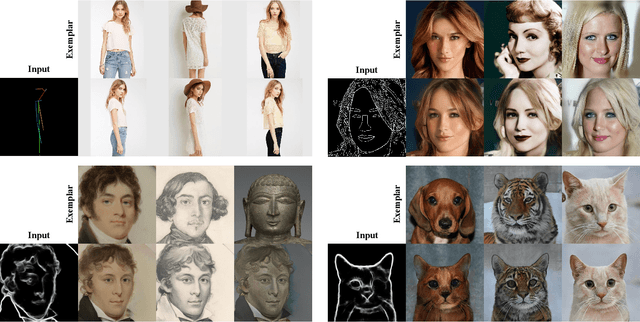

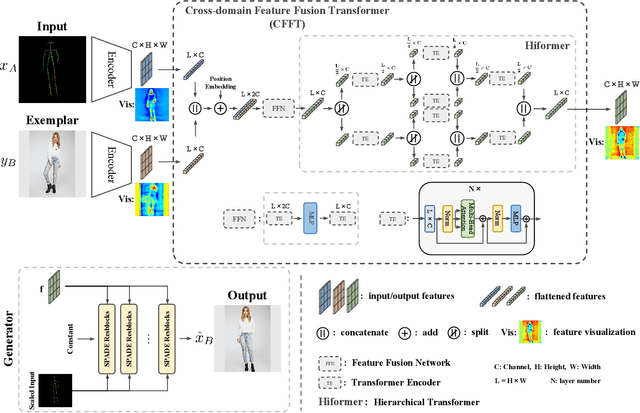
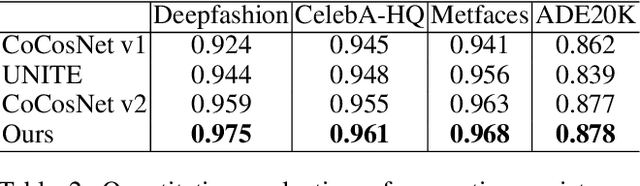
Exemplar-based image translation refers to the task of generating images with the desired style, while conditioning on certain input image. Most of the current methods learn the correspondence between two input domains and lack the mining of information within the domains. In this paper, we propose a more general learning approach by considering two domain features as a whole and learning both inter-domain correspondence and intra-domain potential information interactions. Specifically, we propose a Cross-domain Feature Fusion Transformer (CFFT) to learn inter- and intra-domain feature fusion. Based on CFFT, the proposed CFFT-GAN works well on exemplar-based image translation. Moreover, CFFT-GAN is able to decouple and fuse features from multiple domains by cascading CFFT modules. We conduct rich quantitative and qualitative experiments on several image translation tasks, and the results demonstrate the superiority of our approach compared to state-of-the-art methods. Ablation studies show the importance of our proposed CFFT. Application experimental results reflect the potential of our method.
ReGANIE: Rectifying GAN Inversion Errors for Accurate Real Image Editing
Jan 31, 2023


The StyleGAN family succeed in high-fidelity image generation and allow for flexible and plausible editing of generated images by manipulating the semantic-rich latent style space.However, projecting a real image into its latent space encounters an inherent trade-off between inversion quality and editability. Existing encoder-based or optimization-based StyleGAN inversion methods attempt to mitigate the trade-off but see limited performance. To fundamentally resolve this problem, we propose a novel two-phase framework by designating two separate networks to tackle editing and reconstruction respectively, instead of balancing the two. Specifically, in Phase I, a W-space-oriented StyleGAN inversion network is trained and used to perform image inversion and editing, which assures the editability but sacrifices reconstruction quality. In Phase II, a carefully designed rectifying network is utilized to rectify the inversion errors and perform ideal reconstruction. Experimental results show that our approach yields near-perfect reconstructions without sacrificing the editability, thus allowing accurate manipulation of real images. Further, we evaluate the performance of our rectifying network, and see great generalizability towards unseen manipulation types and out-of-domain images.
MoralDial: A Framework to Train and Evaluate Moral Dialogue Systems via Constructing Moral Discussions
Dec 21, 2022


Morality in dialogue systems has raised great attention in research recently. A moral dialogue system could better connect users and enhance conversation engagement by gaining users' trust. In this paper, we propose a framework, MoralDial to train and evaluate moral dialogue systems. In our framework, we first explore the communication mechanisms of morality and resolve expressed morality into four sub-modules. The sub-modules indicate the roadmap for building a moral dialogue system. Based on that, we design a simple yet effective method: constructing moral discussions from Rules of Thumb (RoTs) between simulated specific users and the dialogue system. The constructed discussion consists of expressing, explaining, and revising the moral views in dialogue exchanges, which makes conversational models learn morality well in a natural manner. Furthermore, we propose a novel evaluation method in the framework. We evaluate the multiple aspects of morality by judging the relation between dialogue responses and RoTs in discussions, where the multifaceted nature of morality is particularly considered. Automatic and manual experiments demonstrate that our framework is promising to train and evaluate moral dialogue systems.