 Add to Chrome
 Add to Firefox
 Add to Edge
GraphReader: Building Graph-based Agent to Enhance Long-Context Abilities of Large Language Models
Jun 20, 2024
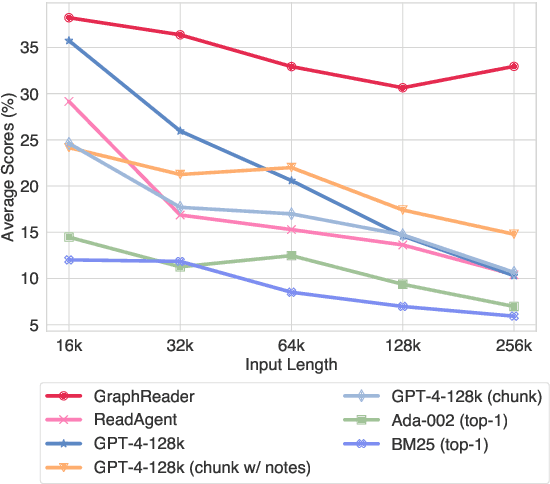
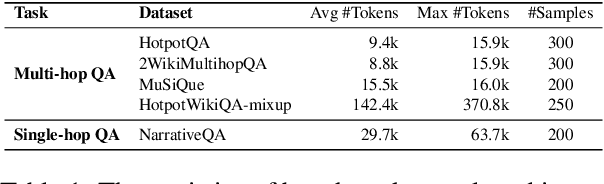
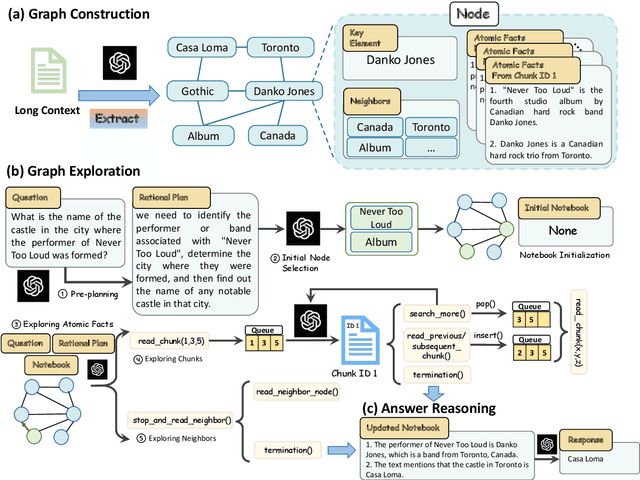
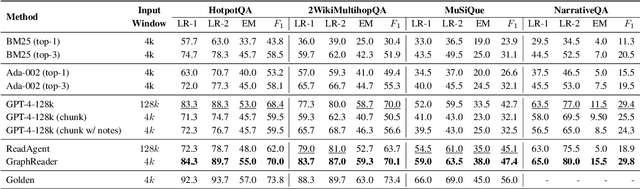
Long-context capabilities are essential for large language models (LLMs) to tackle complex and long-input tasks. Despite numerous efforts made to optimize LLMs for long contexts, challenges persist in robustly processing long inputs. In this paper, we introduce GraphReader, a graph-based agent system designed to handle long texts by structuring them into a graph and employing an agent to explore this graph autonomously. Upon receiving a question, the agent first undertakes a step-by-step analysis and devises a rational plan. It then invokes a set of predefined functions to read node content and neighbors, facilitating a coarse-to-fine exploration of the graph. Throughout the exploration, the agent continuously records new insights and reflects on current circumstances to optimize the process until it has gathered sufficient information to generate an answer. Experimental results on the LV-Eval dataset reveal that GraphReader, using a 4k context window, consistently outperforms GPT-4-128k across context lengths from 16k to 256k by a large margin. Additionally, our approach demonstrates superior performance on four challenging single-hop and multi-hop benchmarks.

Holistic-Motion2D: Scalable Whole-body Human Motion Generation in 2D Space
Jun 17, 2024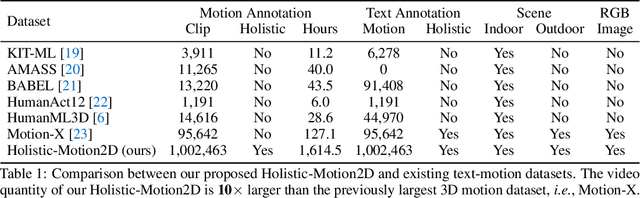
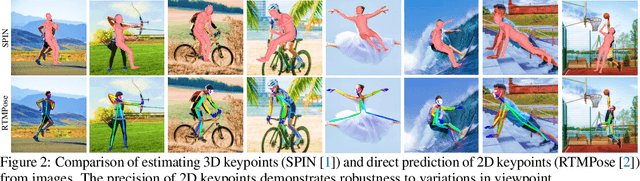
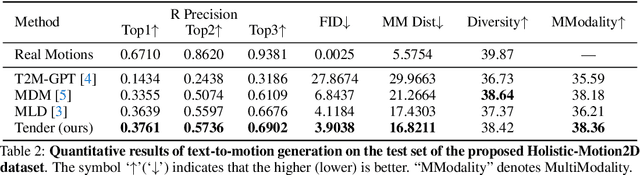
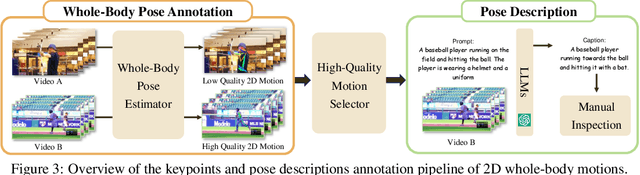
In this paper, we introduce a novel path to $\textit{general}$ human motion generation by focusing on 2D space. Traditional methods have primarily generated human motions in 3D, which, while detailed and realistic, are often limited by the scope of available 3D motion data in terms of both the size and the diversity. To address these limitations, we exploit extensive availability of 2D motion data. We present $\textbf{Holistic-Motion2D}$, the first comprehensive and large-scale benchmark for 2D whole-body motion generation, which includes over 1M in-the-wild motion sequences, each paired with high-quality whole-body/partial pose annotations and textual descriptions. Notably, Holistic-Motion2D is ten times larger than the previously largest 3D motion dataset. We also introduce a baseline method, featuring innovative $\textit{whole-body part-aware attention}$ and $\textit{confidence-aware modeling}$ techniques, tailored for 2D $\underline{\text T}$ext-driv$\underline{\text{EN}}$ whole-bo$\underline{\text D}$y motion gen$\underline{\text{ER}}$ation, namely $\textbf{Tender}$. Extensive experiments demonstrate the effectiveness of $\textbf{Holistic-Motion2D}$ and $\textbf{Tender}$ in generating expressive, diverse, and realistic human motions. We also highlight the utility of 2D motion for various downstream applications and its potential for lifting to 3D motion. The page link is: https://holistic-motion2d.github.io.
Iterative Length-Regularized Direct Preference Optimization: A Case Study on Improving 7B Language Models to GPT-4 Level
Jun 17, 2024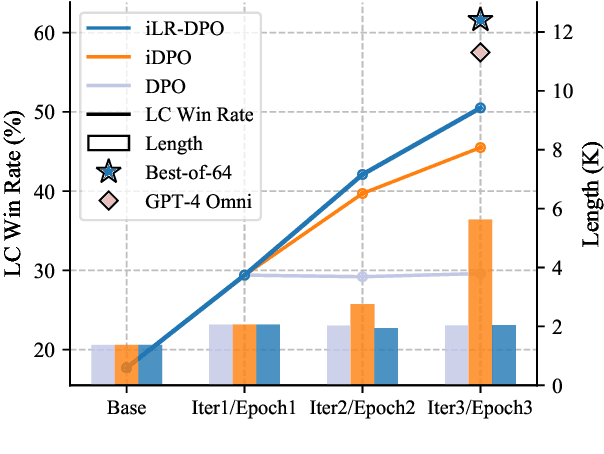
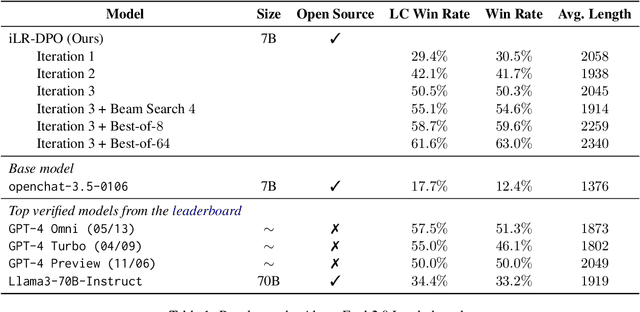
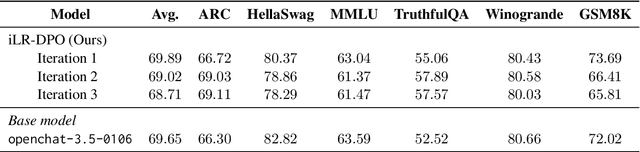
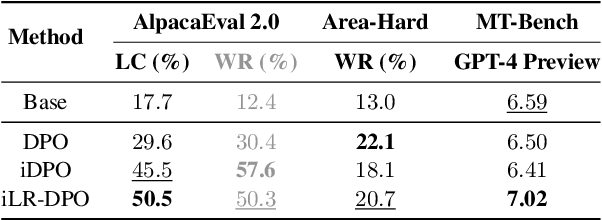
Direct Preference Optimization (DPO), a standard method for aligning language models with human preferences, is traditionally applied to offline preferences. Recent studies show that DPO benefits from iterative training with online preferences labeled by a trained reward model. In this work, we identify a pitfall of vanilla iterative DPO - improved response quality can lead to increased verbosity. To address this, we introduce iterative length-regularized DPO (iLR-DPO) to penalize response length. Our empirical results show that iLR-DPO can enhance a 7B model to perform on par with GPT-4 without increasing verbosity. Specifically, our 7B model achieves a $50.5\%$ length-controlled win rate against $\texttt{GPT-4 Preview}$ on AlpacaEval 2.0, and excels across standard benchmarks including MT-Bench, Arena-Hard and OpenLLM Leaderboard. These results demonstrate the effectiveness of iterative DPO in aligning language models with human feedback.
BEACON: Benchmark for Comprehensive RNA Tasks and Language Models
Jun 14, 2024RNA plays a pivotal role in translating genetic instructions into functional outcomes, underscoring its importance in biological processes and disease mechanisms. Despite the emergence of numerous deep learning approaches for RNA, particularly universal RNA language models, there remains a significant lack of standardized benchmarks to assess the effectiveness of these methods. In this study, we introduce the first comprehensive RNA benchmark BEACON (\textbf{BE}nchm\textbf{A}rk for \textbf{CO}mprehensive R\textbf{N}A Task and Language Models). First, BEACON comprises 13 distinct tasks derived from extensive previous work covering structural analysis, functional studies, and engineering applications, enabling a comprehensive assessment of the performance of methods on various RNA understanding tasks. Second, we examine a range of models, including traditional approaches like CNNs, as well as advanced RNA foundation models based on language models, offering valuable insights into the task-specific performances of these models. Third, we investigate the vital RNA language model components from the tokenizer and positional encoding aspects. Notably, our findings emphasize the superiority of single nucleotide tokenization and the effectiveness of Attention with Linear Biases (ALiBi) over traditional positional encoding methods. Based on these insights, a simple yet strong baseline called BEACON-B is proposed, which can achieve outstanding performance with limited data and computational resources. The datasets and source code of our benchmark are available at https://github.com/terry-r123/RNABenchmark.
Accessing GPT-4 level Mathematical Olympiad Solutions via Monte Carlo Tree Self-refine with LLaMa-3 8B
Jun 11, 2024
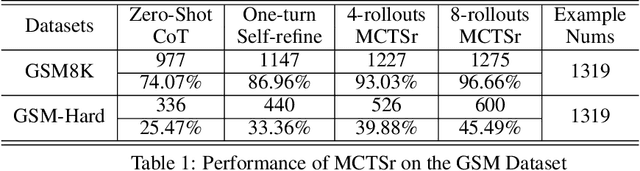
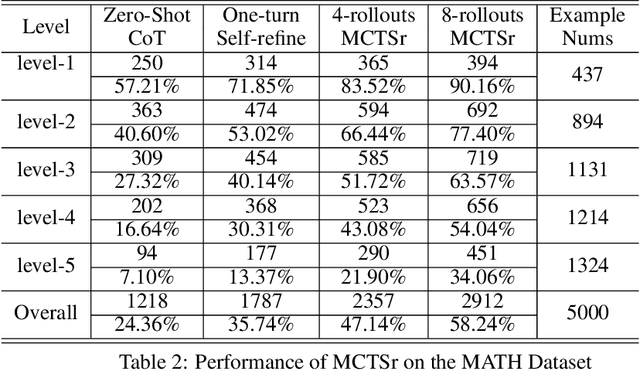
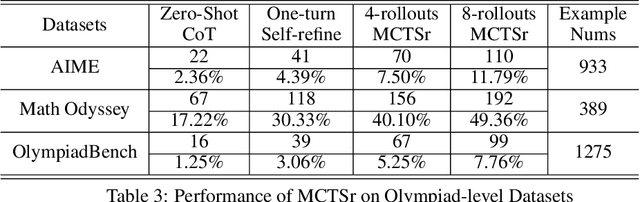
This paper introduces the MCT Self-Refine (MCTSr) algorithm, an innovative integration of Large Language Models (LLMs) with Monte Carlo Tree Search (MCTS), designed to enhance performance in complex mathematical reasoning tasks. Addressing the challenges of accuracy and reliability in LLMs, particularly in strategic and mathematical reasoning, MCTSr leverages systematic exploration and heuristic self-refine mechanisms to improve decision-making frameworks within LLMs. The algorithm constructs a Monte Carlo search tree through iterative processes of Selection, self-refine, self-evaluation, and Backpropagation, utilizing an improved Upper Confidence Bound (UCB) formula to optimize the exploration-exploitation balance. Extensive experiments demonstrate MCTSr's efficacy in solving Olympiad-level mathematical problems, significantly improving success rates across multiple datasets, including GSM8K, GSM Hard, MATH, and Olympiad-level benchmarks, including Math Odyssey, AIME, and OlympiadBench. The study advances the application of LLMs in complex reasoning tasks and sets a foundation for future AI integration, enhancing decision-making accuracy and reliability in LLM-driven applications.
Adapter-X: A Novel General Parameter-Efficient Fine-Tuning Framework for Vision
Jun 06, 2024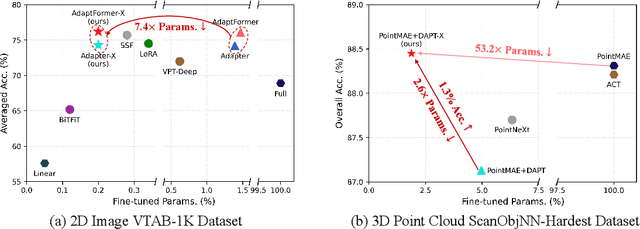

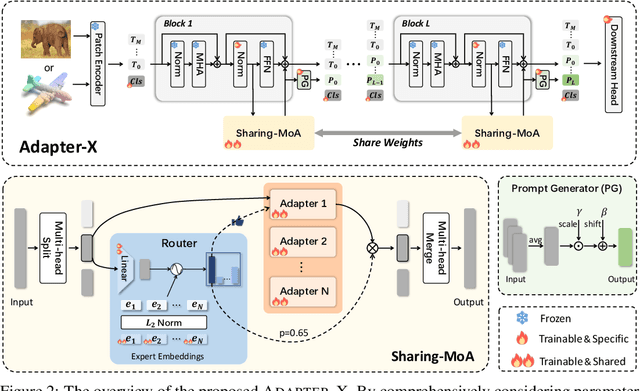

Parameter-efficient fine-tuning (PEFT) has become increasingly important as foundation models continue to grow in both popularity and size. Adapter has been particularly well-received due to their potential for parameter reduction and adaptability across diverse tasks. However, striking a balance between high efficiency and robust generalization across tasks remains a challenge for adapter-based methods. We analyze existing methods and find that: 1) parameter sharing is the key to reducing redundancy; 2) more tunable parameters, dynamic allocation, and block-specific design are keys to improving performance. Unfortunately, no previous work considers all these factors. Inspired by this insight, we introduce a novel framework named Adapter-X. First, a Sharing Mixture of Adapters (SMoA) module is proposed to fulfill token-level dynamic allocation, increased tunable parameters, and inter-block sharing at the same time. Second, some block-specific designs like Prompt Generator (PG) are introduced to further enhance the ability of adaptation. Extensive experiments across 2D image and 3D point cloud modalities demonstrate that Adapter-X represents a significant milestone as it is the first to outperform full fine-tuning in both 2D image and 3D point cloud modalities with significantly fewer parameters, i.e., only 0.20% and 1.88% of original trainable parameters for 2D and 3D classification tasks. Our code will be publicly available.
FNP: Fourier Neural Processes for Arbitrary-Resolution Data Assimilation
Jun 03, 2024Data assimilation is a vital component in modern global medium-range weather forecasting systems to obtain the best estimation of the atmospheric state by combining the short-term forecast and observations. Recently, AI-based data assimilation approaches have attracted increasing attention for their significant advantages over traditional techniques in terms of computational consumption. However, existing AI-based data assimilation methods can only handle observations with a specific resolution, lacking the compatibility and generalization ability to assimilate observations with other resolutions. Considering that complex real-world observations often have different resolutions, we propose the \textit{\textbf{Fourier Neural Processes}} (FNP) for \textit{arbitrary-resolution data assimilation} in this paper. Leveraging the efficiency of the designed modules and flexible structure of neural processes, FNP achieves state-of-the-art results in assimilating observations with varying resolutions, and also exhibits increasing advantages over the counterparts as the resolution and the amount of observations increase. Moreover, our FNP trained on a fixed resolution can directly handle the assimilation of observations with out-of-distribution resolutions and the observational information reconstruction task without additional fine-tuning, demonstrating its excellent generalization ability across data resolutions as well as across tasks.
MAP-Neo: Highly Capable and Transparent Bilingual Large Language Model Series
May 29, 2024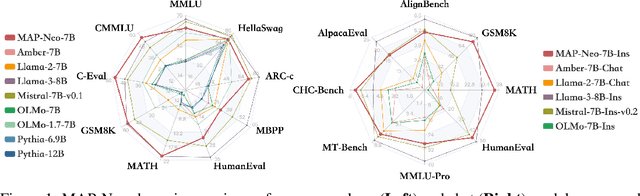


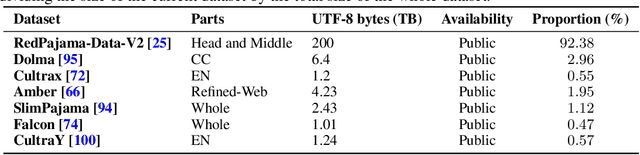
Large Language Models (LLMs) have made great strides in recent years to achieve unprecedented performance across different tasks. However, due to commercial interest, the most competitive models like GPT, Gemini, and Claude have been gated behind proprietary interfaces without disclosing the training details. Recently, many institutions have open-sourced several strong LLMs like LLaMA-3, comparable to existing closed-source LLMs. However, only the model's weights are provided with most details (e.g., intermediate checkpoints, pre-training corpus, and training code, etc.) being undisclosed. To improve the transparency of LLMs, the research community has formed to open-source truly open LLMs (e.g., Pythia, Amber, OLMo), where more details (e.g., pre-training corpus and training code) are being provided. These models have greatly advanced the scientific study of these large models including their strengths, weaknesses, biases and risks. However, we observe that the existing truly open LLMs on reasoning, knowledge, and coding tasks are still inferior to existing state-of-the-art LLMs with similar model sizes. To this end, we open-source MAP-Neo, a highly capable and transparent bilingual language model with 7B parameters trained from scratch on 4.5T high-quality tokens. Our MAP-Neo is the first fully open-sourced bilingual LLM with comparable performance compared to existing state-of-the-art LLMs. Moreover, we open-source all details to reproduce our MAP-Neo, where the cleaned pre-training corpus, data cleaning pipeline, checkpoints, and well-optimized training/evaluation framework are provided. Finally, we hope our MAP-Neo will enhance and strengthen the open research community and inspire more innovations and creativities to facilitate the further improvements of LLMs.
Instruct-ReID++: Towards Universal Purpose Instruction-Guided Person Re-identification
May 28, 2024
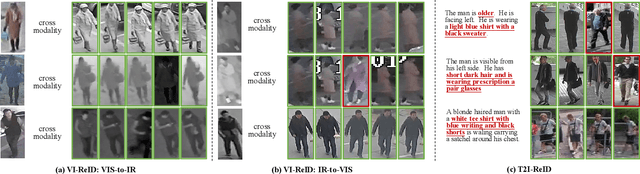


Human intelligence can retrieve any person according to both visual and language descriptions. However, the current computer vision community studies specific person re-identification (ReID) tasks in different scenarios separately, which limits the applications in the real world. This paper strives to resolve this problem by proposing a novel instruct-ReID task that requires the model to retrieve images according to the given image or language instructions. Instruct-ReID is the first exploration of a general ReID setting, where existing 6 ReID tasks can be viewed as special cases by assigning different instructions. To facilitate research in this new instruct-ReID task, we propose a large-scale OmniReID++ benchmark equipped with diverse data and comprehensive evaluation methods e.g., task specific and task-free evaluation settings. In the task-specific evaluation setting, gallery sets are categorized according to specific ReID tasks. We propose a novel baseline model, IRM, with an adaptive triplet loss to handle various retrieval tasks within a unified framework. For task-free evaluation setting, where target person images are retrieved from task-agnostic gallery sets, we further propose a new method called IRM++ with novel memory bank-assisted learning. Extensive evaluations of IRM and IRM++ on OmniReID++ benchmark demonstrate the superiority of our proposed methods, achieving state-of-the-art performance on 10 test sets. The datasets, the model, and the code will be available at https://github.com/hwz-zju/Instruct-ReID
ORCA: A Global Ocean Emulator for Multi-year to Decadal Predictions
May 24, 2024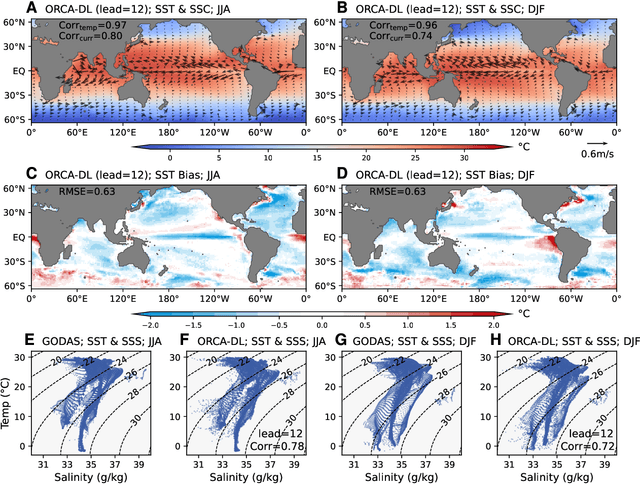

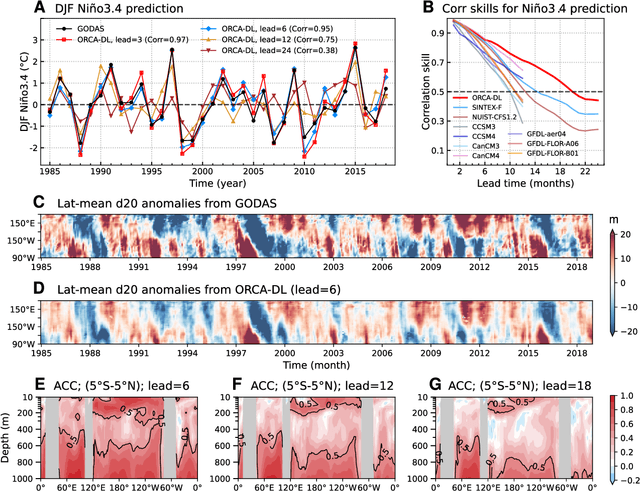

Ocean dynamics plays a crucial role in driving global weather and climate patterns. Accurate and efficient modeling of ocean dynamics is essential for improved understanding of complex ocean circulation and processes, for predicting climate variations and their associated teleconnections, and for addressing the challenges of climate change. While great efforts have been made to improve numerical Ocean General Circulation Models (OGCMs), accurate forecasting of global oceanic variations for multi-year remains to be a long-standing challenge. Here, we introduce ORCA (Oceanic Reliable foreCAst), the first data-driven model predicting global ocean circulation from multi-year to decadal time scales. ORCA accurately simulates the three-dimensional circulations and dynamics of the global ocean with high physical consistency. Hindcasts of key oceanic variables demonstrate ORCA's remarkable prediction skills in predicting ocean variations compared with state-of-the-art numerical OGCMs and abilities in capturing occurrences of extreme events at the subsurface ocean and ENSO vertical patterns. These results demonstrate the potential of data-driven ocean models for providing cheap, efficient, and accurate global ocean modeling and prediction. Moreover, ORCA stably and faithfully emulates ocean dynamics at decadal timescales, demonstrating its potential even for climate projections. The model will be available at https://github.com/OpenEarthLab/ORCA.