 Add to Chrome
 Add to Firefox
 Add to Edge
VLRMBench: A Comprehensive and Challenging Benchmark for Vision-Language Reward Models
Mar 10, 2025
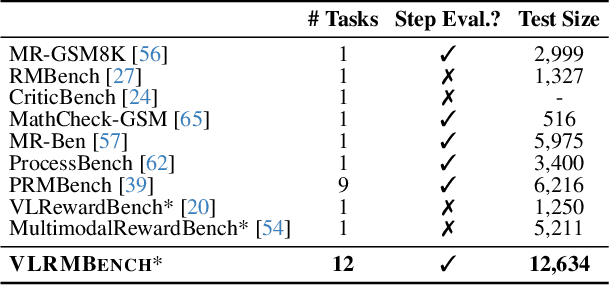
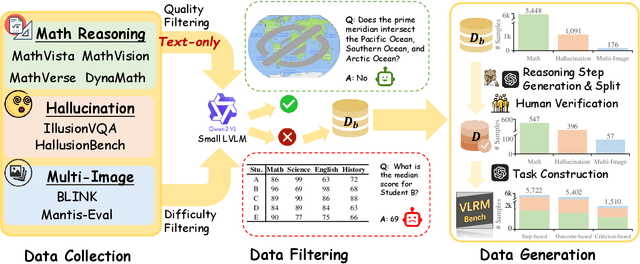
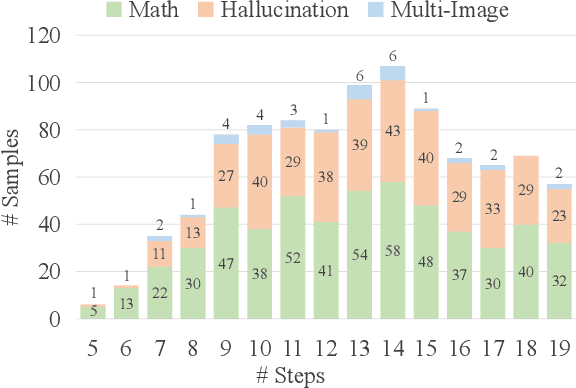
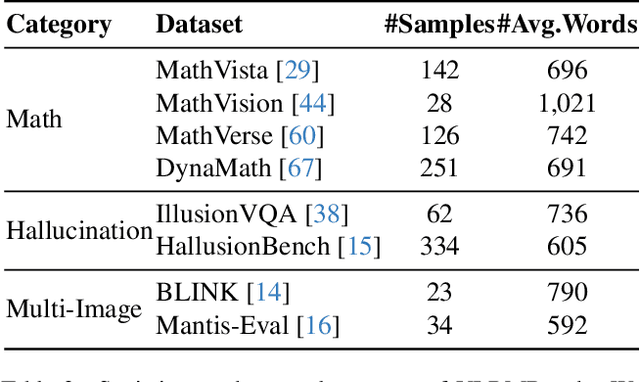
Although large visual-language models (LVLMs) have demonstrated strong performance in multimodal tasks, errors may occasionally arise due to biases during the reasoning process. Recently, reward models (RMs) have become increasingly pivotal in the reasoning process. Specifically, process RMs evaluate each reasoning step, outcome RMs focus on the assessment of reasoning results, and critique RMs perform error analysis on the entire reasoning process, followed by corrections. However, existing benchmarks for vision-language RMs (VLRMs) typically assess only a single aspect of their capabilities (e.g., distinguishing between two answers), thus limiting the all-round evaluation and restricting the development of RMs in the visual-language domain. To address this gap, we propose a comprehensive and challenging benchmark, dubbed as VLRMBench, encompassing 12,634 questions. VLRMBench is constructed based on three distinct types of datasets, covering mathematical reasoning, hallucination understanding, and multi-image understanding. We design 12 tasks across three major categories, focusing on evaluating VLRMs in the aspects of process understanding, outcome judgment, and critique generation. Extensive experiments are conducted on 21 open-source models and 5 advanced closed-source models, highlighting the challenges posed by VLRMBench. For instance, in the `Forecasting Future', a binary classification task, the advanced GPT-4o achieves only a 76.0% accuracy. Additionally, we perform comprehensive analytical studies, offering valuable insights for the future development of VLRMs. We anticipate that VLRMBench will serve as a pivotal benchmark in advancing VLRMs. Code and datasets will be available at https://github.com/JCruan519/VLRMBench.

From Motion Signals to Insights: A Unified Framework for Student Behavior Analysis and Feedback in Physical Education Classes
Mar 09, 2025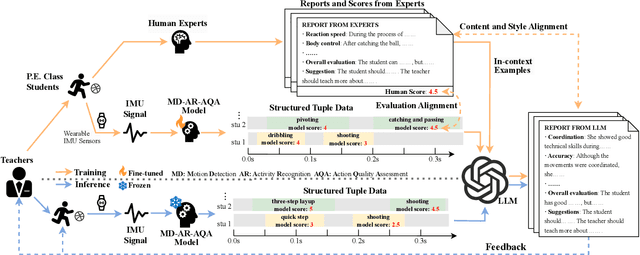
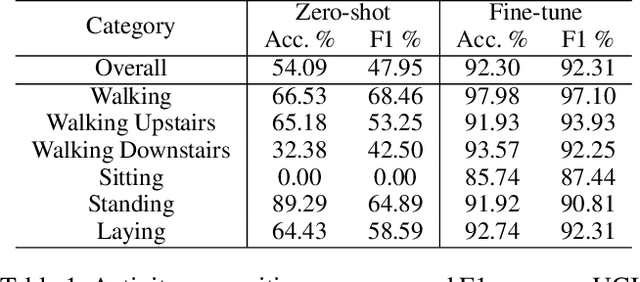
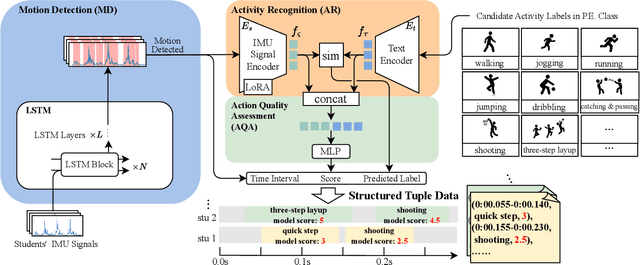
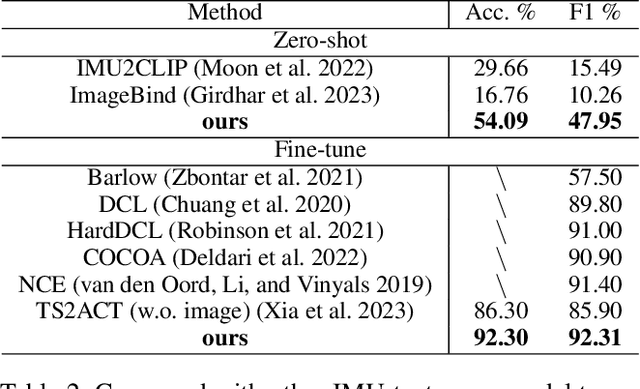
Analyzing student behavior in educational scenarios is crucial for enhancing teaching quality and student engagement. Existing AI-based models often rely on classroom video footage to identify and analyze student behavior. While these video-based methods can partially capture and analyze student actions, they struggle to accurately track each student's actions in physical education classes, which take place in outdoor, open spaces with diverse activities, and are challenging to generalize to the specialized technical movements involved in these settings. Furthermore, current methods typically lack the ability to integrate specialized pedagogical knowledge, limiting their ability to provide in-depth insights into student behavior and offer feedback for optimizing instructional design. To address these limitations, we propose a unified end-to-end framework that leverages human activity recognition technologies based on motion signals, combined with advanced large language models, to conduct more detailed analyses and feedback of student behavior in physical education classes. Our framework begins with the teacher's instructional designs and the motion signals from students during physical education sessions, ultimately generating automated reports with teaching insights and suggestions for improving both learning and class instructions. This solution provides a motion signal-based approach for analyzing student behavior and optimizing instructional design tailored to physical education classes. Experimental results demonstrate that our framework can accurately identify student behaviors and produce meaningful pedagogical insights.
Chain of Strategy Optimization Makes Large Language Models Better Emotional Supporter
Mar 07, 2025The growing emotional stress in modern society has increased the demand for Emotional Support Conversations (ESC). While Large Language Models (LLMs) show promise for ESC, they face two key challenges: (1) low strategy selection accuracy, and (2) preference bias, limiting their adaptability to emotional needs of users. Existing supervised fine-tuning (SFT) struggles to address these issues, as it rigidly trains models on single gold-standard responses without modeling nuanced strategy trade-offs. To overcome these limitations, we propose Chain-of-Strategy Optimization (CSO), a novel approach that optimizes strategy selection preferences at each dialogue turn. We first leverage Monte Carlo Tree Search to construct ESC-Pro, a high-quality preference dataset with turn-level strategy-response pairs. Training on ESC-Pro with CSO improves both strategy accuracy and bias mitigation, enabling LLMs to generate more empathetic and contextually appropriate responses. Experiments on LLaMA-3.1-8B, Gemma-2-9B, and Qwen2.5-7B demonstrate that CSO outperforms standard SFT, highlighting the efficacy of fine-grained, turn-level preference modeling in ESC.
One-shot In-context Part Segmentation
Mar 03, 2025
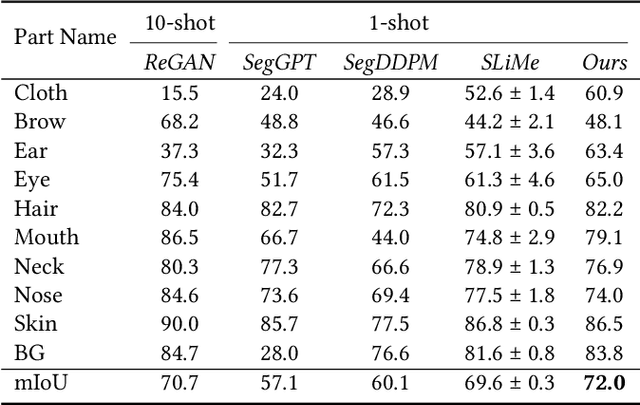
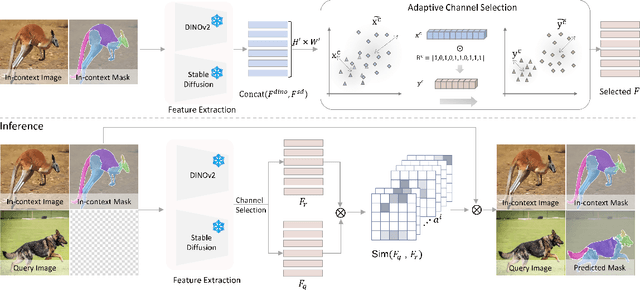
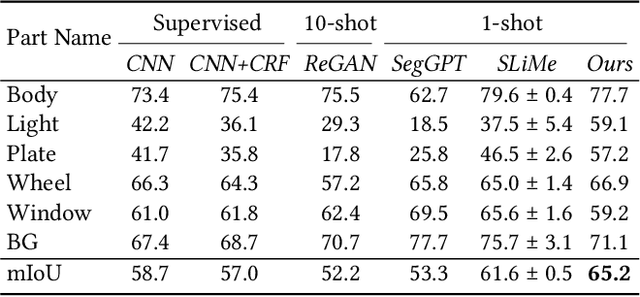
In this paper, we present the One-shot In-context Part Segmentation (OIParts) framework, designed to tackle the challenges of part segmentation by leveraging visual foundation models (VFMs). Existing training-based one-shot part segmentation methods that utilize VFMs encounter difficulties when faced with scenarios where the one-shot image and test image exhibit significant variance in appearance and perspective, or when the object in the test image is partially visible. We argue that training on the one-shot example often leads to overfitting, thereby compromising the model's generalization capability. Our framework offers a novel approach to part segmentation that is training-free, flexible, and data-efficient, requiring only a single in-context example for precise segmentation with superior generalization ability. By thoroughly exploring the complementary strengths of VFMs, specifically DINOv2 and Stable Diffusion, we introduce an adaptive channel selection approach by minimizing the intra-class distance for better exploiting these two features, thereby enhancing the discriminatory power of the extracted features for the fine-grained parts. We have achieved remarkable segmentation performance across diverse object categories. The OIParts framework not only eliminates the need for extensive labeled data but also demonstrates superior generalization ability. Through comprehensive experimentation on three benchmark datasets, we have demonstrated the superiority of our proposed method over existing part segmentation approaches in one-shot settings.
From Hypothesis to Publication: A Comprehensive Survey of AI-Driven Research Support Systems
Mar 03, 2025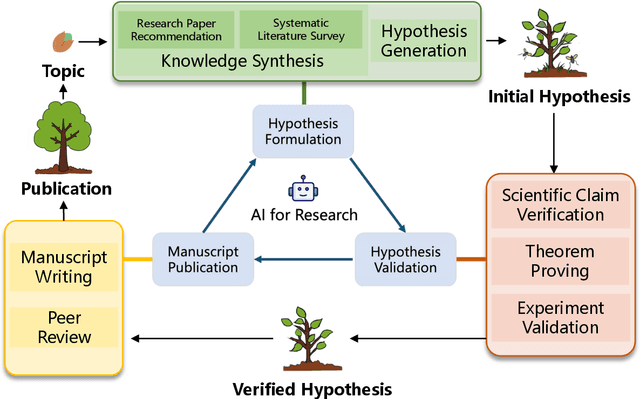
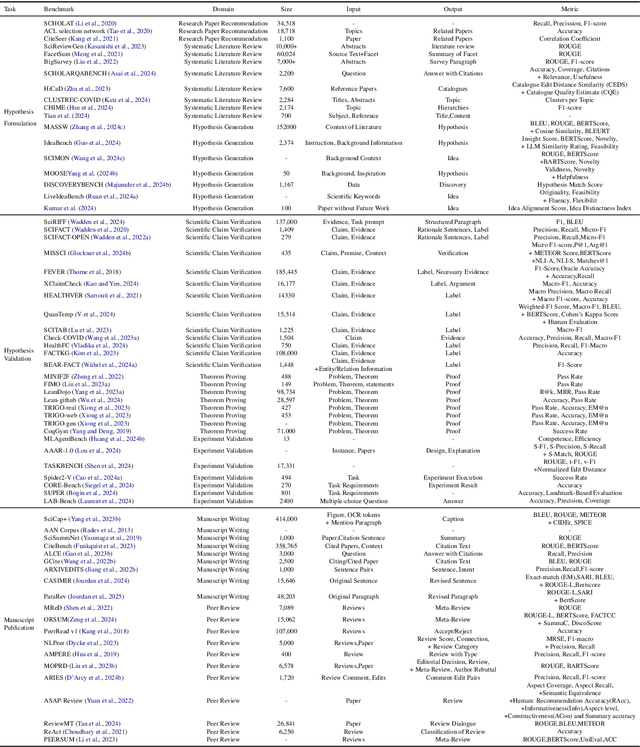
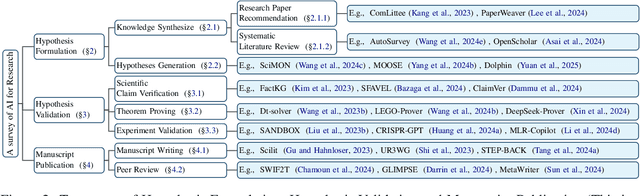

Research is a fundamental process driving the advancement of human civilization, yet it demands substantial time and effort from researchers. In recent years, the rapid development of artificial intelligence (AI) technologies has inspired researchers to explore how AI can accelerate and enhance research. To monitor relevant advancements, this paper presents a systematic review of the progress in this domain. Specifically, we organize the relevant studies into three main categories: hypothesis formulation, hypothesis validation, and manuscript publication. Hypothesis formulation involves knowledge synthesis and hypothesis generation. Hypothesis validation includes the verification of scientific claims, theorem proving, and experiment validation. Manuscript publication encompasses manuscript writing and the peer review process. Furthermore, we identify and discuss the current challenges faced in these areas, as well as potential future directions for research. Finally, we also offer a comprehensive overview of existing benchmarks and tools across various domains that support the integration of AI into the research process. We hope this paper serves as an introduction for beginners and fosters future research. Resources have been made publicly available at https://github.com/zkzhou126/AI-for-Research.
Beware of Your Po! Measuring and Mitigating AI Safety Risks in Role-Play Fine-Tuning of LLMs
Feb 28, 2025Role-playing enables large language models (LLMs) to engage users in immersive and personalized interactions, but it also introduces significant safety risks. Existing role-play fine-tuning techniques improve role adaptability but may degrade safety performance, particularly for villainous characters. In this work, we conduct the first comprehensive assessment of role-play fine-tuning risks by training 95 role-specific LLMs using RoleBench. Our experiments reveal that role-play fine-tuning leads to a noticeable decline in safety performance, with safety risks varying based on character traits. To tackle this challenge, we propose Safety-Aware Role-Play Fine-Tuning (SaRFT), a novel method designed to balance role-playing capabilities and safety. Extensive experiments on LLaMA-3-8B-Instruct, Gemma-2-9B-it, and Qwen2.5-7B-Instruct demonstrate that SaRFT consistently outperforms state-of-the-art baselines under both LoRA and full-parameter fine-tuning settings. Our findings highlight the necessity of role-adaptive safety measures and provide insights into mitigating role-specific safety risks in role-playing LLMs.
SwimVG: Step-wise Multimodal Fusion and Adaption for Visual Grounding
Feb 24, 2025


Visual grounding aims to ground an image region through natural language, which heavily relies on cross-modal alignment. Most existing methods transfer visual/linguistic knowledge separately by fully fine-tuning uni-modal pre-trained models, followed by a simple stack of visual-language transformers for multimodal fusion. However, these approaches not only limit adequate interaction between visual and linguistic contexts, but also incur significant computational costs. Therefore, to address these issues, we explore a step-wise multimodal fusion and adaption framework, namely SwimVG. Specifically, SwimVG proposes step-wise multimodal prompts (Swip) and cross-modal interactive adapters (CIA) for visual grounding, replacing the cumbersome transformer stacks for multimodal fusion. Swip can improve {the} alignment between the vision and language representations step by step, in a token-level fusion manner. In addition, weight-level CIA further promotes multimodal fusion by cross-modal interaction. Swip and CIA are both parameter-efficient paradigms, and they fuse the cross-modal features from shallow to deep layers gradually. Experimental results on four widely-used benchmarks demonstrate that SwimVG achieves remarkable abilities and considerable benefits in terms of efficiency. Our code is available at https://github.com/liuting20/SwimVG.
ECM: A Unified Electronic Circuit Model for Explaining the Emergence of In-Context Learning and Chain-of-Thought in Large Language Model
Feb 05, 2025


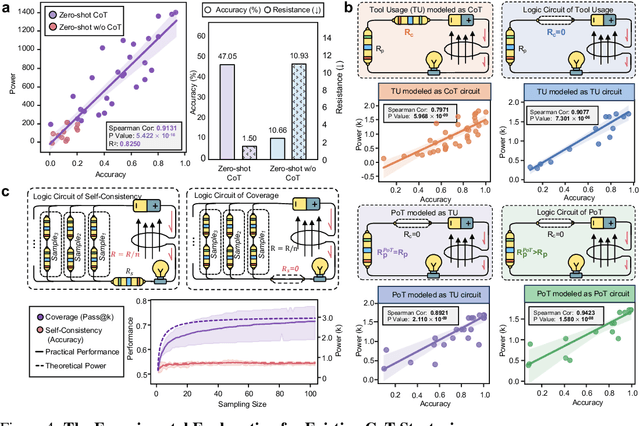
Recent advancements in large language models (LLMs) have led to significant successes across various applications, where the most noticeable is to a series of emerging capabilities, particularly in the areas of In-Context Learning (ICL) and Chain-of-Thought (CoT). To better understand and control model performance, many studies have begun investigating the underlying causes of these phenomena and their impact on task outcomes. However, existing explanatory frameworks predominantly focus on isolating and explaining ICL and CoT independently, leading to an incomplete understanding of their combined influence on model performance. To address this gap, we propose the Electronic Circuit Model (ECM), which provides a foundation for developing scalable, learnable policies and improving the management of AI-generated content. Specifically, ECM conceptualizes model behavior as an electronic circuit: ICL is represented as semantic magnetic field to providing an additional voltage following Faraday's Law, while CoT is modeled as series resistors to constrain the model output performance following Ohm's Law. Experimental results demonstrate that the ECM effectively predicts and explains LLM performance across a variety of prompting strategies. Furthermore, we apply ECM to advanced reasoning strategy optimization on a series of tasks, such as the International Olympiad in Informatics (IOI) and the International Mathematical Olympiad (IMO), achieving competitive performance that surpasses nearly 80% of top human competitors.
The Hidden Life of Tokens: Reducing Hallucination of Large Vision-Language Models via Visual Information Steering
Feb 05, 2025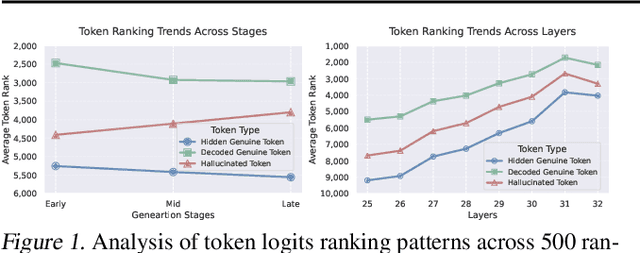
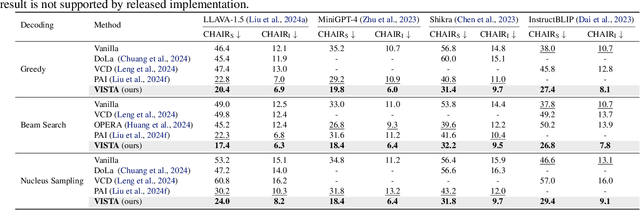
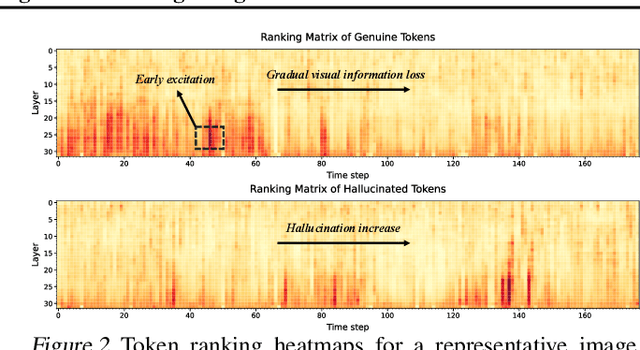
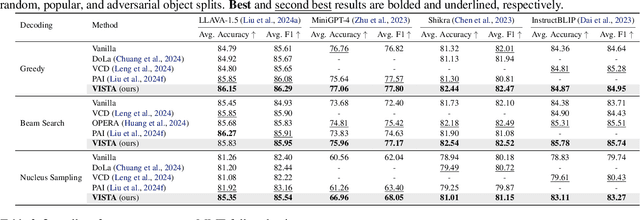
Large Vision-Language Models (LVLMs) can reason effectively over both textual and visual inputs, but they tend to hallucinate syntactically coherent yet visually ungrounded contents. In this paper, we investigate the internal dynamics of hallucination by examining the tokens logits rankings throughout the generation process, revealing three key patterns in how LVLMs process information: (1) gradual visual information loss -- visually grounded tokens gradually become less favored throughout generation, and (2) early excitation -- semantically meaningful tokens achieve peak activation in the layers earlier than the final layer. (3) hidden genuine information -- visually grounded tokens though not being eventually decided still retain relatively high rankings at inference. Based on these insights, we propose VISTA (Visual Information Steering with Token-logit Augmentation), a training-free inference-time intervention framework that reduces hallucination while promoting genuine information. VISTA works by combining two complementary approaches: reinforcing visual information in activation space and leveraging early layer activations to promote semantically meaningful decoding. Compared to existing methods, VISTA requires no external supervision and is applicable to various decoding strategies. Extensive experiments show that VISTA on average reduces hallucination by abount 40% on evaluated open-ended generation task, and it consistently outperforms existing methods on four benchmarks across four architectures under three decoding strategies.
Boosting Tool Use of Large Language Models via Iterative Reinforced Fine-Tuning
Jan 15, 2025


Augmenting large language models (LLMs) with external tools is a promising approach to enhance their capabilities. Effectively leveraging this potential for complex tasks hinges crucially on improving their ability to use tools. Synthesizing tool use data by simulating the real world is an effective approach. Nevertheless, our investigation reveals that training gains significantly decay as the scale of these data increases. The primary factor is the model's poor performance (a.k.a deficiency) in complex scenarios, which hinders learning from data using SFT. Driven by this objective, we propose an iterative reinforced fine-tuning strategy to continually guide the model to alleviate it. Specifically, we first identify deficiency-related data based on feedback from the policy model, then perform a Monte Carlo Tree Search to collect fine-grained preference pairs to pinpoint deficiencies. Subsequently, we update the policy model using preference optimization to align with ground truth and misalign with deficiencies. This process can be iterated. Moreover, before the iteration, we propose an easy-to-hard warm-up SFT strategy to facilitate learning from challenging data. The experiments demonstrate our models go beyond the same parametric models, outperforming many larger open-source and closed-source models. Additionally, it has achieved notable training gains in complex tool use scenarios.