 Add to Chrome
 Add to Firefox
 Add to Edge
The Granularity Axis: A Micro-to-Macro Latent Direction for Social Roles in Language Models
May 07, 2026
Large language models (LLMs) are routinely prompted to take on social roles ranging from individuals to institutions, yet it remains unclear whether their internal representations encode the granularity of such roles, from micro-level individual experience to macro-level organizational, institutional, or national reasoning. We show that they do. We define a contrast-based Granularity Axis as the difference between mean macro- and micro-role hidden states. In Qwen3-8B, this axis aligns with the principal axis (PC1) of the role representation space at cosine 0.972 and accounts for 52.6% of its variance, indicating that granularity is the dominant geometric axis organizing prompted social roles. We construct 75 social roles across five granularity levels and collect 91,200 role-conditioned responses over shared questions and prompt variants, then extract role-level hidden states and project them onto the axis. Role projections increase monotonically across all five levels, remain stable across layers, prompt variants, endpoint definitions, held-out splits, and score-filtered subsets, and transfer to Llama-3.1-8B-Instruct. The axis is also causally relevant: activation steering along it shifts response granularity in the predicted direction, with Llama moving from 2.00 to 3.17 on a five-point macro scale under positive steering on prompts that admit local responses. The two models differ in controllability, suggesting that steering depends on each model's default operating regime. Overall, our findings suggest that social role granularity is not merely a stylistic surface feature, but a structured, ordered, and causally manipulable latent direction in role-conditioned language model behavior.

From Hypothesis to Publication: A Comprehensive Survey of AI-Driven Research Support Systems
Mar 03, 2025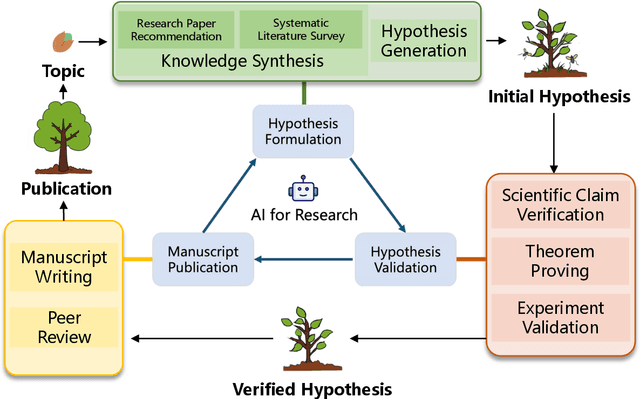
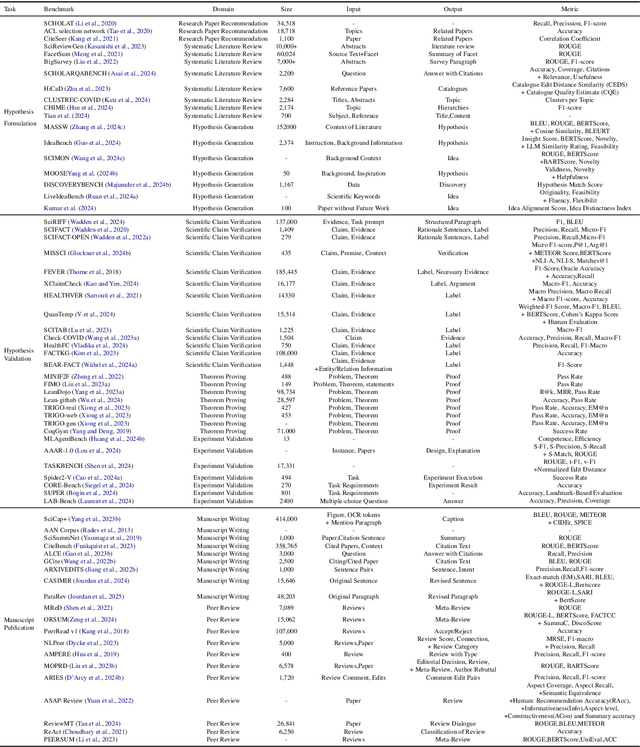
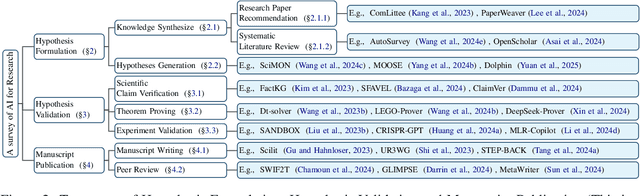
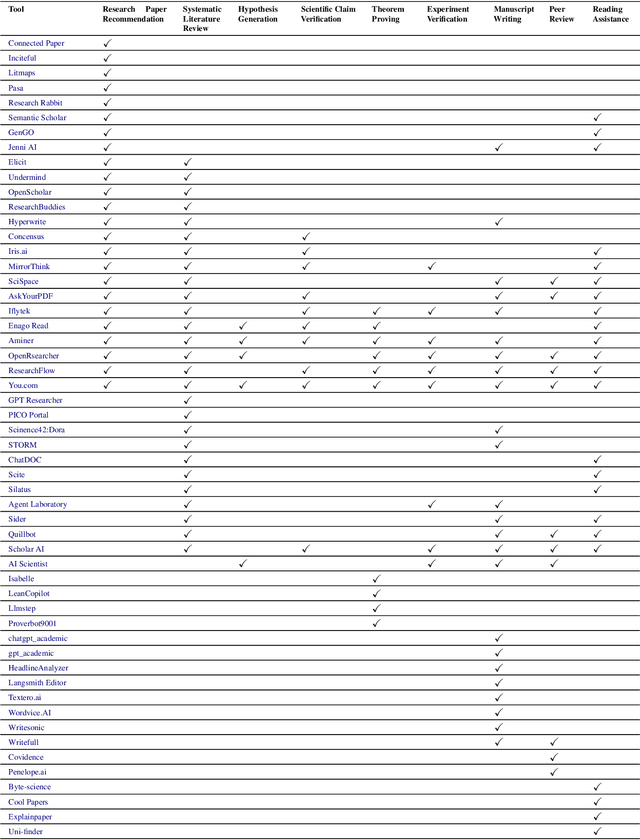
Research is a fundamental process driving the advancement of human civilization, yet it demands substantial time and effort from researchers. In recent years, the rapid development of artificial intelligence (AI) technologies has inspired researchers to explore how AI can accelerate and enhance research. To monitor relevant advancements, this paper presents a systematic review of the progress in this domain. Specifically, we organize the relevant studies into three main categories: hypothesis formulation, hypothesis validation, and manuscript publication. Hypothesis formulation involves knowledge synthesis and hypothesis generation. Hypothesis validation includes the verification of scientific claims, theorem proving, and experiment validation. Manuscript publication encompasses manuscript writing and the peer review process. Furthermore, we identify and discuss the current challenges faced in these areas, as well as potential future directions for research. Finally, we also offer a comprehensive overview of existing benchmarks and tools across various domains that support the integration of AI into the research process. We hope this paper serves as an introduction for beginners and fosters future research. Resources have been made publicly available at https://github.com/zkzhou126/AI-for-Research.