 Add to Chrome
 Add to Firefox
 Add to Edge
CAST: Mitigating Object Hallucination in Large Vision-Language Models via Caption-Guided Visual Attention Steering
May 06, 2026
Although Large Vision-Language Models (LVLMs) have demonstrated remarkable performance on downstream tasks, they frequently produce contents that deviate from visual information, leading to object hallucination. To tackle this, recent works mostly depend on expensive manual annotations and training cost, or decoding strategies which significantly increase inference time. In this work, we observe that LVLMs' attention to visual information is significantly enhanced when answering caption queries compared to non-caption queries. Inspired by this phenomenon, we propose Caption-guided Visual Attention Steering (CAST), a training-free, plug-and-play hallucination mitigation method that leverages the attention activation pattern corresponding to caption queries to enhance LVLMs' visual perception capability. Specifically, we use probing techniques to identify attention heads that are highly sensitive to caption queries and estimate optimized steering directions for their outputs. This steering strengthens LVLM's fine-grained visual perception capabilities, thereby effectively mitigating object hallucination. CAST reduced object hallucination by an average of 6.03% across five widely used LVLMs and five benchmarks including both discriminative and generative tasks, demonstrating state-of-the-art performance while adding little inference cost and preserving other foundational capabilities.

Not All Tokens See Equally: Perception-Grounded Policy Optimization for Large Vision-Language Models
Apr 02, 2026While Reinforcement Learning from Verifiable Rewards (RLVR) has advanced reasoning in Large Vision-Language Models (LVLMs), prevailing frameworks suffer from a foundational methodological flaw: by distributing identical advantages across all generated tokens, these methods inherently dilute the learning signals essential for optimizing the critical, visually-grounded steps of multimodal reasoning. To bridge this gap, we formulate \textit{Token Visual Dependency}, quantifying the causal information gain of visual inputs via the Kullback-Leibler (KL) divergence between visual-conditioned and text-only predictive distributions. Revealing that this dependency is highly sparse and semantically pivotal, we introduce Perception-Grounded Policy Optimization (PGPO), which is a novel fine-grained credit assignment framework that dynamically reshapes advantages at the token level. Through a threshold-gated, mass-conserving mechanism, PGPO actively amplifies learning signals for visually-dependent tokens while suppressing gradient noise from linguistic priors. Extensive experiments based on the Qwen2.5-VL series across seven challenging multimodal reasoning benchmarks demonstrate that PGPO boosts models by 18.7% on average. Both theoretical and empirical analyses confirm that PGPO effectively reduces gradient variance, prevents training collapse, and acts as a potent regularizer for robust, perception-grounded multimodal reasoning. Code will be published on https://github.com/Yzk1114/PGPO.
DinoDental: Benchmarking DINOv3 as a Unified Vision Encoder for Dental Image Analysis
Mar 30, 2026The scarcity and high cost of expert annotations in dental imaging present a significant challenge for the development of AI in dentistry. DINOv3, a state-of-the-art, self-supervised vision foundation model pre-trained on 1.7 billion images, offers a promising pathway to mitigate this issue. However, its reliability when transferred to the dental domain, with its unique imaging characteristics and clinical subtleties, remains unclear. To address this, we introduce DinoDental, a unified benchmark designed to systematically evaluate whether DINOv3 can serve as a reliable, off-the-shelf encoder for comprehensive dental image analysis without requiring domain-specific pre-training. Constructed from multiple public datasets, DinoDental covers a wide range of tasks, including classification, detection, and instance segmentation on both panoramic radiographs and intraoral photographs. We further analyze the model's transfer performance by scaling its size and input resolution, and by comparing different adaptation strategies, including frozen features, full fine-tuning, and the parameter-efficient Low-Rank Adaptation (LoRA) method. Our experiments show that DINOv3 can serve as a strong unified encoder for dental image analysis across both panoramic radiographs and intraoral photographs, remaining competitive across tasks while showing particularly clear advantages for intraoral image understanding and boundary-sensitive dense prediction. Collectively, DinoDental provides a systematic framework for comprehensively evaluating DINOv3 in dental analysis, establishing a foundational benchmark to guide efficient and effective model selection and adaptation for the dental AI community.
From Hypothesis to Publication: A Comprehensive Survey of AI-Driven Research Support Systems
Mar 03, 2025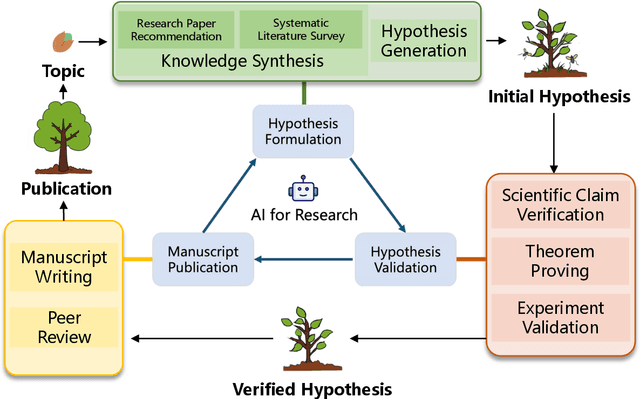
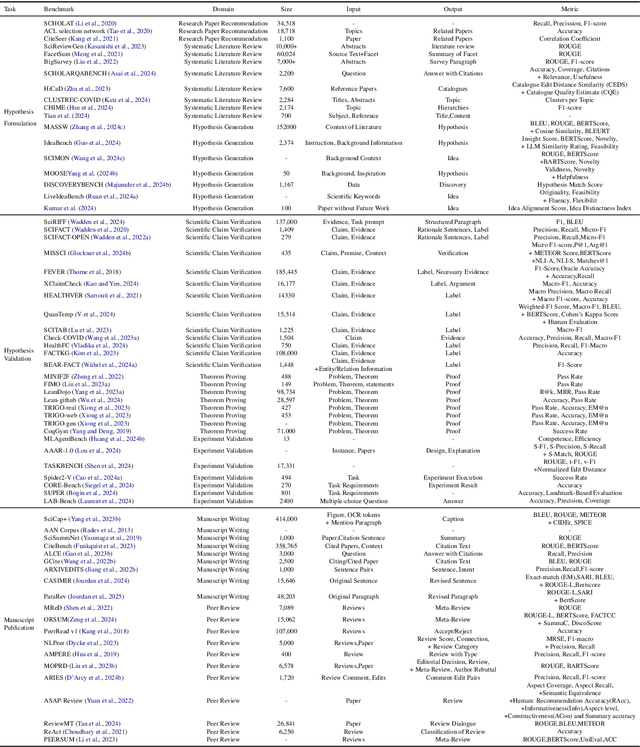
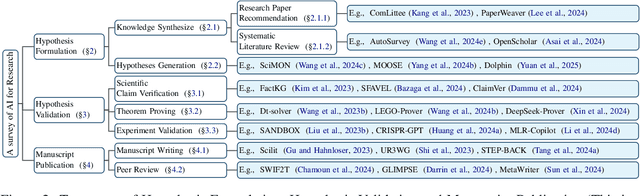
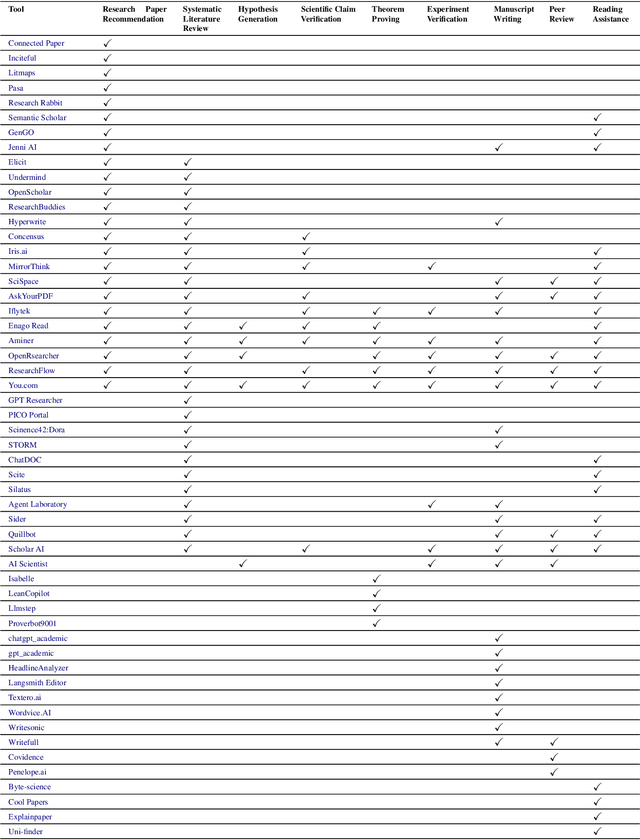
Research is a fundamental process driving the advancement of human civilization, yet it demands substantial time and effort from researchers. In recent years, the rapid development of artificial intelligence (AI) technologies has inspired researchers to explore how AI can accelerate and enhance research. To monitor relevant advancements, this paper presents a systematic review of the progress in this domain. Specifically, we organize the relevant studies into three main categories: hypothesis formulation, hypothesis validation, and manuscript publication. Hypothesis formulation involves knowledge synthesis and hypothesis generation. Hypothesis validation includes the verification of scientific claims, theorem proving, and experiment validation. Manuscript publication encompasses manuscript writing and the peer review process. Furthermore, we identify and discuss the current challenges faced in these areas, as well as potential future directions for research. Finally, we also offer a comprehensive overview of existing benchmarks and tools across various domains that support the integration of AI into the research process. We hope this paper serves as an introduction for beginners and fosters future research. Resources have been made publicly available at https://github.com/zkzhou126/AI-for-Research.
Cross-Lingual Text-Rich Visual Comprehension: An Information Theory Perspective
Dec 23, 2024


Recent Large Vision-Language Models (LVLMs) have shown promising reasoning capabilities on text-rich images from charts, tables, and documents. However, the abundant text within such images may increase the model's sensitivity to language. This raises the need to evaluate LVLM performance on cross-lingual text-rich visual inputs, where the language in the image differs from the language of the instructions. To address this, we introduce XT-VQA (Cross-Lingual Text-Rich Visual Question Answering), a benchmark designed to assess how LVLMs handle language inconsistency between image text and questions. XT-VQA integrates five existing text-rich VQA datasets and a newly collected dataset, XPaperQA, covering diverse scenarios that require faithful recognition and comprehension of visual information despite language inconsistency. Our evaluation of prominent LVLMs on XT-VQA reveals a significant drop in performance for cross-lingual scenarios, even for models with multilingual capabilities. A mutual information analysis suggests that this performance gap stems from cross-lingual questions failing to adequately activate relevant visual information. To mitigate this issue, we propose MVCL-MI (Maximization of Vision-Language Cross-Lingual Mutual Information), where a visual-text cross-lingual alignment is built by maximizing mutual information between the model's outputs and visual information. This is achieved by distilling knowledge from monolingual to cross-lingual settings through KL divergence minimization, where monolingual output logits serve as a teacher. Experimental results on the XT-VQA demonstrate that MVCL-MI effectively reduces the visual-text cross-lingual performance disparity while preserving the inherent capabilities of LVLMs, shedding new light on the potential practice for improving LVLMs. Codes are available at: https://github.com/Stardust-y/XTVQA.git
Rapid and Accurate Diagnosis of Acute Aortic Syndrome using Non-contrast CT: A Large-scale, Retrospective, Multi-center and AI-based Study
Jun 25, 2024

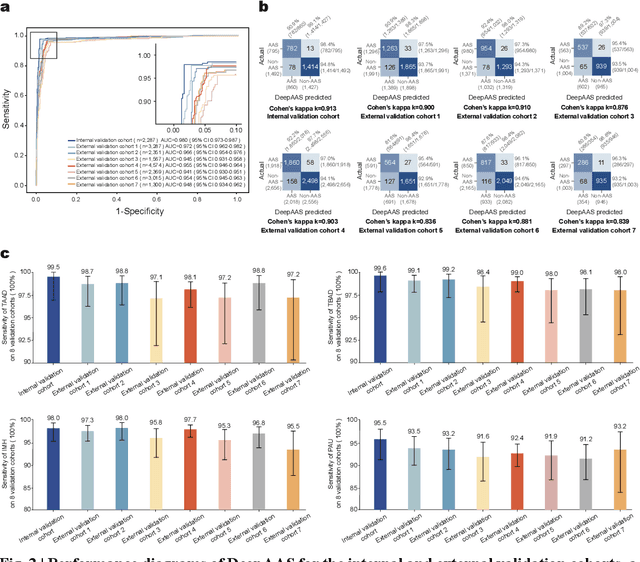

Chest pain symptoms are highly prevalent in emergency departments (EDs), where acute aortic syndrome (AAS) is a catastrophic cardiovascular emergency with a high fatality rate, especially when timely and accurate treatment is not administered. However, current triage practices in the ED can cause up to approximately half of patients with AAS to have an initially missed diagnosis or be misdiagnosed as having other acute chest pain conditions. Subsequently, these AAS patients will undergo clinically inaccurate or suboptimal differential diagnosis. Fortunately, even under these suboptimal protocols, nearly all these patients underwent non-contrast CT covering the aorta anatomy at the early stage of differential diagnosis. In this study, we developed an artificial intelligence model (DeepAAS) using non-contrast CT, which is highly accurate for identifying AAS and provides interpretable results to assist in clinical decision-making. Performance was assessed in two major phases: a multi-center retrospective study (n = 20,750) and an exploration in real-world emergency scenarios (n = 137,525). In the multi-center cohort, DeepAAS achieved a mean area under the receiver operating characteristic curve of 0.958 (95% CI 0.950-0.967). In the real-world cohort, DeepAAS detected 109 AAS patients with misguided initial suspicion, achieving 92.6% (95% CI 76.2%-97.5%) in mean sensitivity and 99.2% (95% CI 99.1%-99.3%) in mean specificity. Our AI model performed well on non-contrast CT at all applicable early stages of differential diagnosis workflows, effectively reduced the overall missed diagnosis and misdiagnosis rate from 48.8% to 4.8% and shortened the diagnosis time for patients with misguided initial suspicion from an average of 681.8 (74-11,820) mins to 68.5 (23-195) mins. DeepAAS could effectively fill the gap in the current clinical workflow without requiring additional tests.