 Add to Chrome
 Add to Firefox
 Add to Edge
Dynamic-VLM: Simple Dynamic Visual Token Compression for VideoLLM
Dec 12, 2024
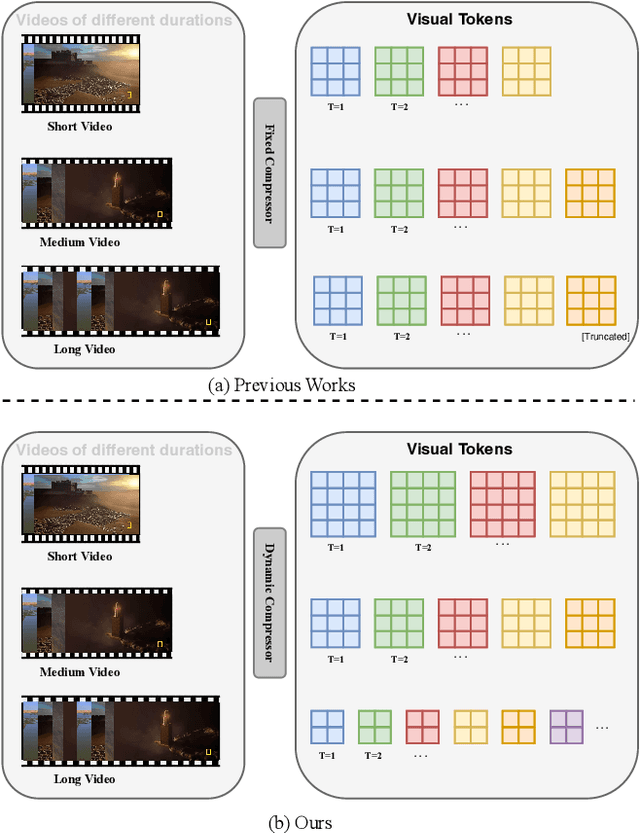
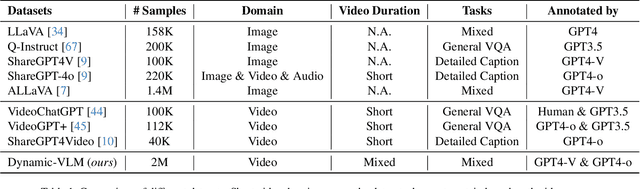
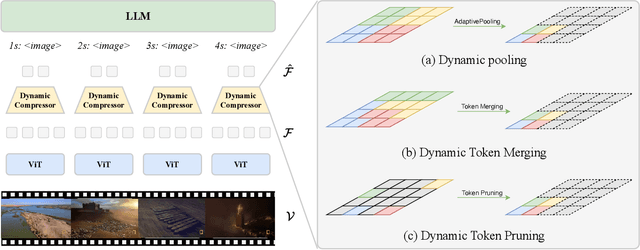
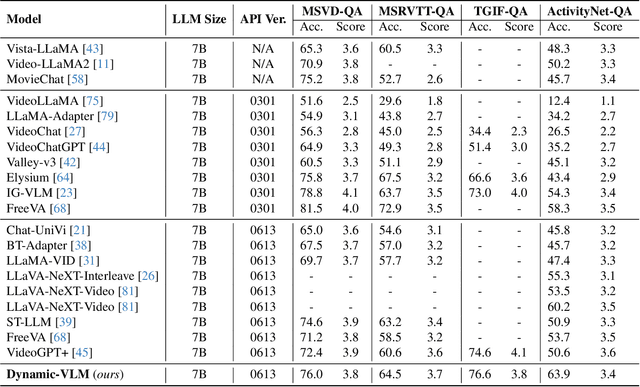
The application of Large Vision-Language Models (LVLMs) for analyzing images and videos is an exciting and rapidly evolving field. In recent years, we've seen significant growth in high-quality image-text datasets for fine-tuning image understanding, but there is still a lack of comparable datasets for videos. Additionally, many VideoLLMs are extensions of single-image VLMs, which may not efficiently handle the complexities of longer videos. In this study, we introduce a large-scale synthetic dataset created from proprietary models, using carefully designed prompts to tackle a wide range of questions. We also explore a dynamic visual token compression architecture that strikes a balance between computational efficiency and performance. Our proposed \model{} achieves state-of-the-art results across various video tasks and shows impressive generalization, setting new baselines in multi-image understanding. Notably, \model{} delivers an absolute improvement of 2.7\% over LLaVA-OneVision on VideoMME and 10.7\% on MuirBench. Codes are available at https://github.com/Hon-Wong/ByteVideoLLM

HunyuanVideo: A Systematic Framework For Large Video Generative Models
Dec 03, 2024
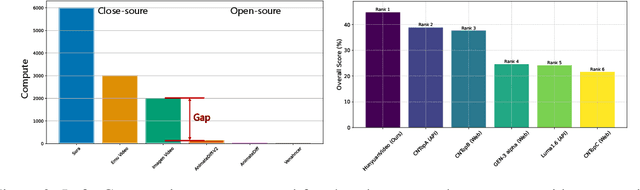

Recent advancements in video generation have significantly impacted daily life for both individuals and industries. However, the leading video generation models remain closed-source, resulting in a notable performance gap between industry capabilities and those available to the public. In this report, we introduce HunyuanVideo, an innovative open-source video foundation model that demonstrates performance in video generation comparable to, or even surpassing, that of leading closed-source models. HunyuanVideo encompasses a comprehensive framework that integrates several key elements, including data curation, advanced architectural design, progressive model scaling and training, and an efficient infrastructure tailored for large-scale model training and inference. As a result, we successfully trained a video generative model with over 13 billion parameters, making it the largest among all open-source models. We conducted extensive experiments and implemented a series of targeted designs to ensure high visual quality, motion dynamics, text-video alignment, and advanced filming techniques. According to evaluations by professionals, HunyuanVideo outperforms previous state-of-the-art models, including Runway Gen-3, Luma 1.6, and three top-performing Chinese video generative models. By releasing the code for the foundation model and its applications, we aim to bridge the gap between closed-source and open-source communities. This initiative will empower individuals within the community to experiment with their ideas, fostering a more dynamic and vibrant video generation ecosystem. The code is publicly available at https://github.com/Tencent/HunyuanVideo.
GraphOTTER: Evolving LLM-based Graph Reasoning for Complex Table Question Answering
Dec 02, 2024


Complex Table Question Answering involves providing accurate answers to specific questions based on intricate tables that exhibit complex layouts and flexible header locations. Despite considerable progress having been made in the LLM era, the reasoning processes of existing methods are often implicit, feeding the entire table into prompts, making it difficult to effectively filter out irrelevant information in the table. To this end, we propose GraphOTTER that explicitly establishes the reasoning process to pinpoint the correct answers. In particular, GraphOTTER leverages a graph-based representation, transforming the complex table into an undirected graph. It then conducts step-by-step reasoning on the graph, with each step guided by a set of pre-defined intermediate reasoning actions. As such, it constructs a clear reasoning path and effectively identifies the answer to a given question. Comprehensive experiments on two benchmark datasets and two LLM backbones demonstrate the effectiveness of GraphOTTER. Further analysis indicates that its success may be attributed to the ability to efficiently filter out irrelevant information, thereby focusing the reasoning process on the most pertinent data. Our code and experimental datasets are available at \url{https://github.com/JDing0521/GraphOTTER}.
Learning a Neural Association Network for Self-supervised Multi-Object Tracking
Nov 18, 2024
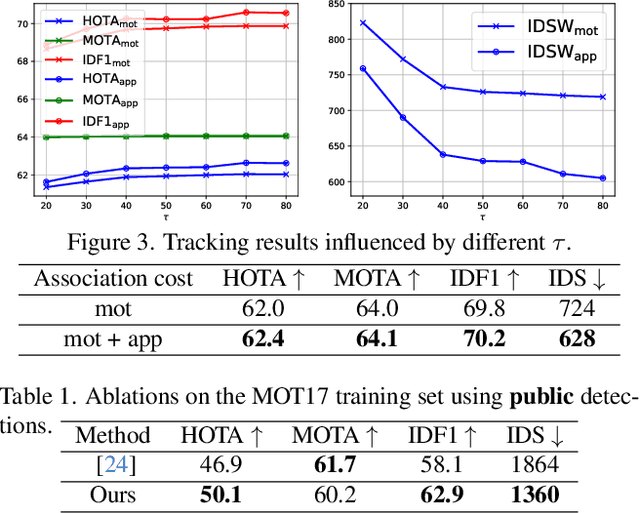

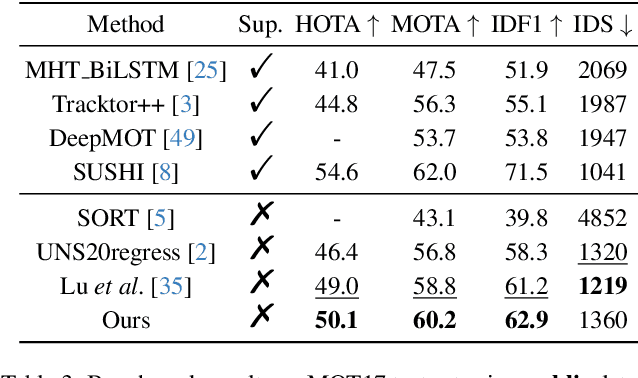
This paper introduces a novel framework to learn data association for multi-object tracking in a self-supervised manner. Fully-supervised learning methods are known to achieve excellent tracking performances, but acquiring identity-level annotations is tedious and time-consuming. Motivated by the fact that in real-world scenarios object motion can be usually represented by a Markov process, we present a novel expectation maximization (EM) algorithm that trains a neural network to associate detections for tracking, without requiring prior knowledge of their temporal correspondences. At the core of our method lies a neural Kalman filter, with an observation model conditioned on associations of detections parameterized by a neural network. Given a batch of frames as input, data associations between detections from adjacent frames are predicted by a neural network followed by a Sinkhorn normalization that determines the assignment probabilities of detections to states. Kalman smoothing is then used to obtain the marginal probability of observations given the inferred states, producing a training objective to maximize this marginal probability using gradient descent. The proposed framework is fully differentiable, allowing the underlying neural model to be trained end-to-end. We evaluate our approach on the challenging MOT17 and MOT20 datasets and achieve state-of-the-art results in comparison to self-supervised trackers using public detections. We furthermore demonstrate the capability of the learned model to generalize across datasets.
Learning Versatile Skills with Curriculum Masking
Oct 23, 2024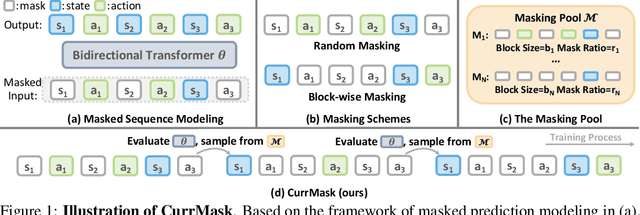
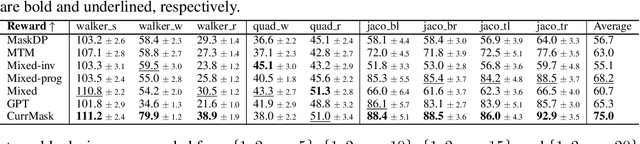
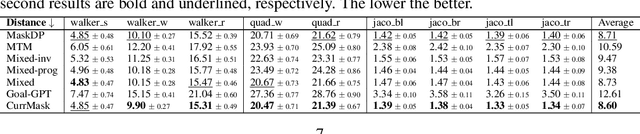
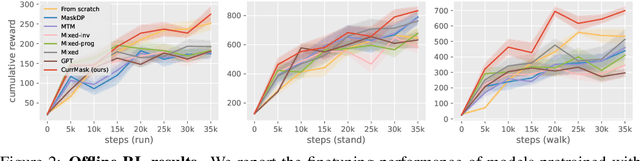
Masked prediction has emerged as a promising pretraining paradigm in offline reinforcement learning (RL) due to its versatile masking schemes, enabling flexible inference across various downstream tasks with a unified model. Despite the versatility of masked prediction, it remains unclear how to balance the learning of skills at different levels of complexity. To address this, we propose CurrMask, a curriculum masking pretraining paradigm for sequential decision making. Motivated by how humans learn by organizing knowledge in a curriculum, CurrMask adjusts its masking scheme during pretraining for learning versatile skills. Through extensive experiments, we show that CurrMask exhibits superior zero-shot performance on skill prompting tasks, goal-conditioned planning tasks, and competitive finetuning performance on offline RL tasks. Additionally, our analysis of training dynamics reveals that CurrMask gradually acquires skills of varying complexity by dynamically adjusting its masking scheme.
Approximately Invertible Neural Network for Learned Image Compression
Aug 30, 2024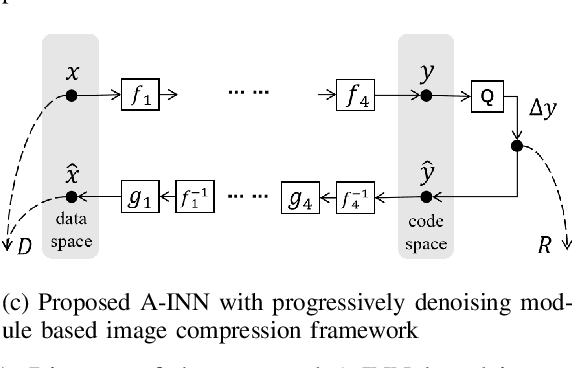
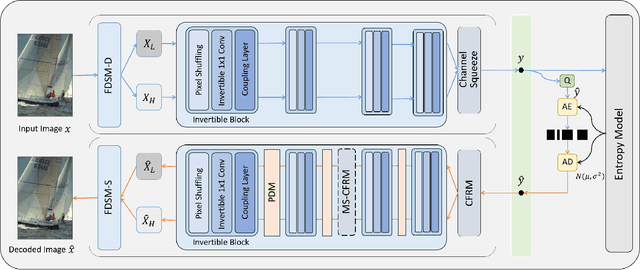
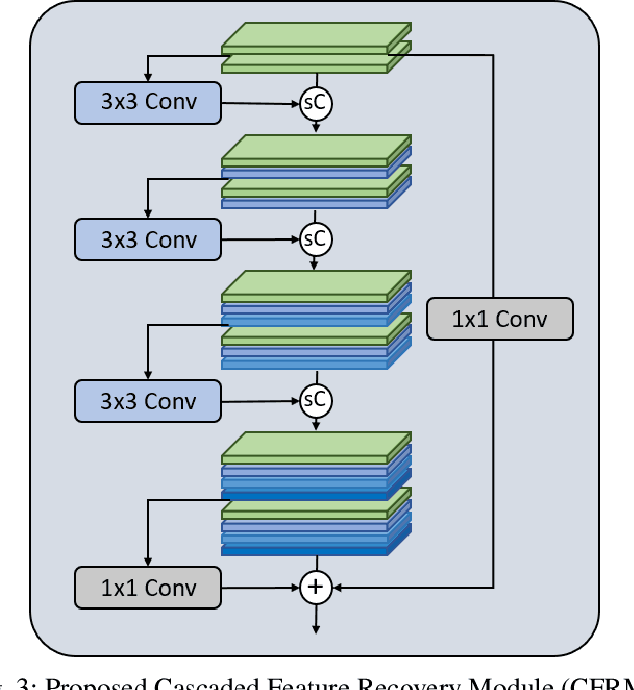
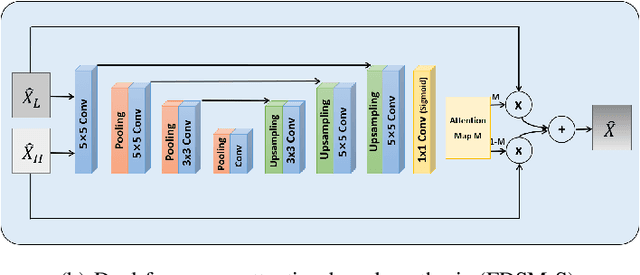
Learned image compression have attracted considerable interests in recent years. It typically comprises an analysis transform, a synthesis transform, quantization and an entropy coding model. The analysis transform and synthesis transform are used to encode an image to latent feature and decode the quantized feature to reconstruct the image, and can be regarded as coupled transforms. However, the analysis transform and synthesis transform are designed independently in the existing methods, making them unreliable in high-quality image compression. Inspired by the invertible neural networks in generative modeling, invertible modules are used to construct the coupled analysis and synthesis transforms. Considering the noise introduced in the feature quantization invalidates the invertible process, this paper proposes an Approximately Invertible Neural Network (A-INN) framework for learned image compression. It formulates the rate-distortion optimization in lossy image compression when using INN with quantization, which differentiates from using INN for generative modelling. Generally speaking, A-INN can be used as the theoretical foundation for any INN based lossy compression method. Based on this formulation, A-INN with a progressive denoising module (PDM) is developed to effectively reduce the quantization noise in the decoding. Moreover, a Cascaded Feature Recovery Module (CFRM) is designed to learn high-dimensional feature recovery from low-dimensional ones to further reduce the noise in feature channel compression. In addition, a Frequency-enhanced Decomposition and Synthesis Module (FDSM) is developed by explicitly enhancing the high-frequency components in an image to address the loss of high-frequency information inherent in neural network based image compression. Extensive experiments demonstrate that the proposed A-INN outperforms the existing learned image compression methods.
Highly Accurate Robot Calibration Using Adaptive and Momental Bound with Decoupled Weight Decay
Aug 22, 2024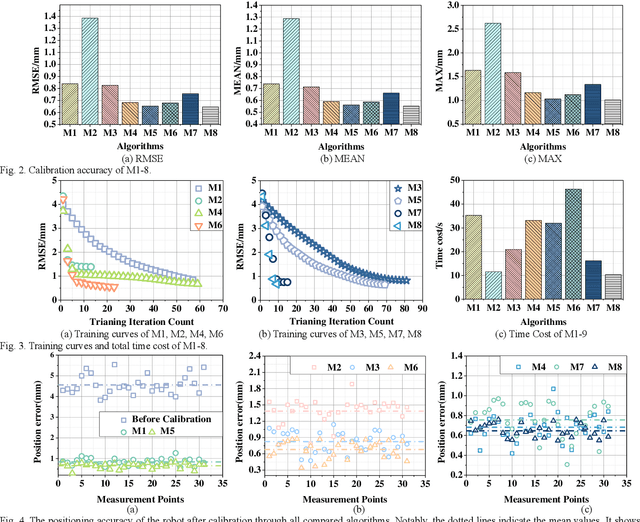
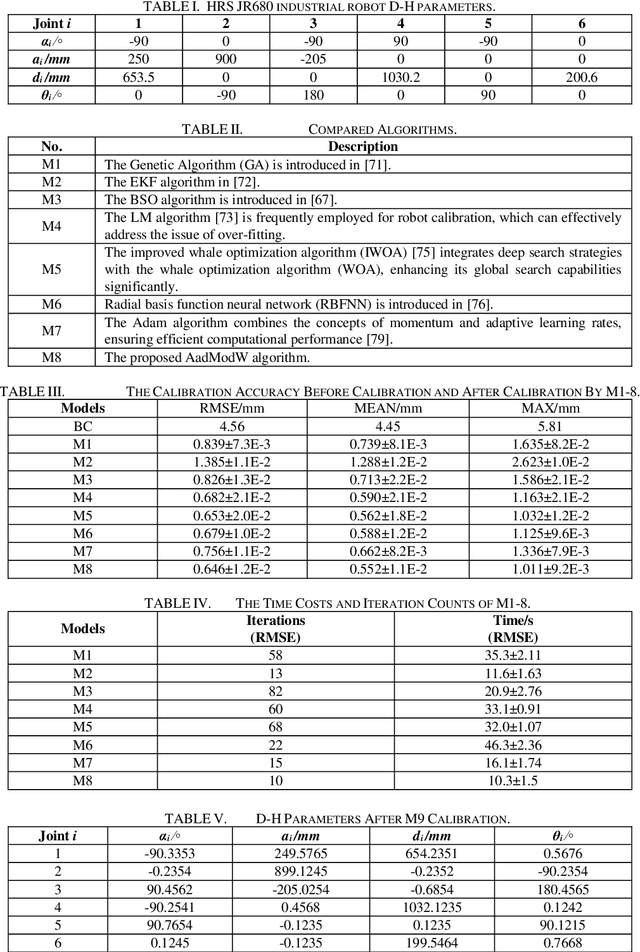
Within the context of intelligent manufacturing, industrial robots have a pivotal function. Nonetheless, extended operational periods cause a decline in their absolute positioning accuracy, preventing them from meeting high precision. To address this issue, this paper presents a novel robot algorithm that combines an adaptive and momental bound algorithm with decoupled weight decay (AdaModW), which has three-fold ideas: a) adopting an adaptive moment estimation (Adam) algorithm to achieve a high convergence rate, b) introducing a hyperparameter into the Adam algorithm to define the length of memory, effectively addressing the issue of the abnormal learning rate, and c) interpolating a weight decay coefficient to improve its generalization. Numerous experiments on an HRS-JR680 industrial robot show that the presented algorithm significantly outperforms state-of-the-art algorithms in robot calibration performance. Thus, in light of its reliability, this algorithm provides an efficient way to address robot calibration concerns.
GenderCARE: A Comprehensive Framework for Assessing and Reducing Gender Bias in Large Language Models
Aug 22, 2024Large language models (LLMs) have exhibited remarkable capabilities in natural language generation, but they have also been observed to magnify societal biases, particularly those related to gender. In response to this issue, several benchmarks have been proposed to assess gender bias in LLMs. However, these benchmarks often lack practical flexibility or inadvertently introduce biases. To address these shortcomings, we introduce GenderCARE, a comprehensive framework that encompasses innovative Criteria, bias Assessment, Reduction techniques, and Evaluation metrics for quantifying and mitigating gender bias in LLMs. To begin, we establish pioneering criteria for gender equality benchmarks, spanning dimensions such as inclusivity, diversity, explainability, objectivity, robustness, and realisticity. Guided by these criteria, we construct GenderPair, a novel pair-based benchmark designed to assess gender bias in LLMs comprehensively. Our benchmark provides standardized and realistic evaluations, including previously overlooked gender groups such as transgender and non-binary individuals. Furthermore, we develop effective debiasing techniques that incorporate counterfactual data augmentation and specialized fine-tuning strategies to reduce gender bias in LLMs without compromising their overall performance. Extensive experiments demonstrate a significant reduction in various gender bias benchmarks, with reductions peaking at over 90% and averaging above 35% across 17 different LLMs. Importantly, these reductions come with minimal variability in mainstream language tasks, remaining below 2%. By offering a realistic assessment and tailored reduction of gender biases, we hope that our GenderCARE can represent a significant step towards achieving fairness and equity in LLMs. More details are available at https://github.com/kstanghere/GenderCARE-ccs24.
Open Vocabulary 3D Scene Understanding via Geometry Guided Self-Distillation
Jul 18, 2024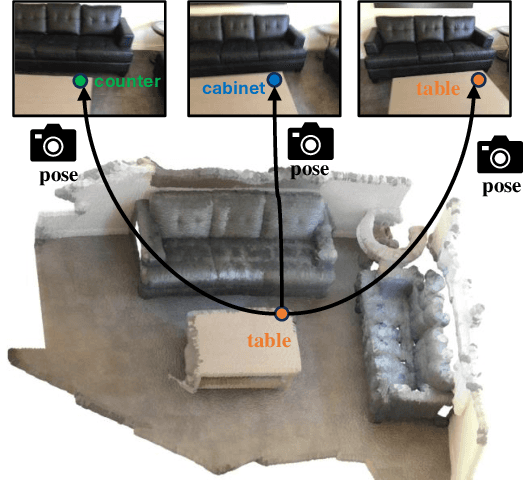
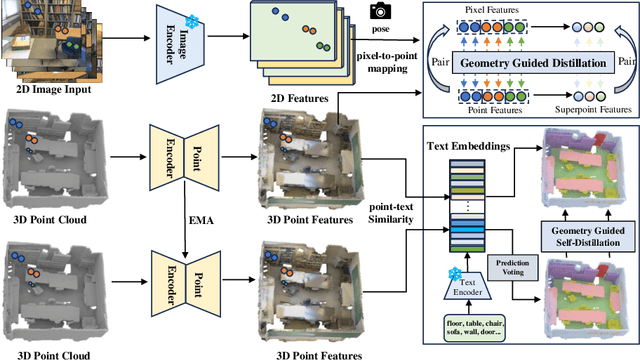
The scarcity of large-scale 3D-text paired data poses a great challenge on open vocabulary 3D scene understanding, and hence it is popular to leverage internet-scale 2D data and transfer their open vocabulary capabilities to 3D models through knowledge distillation. However, the existing distillation-based 3D scene understanding approaches rely on the representation capacity of 2D models, disregarding the exploration of geometric priors and inherent representational advantages offered by 3D data. In this paper, we propose an effective approach, namely Geometry Guided Self-Distillation (GGSD), to learn superior 3D representations from 2D pre-trained models. Specifically, we first design a geometry guided distillation module to distill knowledge from 2D models, and then leverage the 3D geometric priors to alleviate the inherent noise in 2D models and enhance the representation learning process. Due to the advantages of 3D representation, the performance of the distilled 3D student model can significantly surpass that of the 2D teacher model. This motivates us to further leverage the representation advantages of 3D data through self-distillation. As a result, our proposed GGSD approach outperforms the existing open vocabulary 3D scene understanding methods by a large margin, as demonstrated by our experiments on both indoor and outdoor benchmark datasets.
Enhancing context models for point cloud geometry compression with context feature residuals and multi-loss
Jul 11, 2024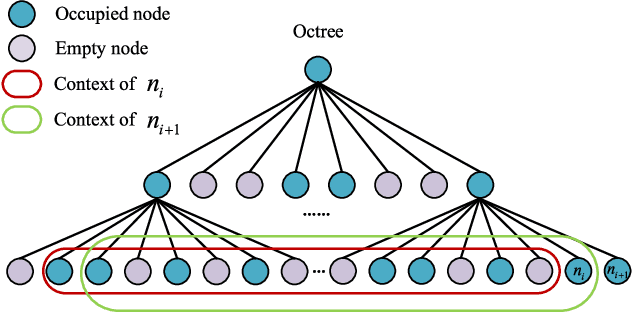
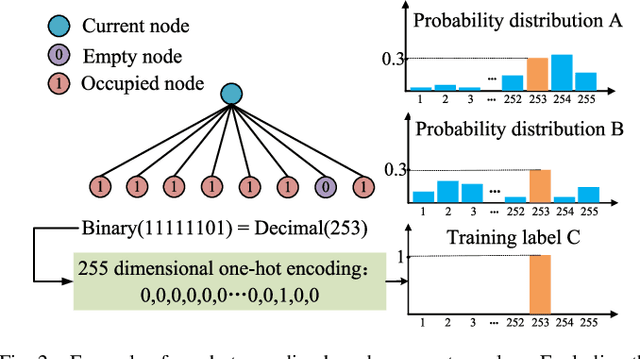
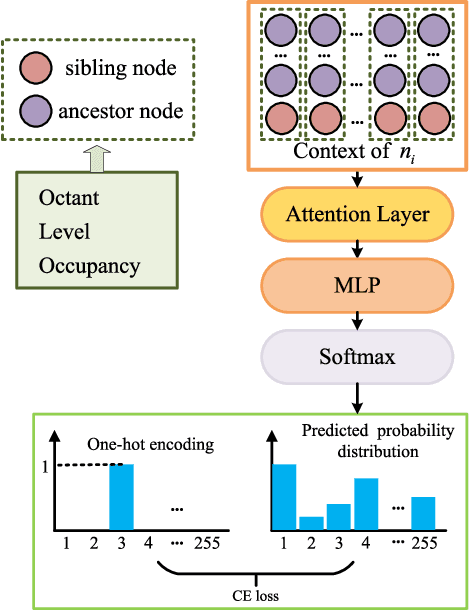
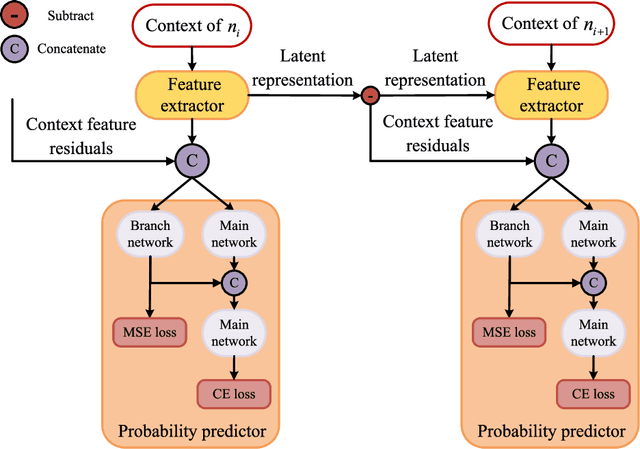
In point cloud geometry compression, context models usually use the one-hot encoding of node occupancy as the label, and the cross-entropy between the one-hot encoding and the probability distribution predicted by the context model as the loss function. However, this approach has two main weaknesses. First, the differences between contexts of different nodes are not significant, making it difficult for the context model to accurately predict the probability distribution of node occupancy. Second, as the one-hot encoding is not the actual probability distribution of node occupancy, the cross-entropy loss function is inaccurate. To address these problems, we propose a general structure that can enhance existing context models. We introduce the context feature residuals into the context model to amplify the differences between contexts. We also add a multi-layer perception branch, that uses the mean squared error between its output and node occupancy as a loss function to provide accurate gradients in backpropagation. We validate our method by showing that it can improve the performance of an octree-based model (OctAttention) and a voxel-based model (VoxelDNN) on the object point cloud datasets MPEG 8i and MVUB, as well as the LiDAR point cloud dataset SemanticKITTI.
* 11 pages, 8 figures