 Add to Chrome
 Add to Firefox
 Add to Edge
Reward-Guided Semantic Evolution for Test-time Adaptive Object Detection
May 06, 2026
Open-vocabulary object detection with vision-language models (VLMs) such as Grounding DINO suffers from performance degradation under test-time distribution shifts, primarily due to semantic misalignment between text embeddings and shifted visual embeddings of region proposals. While recent test-time adaptive object detection methods for VLM-based either rely on costly backpropagation or bypass semantic misalignment via external memory, none directly and efficiently align text and vision in a training-free manner. To address this, we propose Reward-Guided Semantic Evolution (RGSE), a training-free framework that directly refines the text embeddings at test time. Inspired by evolutionary search, RGSE treats text embedding adaptation as a semantic search process: it perturbs text embeddings as candidate variants, evaluates them via cosine similarity with current and historical high-confidence visual proposals as a reward signal, and fuses them into a refined embedding through reward-weighted averaging. Without any backpropagation, RGSE achieves state-of-the-art performance across multiple detection benchmarks while adding minimal computational overhead. Our code will be open source upon publication.

FACTOR: Counterfactual Training-Free Test-Time Adaptation for Open-Vocabulary Object Detection
May 05, 2026Open-vocabulary object detection often fails under distribution shifts, as it can be misled by spurious correlations between non-causal visual attributes (e.g., brightness, texture) and object categories. Existing test-time adaptation (TTA) methods either depend on costly online optimization or perform global calibration, overlooking the attribute-specific nature of these failures. To address this, we propose FACTOR (counterFACtual training-free Test-time adaptation for Open-vocabulaRy object detection), a lightweight framework grounded in counterfactual reasoning. By perturbing test images along non-causal attributes and comparing region-level predictions between original and counterfactual views, FACTOR quantifies attribute sensitivity, semantic relevance, and prediction variation to selectively suppress attribute-dependent predictions-without parameter updates. Experiments on PASCAL-C, COCO-C, and FoggyCityscapes show that FACTOR consistently outperforms prior TTA methods, demonstrating that explicit counterfactual reasoning effectively improves robustness under distribution shifts.
Source-Free Domain Adaptation with Vision-Language Prior
Apr 20, 2026Source-Free Domain Adaptation (SFDA) seeks to adapt a source model, which is pre-trained on a supervised source domain, for a target domain, with only access to unlabeled target training data. Relying on pseudo labeling and/or auxiliary supervision, conventional methods are inevitably error-prone. To mitigate this limitation, in this work we for the first time explore the potentials of off-the-shelf vision-language (ViL) multimodal models (e.g., CLIP) with rich whilst heterogeneous knowledge. We find that directly applying the ViL model to the target domain in a zero-shot fashion is unsatisfactory, as it is not specialized for this particular task but largely generic. To make it task-specific, we propose a novel DIFO++ approach. Specifically, DIFO++ alternates between two steps during adaptation: (i) Customizing the ViL model by maximizing the mutual information with the target model in a prompt learning manner, (ii) Distilling the knowledge of this customized ViL model to the target model, centering on gap region reduction. During progressive knowledge adaptation, we first identify and focus on the gap region, where enclosed features are entangled and class-ambiguous, as it often captures richer task-specific semantics. Reliable pseudo-labels are then generated by fusing predictions from the target and ViL models, supported by a memory mechanism. Finally, gap region reduction is guided by category attention and predictive consistency for semantic alignment, complemented by referenced entropy minimization to suppress uncertainty. Extensive experiments show that DIFO++ significantly outperforms the state-of-the-art alternatives. Our code and data are available at https://github.com/tntek/DIFO-Plus.
H2VLR: Heterogeneous Hypergraph Vision-Language Reasoning for Few-Shot Anomaly Detection
Apr 16, 2026As a classic vision task, anomaly detection has been widely applied in industrial inspection and medical imaging. In this task, data scarcity is often a frequently-faced issue. To solve it, the few-shot anomaly detection (FSAD) scheme is attracting increasing attention. In recent years, beyond traditional visual paradigm, Vision-Language Model (VLM) has been extensively explored to boost this field. However, in currently-existing VLM-based FSAD schemes, almost all perform anomaly inference only by pairwise feature matching, ignoring structural dependencies and global consistency. To further redound to FSAD via VLM, we propose a Heterogeneous Hypergraph Vision-Language Reasoning (H2VLR) framework. It reformulates the FSAD as a high-order inference problem of visual-semantic relations, by jointly modeling visual regions and semantic concepts in a unified hypergraph. Experimental comparisons verify the effectiveness and advantages of H2VLR. It could often achieve state-of-the-art (SOTA) performance on representative industrial and medical benchmarks. Our code will be released upon acceptance.
SocialMirror: Reconstructing 3D Human Interaction Behaviors from Monocular Videos with Semantic and Geometric Guidance
Apr 15, 2026Accurately reconstructing human behavior in close-interaction scenarios is crucial for enabling realistic virtual interactions in augmented reality, precise motion analysis in sports, and natural collaborative behavior in human-robot tasks. Reliable reconstruction in these contexts significantly enhances the realism and effectiveness of AI-driven interactive applications. However, human reconstruction from monocular videos in close-interaction scenarios remains challenging due to severe mutual occlusions, leading local motion ambiguity, disrupted temporal continuity and spatial relationship error. In this paper, we propose SocialMirror, a diffusion-based framework that integrates semantic and geometric cues to effectively address these issues. Specifically, we first leverage high-level interaction descriptions generated by a vision-language model to guide a semantic-guided motion infiller, hallucinating occluded bodies and resolving local pose ambiguities. Next, we propose a sequence-level temporal refiner that enforces smooth, jitter-free motions, while incorporating geometric constraints during sampling to ensure plausible contact and spatial relationships. Evaluations on multiple interaction benchmarks show that SocialMirror achieves state-of-the-art performance in reconstructing interactive human meshes, demonstrating strong generalization across unseen datasets and in-the-wild scenarios. The code will be released upon publication.
CWRNN-INVR: A Coupled WarpRNN based Implicit Neural Video Representation
Apr 08, 2026Implicit Neural Video Representation (INVR) has emerged as a novel approach for video representation and compression, using learnable grids and neural networks. Existing methods focus on developing new grid structures efficient for latent representation and neural network architectures with large representation capability, lacking the study on their roles in video representation. In this paper, the difference between INVR based on neural network and INVR based on grid is first investigated from the perspective of video information composition to specify their own advantages, i.e., neural network for general structure while grid for specific detail. Accordingly, an INVR based on mixed neural network and residual grid framework is proposed, where the neural network is used to represent the regular and structured information and the residual grid is used to represent the remaining irregular information in a video. A Coupled WarpRNN-based multi-scale motion representation and compensation module is specifically designed to explicitly represent the regular and structured information, thus terming our method as CWRNN-INVR. For the irregular information, a mixed residual grid is learned where the irregular appearance and motion information are represented together. The mixed residual grid can be combined with the coupled WarpRNN in a way that allows for network reuse. Experiments show that our method achieves the best reconstruction results compared with the existing methods, with an average PSNR of 33.73 dB on the UVG dataset under the 3M model and outperforms existing INVR methods in other downstream tasks. The code can be found at https://github.com/yiyang-sdu/CWRNN-INVR.git}{https://github.com/yiyang-sdu/CWRNN-INVR.git.
A Noise Constrained Diffusion (NC-Diffusion) Framework for High Fidelity Image Compression
Apr 08, 2026With the great success of diffusion models in image generation, diffusion-based image compression is attracting increasing interests. However, due to the random noise introduced in the diffusion learning, they usually produce reconstructions with deviation from the original images, leading to suboptimal compression results. To address this problem, in this paper, we propose a Noise Constrained Diffusion (NC-Diffusion) framework for high fidelity image compression. Unlike existing diffusion-based compression methods that add random Gaussian noise and direct the noise into the image space, the proposed NC-Diffusion formulates the quantization noise originally added in the learned image compression as the noise in the forward process of diffusion. Then a noise constrained diffusion process is constructed from the ground-truth image to the initial compression result generated with quantization noise. The NC-Diffusion overcomes the problem of noise mismatch between compression and diffusion, significantly improving the inference efficiency. In addition, an adaptive frequency-domain filtering module is developed to enhance the skip connections in the U-Net based diffusion architecture, in order to enhance high-frequency details. Moreover, a zero-shot sample-guided enhancement method is designed to further improve the fidelity of the image. Experiments on multiple benchmark datasets demonstrate that our method can achieve the best performance compared with existing methods.
ToLL: Topological Layout Learning with Structural Multi-view Augmentation for 3D Scene Graph Pretraining
Mar 30, 20263D Scene Graph (3DSG) generation plays a pivotal role in spatial understanding and semantic-affordance perception. However, its generalizability is often constrained by data scarcity. Current solutions primarily focus on cross-modal assisted representation learning and object-centric generation pre-training. The former relies heavily on predicate annotations, while the latter's predicate learning may be bypassed due to strong object priors. Consequently, they could not often provide a label-free and robust self-supervised proxy task for 3DSG fine-tuning. To bridge this gap, we propose a Topological Layout Learning (ToLL) for 3DSG pretraining framework. In detail, we design an Anchor-Conditioned Topological Geometry Reasoning, with a GNN to recover the global layout of zero-centered subgraphs by the spatial priors from sparse anchors. This process is strictly modulated by predicate features, thereby enforcing the predicate relation learning. Furthermore, we construct a Structural Multi-view Augmentation to avoid semantic corruption, and enhancing representations via self-distillation. The extensive experiments on 3DSSG dataset demonstrate that our ToLL could improve representation quality, outperforming state-of-the-art baselines.
Weakly-supervised Contrastive Learning with Quantity Prompts for Moving Infrared Small Target Detection
Jul 03, 2025Different from general object detection, moving infrared small target detection faces huge challenges due to tiny target size and weak background contrast.Currently, most existing methods are fully-supervised, heavily relying on a large number of manual target-wise annotations. However, manually annotating video sequences is often expensive and time-consuming, especially for low-quality infrared frame images. Inspired by general object detection, non-fully supervised strategies ($e.g.$, weakly supervised) are believed to be potential in reducing annotation requirements. To break through traditional fully-supervised frameworks, as the first exploration work, this paper proposes a new weakly-supervised contrastive learning (WeCoL) scheme, only requires simple target quantity prompts during model training.Specifically, in our scheme, based on the pretrained segment anything model (SAM), a potential target mining strategy is designed to integrate target activation maps and multi-frame energy accumulation.Besides, contrastive learning is adopted to further improve the reliability of pseudo-labels, by calculating the similarity between positive and negative samples in feature subspace.Moreover, we propose a long-short term motion-aware learning scheme to simultaneously model the local motion patterns and global motion trajectory of small targets.The extensive experiments on two public datasets (DAUB and ITSDT-15K) verify that our weakly-supervised scheme could often outperform early fully-supervised methods. Even, its performance could reach over 90\% of state-of-the-art (SOTA) fully-supervised ones.
AGENT-X: Adaptive Guideline-based Expert Network for Threshold-free AI-generated teXt detection
May 21, 2025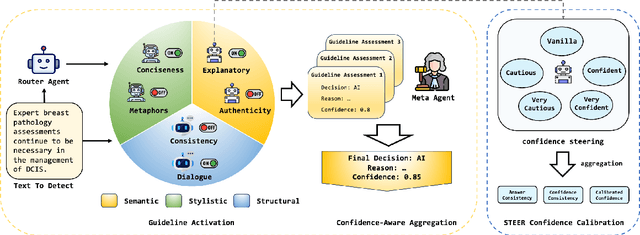
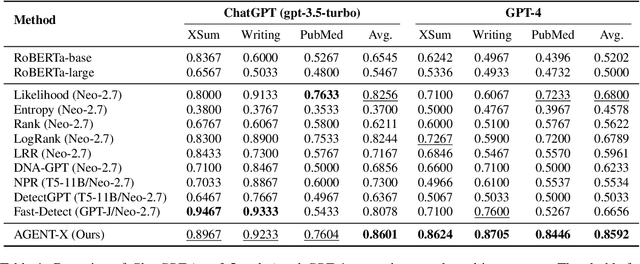
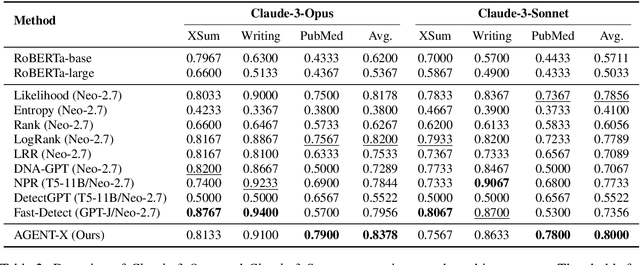
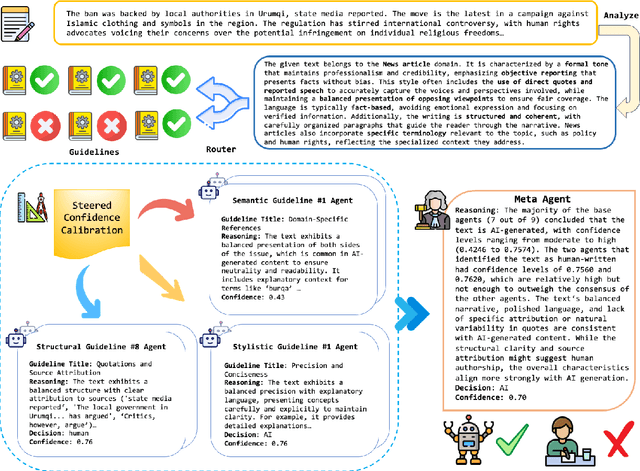
Existing AI-generated text detection methods heavily depend on large annotated datasets and external threshold tuning, restricting interpretability, adaptability, and zero-shot effectiveness. To address these limitations, we propose AGENT-X, a zero-shot multi-agent framework informed by classical rhetoric and systemic functional linguistics. Specifically, we organize detection guidelines into semantic, stylistic, and structural dimensions, each independently evaluated by specialized linguistic agents that provide explicit reasoning and robust calibrated confidence via semantic steering. A meta agent integrates these assessments through confidence-aware aggregation, enabling threshold-free, interpretable classification. Additionally, an adaptive Mixture-of-Agent router dynamically selects guidelines based on inferred textual characteristics. Experiments on diverse datasets demonstrate that AGENT-X substantially surpasses state-of-the-art supervised and zero-shot approaches in accuracy, interpretability, and generalization.