 Add to Chrome
 Add to Firefox
 Add to Edge
Generative Site-Specific Beamforming for UPAs via Decoupled Channel Sensing
Jun 21, 2026
A cross-fused generative site-specific beamforming (GenSSBF) framework is proposed for low-overhead beam alignment in uniform planar array (UPA) systems. A decoupled channel sensing strategy is developed, where the azimuth and elevation domains of the UPA are probed independently, and the online sweeping overhead is reduced from multiplicative to linear complexity compared to exhaustive two-dimensional codebook sweeping. However, the resulting reference signal received power (RSRP) observations only contain marginal angular power information. The explicit azimuth-elevation coupling of the UPA channel is therefore lost. Beam generation from these separate observations becomes highly ambiguous. To address this issue, a bidirectional cross-attention encoder is designed to extract and fuse the latent dependency between the azimuth and elevation sensing branches. Conditioned on the fused feature, a conditional normalizing flow generator is proposed to generate a compact set of high-fidelity beam candidates. These candidates are further verified through lightweight pilot measurements for final beam selection. A task-oriented training objective is also introduced to encourage the generated candidate set to contain at least one high-gain beam, rather than fitting the full conditional beam distribution. Simulation results based on DeepMIMO scenarios show that the proposed framework consistently outperforms deterministic beam prediction and conventional discrete Fourier transform (DFT) codebook search. Compared with the full 1024-beam two-dimensional DFT search, normalized beamforming gain improvements of 83.6%, 74.6%, and 38.1% are achieved in the I2_28, O1B_28, and Boston5G_28 scenarios, respectively, while the sweeping overhead is reduced by 93.8%.

OneBar: An End-to-End Content-Grounded Generative Query Recommendation Framework for E-Commerce Video Feeds
Jun 13, 2026Short-video platforms now expose clickable search entries beneath the video player, enabling users to easily express content-induced search intent. However, conventional query recommendation systems on short-video platforms suffer from latency constraints and objective misalignment, while recent generative approaches struggle with noisy content-side metadata and preference drift. To address these issues, we propose OneBar, an end-to-end generative framework for real-time query recommendation for E-Commerce video feeds. OneBar features three key innovations: (1) a collaborative-multimodal intent grounding module that fuses multimodal video understanding and behavior-derived collaborative anchors; (2) a Unified End-to-End architecture equipped with a prompt-compression mechanism for efficient online serving; and (3) a progressive preference learning strategy for efficient preference-internalization, which internalizes hierarchical behavior preferences into the generative policy, eliminating the need for a separately trained reward model. Compared with online base, OneBar increases Query Exposure by 16.91\% and Query Click by 18.68\%, while maintaining a slight Query CTR gain of 0.19\%. The additional search traffic further contributes to 20.36\% more guided orders and 21.67\% higher GMV.
Latent Reasoning with Normalizing Flows
Jun 04, 2026Large language models often improve reasoning by generating explicit chain-of-thought (CoT), demonstrating the importance of intermediate computation. However, textual CoT forces this computation through a discrete, serial, and communication-oriented token stream: each reasoning step must be verbalized before the model can proceed, even when the underlying update is semantic, uncertain, or only partially formed. Latent reasoning offers a higher-bandwidth alternative by performing intermediate computation in compact continuous states before committing to text. Yet existing latent-reasoning methods often sacrifice key advantages that make CoT effective in autoregressive language models, including native left-to-right generation, probabilistic sampling, compatibility with KV-cache decoding, and tractable likelihood estimation. We propose NF-CoT, a latent reasoning framework that preserves these advantages by modeling continuous thoughts with normalizing flows. NF-CoT instantiates a TARFlow-style normalizing flow inside the LLM backbone, defining a tractable probability model over compact continuous thoughts distilled from explicit CoT. Continuous-thought positions are generated by an NF head, while text positions are generated by the standard LM head within the same causal stream. This design provides exact likelihoods for latent thoughts, enables probabilistic left-to-right decoding with the original KV cache, and supports direct policy-gradient optimization in the latent reasoning space. On code-generation benchmarks, NF-CoT improves pass rates over explicit-CoT and prior latent-reasoning baselines while substantially reducing intermediate-reasoning cost.
The Velocity Deficit: Initial Energy Injection for Flow Matching
May 14, 2026While Flow Matching theoretically guarantees constant-velocity trajectories, we identify a critical breakdown in high-dimensional practice: the Velocity Deficit. We show that the MSE objective systematically underestimates velocity magnitude, causing generated samples to fail to reach the data manifold-a phenomenon we term Integration Lag. To rectify this, we propose Initial Energy Injection, instantiated via two complementary methods: the training-based Magnitude-Aware Flow Matching (MAFM) and the training-free Scale Schedule Corrector (SSC). Both are grounded in our discovery of a crucial asymmetry: velocity contraction causes harmful kinetic stagnation at the trajectory's start, yet acts as a beneficial denoising mechanism at its end. Empirically, SSC yields significant efficiency gains with zero retraining and just one line of code. On ImageNet-1k (256x256), it improves FID by 44.6% (from 13.68 to 7.58) and achieves a 5x speedup, enabling a 50-step generator (FID 7.58) to beat a 250-step baseline (FID 8.65). Furthermore, our methods generalize to Text-to-Image tasks and high-resolution generation, improving FID on MS-COCO by ~22%.
Diagnosing and Repairing Citation Failures in Generative Engine Optimization
Mar 10, 2026Generative Engine Optimization (GEO) aims to improve content visibility in AI-generated responses. However, existing methods measure contribution-how much a document influences a response-rather than citation, the mechanism that actually drives traffic back to creators. Also, these methods apply generic rewriting rules uniformly, failing to diagnose why individual document are not cited. This paper introduces a diagnostic approach to GEO that asks why a document fails to be cited and intervenes accordingly. We develop a unified framework comprising: (1) the first taxonomy of citation failure modes spanning different stages of a citation pipeline; (2) AgentGEO, an agentic system that diagnoses failures using this taxonomy, selects targeted repairs from a corresponding tool library, and iterates until citation is achieved; and (3) a document-centric benchmark evaluating whether optimizations generalize across held-out queries. AgentGEO achieves over 40% relative improvement in citation rates while modifying only 5% of content, compared to 25% for baselines. Our analysis reveals that generic optimization can harm long-tail content and some documents face challenges that optimization alone cannot fully address-findings with implications for equitable visibility in AI-mediated information access.
Multiplex Thinking: Reasoning via Token-wise Branch-and-Merge
Jan 13, 2026Large language models often solve complex reasoning tasks more effectively with Chain-of-Thought (CoT), but at the cost of long, low-bandwidth token sequences. Humans, by contrast, often reason softly by maintaining a distribution over plausible next steps. Motivated by this, we propose Multiplex Thinking, a stochastic soft reasoning mechanism that, at each thinking step, samples K candidate tokens and aggregates their embeddings into a single continuous multiplex token. This preserves the vocabulary embedding prior and the sampling dynamics of standard discrete generation, while inducing a tractable probability distribution over multiplex rollouts. Consequently, multiplex trajectories can be directly optimized with on-policy reinforcement learning (RL). Importantly, Multiplex Thinking is self-adaptive: when the model is confident, the multiplex token is nearly discrete and behaves like standard CoT; when it is uncertain, it compactly represents multiple plausible next steps without increasing sequence length. Across challenging math reasoning benchmarks, Multiplex Thinking consistently outperforms strong discrete CoT and RL baselines from Pass@1 through Pass@1024, while producing shorter sequences. The code and checkpoints are available at https://github.com/GMLR-Penn/Multiplex-Thinking.
NoteBar: An AI-Assisted Note-Taking System for Personal Knowledge Management
Sep 03, 2025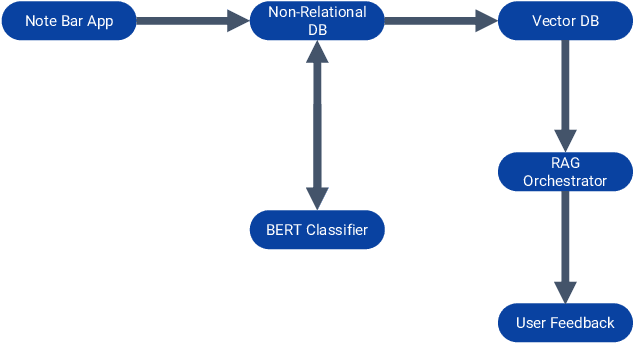
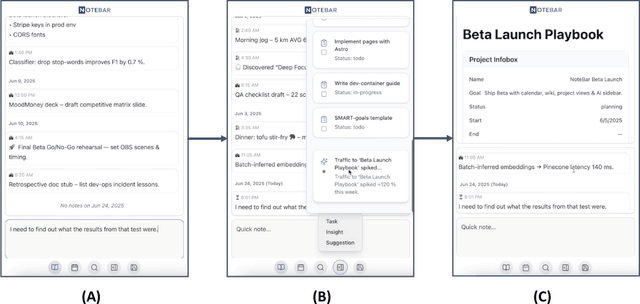
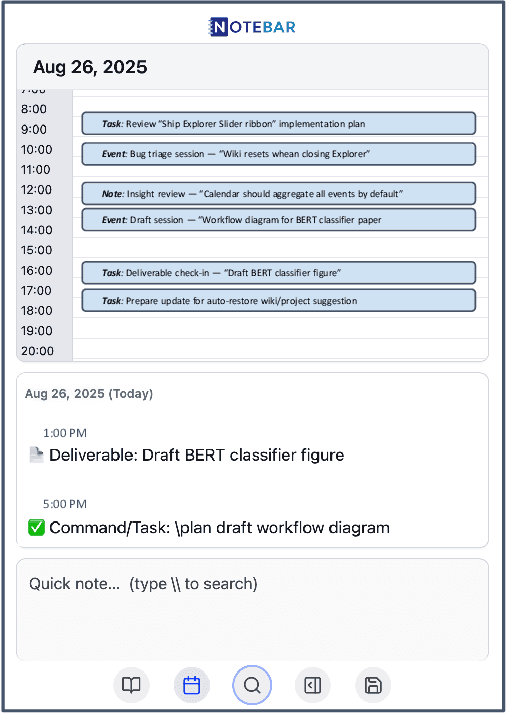
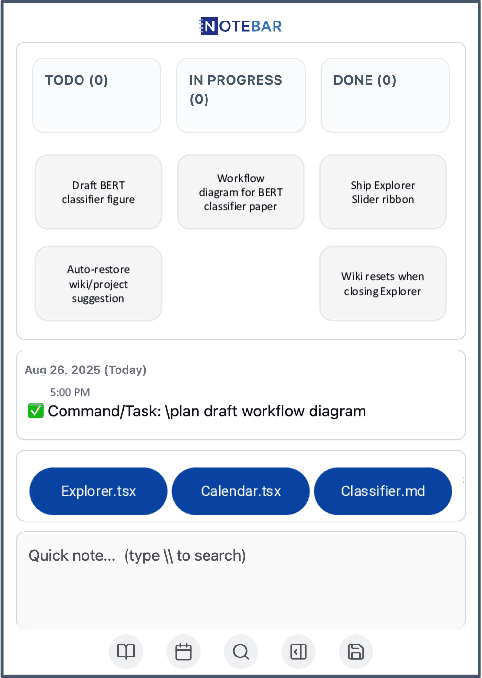
Note-taking is a critical practice for capturing, organizing, and reflecting on information in both academic and professional settings. The recent success of large language models has accelerated the development of AI-assisted tools, yet existing solutions often struggle with efficiency. We present NoteBar, an AI-assisted note-taking tool that leverages persona information and efficient language models to automatically organize notes into multiple categories and better support user workflows. To support research and evaluation in this space, we further introduce a novel persona-conditioned dataset of 3,173 notes and 8,494 annotated concepts across 16 MBTI personas, offering both diversity and semantic richness for downstream tasks. Finally, we demonstrate that NoteBar can be deployed in a practical and cost-effective manner, enabling interactive use without reliance on heavy infrastructure. Together, NoteBar and its accompanying dataset provide a scalable and extensible foundation for advancing AI-assisted personal knowledge management.
Representation Entanglement for Generation:Training Diffusion Transformers Is Much Easier Than You Think
Jul 02, 2025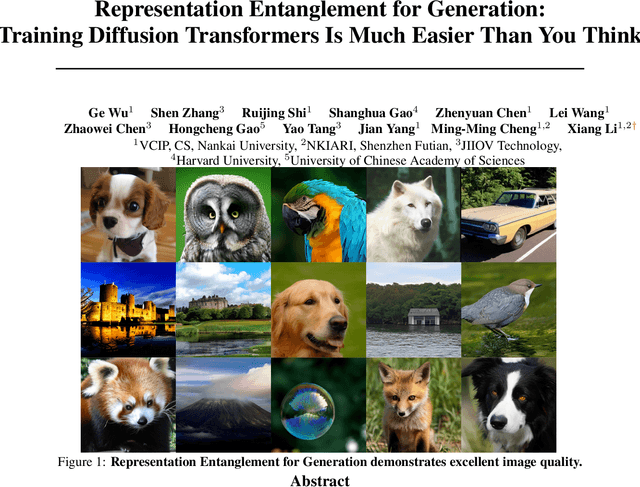
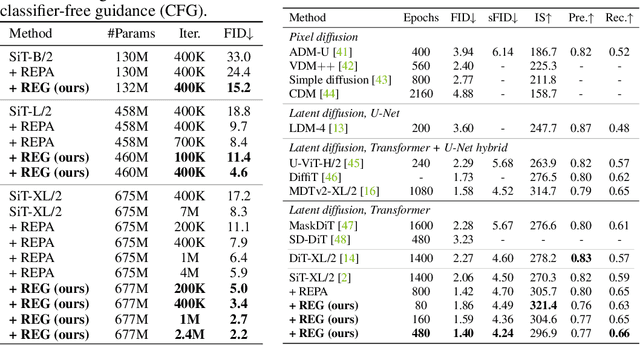
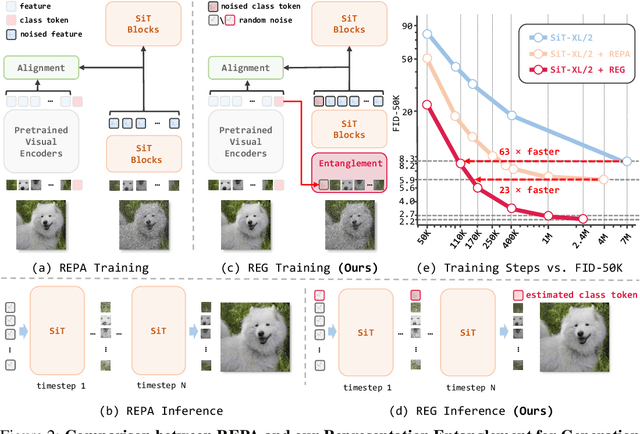
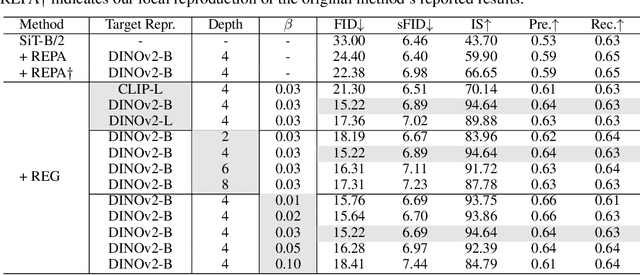
REPA and its variants effectively mitigate training challenges in diffusion models by incorporating external visual representations from pretrained models, through alignment between the noisy hidden projections of denoising networks and foundational clean image representations. We argue that the external alignment, which is absent during the entire denoising inference process, falls short of fully harnessing the potential of discriminative representations. In this work, we propose a straightforward method called Representation Entanglement for Generation (REG), which entangles low-level image latents with a single high-level class token from pretrained foundation models for denoising. REG acquires the capability to produce coherent image-class pairs directly from pure noise, substantially improving both generation quality and training efficiency. This is accomplished with negligible additional inference overhead, requiring only one single additional token for denoising (<0.5\% increase in FLOPs and latency). The inference process concurrently reconstructs both image latents and their corresponding global semantics, where the acquired semantic knowledge actively guides and enhances the image generation process. On ImageNet 256$\times$256, SiT-XL/2 + REG demonstrates remarkable convergence acceleration, achieving $\textbf{63}\times$ and $\textbf{23}\times$ faster training than SiT-XL/2 and SiT-XL/2 + REPA, respectively. More impressively, SiT-L/2 + REG trained for merely 400K iterations outperforms SiT-XL/2 + REPA trained for 4M iterations ($\textbf{10}\times$ longer). Code is available at: https://github.com/Martinser/REG.
Reinforcement Pre-Training
Jun 09, 2025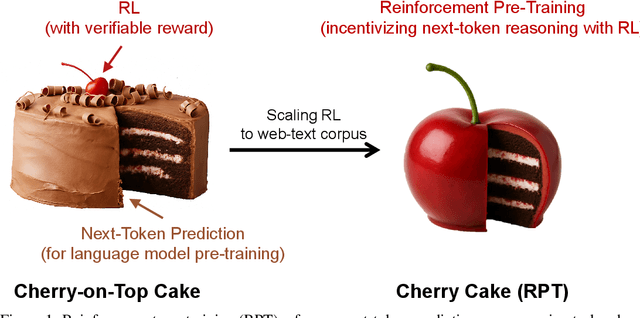
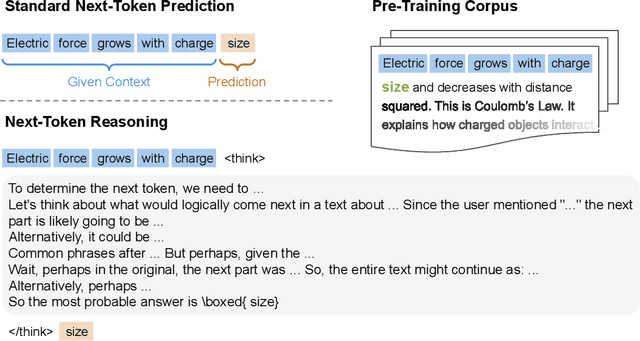
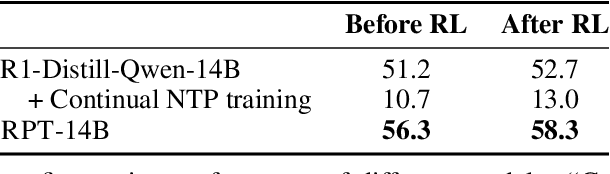
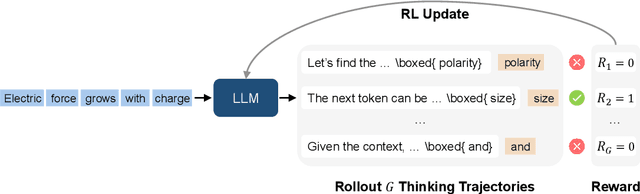
In this work, we introduce Reinforcement Pre-Training (RPT) as a new scaling paradigm for large language models and reinforcement learning (RL). Specifically, we reframe next-token prediction as a reasoning task trained using RL, where it receives verifiable rewards for correctly predicting the next token for a given context. RPT offers a scalable method to leverage vast amounts of text data for general-purpose RL, rather than relying on domain-specific annotated answers. By incentivizing the capability of next-token reasoning, RPT significantly improves the language modeling accuracy of predicting the next tokens. Moreover, RPT provides a strong pre-trained foundation for further reinforcement fine-tuning. The scaling curves show that increased training compute consistently improves the next-token prediction accuracy. The results position RPT as an effective and promising scaling paradigm to advance language model pre-training.
LEDiT: Your Length-Extrapolatable Diffusion Transformer without Positional Encoding
Mar 07, 2025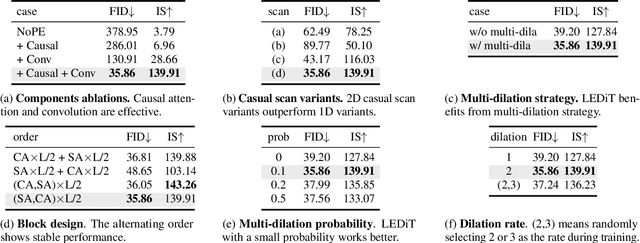
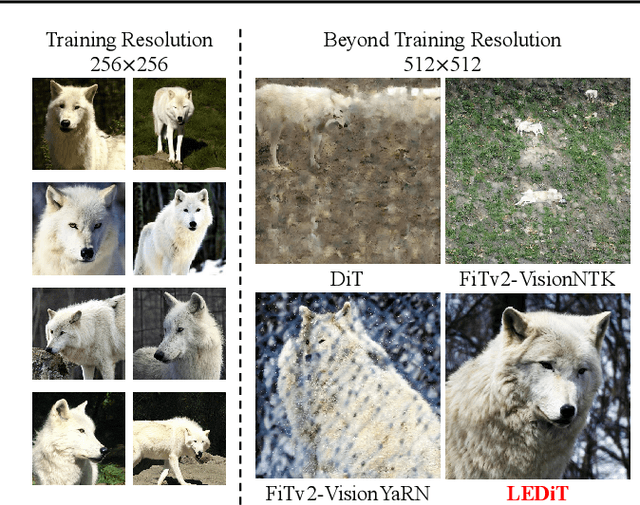
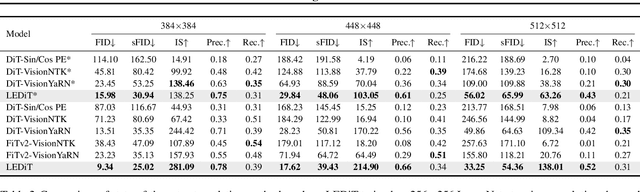
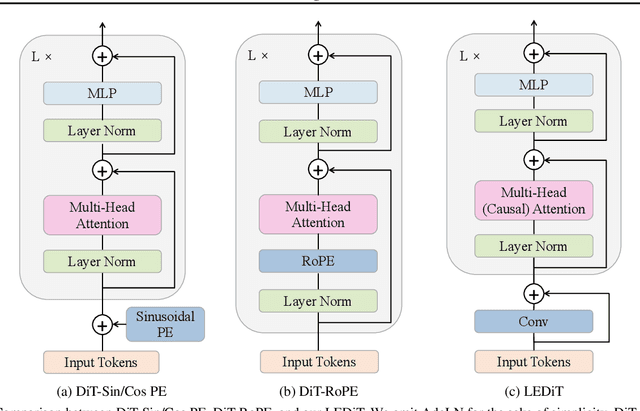
Diffusion transformers(DiTs) struggle to generate images at resolutions higher than their training resolutions. The primary obstacle is that the explicit positional encodings(PE), such as RoPE, need extrapolation which degrades performance when the inference resolution differs from training. In this paper, we propose a Length-Extrapolatable Diffusion Transformer(LEDiT), a simple yet powerful architecture to overcome this limitation. LEDiT needs no explicit PEs, thereby avoiding extrapolation. The key innovations of LEDiT are introducing causal attention to implicitly impart global positional information to tokens, while enhancing locality to precisely distinguish adjacent tokens. Experiments on 256x256 and 512x512 ImageNet show that LEDiT can scale the inference resolution to 512x512 and 1024x1024, respectively, while achieving better image quality compared to current state-of-the-art length extrapolation methods(NTK-aware, YaRN). Moreover, LEDiT achieves strong extrapolation performance with just 100K steps of fine-tuning on a pretrained DiT, demonstrating its potential for integration into existing text-to-image DiTs. Project page: https://shenzhang2145.github.io/ledit/