 Add to Chrome
 Add to Firefox
 Add to Edge
Learning to Assemble Novel Structures with Unfamiliar Parts under Semantic Constraints
Aug 13, 2026
This paper describes a neurosymbolic architecture for learning to assemble novel structures using evidence from embodied conversations and task demonstrations. We focus on scenarios where an agent encounters, after deployment, semantic constraints on structures--in other words, constraints as to which part types and features make valid structures--that were not available during training, and where it is initially unaware of the relevant structure and component part concepts. The agent must acquire and exploit such knowledge through user interactions while attempting assembly. We study this setting in a simulated toy truck assembly domain, learning from symbolic evidence encoded in natural language and from dense visual observations. Our experiments show that communicating semantic constraints through natural language (e.g., "dump trucks have a dumper") yields more data-efficient online adaptation than relying only on task demonstrations and/or only naming the parts through natural language.

Identifying Informative Environments for Cognition Parameter Inference via Bayesian Experimental Design
Aug 03, 2026Computational cognitive modeling seeks to infer latent cognitive mechanisms underlying observed behavior. Bayesian inverse planning provides a principled framework for such inference, but its success depends critically on the experimental environment. Existing approaches typically treat environments as fixed, leaving open the question of which cognitive experiments are most informative for cognition parameter inference. We formulate the design of cognitive planning experiments as a Bayesian Experimental Design (BED) problem, treating the experimental environment as the design variable. We establish an exact Monte Carlo BED benchmark and introduce an amortized Bayesian experimental design framework for efficient posterior inference and design evaluation. Experiments on the Mouselab-MDP process-tracing paradigm show that amortized BED closely matches the environment rankings of exact Monte Carlo BED while substantially reducing computational cost. We further show that no single environment is uniformly optimal across cognitive inference objectives, revealing trade-offs between expected information gain, posterior recoverability, and information efficiency. These results provide a principled framework for designing informative cognitive experiments for Bayesian parameter inference.
BayesContact: Uncertain Pose Estimation via Visuo-Tactile Proposals and Simulation-based Inference
Jul 17, 2026Contact-rich manipulation requires pose estimates that are often more accurate than what depth-only sensing provides. Existing methods, relying on vision and contact, employ costly offline training procedures that need to be retrained for new environments and geometries. We propose BayesContact, a Simulation-Based Inference framework for visuo-tactile pose estimation in peg-in-hole insertion. BayesContact maintains a particle belief over object pose and fuses depth observations with force/torque-derived contact evidence. We employ simulation based forward models to approximate these observation likelihoods. For each pose hypothesis, a renderer predicts depth measurements and a physics simulator predicts contact outcomes under guarded probing actions; both are scored against real observations to update the belief. The resulting multimodal belief also enables information-gain-based probing for active disambiguation. Across simulated geometries and real-robot experiments, BayesContact improves pose observability and insertion success over vision-only inference by 30%
RENEW: Towards Learning World Models and Repairing Model Exploitation from Preferences
Jul 15, 2026World models are widely used in offline reinforcement learning (RL) to improve sample efficiency and generate experience beyond a fixed dataset. However, they are vulnerable to model exploitation where data coverage is thin. Prior work addresses this either by collecting more expert demonstrations, which is often expensive, unsafe, or unavailable, or by conservative algorithms that avoid uncertain regions, which limits generalization. We propose instead to repair exploitation directly using human preferences over imagined rollouts, leveraging the strong intuitive physics that allows humans to easily spot egregious dynamics hallucinations. We formalize this as Dynamics Learning from Human Feedback (DLHF), a Bradley-Terry preference loss over trajectory log-likelihoods under a learned dynamics model. Unfortunately, naive DLHF is sample inefficient, so we introduce RENEW, which uses epistemic uncertainty to focus finetuning where the model is most exploitable. We evaluate on several Jumanji and classic control environments and find that while naive DLHF requires an outsize preference budget, RENEW makes the framework practical by improving sample efficiency, limiting catastrophic forgetting, and reducing exploitation in pretrained world models. Taken together, our results provide initial evidence that preferences can supervise world model dynamics directly, offering a new approach to addressing exploitation in offline model-based RL.
A Minimal Model of Bounded Trade-Off Screening in Multi-Attribute Choice
Jun 11, 2026Human decision-making often involves choosing between multi-attribute alternatives, yet classical models assume fully compensatory utility aggregation despite evidence that people reject options with poor performance on critical attributes. We propose a bounded trade-off reasoning framework in which decisions are governed by a screening process that evaluates the balance between gains and losses across attributes. The model introduces a trade-off tolerance parameter that controls acceptable imbalance and can vary across contexts. Through simulation, we show that this mechanism produces preference patterns that differ from standard utility-based models and captures context-dependent variation in trade-off behavior. These results establish bounded trade-off screening as a plausible computational mechanism for multi-attribute choice and generate testable predictions for future behavioral studies.
Understanding Human Actions through the Lens of Executable Models
Apr 20, 2026Human-centred systems require an understanding of human actions in the physical world. Temporally extended sequences of actions are intentional and structured, yet existing methods for recognising what actions are performed often do not attempt to capture their structure, particularly how the actions are executed. This, however, is crucial for assessing the quality of the action's execution and its differences from other actions. To capture the internal mechanics of actions, we introduce a domain-specific language EXACT that represents human motions as underspecified motion programs, interpreted as reward-generating functions for zero-shot policy inference using forward-backwards representations. By leveraging the compositional nature of EXACT motion programs, we combine individual policies into an executable neuro-symbolic model that uses program structure for compositional modelling. We evaluate the utility of the proposed pipeline for creating executable action models by analysing motion-capture data to understand human actions, for the tasks of human action segmentation and action anomaly detection. Our results show that the use of executable action models improves data efficiency and captures intuitive relationships between actions compared with monolithic, task-specific approaches.
Learning to unfold cloth: Scaling up world models to deformable object manipulation
Feb 18, 2026Learning to manipulate cloth is both a paradigmatic problem for robotic research and a problem of immediate relevance to a variety of applications ranging from assistive care to the service industry. The complex physics of the deformable object makes this problem of cloth manipulation nontrivial. In order to create a general manipulation strategy that addresses a variety of shapes, sizes, fold and wrinkle patterns, in addition to the usual problems of appearance variations, it becomes important to carefully consider model structure and their implications for generalisation performance. In this paper, we present an approach to in-air cloth manipulation that uses a variation of a recently proposed reinforcement learning architecture, DreamerV2. Our implementation modifies this architecture to utilise surface normals input, in addition to modiying the replay buffer and data augmentation procedures. Taken together these modifications represent an enhancement to the world model used by the robot, addressing the physical complexity of the object being manipulated by the robot. We present evaluations both in simulation and in a zero-shot deployment of the trained policies in a physical robot setup, performing in-air unfolding of a variety of different cloth types, demonstrating the generalisation benefits of our proposed architecture.
Heuristic Adaptation of Potentially Misspecified Domain Support for Likelihood-Free Inference in Stochastic Dynamical Systems
Oct 30, 2025In robotics, likelihood-free inference (LFI) can provide the domain distribution that adapts a learnt agent in a parametric set of deployment conditions. LFI assumes an arbitrary support for sampling, which remains constant as the initial generic prior is iteratively refined to more descriptive posteriors. However, a potentially misspecified support can lead to suboptimal, yet falsely certain, posteriors. To address this issue, we propose three heuristic LFI variants: EDGE, MODE, and CENTRE. Each interprets the posterior mode shift over inference steps in its own way and, when integrated into an LFI step, adapts the support alongside posterior inference. We first expose the support misspecification issue and evaluate our heuristics using stochastic dynamical benchmarks. We then evaluate the impact of heuristic support adaptation on parameter inference and policy learning for a dynamic deformable linear object (DLO) manipulation task. Inference results in a finer length and stiffness classification for a parametric set of DLOs. When the resulting posteriors are used as domain distributions for sim-based policy learning, they lead to more robust object-centric agent performance.
ROOM: A Physics-Based Continuum Robot Simulator for Photorealistic Medical Datasets Generation
Sep 16, 2025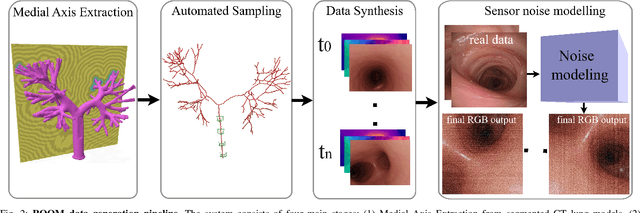
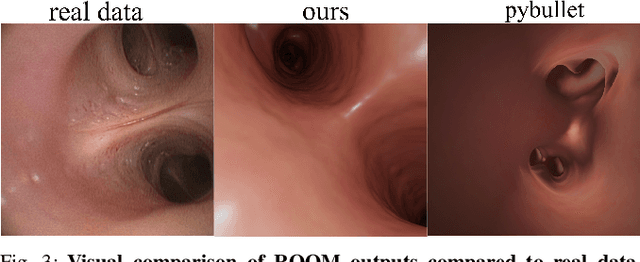
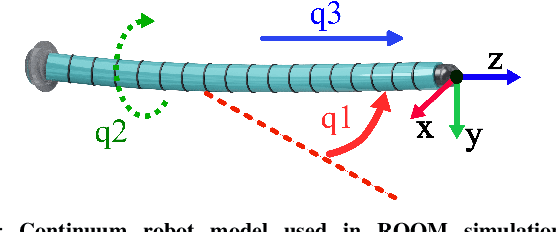
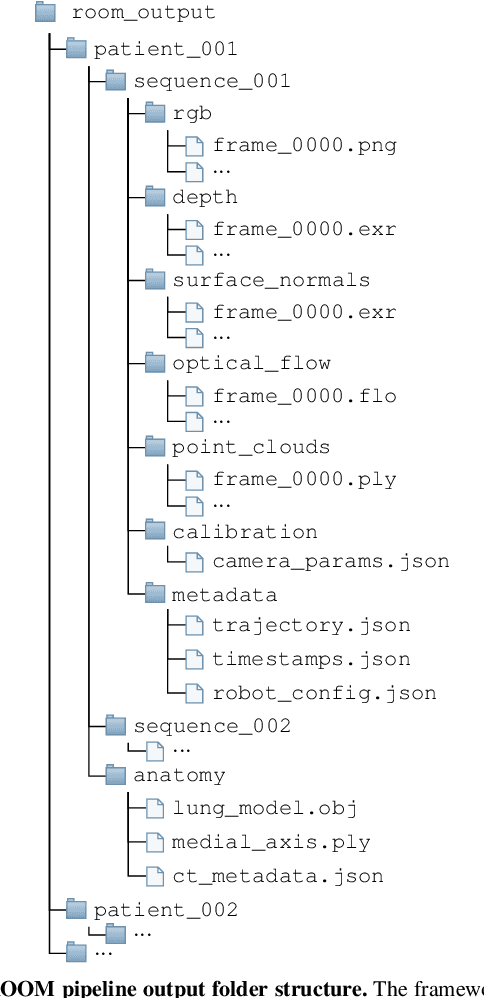
Continuum robots are advancing bronchoscopy procedures by accessing complex lung airways and enabling targeted interventions. However, their development is limited by the lack of realistic training and test environments: Real data is difficult to collect due to ethical constraints and patient safety concerns, and developing autonomy algorithms requires realistic imaging and physical feedback. We present ROOM (Realistic Optical Observation in Medicine), a comprehensive simulation framework designed for generating photorealistic bronchoscopy training data. By leveraging patient CT scans, our pipeline renders multi-modal sensor data including RGB images with realistic noise and light specularities, metric depth maps, surface normals, optical flow and point clouds at medically relevant scales. We validate the data generated by ROOM in two canonical tasks for medical robotics -- multi-view pose estimation and monocular depth estimation, demonstrating diverse challenges that state-of-the-art methods must overcome to transfer to these medical settings. Furthermore, we show that the data produced by ROOM can be used to fine-tune existing depth estimation models to overcome these challenges, also enabling other downstream applications such as navigation. We expect that ROOM will enable large-scale data generation across diverse patient anatomies and procedural scenarios that are challenging to capture in clinical settings. Code and data: https://github.com/iamsalvatore/room.
ContactFusion: Stochastic Poisson Surface Maps from Visual and Contact Sensing
Mar 20, 2025Robust and precise robotic assembly entails insertion of constituent components. Insertion success is hindered when noise in scene understanding exceeds tolerance limits, especially when fabricated with tight tolerances. In this work, we propose ContactFusion which combines global mapping with local contact information, fusing point clouds with force sensing. Our method entails a Rejection Sampling based contact occupancy sensing procedure which estimates contact locations on the end-effector from Force/Torque sensing at the wrist. We demonstrate how to fuse contact with visual information into a Stochastic Poisson Surface Map (SPSMap) - a map representation that can be updated with the Stochastic Poisson Surface Reconstruction (SPSR) algorithm. We first validate the contact occupancy sensor in simulation and show its ability to detect the contact location on the robot from force sensing information. Then, we evaluate our method in a peg-in-hole task, demonstrating an improvement in the hole pose estimate with the fusion of the contact information with the SPSMap.