 Add to Chrome
 Add to Firefox
 Add to Edge
JADE-GS: Joint Alternating Deblurring Guided by Events in 3D Gaussian Splatting
Jul 16, 2026
When a camera moves fast during exposure, blur destroys the intra-exposure motion a 3D model needs to recover the sharp scene, while event cameras capture exactly this signal at microsecond resolution. Turning them into reliable 3D supervision faces two obstacles. First, the two restoration priors fail in opposite ways: physics-based event-integration priors preserve edges but accumulate drift; learned networks recover texture but distort boundaries. Second, existing pipelines run in one direction only, so raw event noise or the biases of fixed 2D pseudo-labels pass uncorrected into the geometry. JADE-GS addresses both: a pixel-adaptive routing gate fuses the complementary priors, and the resulting 2D restorer is coupled to a 3D Gaussian Splatting student in a bidirectional loop, where detached, multi-view-consistent renders and a physics-based reblurring constraint regularize the restorer, turning a fixed preprocessor into a geometry-aware predictor. Across synthetic and real benchmarks, JADE-GS attains the best perceptual quality, leading LPIPS and CLIP-IQA on both benchmarks with competitive PSNR and SSIM, and trainsin about one hour under 5 GB on a single consumer GPU while preserving real-time rendering.

LXD-SLAM: LiDAR+X Dense SLAM with $\sum_{i=0}^{5}C_5^i$ Configurable Sensor Combinations
Jun 26, 2026Simultaneous Localization and Mapping (SLAM) is essential for autonomous systems, yet achieving reliable, globally consistent pose estimation and dense mapping in complex environments remains challenging due to geometric degeneracy and sensor drift. While multi-sensor fusion addresses these issues, existing systems often lack the modularity to adapt to diverse platforms and rely on mathematically inconsistent fusion or suboptimal map representations. To address these limitations, we propose LXD-SLAM (LiDAR+X Dense SLAM), a highly versatile and unified multi-sensor fusion framework. Centered around 3D LiDAR, our system allows for the plug-and-play integration of LiDAR, Camera, IMU, Wheel Encoder, and GNSS, supporting up to 32 distinct sensor combinations. We employ a mathematically unified Iterative Error-Sate Kalman Filter with an adaptive hierarchical prediction strategy and an update step that minimizes point-to-mesh distances and visual reprojection errors. To support this, the environment is modeled using continuous multi-layered Gaussian Process (GP) sub-meshes, which enables efficient ray-to-mesh depth recovery for visual features. For global consistency, we introduce an Extended Scan Context (ESC) descriptor derived from the GP sub-meshes alongside a Bidirectional PnP optimization for robust multi-modal loop closure within a hybrid pose graph. Extensive evaluations on public datasets and real-world experiments demonstrate that LXD-SLAM matches or exceeds state-of-the-art specialized odometry solutions across various configurations while generating high-fidelity, globally consistent dense meshes in real-time. The relevant codes and data will be made available at https://github.com/peterWon/LXD-SLAM upon publication.
Metacognition as Reward: Reinforcing LLM Reasoning via Knowledge and Regulation Signals
May 22, 2026Recent RL methods have substantially improved the reasoning abilities of LLMs. Existing reward designs mainly follow two paradigms: (1) Reinforcement learning with verifiable rewards (RLVR) derives outcome signals from executable checks or ground-truth answers, but provides limited guidance for intermediate reasoning behaviors. (2) Rubrics-as-reward (RaR) goes beyond final-answer checking by using natural-language rubrics to assess reasoning quality and task compliance, but often requires instance-specific rubrics and substantial design effort. To address these issues, we introduce Metacognition-as-Reward (MaR), a metacognition-inspired RL framework that guides LLM reasoning through two general process dimensions: i) metacognitive knowledge, which identifies task-relevant information without hand-crafted instance-specific rubrics, and ii) metacognitive regulation, which plans and adjusts the reasoning process to provide reward guidance beyond final-answer outcomes. MaR scaffolds model rollouts into explicit metacognitive components and optimizes them with a trajectory-level reward over task knowledge coverage, regulation fidelity, and final-answer correctness. In this way, MaR extends reward feedback to reasoning trajectories while grounding the reward signals in general metacognitive dimensions. Experiments on 22 benchmarks show that MaR consistently improves model performance, achieving up to a 7.7% gain over the base model and up to an 11.0% gain over vanilla DAPO. Notably, Qwen3.5-9B + MaR narrows the gap to frontier models, surpassing GPT-OSS-120B on overall average and outperforming stronger models on several individual benchmarks. Process-level analysis further shows substantial improvements in reasoning process quality. MaR also generalizes to out-of-domain datasets, where MaR-trained models improve over their corresponding base models on average.
GenCape: Structure-Inductive Generative Modeling for Category-Agnostic Pose Estimation
May 13, 2026Category-agnostic pose estimation (CAPE) aims to localize keypoints on query images from arbitrary categories, using only a few annotated support examples for guidance. Recent approaches either treat keypoints as isolated entities or rely on manually defined skeleton priors, which are costly to annotate and inherently inflexible across diverse categories. Such oversimplification limits the model's capacity to capture instance-wise structural cues critical for accurate pixel-level localization. To overcome these limitations, we propose GenCape, a Generative-based framework for CAPE that infers keypoint relationships solely from image-based support inputs, without additional textual descriptions or predefined skeletons. Our framework consists of two principal components: an iterative Structure-aware Variational Autoencoder (i-SVAE) and a Compositional Graph Transfer (CGT) module. The former infers soft, instance-specific adjacency matrices from support features through variational inference, embedded layer-wise into the Graph Transformer Decoder for progressive structural priors refinement. The latter adaptively aggregates multiple latent graphs into a query-aware structure via Bayesian fusion and attention-based reweighting, enhancing resilience to visual uncertainty and support-induced bias. This structure-aware design facilitates effective message propagation among keypoints and promotes semantic alignment across object categories with diverse keypoint topologies. Experimental results on the MP-100 dataset show that our method achieves substantial gains over graph-support baselines under both 1- and 5-shot settings, while maintaining competitive performance against text-support counterparts.
STAR: Semantic-Temporal Adaptive Representation Learning for Few-Shot Action Recognition
May 13, 2026Few-shot action recognition (FSAR) requires models to generalize to novel action categories from only a handful of annotated samples. Despite progress with vision-language models, existing approaches still suffer from semantic-temporal misalignment, where static textual prompts fail to capture decisive visual cues that appear sparsely across sequences, and from inadequate modeling of multi-scale temporal dynamics, as short-term discriminative cues and long-range dependencies are often either oversmoothed or fragmented. To address these challenges, we propose Semantic Temporal Adaptive Representation Learning (STAR), a unified framework, consisting of a semantic-alignment component and a temporal-aware component, effectively bridging the semantic and temporal gaps and transferring the sequence modeling capability of Mamba into the FSAR. The semantic alignment module introduces a Temporal Semantic Attention (TSA) mechanism, which performs frame-level cross-modal alignment with textual cues, ensuring fine-grained semantic-temporal consistency. The temporal-aware module incorporates a Semantic Temporal Prototype Refiner (STPR) that integrates semantic-guided Mamba blocks with multi-frequency temporal sampling and bidirectional state-space refinement, yielding semantically aligned prototypes with enhanced discriminative fidelity and temporal consistency. Furthermore, temporally dependent class descriptors derived from large language models (LLMs) provide long-range semantic guidance. Extensive experiments on five FSAR benchmarks demonstrate the consistent superiority of STAR over state-of-the-art methods. For instance, STAR achieves up to 8.1% and 6.7% gains on the SSv2-Full and SSv2-Small datasets under the 1-shot setting, and 7.3% on HMDB51, validating its effectiveness under limited supervision. The code is available at https://github.com/HongliLiu1/STAR-main.
SiMO: Single-Modality-Operable Multimodal Collaborative Perception
Mar 09, 2026Collaborative perception integrates multi-agent perspectives to enhance the sensing range and overcome occlusion issues. While existing multimodal approaches leverage complementary sensors to improve performance, they are highly prone to failure--especially when a key sensor like LiDAR is unavailable. The root cause is that feature fusion leads to semantic mismatches between single-modality features and the downstream modules. This paper addresses this challenge for the first time in the field of collaborative perception, introducing Single-Modality-Operable Multimodal Collaborative Perception (SiMO). By adopting the proposed Length-Adaptive Multi-Modal Fusion (LAMMA), SiMO can adaptively handle remaining modal features during modal failures while maintaining consistency of the semantic space. Additionally, leveraging the innovative "Pretrain-Align-Fuse-RD" training strategy, SiMO addresses the issue of modality competition--generally overlooked by existing methods--ensuring the independence of each individual modality branch. Experiments demonstrate that SiMO effectively aligns multimodal features while simultaneously preserving modality-specific features, enabling it to maintain optimal performance across all individual modalities. The implementation details can be found in https://github.com/dempsey-wen/SiMO.
DEPO: Dual-Efficiency Preference Optimization for LLM Agents
Nov 19, 2025Recent advances in large language models (LLMs) have greatly improved their reasoning and decision-making abilities when deployed as agents. Richer reasoning, however, often comes at the cost of longer chain of thought (CoT), hampering interaction efficiency in real-world scenarios. Nevertheless, there still lacks systematic definition of LLM agent efficiency, hindering targeted improvements. To this end, we introduce dual-efficiency, comprising (i) step-level efficiency, which minimizes tokens per step, and (ii) trajectory-level efficiency, which minimizes the number of steps to complete a task. Building on this definition, we propose DEPO, a dual-efficiency preference optimization method that jointly rewards succinct responses and fewer action steps. Experiments on WebShop and BabyAI show that DEPO cuts token usage by up to 60.9% and steps by up to 26.9%, while achieving up to a 29.3% improvement in performance. DEPO also generalizes to three out-of-domain math benchmarks and retains its efficiency gains when trained on only 25% of the data. Our project page is at https://opencausalab.github.io/DEPO.
ShotBench: Expert-Level Cinematic Understanding in Vision-Language Models
Jun 26, 2025Cinematography, the fundamental visual language of film, is essential for conveying narrative, emotion, and aesthetic quality. While recent Vision-Language Models (VLMs) demonstrate strong general visual understanding, their proficiency in comprehending the nuanced cinematic grammar embedded within individual shots remains largely unexplored and lacks robust evaluation. This critical gap limits both fine-grained visual comprehension and the precision of AI-assisted video generation. To address this, we introduce \textbf{ShotBench}, a comprehensive benchmark specifically designed for cinematic language understanding. It features over 3.5k expert-annotated QA pairs from images and video clips, meticulously curated from over 200 acclaimed (predominantly Oscar-nominated) films and spanning eight key cinematography dimensions. Our evaluation of 24 leading VLMs on ShotBench reveals their substantial limitations: even the top-performing model achieves less than 60\% average accuracy, particularly struggling with fine-grained visual cues and complex spatial reasoning. To catalyze advancement in this domain, we construct \textbf{ShotQA}, a large-scale multimodal dataset comprising approximately 70k cinematic QA pairs. Leveraging ShotQA, we develop \textbf{ShotVL} through supervised fine-tuning and Group Relative Policy Optimization. ShotVL significantly outperforms all existing open-source and proprietary models on ShotBench, establishing new \textbf{state-of-the-art} performance. We open-source our models, data, and code to foster rapid progress in this crucial area of AI-driven cinematic understanding and generation.
Exploring Consciousness in LLMs: A Systematic Survey of Theories, Implementations, and Frontier Risks
May 26, 2025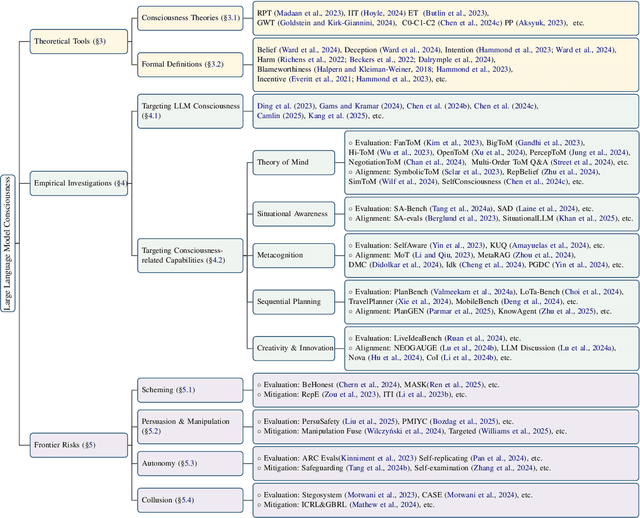

Consciousness stands as one of the most profound and distinguishing features of the human mind, fundamentally shaping our understanding of existence and agency. As large language models (LLMs) develop at an unprecedented pace, questions concerning intelligence and consciousness have become increasingly significant. However, discourse on LLM consciousness remains largely unexplored territory. In this paper, we first clarify frequently conflated terminologies (e.g., LLM consciousness and LLM awareness). Then, we systematically organize and synthesize existing research on LLM consciousness from both theoretical and empirical perspectives. Furthermore, we highlight potential frontier risks that conscious LLMs might introduce. Finally, we discuss current challenges and outline future directions in this emerging field. The references discussed in this paper are organized at https://github.com/OpenCausaLab/Awesome-LLM-Consciousness.
NTIRE 2025 Challenge on Day and Night Raindrop Removal for Dual-Focused Images: Methods and Results
Apr 19, 2025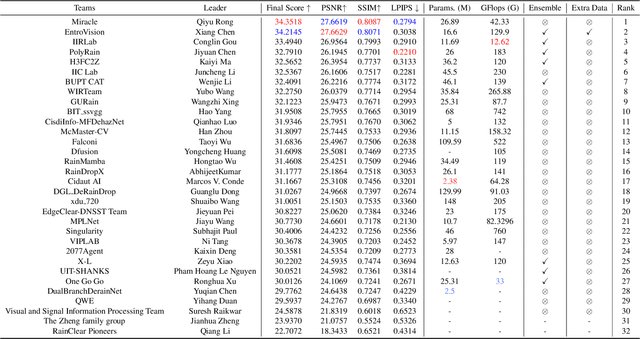
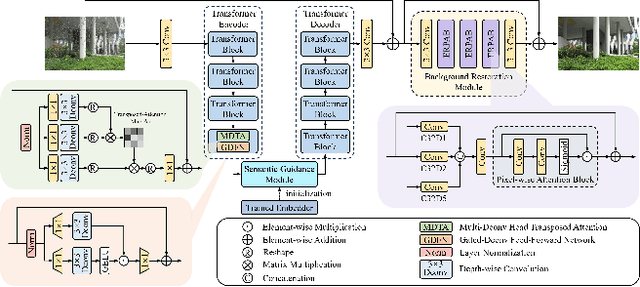
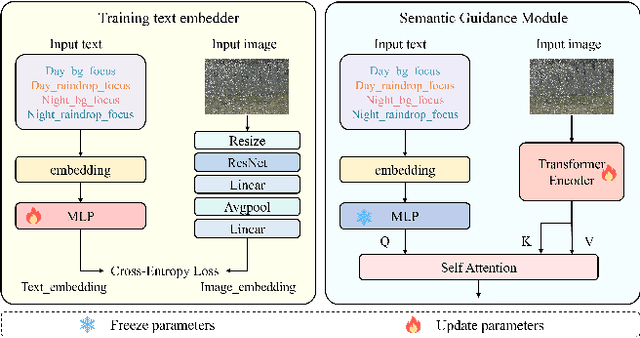
This paper reviews the NTIRE 2025 Challenge on Day and Night Raindrop Removal for Dual-Focused Images. This challenge received a wide range of impressive solutions, which are developed and evaluated using our collected real-world Raindrop Clarity dataset. Unlike existing deraining datasets, our Raindrop Clarity dataset is more diverse and challenging in degradation types and contents, which includes day raindrop-focused, day background-focused, night raindrop-focused, and night background-focused degradations. This dataset is divided into three subsets for competition: 14,139 images for training, 240 images for validation, and 731 images for testing. The primary objective of this challenge is to establish a new and powerful benchmark for the task of removing raindrops under varying lighting and focus conditions. There are a total of 361 participants in the competition, and 32 teams submitting valid solutions and fact sheets for the final testing phase. These submissions achieved state-of-the-art (SOTA) performance on the Raindrop Clarity dataset. The project can be found at https://lixinustc.github.io/CVPR-NTIRE2025-RainDrop-Competition.github.io/.