 Add to Chrome
 Add to Firefox
 Add to Edge
SciDataSailor: Deep Scientific Data Exploring
Jul 29, 2026
Scientific datasets are commonly organized as hierarchical repositories containing heterogeneous and interdependent files, making their inspection, integration, and analysis labor-intensive and reliant on domain expertise. Although large language model (LLM) agents have advanced substantially in planning, reasoning, and tool use, existing research has largely overlooked their ability to interact with real scientific data assets through executable environments. We introduce Deep Scientific Data Exploration, an agentic task paradigm in which agents navigate repositories, interpret heterogeneous files and schemas, execute analyses, integrate cross-file evidence, and produce conclusions grounded in executed observations. To operationalize this paradigm, we present SciDataSailor, a framework for synthesizing tool-interactive trajectories by balancing broad exploration with targeted exploitation. SciDataSailor instantiates trajectory synthesis as Monte Carlo Tree Search (MCTS) with four task-specific mechanisms: difficulty-stratified exploration seeds, dual-feedback first-play urgency, hierarchical strategy-to-tool action generation, and entropy-guided branching. Using this framework, we construct SciDataSailor-SFT-2K for supervised fine-tuning and SciDataSailor-Bench for evaluation, with the latter comprising 627 meta-information summarization tasks and 586 scientific question-answering tasks across 27 datasets spanning the life, earth, and physical sciences.

GenCape: Structure-Inductive Generative Modeling for Category-Agnostic Pose Estimation
May 13, 2026Category-agnostic pose estimation (CAPE) aims to localize keypoints on query images from arbitrary categories, using only a few annotated support examples for guidance. Recent approaches either treat keypoints as isolated entities or rely on manually defined skeleton priors, which are costly to annotate and inherently inflexible across diverse categories. Such oversimplification limits the model's capacity to capture instance-wise structural cues critical for accurate pixel-level localization. To overcome these limitations, we propose GenCape, a Generative-based framework for CAPE that infers keypoint relationships solely from image-based support inputs, without additional textual descriptions or predefined skeletons. Our framework consists of two principal components: an iterative Structure-aware Variational Autoencoder (i-SVAE) and a Compositional Graph Transfer (CGT) module. The former infers soft, instance-specific adjacency matrices from support features through variational inference, embedded layer-wise into the Graph Transformer Decoder for progressive structural priors refinement. The latter adaptively aggregates multiple latent graphs into a query-aware structure via Bayesian fusion and attention-based reweighting, enhancing resilience to visual uncertainty and support-induced bias. This structure-aware design facilitates effective message propagation among keypoints and promotes semantic alignment across object categories with diverse keypoint topologies. Experimental results on the MP-100 dataset show that our method achieves substantial gains over graph-support baselines under both 1- and 5-shot settings, while maintaining competitive performance against text-support counterparts.
VirPro: Visual-referred Probabilistic Prompt Learning for Weakly-Supervised Monocular 3D Detection
Mar 18, 2026Monocular 3D object detection typically relies on pseudo-labeling techniques to reduce dependency on real-world annotations. Recent advances demonstrate that deterministic linguistic cues can serve as effective auxiliary weak supervision signals, providing complementary semantic context. However, hand-crafted textual descriptions struggle to capture the inherent visual diversity of individuals across scenes, limiting the model's ability to learn scene-aware representations. To address this challenge, we propose Visual-referred Probabilistic Prompt Learning (VirPro), an adaptive multi-modal pretraining paradigm that can be seamlessly integrated into diverse weakly supervised monocular 3D detection frameworks. Specifically, we generate a diverse set of learnable, instance-conditioned prompts across scenes and store them in an Adaptive Prompt Bank (APB). Subsequently, we introduce Multi-Gaussian Prompt Modeling (MGPM), which incorporates scene-based visual features into the corresponding textual embeddings, allowing the text prompts to express visual uncertainties. Then, from the fused vision-language embeddings, we decode a prompt-targeted Gaussian, from which we derive a unified object-level prompt embedding for each instance. RoI-level contrastive matching is employed to enforce modality alignment, bringing embeddings of co-occurring objects within the same scene closer in the latent space, thus enhancing semantic coherence. Extensive experiments on the KITTI benchmark demonstrate that integrating our pretraining paradigm consistently yields substantial performance gains, achieving up to a 4.8% average precision improvement than the baseline.
Probabilistic Prompt Distribution Learning for Animal Pose Estimation
Mar 20, 2025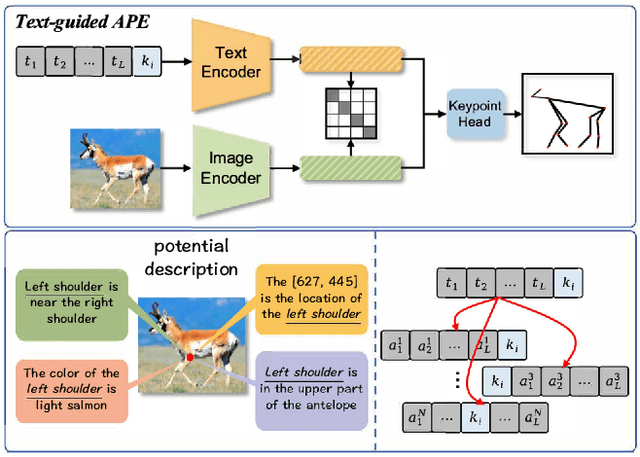
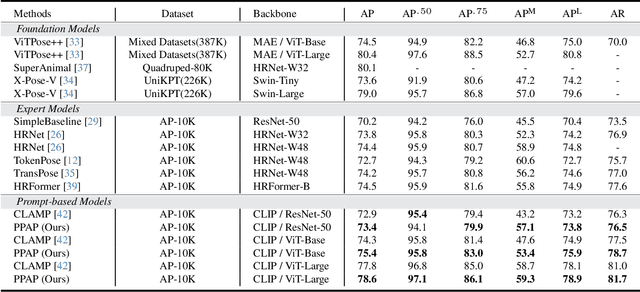


Multi-species animal pose estimation has emerged as a challenging yet critical task, hindered by substantial visual diversity and uncertainty. This paper challenges the problem by efficient prompt learning for Vision-Language Pretrained (VLP) models, \textit{e.g.} CLIP, aiming to resolve the cross-species generalization problem. At the core of the solution lies in the prompt designing, probabilistic prompt modeling and cross-modal adaptation, thereby enabling prompts to compensate for cross-modal information and effectively overcome large data variances under unbalanced data distribution. To this end, we propose a novel probabilistic prompting approach to fully explore textual descriptions, which could alleviate the diversity issues caused by long-tail property and increase the adaptability of prompts on unseen category instance. Specifically, we first introduce a set of learnable prompts and propose a diversity loss to maintain distinctiveness among prompts, thus representing diverse image attributes. Diverse textual probabilistic representations are sampled and used as the guidance for the pose estimation. Subsequently, we explore three different cross-modal fusion strategies at spatial level to alleviate the adverse impacts of visual uncertainty. Extensive experiments on multi-species animal pose benchmarks show that our method achieves the state-of-the-art performance under both supervised and zero-shot settings. The code is available at https://github.com/Raojiyong/PPAP.
Learning Structure-Supporting Dependencies via Keypoint Interactive Transformer for General Mammal Pose Estimation
Feb 25, 2025General mammal pose estimation is an important and challenging task in computer vision, which is essential for understanding mammal behaviour in real-world applications. However, existing studies are at their preliminary research stage, which focus on addressing the problem for only a few specific mammal species. In principle, from specific to general mammal pose estimation, the biggest issue is how to address the huge appearance and pose variances for different species. We argue that given appearance context, instance-level prior and the structural relation among keypoints can serve as complementary evidence. To this end, we propose a Keypoint Interactive Transformer (KIT) to learn instance-level structure-supporting dependencies for general mammal pose estimation. Specifically, our KITPose consists of two coupled components. The first component is to extract keypoint features and generate body part prompts. The features are supervised by a dedicated generalised heatmap regression loss (GHRL). Instead of introducing external visual/text prompts, we devise keypoints clustering to generate body part biases, aligning them with image context to generate corresponding instance-level prompts. Second, we propose a novel interactive transformer that takes feature slices as input tokens without performing spatial splitting. In addition, to enhance the capability of the KIT model, we design an adaptive weight strategy to address the imbalance issue among different keypoints.