 Add to Chrome
 Add to Firefox
 Add to Edge
Action from Adjacent Set in Physical Space Outperforms the Best Prediction in World Models
Jul 26, 2026
Controllers based on sampling and latent world models assign a predicted terminal cost to each candidate action sequence, choose the minimum, execute its first action block, and replan. This rule can fail even when the terminal cost perfectly and accurately reflects the true task objective in the physical world. Residual prediction error can give an infeasible sequence an anomalously low cost, and a larger proposal pool gives such errors more chances to outrank feasible alternatives. We call this conditional failure proposal overgeneration. In Cube candidate execution audits, increasing the total proposal budget from 72 to 288 reduces the feasibility of selection by minimum latent cost from .375 to .062 for position targets and from .344 to .031 for targets defined by position and yaw, although every larger pool contains a feasible sequence. We introduce Adjacent Set Action Reconstruction (ASAR). Among proposals with low cost, ASAR measures density from standardized early action prefixes and reconstructs a full sequence from an adjacent set with a light anchor from the sequence with minimum cost. On a Carry and Release evaluation set of 75 queries, Kernel ASAR improves event completion success over matching selection by 28.0, 24.0, and 18.7 percentage points under latent cost and by 18.7, 20.0, and 17.3 points under a trajectory reachability cost at 72, 144, and 288 proposals. Analysis of finite proposal pools characterizes selection risk from the lower tail, separation by a related radius support statistic, and sequence containment under an explicit local feasibility condition.

A Comprehensive Comparison between Terahertz and Optical Wireless Communications
Mar 29, 2025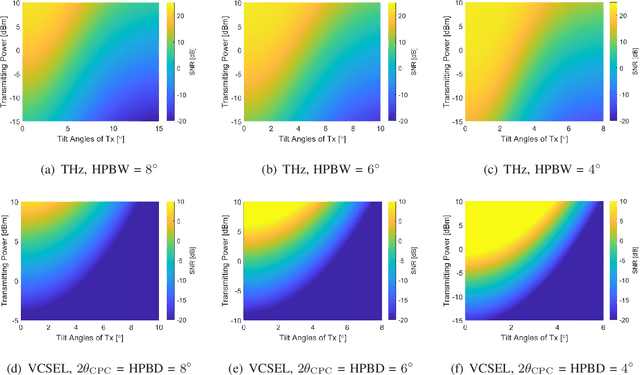
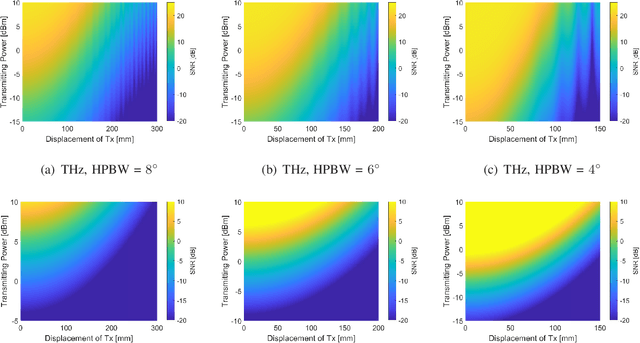
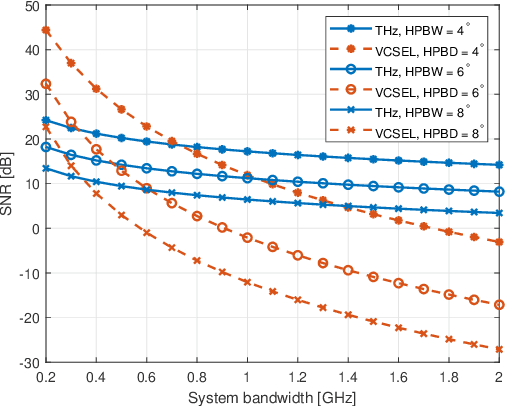
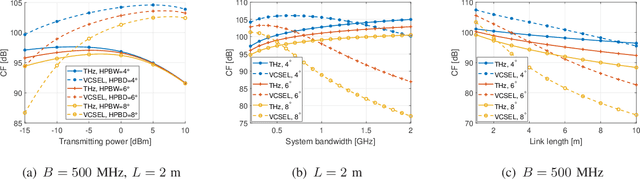
This paper presents a comprehensive quantitative comparison between Terahertz (THz) communication (TeraCom) and optical wireless communication (OWC) technologies, focusing on both indoor and outdoor environments. We propose a comparison method for TeraCom and vertical-cavity surface-emitting laser (VCSEL)-based OWC in indoor scenarios, incorporating misalignment effects by modeling the THz antenna radiation pattern within a multi-ray THz channel model and using a Gaussian beam model for VCSEL-based OWC. Unified beamwidth parameters allow for a detailed analysis of misalignment impact on both systems. Furthermore, we develop power consumption models for each technology, integrating key parameters such as THz phase noise, VCSEL non-linearities, and photodetector bandwidth-area tradeoffs. These models enable an in-depth analysis of energy efficiency in indoor environments, including multi-transmitter coverage scenarios. For outdoor scenarios, we summarize existing stochastic channel models addressing path loss, pointing errors, and small-scale fading for free space optics (FSO) and THz links. We then apply these models to unmanned aerial vehicle (UAV) applications to assess performance in dynamic conditions. Our results provide critical insights into the suitability of each technology for various deployment scenarios.
H2-MARL: Multi-Agent Reinforcement Learning for Pareto Optimality in Hospital Capacity Strain and Human Mobility during Epidemic
Mar 13, 2025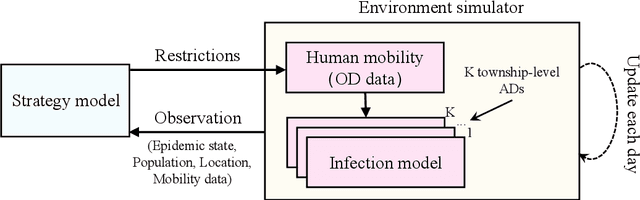
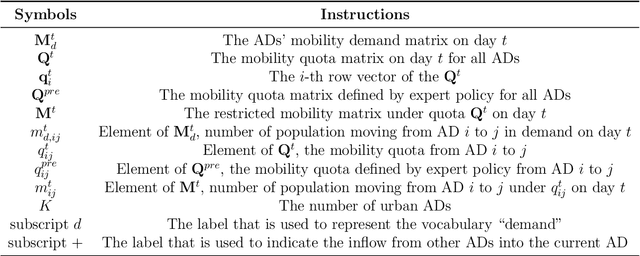
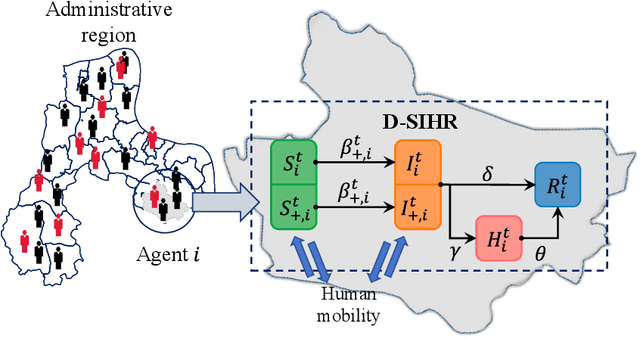
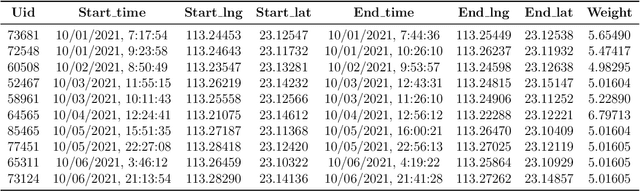
The necessity of achieving an effective balance between minimizing the losses associated with restricting human mobility and ensuring hospital capacity has gained significant attention in the aftermath of COVID-19. Reinforcement learning (RL)-based strategies for human mobility management have recently advanced in addressing the dynamic evolution of cities and epidemics; however, they still face challenges in achieving coordinated control at the township level and adapting to cities of varying scales. To address the above issues, we propose a multi-agent RL approach that achieves Pareto optimality in managing hospital capacity and human mobility (H2-MARL), applicable across cities of different scales. We first develop a township-level infection model with online-updatable parameters to simulate disease transmission and construct a city-wide dynamic spatiotemporal epidemic simulator. On this basis, H2-MARL is designed to treat each division as an agent, with a trade-off dual-objective reward function formulated and an experience replay buffer enriched with expert knowledge built. To evaluate the effectiveness of the model, we construct a township-level human mobility dataset containing over one billion records from four representative cities of varying scales. Extensive experiments demonstrate that H2-MARL has the optimal dual-objective trade-off capability, which can minimize hospital capacity strain while minimizing human mobility restriction loss. Meanwhile, the applicability of the proposed model to epidemic control in cities of varying scales is verified, which showcases its feasibility and versatility in practical applications.
PVBF: A Framework for Mitigating Parameter Variation Imbalance in Online Continual Learning
Feb 25, 2025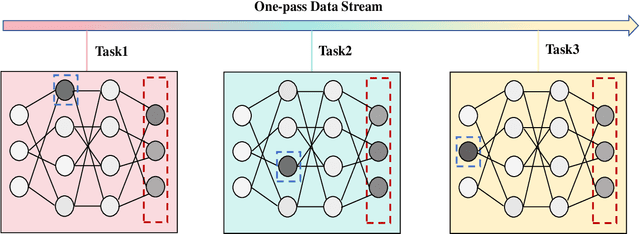
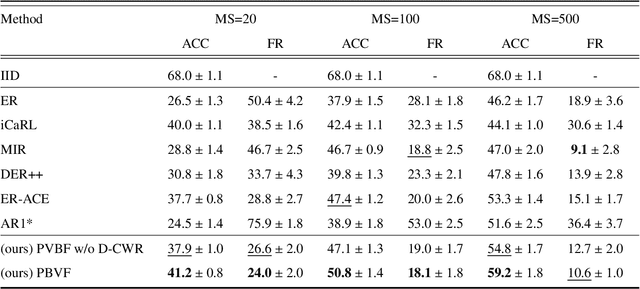
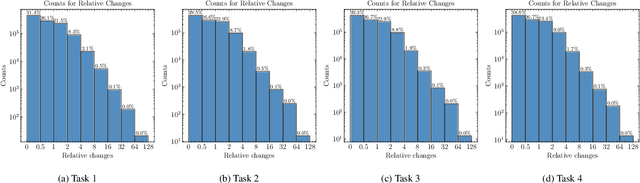
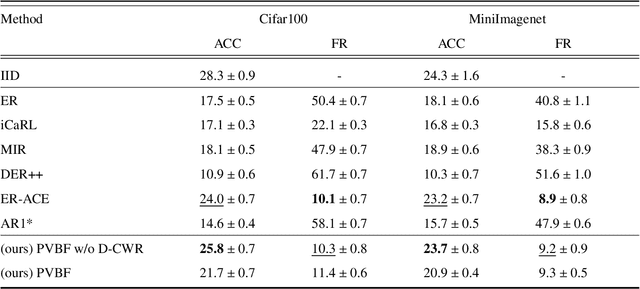
Online continual learning (OCL), which enables AI systems to adaptively learn from non-stationary data streams, is commonly achieved using experience replay (ER)-based methods that retain knowledge by replaying stored past during training. However, these methods face challenges of prediction bias, stemming from deviations in parameter update directions during task transitions. This paper identifies parameter variation imbalance as a critical factor contributing to prediction bias in ER-based OCL. Specifically, using the proposed parameter variation evaluation method, we highlight two types of imbalance: correlation-induced imbalance, where certain parameters are disproportionately updated across tasks, and layer-wise imbalance, where output layer parameters update faster than those in preceding layers. To mitigate the above imbalances, we propose the Parameter Variation Balancing Framework (PVBF), which incorporates: 1) a novel method to compute parameter correlations with previous tasks based on parameter variations, 2) an encourage-and-consolidate (E&C) method utilizing parameter correlations to perform gradient adjustments across all parameters during training, 3) a dual-layer copy weights with reinit (D-CWR) strategy to slowly update output layer parameters for frequently occuring sample categories. Experiments on short and long task sequences demonstrate that PVBF significantly reduces prediction bias and improves OCL performance, achieving up to 47\% higher accuracy compared to existing ER-based methods.
Optical Wireless Communications: Enabling the Next Generation Network of Networks
Dec 21, 2024


Optical wireless communication (OWC) is a promising technology anticipated to play a key role in the next-generation network of networks. To this end, this paper details the potential of OWC, as a complementary technology to traditional radio frequency communications, in enhancing networking capabilities beyond conventional terrestrial networks. Several usage scenarios and the current state of development are presented. Furthermore, a summary of existing challenges and opportunities are provided. Emerging technologies aimed at further enhancing future OWC capabilities are introduced. Additionally, value-added OWC-based technologies that leverage the unique properties of light are discussed, including applications such as positioning and gesture recognition. The paper concludes with the reflection that OWC provides unique functionalities that can play a crucial role in building convergent and resilient future network of networks.
Resonant Beam Multi-Target DOA Estimation
Dec 20, 2024With the increasing demand for internet of things (IoT) applications, especially for location-based services, how to locate passive mobile targets (MTs) with minimal beam control has become a challenge. Resonant beam systems are considered promising IoT technologies with advantages such as beam self-alignment and energy concentration. To establish a resonant system in the radio frequency (RF) band and achieve multi-target localization, this paper designs a multi-target resonant system architecture, allowing a single base station (BS) to independently connect with multiple MTs. By employing a retro-directive array, a multi-channel cyclic model is established to realize one-to-many electromagnetic wave propagation and MT direction-of-arrival (DOA) estimation through echo resonance. Simulation results show that the proposed system supports resonant establishment between the BS and multiple MTs. This helps the BS to still have high DOA estimation accuracy in the face of multiple passive MTs, and can ensure that the DOA error is less than 1 degree within a range of 6 meters at a 50degree field of view, with higher accuracy than active beamforming localization systems.
Field of View Expansion for Resonant Beam Information and Power Transfer
Aug 08, 2024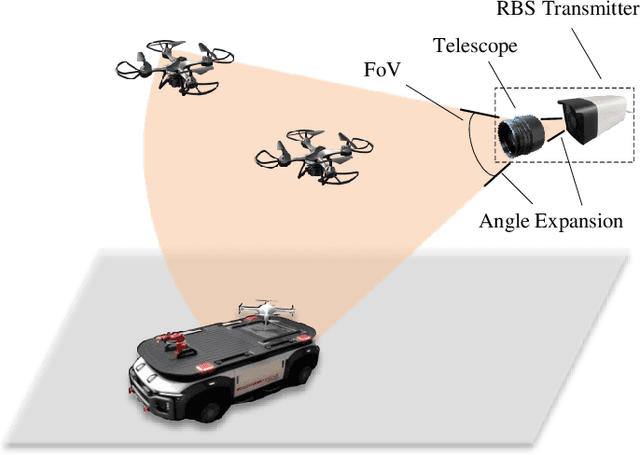


Simultaneous wireless information and power transfer (SWIPT) leverages lightwave as the wireless transmission medium, emerging as a promising technology in the future Internet of Things (IoT) scenarios. The use of retro-reflectors in constructing spatially separated laser resonators (SSLR) enables a self-aligning wireless transmission system with the self-reproducing resonant beam, i.e. resonant beam system (RBS). However, it's effective Field of View (FoV) is physically limited by the size of retroreflectors and still requires significant improvement. This restricts the transmitter from providing seamless wireless connectivity and power supply to receivers within a large dynamic movement range. In this paper, we propose an FoV-enlarged resonant beam system operating at a meter distance by incorporating a telescope. The telescope plays a crucial role in minimizing the extra loss inflicted on the gain medium, which typically arises from the deviation of the resonant beam within the cavity. Further, we construct the proposed telescope-based RBS and experimentally demonstrate that the design could expand the FoV to 28$^\circ$ over 1 m transmission distance is about triple that of the ordinary RBS design.
Sensing with OFDM Waveform at mmWave Band based on Micro-Doppler Analysis
Mar 29, 2023Joint communication and sensing (JCAS) technology has been regarded as one of the innovations in the 6G network. With the channel modeling proposed by the 3rd Generation Partnership Project (3GPP) TR 38.901, this paper investigates the sensing capability using the millimeter-wave (mmWave) band with an orthogonal frequency division multiplexing (OFDM) waveform. Based on micro-Doppler (MD) analysis, we present two case studies, i.e., fan speed detection and human activity recognition, to demonstrate the target modeling with micro-motions, backscattering signal construction, and MD signature extraction using an OFDM waveform at 28 GHz. Simulated signatures demonstrate distinct fan rotation or human motion, and waveform parameters that affect the MD signature extraction are analyzed. Simulation results draw the validity of the proposed modeling and simulation methods, which also aim to facilitate the generation of data sets for various JCAS applications.
Binocular Localization Using Resonant Beam
Dec 02, 2022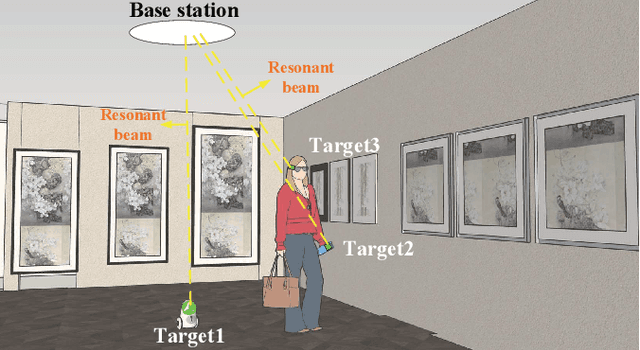


Locating mobile devices precisely in indoor scenarios is a challenging task because of the signal diffraction and reflection in complicated environments. One vital cause deteriorating the localization performance is the inevitable power dissipation along the propagation path of localization signals. In this paper, we propose a high-accuracy localization scheme based on the resonant beam system (RBS) and the binocular vision, i.e., binocular based resonant beam localization (BRBL). The BRBL system utilizes the energy-concentrated and self-aligned transmission of RBS to realize high-efficiency signal propagation and self-positioning for the target. The binocular method is combined with RBS to obtain the three-dimensional (3-D) coordinates of the target for the first time. To exhibit the localization mechanism, we first elaborate on the binocular localization model, including the resonant beam transmission analysis and the geometric derivation of the binocular method with RBS. Then, we establish the power model of RBS, and the signal and noise models of beam spot imaging, respectively, to analyse the performance of the BRBL system. Finally, the numerical results show an outstanding performance of centimeter level accuracy (i.e., $<5\mathrm{cm}$ in $0.4\mathrm{m}$ width and $0.4\mathrm{m}$ length effective range at $1\mathrm{m}$ vertical distance, $<13\mathrm{cm}$ in $0.6\mathrm{m}$ width and $0.6\mathrm{m}$ length effective range at $2\mathrm{m}$ vertical distance), which applies to indoor scenarios.
High-Power and High-Capacity Mobile Optical SWIPT
Jul 26, 2021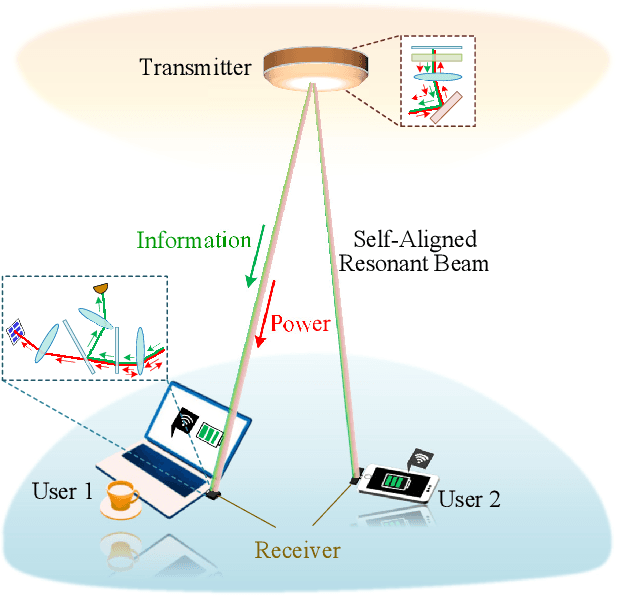
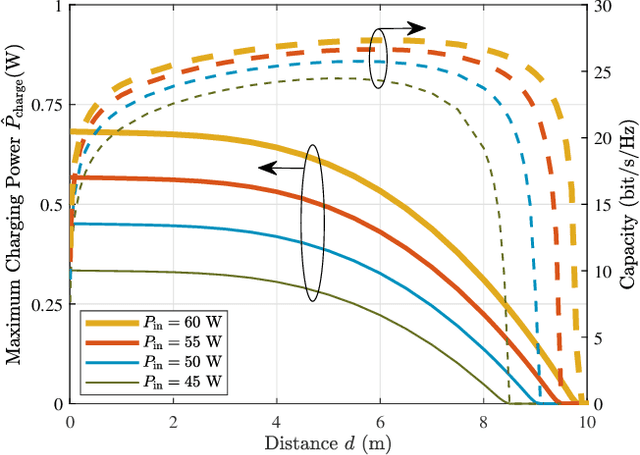
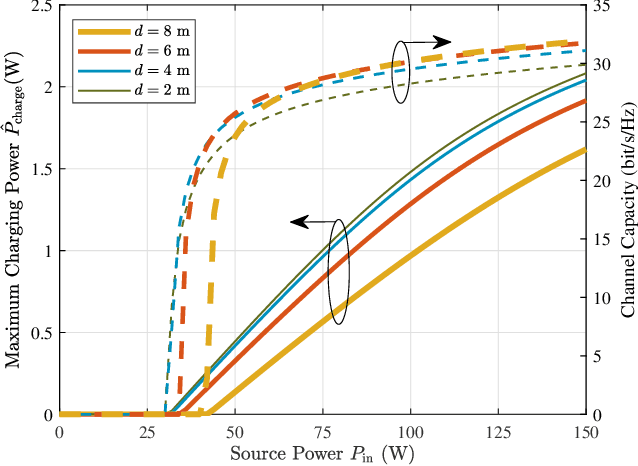
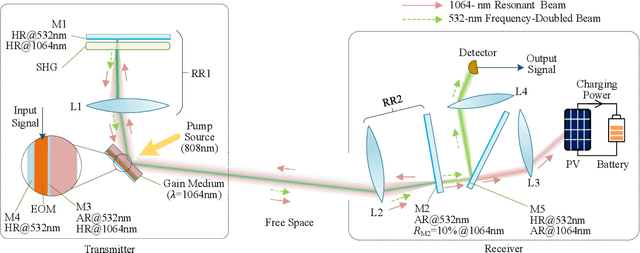
The increasing demands of power supply and data rate for mobile devices promote the research of simultaneous information and power transfer (SWIPT). Optical SWIPT, as known as simultaneous light information and power transfer (SLIPT), can provide high-capacity communication and high-power charging. However, light emitting diodes (LEDs)-based SLIPT technologies have low efficiency due to energy dissipation over the air. Laser-based SLIPT technologies face the challenge in mobility, as it needs accurate positioning, fast beam steering, and real-time tracking. In this paper, we propose a mobile SLIPT scheme based on spatially separated laser resonator (SSLR) and intra-cavity second harmonic generation (SHG). The power and data are transferred via separated frequencies, while they share the same self-aligned resonant beam path, without the needs of receiver positioning and beam steering. We establish the analysis model of the resonant beam power and its second harmonic power. We also evaluate the system performance on deliverable power and channel capacity. Numerical results show that the proposed system can achieve watt-level battery charging power and above 20-bit/s/Hz communication capacity over 8-m distance, which satisfies the requirements of most indoor mobile devices.