 Add to Chrome
 Add to Firefox
 Add to Edge
Intrinsic Computational Functionalism and Simulated Consciousness
Jun 13, 2026
A common objection to artificial or simulated consciousness is that a simulated brain is no more conscious than simulated water is wet. We address this from the perspective of Intrinsic Computational Functionalism (ICF): if consciousness is computationally constituted, it depends not on externally imposed descriptions but on the computational structures a system physically realizes in virtue of its own causal-dynamical organization. In previous work we developed Canonical Functionalism as a mathematically precise special case of this anti-interpretivist program, identifying functional states by their complete future input-output roles under a fixed interface. Here we argue that this input-output construction, though important, is incomplete: as a behavioral boundary case of ICF, it makes lookup tables and unfolded systems that preserve the same boundary behavior canonically equivalent. A consciousness-relevant canonical representation must instead include internal mechanisms, interventions, and joint readouts belonging to the relevant intrinsic organization. We therefore define a mechanism-enriched canonical structure and use it to formulate Intrinsic Causal-Computational Realization (ICCR), a realization relation preserving physical implementation, intrinsic state individuation, transition structure, intervention profiles, and the relevant agent-body-world boundary. The central result is conditional: if conscious properties are invariants of intrinsic causal-computational organization, then any system satisfying ICCR realizes the same consciousness-relevant properties, whether biological, artificial, or simulated. We discuss objections including biological naturalism and integrated information theory. We conclude that to deny consciousness to a simulation, one must identify a consciousness-relevant intrinsic causal-computational structure that the simulation fails to realize.

Exploring Consciousness in LLMs: A Systematic Survey of Theories, Implementations, and Frontier Risks
May 26, 2025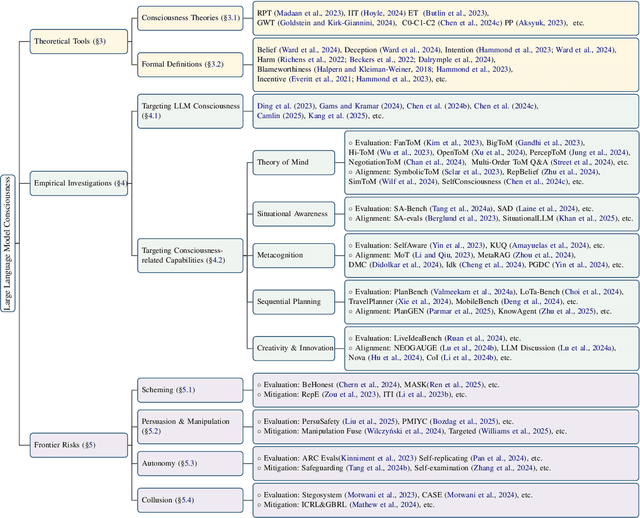

Consciousness stands as one of the most profound and distinguishing features of the human mind, fundamentally shaping our understanding of existence and agency. As large language models (LLMs) develop at an unprecedented pace, questions concerning intelligence and consciousness have become increasingly significant. However, discourse on LLM consciousness remains largely unexplored territory. In this paper, we first clarify frequently conflated terminologies (e.g., LLM consciousness and LLM awareness). Then, we systematically organize and synthesize existing research on LLM consciousness from both theoretical and empirical perspectives. Furthermore, we highlight potential frontier risks that conscious LLMs might introduce. Finally, we discuss current challenges and outline future directions in this emerging field. The references discussed in this paper are organized at https://github.com/OpenCausaLab/Awesome-LLM-Consciousness.