 Add to Chrome
 Add to Firefox
 Add to Edge
UniCAD: Efficient and Extendable Architecture for Multi-Task Computer-Aided Diagnosis System
May 15, 2025
The growing complexity and scale of visual model pre-training have made developing and deploying multi-task computer-aided diagnosis (CAD) systems increasingly challenging and resource-intensive. Furthermore, the medical imaging community lacks an open-source CAD platform to enable the rapid creation of efficient and extendable diagnostic models. To address these issues, we propose UniCAD, a unified architecture that leverages the robust capabilities of pre-trained vision foundation models to seamlessly handle both 2D and 3D medical images while requiring only minimal task-specific parameters. UniCAD introduces two key innovations: (1) Efficiency: A low-rank adaptation strategy is employed to adapt a pre-trained visual model to the medical image domain, achieving performance on par with fully fine-tuned counterparts while introducing only 0.17% trainable parameters. (2) Plug-and-Play: A modular architecture that combines a frozen foundation model with multiple plug-and-play experts, enabling diverse tasks and seamless functionality expansion. Building on this unified CAD architecture, we establish an open-source platform where researchers can share and access lightweight CAD experts, fostering a more equitable and efficient research ecosystem. Comprehensive experiments across 12 diverse medical datasets demonstrate that UniCAD consistently outperforms existing methods in both accuracy and deployment efficiency. The source code and project page are available at https://mii-laboratory.github.io/UniCAD/.

Enhancing Speech-to-Speech Dialogue Modeling with End-to-End Retrieval-Augmented Generation
Apr 27, 2025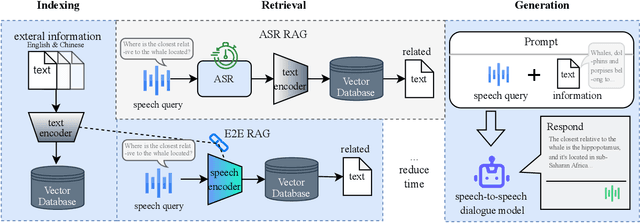
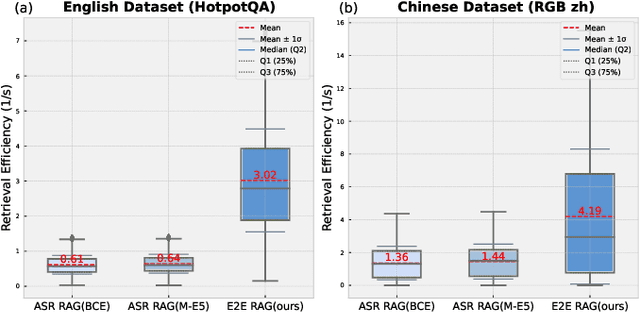
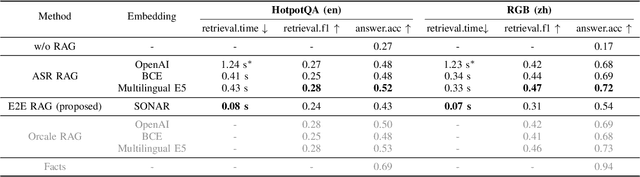
In recent years, end-to-end speech-to-speech (S2S) dialogue systems have garnered increasing research attention due to their advantages over traditional cascaded systems, including achieving lower latency and more natural integration of nonverbal cues such as emotion and speaker identity. However, these end-to-end systems face key challenges, particularly in incorporating external knowledge, a capability commonly addressed by Retrieval-Augmented Generation (RAG) in text-based large language models (LLMs). The core difficulty lies in the modality gap between input speech and retrieved textual knowledge, which hinders effective integration. To address this issue, we propose a novel end-to-end RAG framework that directly retrieves relevant textual knowledge from speech queries, eliminating the need for intermediate speech-to-text conversion via techniques like ASR. Experimental results demonstrate that our method significantly improves the performance of end-to-end S2S dialogue systems while achieving higher retrieval efficiency. Although the overall performance still lags behind cascaded models, our framework offers a promising direction for enhancing knowledge integration in end-to-end S2S systems. We will release the code and dataset to support reproducibility and promote further research in this area.
RoboFlamingo-Plus: Fusion of Depth and RGB Perception with Vision-Language Models for Enhanced Robotic Manipulation
Mar 25, 2025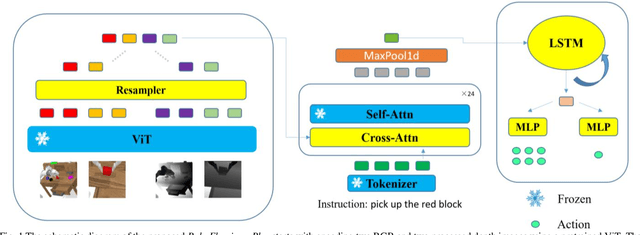

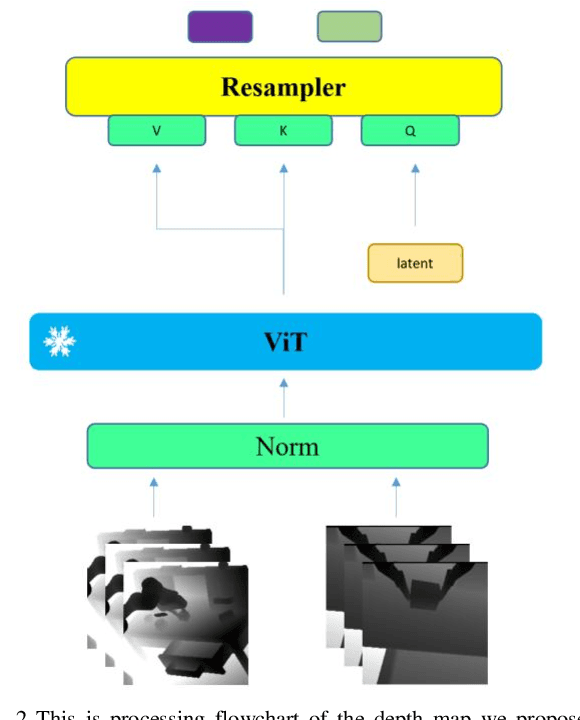
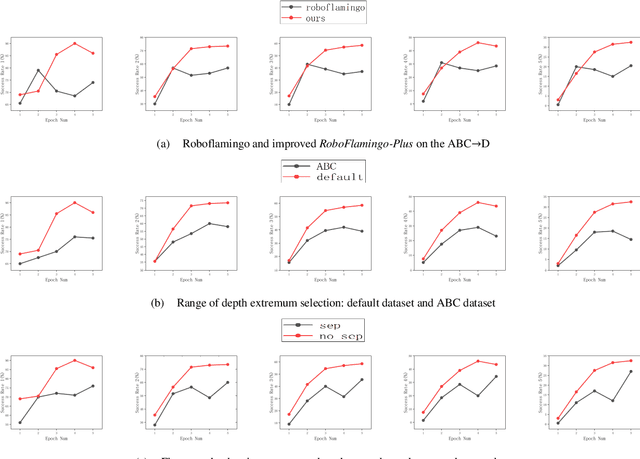
As robotic technologies advancing towards more complex multimodal interactions and manipulation tasks, the integration of advanced Vision-Language Models (VLMs) has become a key driver in the field. Despite progress with current methods, challenges persist in fusing depth and RGB information within 3D environments and executing tasks guided by linguistic instructions. In response to these challenges, we have enhanced the existing RoboFlamingo framework by introducing RoboFlamingo-Plus, which incorporates depth data into VLMs to significantly improve robotic manipulation performance. Our research achieves a nuanced fusion of RGB and depth information by integrating a pre-trained Vision Transformer (ViT) with a resampling technique, closely aligning this combined data with linguistic cues for superior multimodal understanding. The novelty of RoboFlamingo-Plus lies in its adaptation of inputs for depth data processing, leveraging a pre-trained resampler for depth feature extraction, and employing cross-attention mechanisms for optimal feature integration. These improvements allow RoboFlamingo-Plus to not only deeply understand 3D environments but also easily perform complex, language-guided tasks in challenging settings. Experimental results show that RoboFlamingo-Plus boosts robotic manipulation by 10-20% over current methods, marking a significant advancement. Codes and model weights are public at RoboFlamingo-Plus.
TreeSynth: Synthesizing Diverse Data from Scratch via Tree-Guided Subspace Partitioning
Mar 21, 2025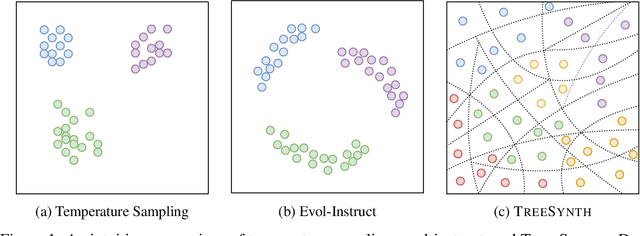
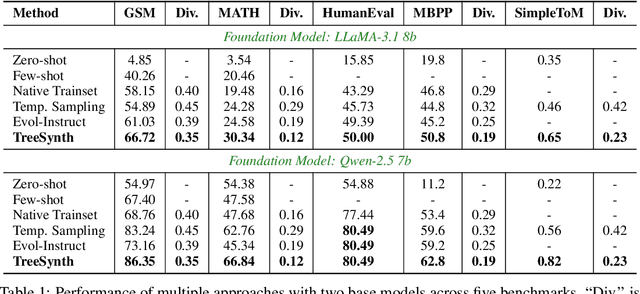
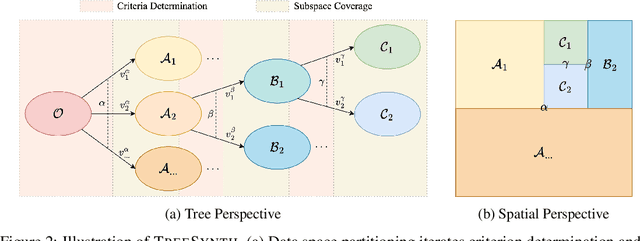
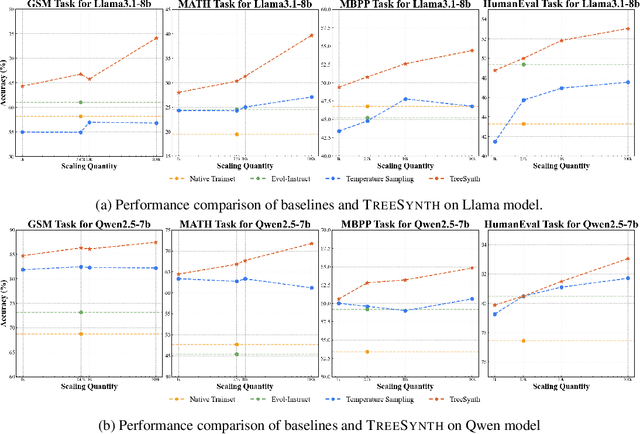
Model customization requires high-quality and diverse datasets, but acquiring such data remains challenging and costly. Although large language models (LLMs) can synthesize training data, current approaches are constrained by limited seed data, model bias and insufficient control over the generation process, resulting in limited diversity and biased distribution with the increase of data scales. To tackle this challenge, we present TreeSynth, a tree-guided subspace-based data synthesis framework that recursively partitions the entire data space into hierar-chical subspaces, enabling comprehensive and diverse scaling of data synthesis. Briefly, given a task-specific description, we construct a data space partitioning tree by iteratively executing criteria determination and subspace coverage steps. This hierarchically divides the whole space (i.e., root node) into mutually exclusive and complementary atomic subspaces (i.e., leaf nodes). By collecting synthesized data according to the attributes of each leaf node, we obtain a diverse dataset that fully covers the data space. Empirically, our extensive experiments demonstrate that TreeSynth surpasses both human-designed datasets and the state-of-the-art data synthesis baselines, achieving maximum improvements of 45.2% in data diversity and 17.6% in downstream task performance across various models and tasks. Hopefully, TreeSynth provides a scalable solution to synthesize diverse and comprehensive datasets from scratch without human intervention.
DAST: Difficulty-Aware Self-Training on Large Language Models
Mar 12, 2025Present Large Language Models (LLM) self-training methods always under-sample on challenging queries, leading to inadequate learning on difficult problems which limits LLMs' ability. Therefore, this work proposes a difficulty-aware self-training (DAST) framework that focuses on improving both the quantity and quality of self-generated responses on challenging queries during self-training. DAST is specified in three components: 1) sampling-based difficulty level estimation, 2) difficulty-aware data augmentation, and 3) the self-training algorithm using SFT and DPO respectively. Experiments on mathematical tasks demonstrate the effectiveness and generalization of DAST, highlighting the critical role of difficulty-aware strategies in advancing LLM self-training.
GrInAdapt: Scaling Retinal Vessel Structural Map Segmentation Through Grounding, Integrating and Adapting Multi-device, Multi-site, and Multi-modal Fundus Domains
Mar 08, 2025Retinal vessel segmentation is critical for diagnosing ocular conditions, yet current deep learning methods are limited by modality-specific challenges and significant distribution shifts across imaging devices, resolutions, and anatomical regions. In this paper, we propose GrInAdapt, a novel framework for source-free multi-target domain adaptation that leverages multi-view images to refine segmentation labels and enhance model generalizability for optical coherence tomography angiography (OCTA) of the fundus of the eye. GrInAdapt follows an intuitive three-step approach: (i) grounding images to a common anchor space via registration, (ii) integrating predictions from multiple views to achieve improved label consensus, and (iii) adapting the source model to diverse target domains. Furthermore, GrInAdapt is flexible enough to incorporate auxiliary modalities such as color fundus photography, to provide complementary cues for robust vessel segmentation. Extensive experiments on a multi-device, multi-site, and multi-modal retinal dataset demonstrate that GrInAdapt significantly outperforms existing domain adaptation methods, achieving higher segmentation accuracy and robustness across multiple domains. These results highlight the potential of GrInAdapt to advance automated retinal vessel analysis and support robust clinical decision-making.
Developing and Utilizing a Large-Scale Cantonese Dataset for Multi-Tasking in Large Language Models
Mar 05, 2025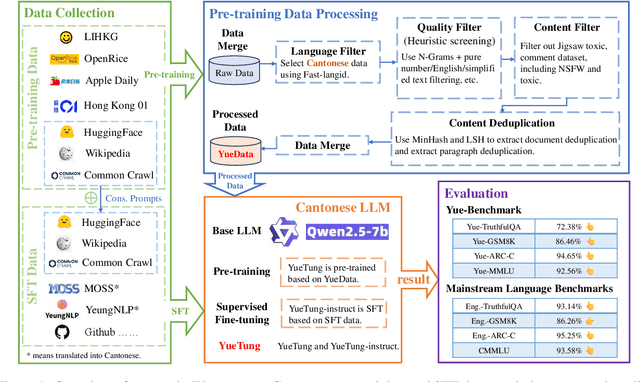
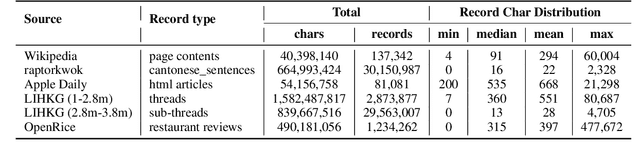
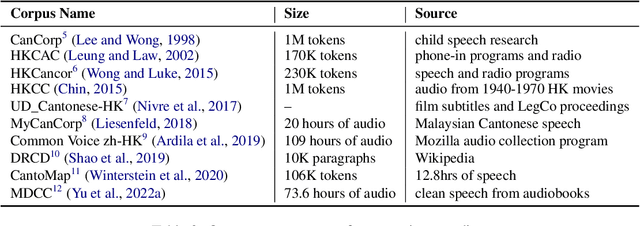
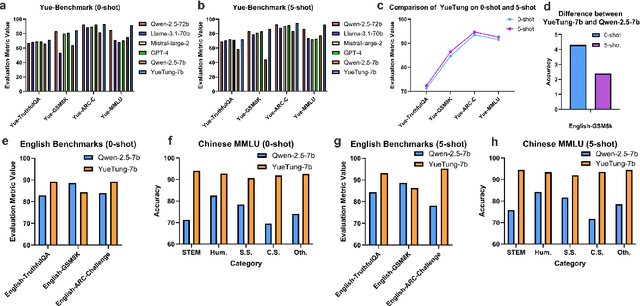
High-quality data resources play a crucial role in learning large language models (LLMs), particularly for low-resource languages like Cantonese. Despite having more than 85 million native speakers, Cantonese is still considered a low-resource language in the field of natural language processing (NLP) due to factors such as the dominance of Mandarin, lack of cohesion within the Cantonese-speaking community, diversity in character encoding and input methods, and the tendency of overseas Cantonese speakers to prefer using English. In addition, rich colloquial vocabulary of Cantonese, English loanwords, and code-switching characteristics add to the complexity of corpus collection and processing. To address these challenges, we collect Cantonese texts from a variety of sources, including open source corpora, Hong Kong-specific forums, Wikipedia, and Common Crawl data. We conduct rigorous data processing through language filtering, quality filtering, content filtering, and de-duplication steps, successfully constructing a high-quality Cantonese corpus of over 2 billion tokens for training large language models. We further refined the model through supervised fine-tuning (SFT) on curated Cantonese tasks, enhancing its ability to handle specific applications. Upon completion of the training, the model achieves state-of-the-art (SOTA) performance on four Cantonese benchmarks. After training on our dataset, the model also exhibits improved performance on other mainstream language tasks.
Biomedical Foundation Model: A Survey
Mar 03, 2025Foundation models, first introduced in 2021, are large-scale pre-trained models (e.g., large language models (LLMs) and vision-language models (VLMs)) that learn from extensive unlabeled datasets through unsupervised methods, enabling them to excel in diverse downstream tasks. These models, like GPT, can be adapted to various applications such as question answering and visual understanding, outperforming task-specific AI models and earning their name due to broad applicability across fields. The development of biomedical foundation models marks a significant milestone in leveraging artificial intelligence (AI) to understand complex biological phenomena and advance medical research and practice. This survey explores the potential of foundation models across diverse domains within biomedical fields, including computational biology, drug discovery and development, clinical informatics, medical imaging, and public health. The purpose of this survey is to inspire ongoing research in the application of foundation models to health science.
Med-LEGO: Editing and Adapting toward Generalist Medical Image Diagnosis
Mar 03, 2025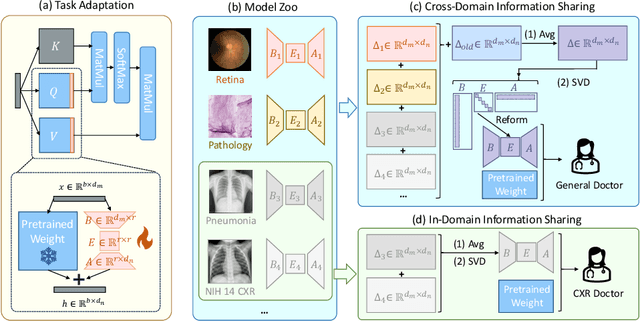
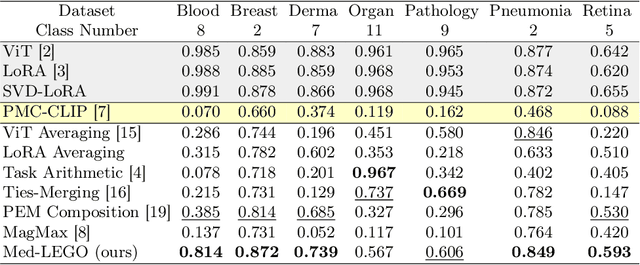
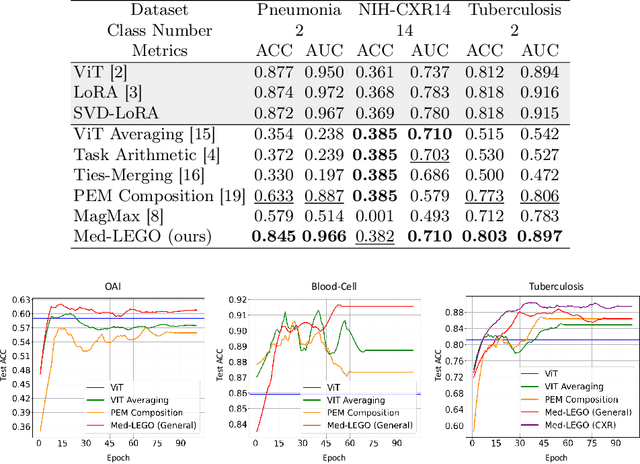
The adoption of visual foundation models has become a common practice in computer-aided diagnosis (CAD). While these foundation models provide a viable solution for creating generalist medical AI, privacy concerns make it difficult to pre-train or continuously update such models across multiple domains and datasets, leading many studies to focus on specialist models. To address this challenge, we propose Med-LEGO, a training-free framework that enables the seamless integration or updating of a generalist CAD model by combining multiple specialist models, similar to assembling LEGO bricks. Med-LEGO enhances LoRA (low-rank adaptation) by incorporating singular value decomposition (SVD) to efficiently capture the domain expertise of each specialist model with minimal additional parameters. By combining these adapted weights through simple operations, Med-LEGO allows for the easy integration or modification of specific diagnostic capabilities without the need for original data or retraining. Finally, the combined model can be further adapted to new diagnostic tasks, making it a versatile generalist model. Our extensive experiments demonstrate that Med-LEGO outperforms existing methods in both cross-domain and in-domain medical tasks while using only 0.18% of full model parameters. These merged models show better convergence and generalization to new tasks, providing an effective path toward generalist medical AI.
MITracker: Multi-View Integration for Visual Object Tracking
Feb 27, 2025Multi-view object tracking (MVOT) offers promising solutions to challenges such as occlusion and target loss, which are common in traditional single-view tracking. However, progress has been limited by the lack of comprehensive multi-view datasets and effective cross-view integration methods. To overcome these limitations, we compiled a Multi-View object Tracking (MVTrack) dataset of 234K high-quality annotated frames featuring 27 distinct objects across various scenes. In conjunction with this dataset, we introduce a novel MVOT method, Multi-View Integration Tracker (MITracker), to efficiently integrate multi-view object features and provide stable tracking outcomes. MITracker can track any object in video frames of arbitrary length from arbitrary viewpoints. The key advancements of our method over traditional single-view approaches come from two aspects: (1) MITracker transforms 2D image features into a 3D feature volume and compresses it into a bird's eye view (BEV) plane, facilitating inter-view information fusion; (2) we propose an attention mechanism that leverages geometric information from fused 3D feature volume to refine the tracking results at each view. MITracker outperforms existing methods on the MVTrack and GMTD datasets, achieving state-of-the-art performance. The code and the new dataset will be available at https://mii-laboratory.github.io/MITracker/.