 Add to Chrome
 Add to Firefox
 Add to Edge
Streaming Video Generation with Streaming Force Control
Jun 05, 2026
We introduce StreamForce, a streaming video generation framework that enables physically grounded control through continuous force inputs. Unlike prior video models that train separate models for different force types, assume fixed forces, or rely on non-causal processing, StreamForce is a causal and unified model that responds instantly and coherently to both local and global, time-varying forces. To achieve this, we design a unified force representation as a control signal and develop a distillation pipeline for force-controllable video generation. Our model combines autoregressive efficiency with force responsiveness, sustaining stable photometric and dynamic realism. StreamForce runs at up to 16.6 FPS on a single GPU, achieving state-of-the-art performance in both force adherence and motion realism. Project website: https://neu-vi.github.io/StreamForce/

Seeing Without Eyes: 4D Human-Scene Understanding from Wearable IMUs
Apr 23, 2026Understanding human activities and their surrounding environments typically relies on visual perception, yet cameras pose persistent challenges in privacy, safety, energy efficiency, and scalability. We explore an alternative: 4D perception without vision. Its goal is to reconstruct human motion and 3D scene layouts purely from everyday wearable sensors. For this we introduce IMU-to-4D, a framework that repurposes large language models for non-visual spatiotemporal understanding of human-scene dynamics. IMU-to-4D uses data from a few inertial sensors from earbuds, watches, or smartphones and predicts detailed 4D human motion together with coarse scene structure. Experiments across diverse human-scene datasets show that IMU-to-4D yields more coherent and temporally stable results than SoTA cascaded pipelines, suggesting wearable motion sensors alone can support rich 4D understanding.
MoRight: Motion Control Done Right
Apr 08, 2026Generating motion-controlled videos--where user-specified actions drive physically plausible scene dynamics under freely chosen viewpoints--demands two capabilities: (1) disentangled motion control, allowing users to separately control the object motion and adjust camera viewpoint; and (2) motion causality, ensuring that user-driven actions trigger coherent reactions from other objects rather than merely displacing pixels. Existing methods fall short on both fronts: they entangle camera and object motion into a single tracking signal and treat motion as kinematic displacement without modeling causal relationships between object motion. We introduce MoRight, a unified framework that addresses both limitations through disentangled motion modeling. Object motion is specified in a canonical static-view and transferred to an arbitrary target camera viewpoint via temporal cross-view attention, enabling disentangled camera and object control. We further decompose motion into active (user-driven) and passive (consequence) components, training the model to learn motion causality from data. At inference, users can either supply active motion and MoRight predicts consequences (forward reasoning), or specify desired passive outcomes and MoRight recovers plausible driving actions (inverse reasoning), all while freely adjusting the camera viewpoint. Experiments on three benchmarks demonstrate state-of-the-art performance in generation quality, motion controllability, and interaction awareness.
Imitating What Works: Simulation-Filtered Modular Policy Learning from Human Videos
Feb 13, 2026The ability to learn manipulation skills by watching videos of humans has the potential to unlock a new source of highly scalable data for robot learning. Here, we tackle prehensile manipulation, in which tasks involve grasping an object before performing various post-grasp motions. Human videos offer strong signals for learning the post-grasp motions, but they are less useful for learning the prerequisite grasping behaviors, especially for robots without human-like hands. A promising way forward is to use a modular policy design, leveraging a dedicated grasp generator to produce stable grasps. However, arbitrary stable grasps are often not task-compatible, hindering the robot's ability to perform the desired downstream motion. To address this challenge, we present Perceive-Simulate-Imitate (PSI), a framework for training a modular manipulation policy using human video motion data processed by paired grasp-trajectory filtering in simulation. This simulation step extends the trajectory data with grasp suitability labels, which allows for supervised learning of task-oriented grasping capabilities. We show through real-world experiments that our framework can be used to learn precise manipulation skills efficiently without any robot data, resulting in significantly more robust performance than using a grasp generator naively.
SAGE: Scalable Agentic 3D Scene Generation for Embodied AI
Feb 10, 2026Real-world data collection for embodied agents remains costly and unsafe, calling for scalable, realistic, and simulator-ready 3D environments. However, existing scene-generation systems often rely on rule-based or task-specific pipelines, yielding artifacts and physically invalid scenes. We present SAGE, an agentic framework that, given a user-specified embodied task (e.g., "pick up a bowl and place it on the table"), understands the intent and automatically generates simulation-ready environments at scale. The agent couples multiple generators for layout and object composition with critics that evaluate semantic plausibility, visual realism, and physical stability. Through iterative reasoning and adaptive tool selection, it self-refines the scenes until meeting user intent and physical validity. The resulting environments are realistic, diverse, and directly deployable in modern simulators for policy training. Policies trained purely on this data exhibit clear scaling trends and generalize to unseen objects and layouts, demonstrating the promise of simulation-driven scaling for embodied AI. Code, demos, and the SAGE-10k dataset can be found on the project page here: https://nvlabs.github.io/sage.
FreeOrbit4D: Training-Free Arbitrary Camera Redirection for Monocular Videos via Geometry-Complete 4D Reconstruction
Jan 26, 2026Camera redirection aims to replay a dynamic scene from a single monocular video under a user-specified camera trajectory. However, large-angle redirection is inherently ill-posed: a monocular video captures only a narrow spatio-temporal view of a dynamic 3D scene, providing highly partial observations of the underlying 4D world. The key challenge is therefore to recover a complete and coherent representation from this limited input, with consistent geometry and motion. While recent diffusion-based methods achieve impressive results, they often break down under large-angle viewpoint changes far from the original trajectory, where missing visual grounding leads to severe geometric ambiguity and temporal inconsistency. To address this, we present FreeOrbit4D, an effective training-free framework that tackles this geometric ambiguity by recovering a geometry-complete 4D proxy as structural grounding for video generation. We obtain this proxy by decoupling foreground and background reconstructions: we unproject the monocular video into a static background and geometry-incomplete foreground point clouds in a unified global space, then leverage an object-centric multi-view diffusion model to synthesize multi-view images and reconstruct geometry-complete foreground point clouds in canonical object space. By aligning the canonical foreground point cloud to the global scene space via dense pixel-synchronized 3D--3D correspondences and projecting the geometry-complete 4D proxy onto target camera viewpoints, we provide geometric scaffolds that guide a conditional video diffusion model. Extensive experiments show that FreeOrbit4D produces more faithful redirected videos under challenging large-angle trajectories, and our geometry-complete 4D proxy further opens a potential avenue for practical applications such as edit propagation and 4D data generation. Project page and code will be released soon.
SceneDiff: A Benchmark and Method for Multiview Object Change Detection
Dec 18, 2025We investigate the problem of identifying objects that have been added, removed, or moved between a pair of captures (images or videos) of the same scene at different times. Detecting such changes is important for many applications, such as robotic tidying or construction progress and safety monitoring. A major challenge is that varying viewpoints can cause objects to falsely appear changed. We introduce SceneDiff Benchmark, the first multiview change detection benchmark with object instance annotations, comprising 350 diverse video pairs with thousands of changed objects. We also introduce the SceneDiff method, a new training-free approach for multiview object change detection that leverages pretrained 3D, segmentation, and image encoding models to robustly predict across multiple benchmarks. Our method aligns the captures in 3D, extracts object regions, and compares spatial and semantic region features to detect changes. Experiments on multi-view and two-view benchmarks demonstrate that our method outperforms existing approaches by large margins (94% and 37.4% relative AP improvements). The benchmark and code will be publicly released.
InvRGB+L: Inverse Rendering of Complex Scenes with Unified Color and LiDAR Reflectance Modeling
Jul 23, 2025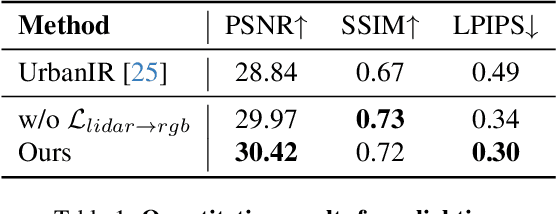
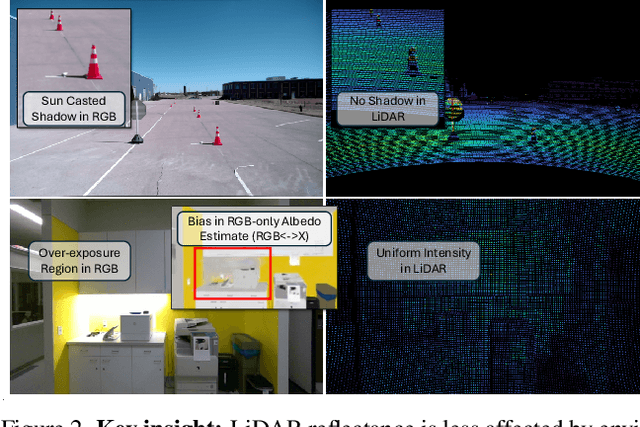
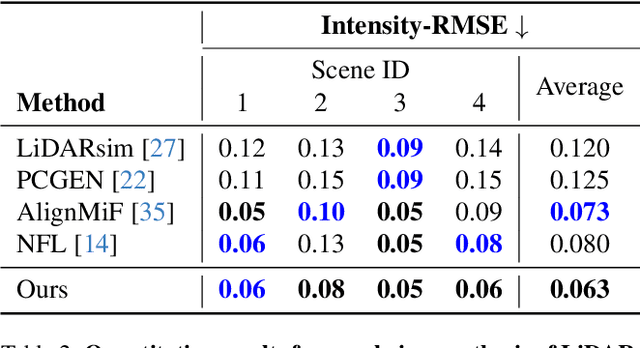
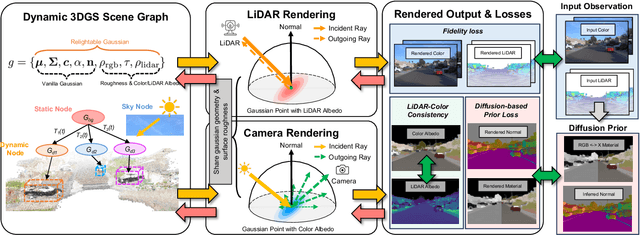
We present InvRGB+L, a novel inverse rendering model that reconstructs large, relightable, and dynamic scenes from a single RGB+LiDAR sequence. Conventional inverse graphics methods rely primarily on RGB observations and use LiDAR mainly for geometric information, often resulting in suboptimal material estimates due to visible light interference. We find that LiDAR's intensity values-captured with active illumination in a different spectral range-offer complementary cues for robust material estimation under variable lighting. Inspired by this, InvRGB+L leverages LiDAR intensity cues to overcome challenges inherent in RGB-centric inverse graphics through two key innovations: (1) a novel physics-based LiDAR shading model and (2) RGB-LiDAR material consistency losses. The model produces novel-view RGB and LiDAR renderings of urban and indoor scenes and supports relighting, night simulations, and dynamic object insertions, achieving results that surpass current state-of-the-art methods in both scene-level urban inverse rendering and LiDAR simulation.
AD-GS: Object-Aware B-Spline Gaussian Splatting for Self-Supervised Autonomous Driving
Jul 16, 2025Modeling and rendering dynamic urban driving scenes is crucial for self-driving simulation. Current high-quality methods typically rely on costly manual object tracklet annotations, while self-supervised approaches fail to capture dynamic object motions accurately and decompose scenes properly, resulting in rendering artifacts. We introduce AD-GS, a novel self-supervised framework for high-quality free-viewpoint rendering of driving scenes from a single log. At its core is a novel learnable motion model that integrates locality-aware B-spline curves with global-aware trigonometric functions, enabling flexible yet precise dynamic object modeling. Rather than requiring comprehensive semantic labeling, AD-GS automatically segments scenes into objects and background with the simplified pseudo 2D segmentation, representing objects using dynamic Gaussians and bidirectional temporal visibility masks. Further, our model incorporates visibility reasoning and physically rigid regularization to enhance robustness. Extensive evaluations demonstrate that our annotation-free model significantly outperforms current state-of-the-art annotation-free methods and is competitive with annotation-dependent approaches.
VoxelSplat: Dynamic Gaussian Splatting as an Effective Loss for Occupancy and Flow Prediction
Jun 05, 2025Recent advancements in camera-based occupancy prediction have focused on the simultaneous prediction of 3D semantics and scene flow, a task that presents significant challenges due to specific difficulties, e.g., occlusions and unbalanced dynamic environments. In this paper, we analyze these challenges and their underlying causes. To address them, we propose a novel regularization framework called VoxelSplat. This framework leverages recent developments in 3D Gaussian Splatting to enhance model performance in two key ways: (i) Enhanced Semantics Supervision through 2D Projection: During training, our method decodes sparse semantic 3D Gaussians from 3D representations and projects them onto the 2D camera view. This provides additional supervision signals in the camera-visible space, allowing 2D labels to improve the learning of 3D semantics. (ii) Scene Flow Learning: Our framework uses the predicted scene flow to model the motion of Gaussians, and is thus able to learn the scene flow of moving objects in a self-supervised manner using the labels of adjacent frames. Our method can be seamlessly integrated into various existing occupancy models, enhancing performance without increasing inference time. Extensive experiments on benchmark datasets demonstrate the effectiveness of VoxelSplat in improving the accuracy of both semantic occupancy and scene flow estimation. The project page and codes are available at https://zzy816.github.io/VoxelSplat-Demo/.