 Add to Chrome
 Add to Firefox
 Add to Edge
Is Value Learning Really the Main Bottleneck in Offline RL?
Jun 13, 2024
While imitation learning requires access to high-quality data, offline reinforcement learning (RL) should, in principle, perform similarly or better with substantially lower data quality by using a value function. However, current results indicate that offline RL often performs worse than imitation learning, and it is often unclear what holds back the performance of offline RL. Motivated by this observation, we aim to understand the bottlenecks in current offline RL algorithms. While poor performance of offline RL is typically attributed to an imperfect value function, we ask: is the main bottleneck of offline RL indeed in learning the value function, or something else? To answer this question, we perform a systematic empirical study of (1) value learning, (2) policy extraction, and (3) policy generalization in offline RL problems, analyzing how these components affect performance. We make two surprising observations. First, we find that the choice of a policy extraction algorithm significantly affects the performance and scalability of offline RL, often more so than the value learning objective. For instance, we show that common value-weighted behavioral cloning objectives (e.g., AWR) do not fully leverage the learned value function, and switching to behavior-constrained policy gradient objectives (e.g., DDPG+BC) often leads to substantial improvements in performance and scalability. Second, we find that a big barrier to improving offline RL performance is often imperfect policy generalization on test-time states out of the support of the training data, rather than policy learning on in-distribution states. We then show that the use of suboptimal but high-coverage data or test-time policy training techniques can address this generalization issue in practice. Specifically, we propose two simple test-time policy improvement methods and show that these methods lead to better performance.

Language Guided Skill Discovery
Jun 07, 2024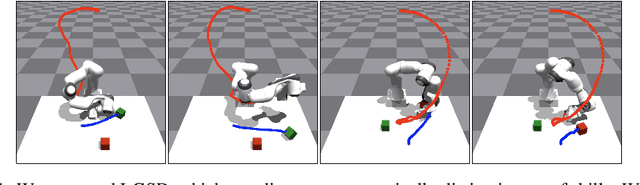
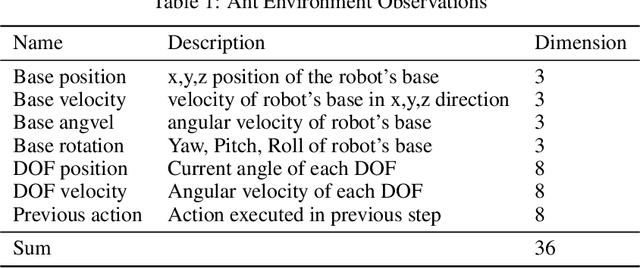
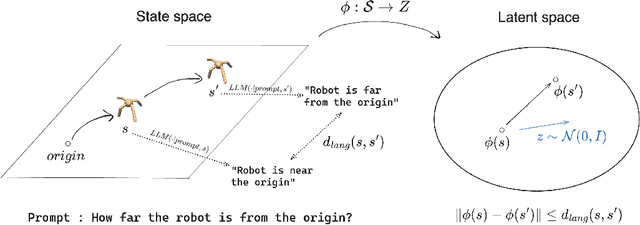
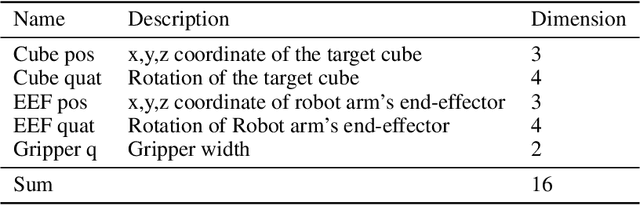
Skill discovery methods enable agents to learn diverse emergent behaviors without explicit rewards. To make learned skills useful for unknown downstream tasks, obtaining a semantically diverse repertoire of skills is essential. While some approaches introduce a discriminator to distinguish skills and others aim to increase state coverage, no existing work directly addresses the "semantic diversity" of skills. We hypothesize that leveraging the semantic knowledge of large language models (LLMs) can lead us to improve semantic diversity of resulting behaviors. In this sense, we introduce Language Guided Skill Discovery (LGSD), a skill discovery framework that aims to directly maximize the semantic diversity between skills. LGSD takes user prompts as input and outputs a set of semantically distinctive skills. The prompts serve as a means to constrain the search space into a semantically desired subspace, and the generated LLM outputs guide the agent to visit semantically diverse states within the subspace. We demonstrate that LGSD enables legged robots to visit different user-intended areas on a plane by simply changing the prompt. Furthermore, we show that language guidance aids in discovering more diverse skills compared to five existing skill discovery methods in robot-arm manipulation environments. Lastly, LGSD provides a simple way of utilizing learned skills via natural language.
Strategically Conservative Q-Learning
Jun 06, 2024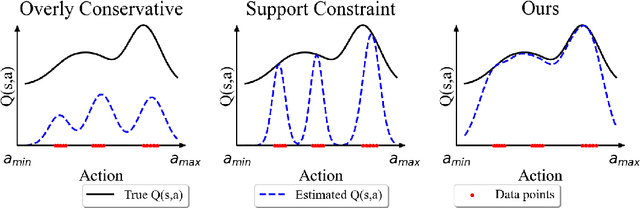
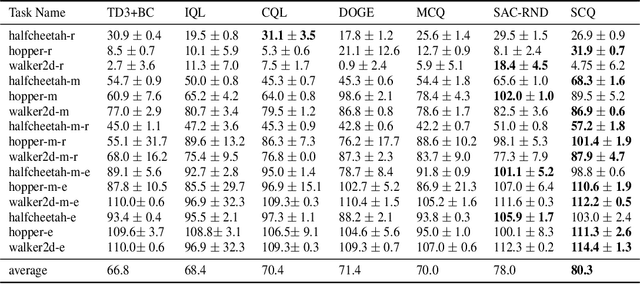
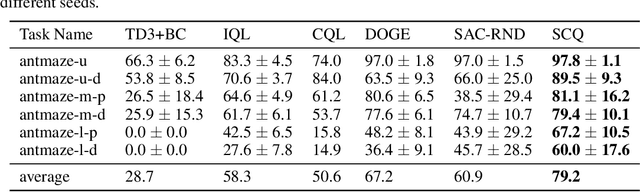
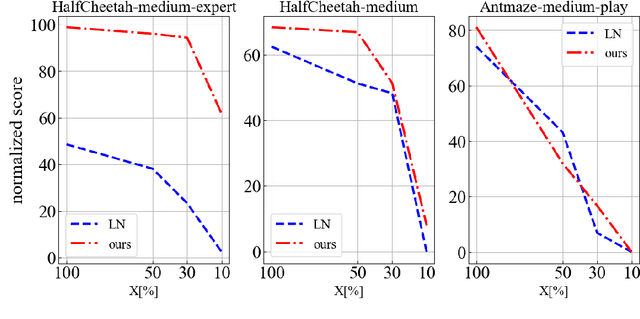
Offline reinforcement learning (RL) is a compelling paradigm to extend RL's practical utility by leveraging pre-collected, static datasets, thereby avoiding the limitations associated with collecting online interactions. The major difficulty in offline RL is mitigating the impact of approximation errors when encountering out-of-distribution (OOD) actions; doing so ineffectively will lead to policies that prefer OOD actions, which can lead to unexpected and potentially catastrophic results. Despite the variety of works proposed to address this issue, they tend to excessively suppress the value function in and around OOD regions, resulting in overly pessimistic value estimates. In this paper, we propose a novel framework called Strategically Conservative Q-Learning (SCQ) that distinguishes between OOD data that is easy and hard to estimate, ultimately resulting in less conservative value estimates. Our approach exploits the inherent strengths of neural networks to interpolate, while carefully navigating their limitations in extrapolation, to obtain pessimistic yet still property calibrated value estimates. Theoretical analysis also shows that the value function learned by SCQ is still conservative, but potentially much less so than that of Conservative Q-learning (CQL). Finally, extensive evaluation on the D4RL benchmark tasks shows our proposed method outperforms state-of-the-art methods. Our code is available through \url{https://github.com/purewater0901/SCQ}.
Bridging Model-Based Optimization and Generative Modeling via Conservative Fine-Tuning of Diffusion Models
May 31, 2024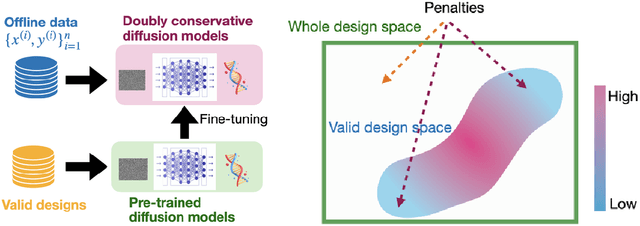


AI-driven design problems, such as DNA/protein sequence design, are commonly tackled from two angles: generative modeling, which efficiently captures the feasible design space (e.g., natural images or biological sequences), and model-based optimization, which utilizes reward models for extrapolation. To combine the strengths of both approaches, we adopt a hybrid method that fine-tunes cutting-edge diffusion models by optimizing reward models through RL. Although prior work has explored similar avenues, they primarily focus on scenarios where accurate reward models are accessible. In contrast, we concentrate on an offline setting where a reward model is unknown, and we must learn from static offline datasets, a common scenario in scientific domains. In offline scenarios, existing approaches tend to suffer from overoptimization, as they may be misled by the reward model in out-of-distribution regions. To address this, we introduce a conservative fine-tuning approach, BRAID, by optimizing a conservative reward model, which includes additional penalization outside of offline data distributions. Through empirical and theoretical analysis, we demonstrate the capability of our approach to outperform the best designs in offline data, leveraging the extrapolation capabilities of reward models while avoiding the generation of invalid designs through pre-trained diffusion models.
Octo: An Open-Source Generalist Robot Policy
May 20, 2024


Large policies pretrained on diverse robot datasets have the potential to transform robotic learning: instead of training new policies from scratch, such generalist robot policies may be finetuned with only a little in-domain data, yet generalize broadly. However, to be widely applicable across a range of robotic learning scenarios, environments, and tasks, such policies need to handle diverse sensors and action spaces, accommodate a variety of commonly used robotic platforms, and finetune readily and efficiently to new domains. In this work, we aim to lay the groundwork for developing open-source, widely applicable, generalist policies for robotic manipulation. As a first step, we introduce Octo, a large transformer-based policy trained on 800k trajectories from the Open X-Embodiment dataset, the largest robot manipulation dataset to date. It can be instructed via language commands or goal images and can be effectively finetuned to robot setups with new sensory inputs and action spaces within a few hours on standard consumer GPUs. In experiments across 9 robotic platforms, we demonstrate that Octo serves as a versatile policy initialization that can be effectively finetuned to new observation and action spaces. We also perform detailed ablations of design decisions for the Octo model, from architecture to training data, to guide future research on building generalist robot models.
Fine-Tuning Large Vision-Language Models as Decision-Making Agents via Reinforcement Learning
May 17, 2024


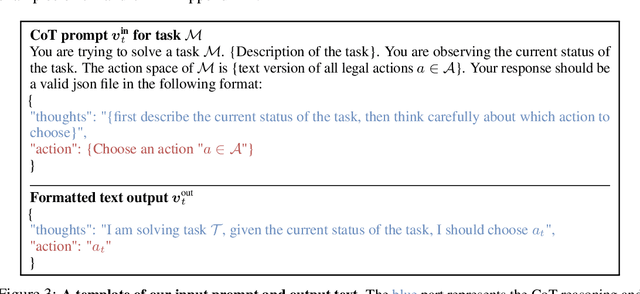
Large vision-language models (VLMs) fine-tuned on specialized visual instruction-following data have exhibited impressive language reasoning capabilities across various scenarios. However, this fine-tuning paradigm may not be able to efficiently learn optimal decision-making agents in multi-step goal-directed tasks from interactive environments. To address this challenge, we propose an algorithmic framework that fine-tunes VLMs with reinforcement learning (RL). Specifically, our framework provides a task description and then prompts the VLM to generate chain-of-thought (CoT) reasoning, enabling the VLM to efficiently explore intermediate reasoning steps that lead to the final text-based action. Next, the open-ended text output is parsed into an executable action to interact with the environment to obtain goal-directed task rewards. Finally, our framework uses these task rewards to fine-tune the entire VLM with RL. Empirically, we demonstrate that our proposed framework enhances the decision-making capabilities of VLM agents across various tasks, enabling 7b models to outperform commercial models such as GPT4-V or Gemini. Furthermore, we find that CoT reasoning is a crucial component for performance improvement, as removing the CoT reasoning results in a significant decrease in the overall performance of our method.
Evaluating Real-World Robot Manipulation Policies in Simulation
May 09, 2024


The field of robotics has made significant advances towards generalist robot manipulation policies. However, real-world evaluation of such policies is not scalable and faces reproducibility challenges, which are likely to worsen as policies broaden the spectrum of tasks they can perform. We identify control and visual disparities between real and simulated environments as key challenges for reliable simulated evaluation and propose approaches for mitigating these gaps without needing to craft full-fidelity digital twins of real-world environments. We then employ these approaches to create SIMPLER, a collection of simulated environments for manipulation policy evaluation on common real robot setups. Through paired sim-and-real evaluations of manipulation policies, we demonstrate strong correlation between policy performance in SIMPLER environments and in the real world. Additionally, we find that SIMPLER evaluations accurately reflect real-world policy behavior modes such as sensitivity to various distribution shifts. We open-source all SIMPLER environments along with our workflow for creating new environments at https://simpler-env.github.io to facilitate research on general-purpose manipulation policies and simulated evaluation frameworks.
RACER: Epistemic Risk-Sensitive RL Enables Fast Driving with Fewer Crashes
May 07, 2024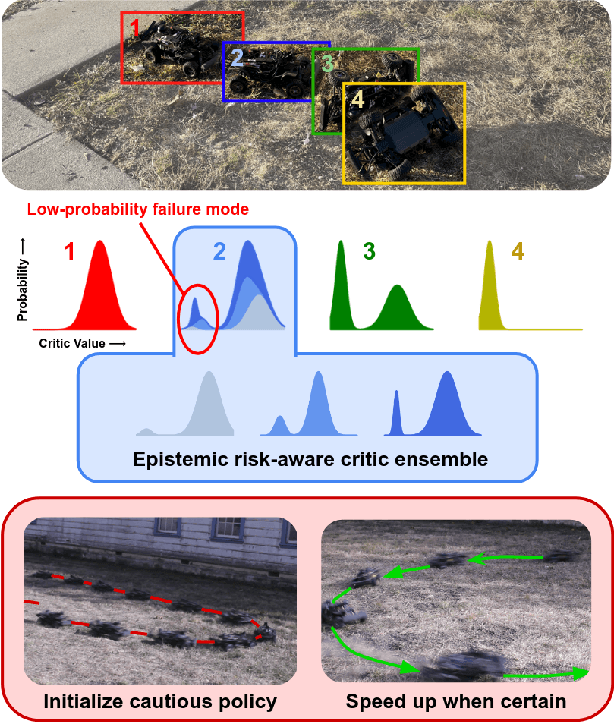
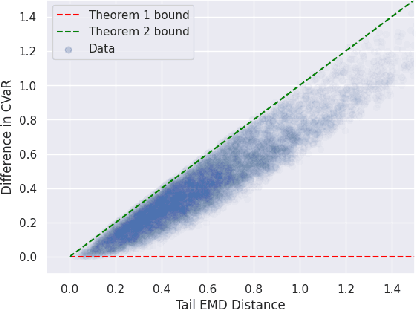
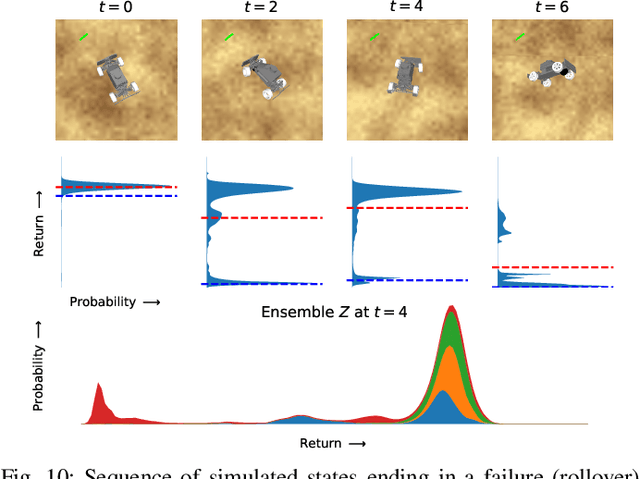
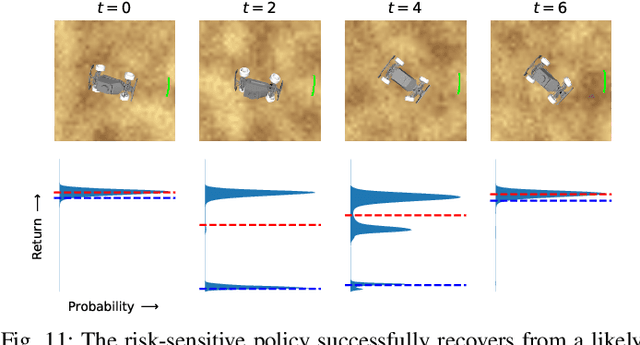
Reinforcement learning provides an appealing framework for robotic control due to its ability to learn expressive policies purely through real-world interaction. However, this requires addressing real-world constraints and avoiding catastrophic failures during training, which might severely impede both learning progress and the performance of the final policy. In many robotics settings, this amounts to avoiding certain "unsafe" states. The high-speed off-road driving task represents a particularly challenging instantiation of this problem: a high-return policy should drive as aggressively and as quickly as possible, which often requires getting close to the edge of the set of "safe" states, and therefore places a particular burden on the method to avoid frequent failures. To both learn highly performant policies and avoid excessive failures, we propose a reinforcement learning framework that combines risk-sensitive control with an adaptive action space curriculum. Furthermore, we show that our risk-sensitive objective automatically avoids out-of-distribution states when equipped with an estimator for epistemic uncertainty. We implement our algorithm on a small-scale rally car and show that it is capable of learning high-speed policies for a real-world off-road driving task. We show that our method greatly reduces the number of safety violations during the training process, and actually leads to higher-performance policies in both driving and non-driving simulation environments with similar challenges.
Learning Visuotactile Skills with Two Multifingered Hands
Apr 25, 2024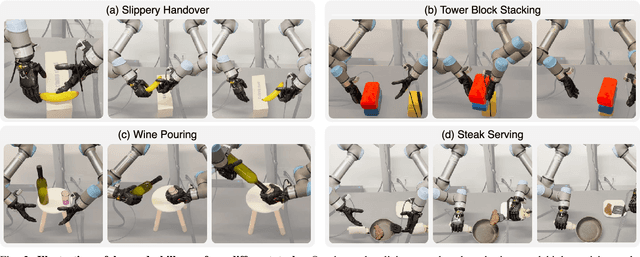
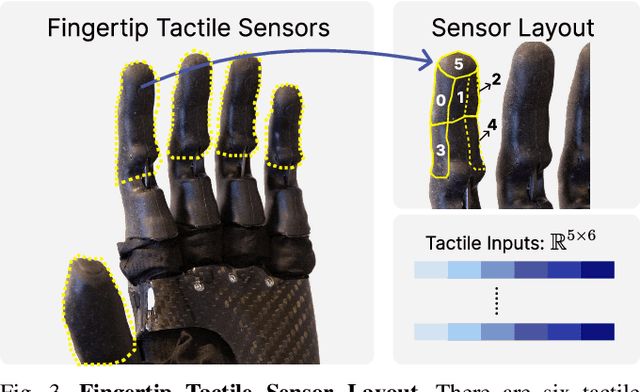
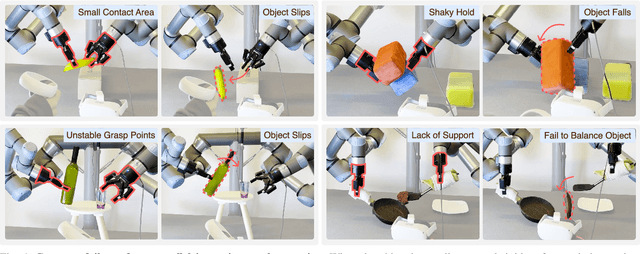
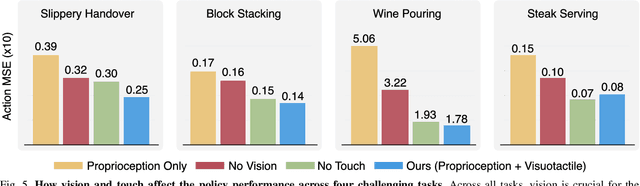
Aiming to replicate human-like dexterity, perceptual experiences, and motion patterns, we explore learning from human demonstrations using a bimanual system with multifingered hands and visuotactile data. Two significant challenges exist: the lack of an affordable and accessible teleoperation system suitable for a dual-arm setup with multifingered hands, and the scarcity of multifingered hand hardware equipped with touch sensing. To tackle the first challenge, we develop HATO, a low-cost hands-arms teleoperation system that leverages off-the-shelf electronics, complemented with a software suite that enables efficient data collection; the comprehensive software suite also supports multimodal data processing, scalable policy learning, and smooth policy deployment. To tackle the latter challenge, we introduce a novel hardware adaptation by repurposing two prosthetic hands equipped with touch sensors for research. Using visuotactile data collected from our system, we learn skills to complete long-horizon, high-precision tasks which are difficult to achieve without multifingered dexterity and touch feedback. Furthermore, we empirically investigate the effects of dataset size, sensing modality, and visual input preprocessing on policy learning. Our results mark a promising step forward in bimanual multifingered manipulation from visuotactile data. Videos, code, and datasets can be found at https://toruowo.github.io/hato/ .
Autonomous Evaluation and Refinement of Digital Agents
Apr 10, 2024We show that domain-general automatic evaluators can significantly improve the performance of agents for web navigation and device control. We experiment with multiple evaluation models that trade off between inference cost, modularity of design, and accuracy. We validate the performance of these models in several popular benchmarks for digital agents, finding between 74.4 and 92.9% agreement with oracle evaluation metrics. Finally, we use these evaluators to improve the performance of existing agents via fine-tuning and inference-time guidance. Without any additional supervision, we improve state-of-the-art performance by 29% on the popular benchmark WebArena, and achieve a 75% relative improvement in a challenging domain transfer scenario.