 Add to Chrome
 Add to Firefox
 Add to Edge
Discovering High-Quality Chess Puzzles with Offline Reinforcement Learning
Aug 14, 2026
Learning and skill mastery require extensive and deliberate practice. In many learning settings, producing high-quality pedagogical materials can require a high level of domain expertise and be very time-consuming. Pedagogical materials often need to train students to engage in different thinking patterns. In some domains, such as chess, puzzles are used to help students practice their skills in calculating the next moves and recognizing known patterns on a board. Giving students a practice set of puzzles to help them learn different modes of thinking is challenging because the teacher needs to carefully balance between different motifs and how many look-ahead steps a student needs to perform. Popular online platforms like Chess.com and Lichess offer players millions of puzzles. Unlike chess tactics puzzles procured by human experts, where chess beginners can learn valuable insights, these puzzles are automatically generated and often regarded as having low pedagogical value. These platforms also rely on a heuristic to recommend puzzles to users for practice. Using the user history data over an entire year, a total of 1.5 billion puzzle-solving histories, we learn the pedagogical value of a puzzle and how to automatically choose a set of puzzles to better support chess learners using insights from offline reinforcement learning. We show that using offline policy evaluation, our trained policy has significant impact on beginners with puzzle-solving Elo range of 100--1000, particularly for the group of beginners whose learning growth was stagnant. We also performed a qualitative analysis of the puzzles discovered by our model by collecting annotation ratings from expert chess players. The success of our pipeline shows promise for a future where we can understand the pedagogical values of practice items given general user interaction data.

One Frozen Simulator Is Not Enough: Simulator Collapse in Multi-Agent RL
Aug 12, 2026Multi-agent reinforcement learning for human-AI interaction typically relies on a single large language model to simulate user behavior. We show that this approach systematically fails to generalize, and trace the failure to simulator collapse: because the simulator LLM is mode-collapsed, an LLM policy trained against it overfits to narrow strategies that exploit the simulator's dominant mode, and such a policy transfers poorly to unseen simulators and real users. We formalize this collapse theoretically and propose two complementary solutions, one at inference time and one at training time. The inference-time solution, Verbalized Sampling, broadens the simulator's behavior by sampling from a verbalized response distribution, reducing mode collapse. The training-time solution, Co-Training, jointly optimizes the policy against a population of trainable simulators, preventing it from overfitting to any single simulator's mode. We validate both solutions on three multi-turn benchmarks: Persuasion for Good, $τ^2$-bench, and CooperBench. Verbalized Sampling improves held-out success by up to 9% over single-simulator RL, and Co-Training pushes gains further to 14%; the human study shows similar gain on real users. Both solutions preserve the policy diversity that collapses under single-simulator RL. To support further work in this direction, we release SCOPE, an open-source framework for Population Co-Training multi-agent RL. More broadly, our results suggest that the diversity of the training environment, not only the policy, is critical to the generalization of multi-turn RL to real-world deployment.
Simulating Human Memory with Language Models
May 25, 2026Language models are increasingly being deployed as user simulators, but their memory is far more reliable than that of real users. To measure this gap, we run a series of classic memory experiments from psychology on both humans and language models. Across tasks, we find that out-of-the-box language models exhibit better memory than humans, even when prompted to imitate human behavior. We then show that better prompting strategies and the use of a compactor can cause language models to forget content in a more human-like way. Using these methods, we show preliminary evidence that language models with human-like memory constraints can function as more effective user simulators in a downstream education task. Finally, we release human reference data and benchmarks to support future work on simulating human memory with language models.
Calibrate-Then-Act: Cost-Aware Exploration in LLM Agents
Feb 19, 2026LLMs are increasingly being used for complex problems which are not necessarily resolved in a single response, but require interacting with an environment to acquire information. In these scenarios, LLMs must reason about inherent cost-uncertainty tradeoffs in when to stop exploring and commit to an answer. For instance, on a programming task, an LLM should test a generated code snippet if it is uncertain about the correctness of that code; the cost of writing a test is nonzero, but typically lower than the cost of making a mistake. In this work, we show that we can induce LLMs to explicitly reason about balancing these cost-uncertainty tradeoffs, then perform more optimal environment exploration. We formalize multiple tasks, including information retrieval and coding, as sequential decision-making problems under uncertainty. Each problem has latent environment state that can be reasoned about via a prior which is passed to the LLM agent. We introduce a framework called Calibrate-Then-Act (CTA), where we feed the LLM this additional context to enable it to act more optimally. This improvement is preserved even under RL training of both the baseline and CTA. Our results on information-seeking QA and on a simplified coding task show that making cost-benefit tradeoffs explicit with CTA can help agents discover more optimal decision-making strategies.
Measuring General Intelligence with Generated Games
May 12, 2025We present gg-bench, a collection of game environments designed to evaluate general reasoning capabilities in language models. Unlike most static benchmarks, gg-bench is a data generating process where new evaluation instances can be generated at will. In particular, gg-bench is synthetically generated by (1) using a large language model (LLM) to generate natural language descriptions of novel games, (2) using the LLM to implement each game in code as a Gym environment, and (3) training reinforcement learning (RL) agents via self-play on the generated games. We evaluate language models by their winrate against these RL agents by prompting models with the game description, current board state, and a list of valid moves, after which models output the moves they wish to take. gg-bench is challenging: state-of-the-art LLMs such as GPT-4o and Claude 3.7 Sonnet achieve winrates of 7-9% on gg-bench using in-context learning, while reasoning models such as o1, o3-mini and DeepSeek-R1 achieve average winrates of 31-36%. We release the generated games, data generation process, and evaluation code in order to support future modeling work and expansion of our benchmark.
Efficacy of Language Model Self-Play in Non-Zero-Sum Games
Jun 27, 2024Game-playing agents like AlphaGo have achieved superhuman performance through self-play, which is theoretically guaranteed to yield optimal policies in competitive games. However, most language tasks are partially or fully cooperative, so it is an open question whether techniques like self-play can effectively be used to improve language models. We empirically investigate this question in a negotiation game setting known as Deal or No Deal (DoND). Crucially, the objective in DoND can be modified to produce a fully cooperative game, a strictly competitive one, or anything in between. We finetune language models in self-play over multiple rounds of filtered behavior cloning in DoND for each of these objectives. Contrary to expectations, we find that language model self-play leads to significant performance gains in both cooperation and competition with humans, suggesting that self-play and related techniques have promise despite a lack of theoretical guarantees.
Autonomous Evaluation and Refinement of Digital Agents
Apr 10, 2024We show that domain-general automatic evaluators can significantly improve the performance of agents for web navigation and device control. We experiment with multiple evaluation models that trade off between inference cost, modularity of design, and accuracy. We validate the performance of these models in several popular benchmarks for digital agents, finding between 74.4 and 92.9% agreement with oracle evaluation metrics. Finally, we use these evaluators to improve the performance of existing agents via fine-tuning and inference-time guidance. Without any additional supervision, we improve state-of-the-art performance by 29% on the popular benchmark WebArena, and achieve a 75% relative improvement in a challenging domain transfer scenario.
Decision-Oriented Dialogue for Human-AI Collaboration
Jun 01, 2023We describe a class of tasks called decision-oriented dialogues, in which AI assistants must collaborate with one or more humans via natural language to help them make complex decisions. We formalize three domains in which users face everyday decisions: (1) choosing an assignment of reviewers to conference papers, (2) planning a multi-step itinerary in a city, and (3) negotiating travel plans for a group of friends. In each of these settings, AI assistants and users have disparate abilities that they must combine to arrive at the best decision: assistants can access and process large amounts of information, while users have preferences and constraints external to the system. For each task, we build a dialogue environment where agents receive a reward based on the quality of the final decision they reach. Using these environments, we collect human-human dialogues with humans playing the role of assistant. To compare how current AI assistants communicate in these settings, we present baselines using large language models in self-play. Finally, we highlight a number of challenges models face in decision-oriented dialogues, ranging from efficient communication to reasoning and optimization, and release our environments as a testbed for future modeling work.
Ghostbuster: Detecting Text Ghostwritten by Large Language Models
May 24, 2023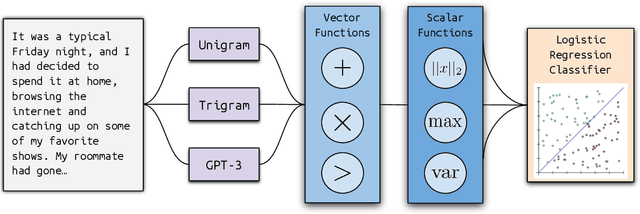
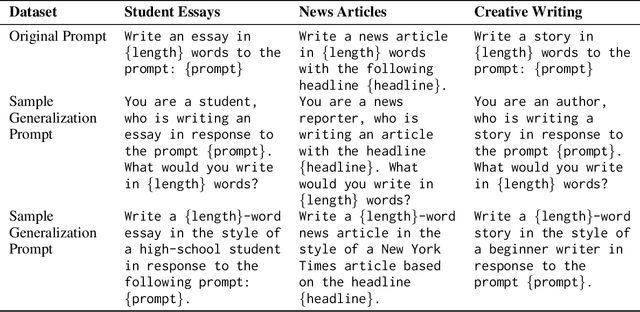
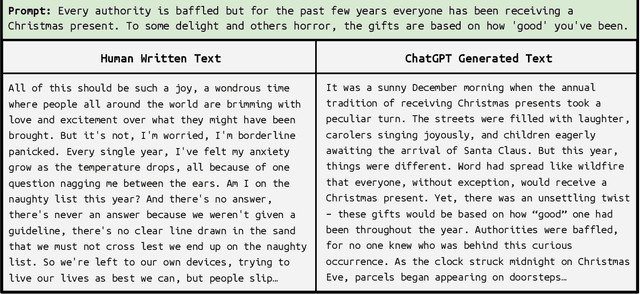
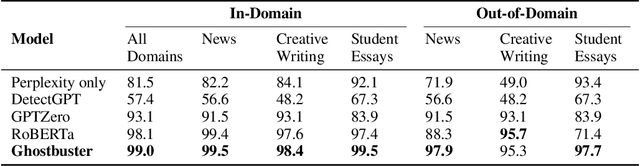
We introduce Ghostbuster, a state-of-the-art system for detecting AI-generated text. Our method works by passing documents through a series of weaker language models and running a structured search over possible combinations of their features, then training a classifier on the selected features to determine if the target document was AI-generated. Crucially, Ghostbuster does not require access to token probabilities from the target model, making it useful for detecting text generated by black-box models or unknown model versions. In conjunction with our model, we release three new datasets of human and AI-generated text as detection benchmarks that cover multiple domains (student essays, creative fiction, and news) and task setups: document-level detection, author identification, and a challenge task of paragraph-level detection. Ghostbuster averages 99.1 F1 across all three datasets on document-level detection, outperforming previous approaches such as GPTZero and DetectGPT by up to 32.7 F1.
Revisiting Entropy Rate Constancy in Text
May 20, 2023
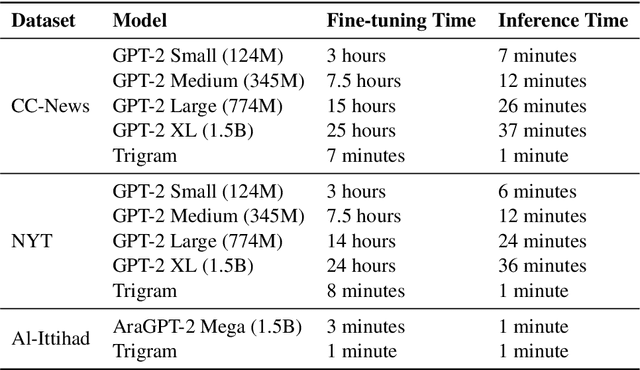
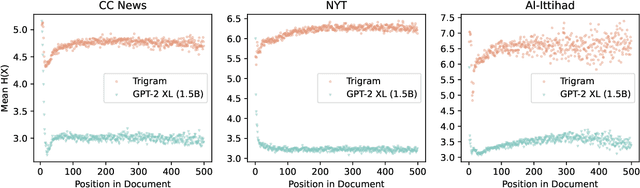
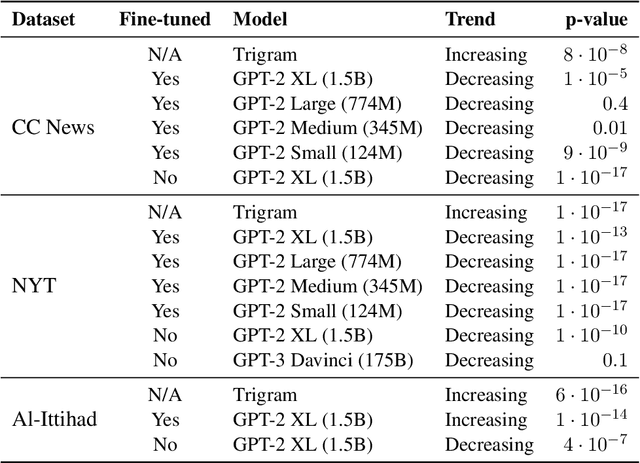
The uniform information density (UID) hypothesis states that humans tend to distribute information roughly evenly across an utterance or discourse. Early evidence in support of the UID hypothesis came from Genzel & Charniak (2002), which proposed an entropy rate constancy principle based on the probability of English text under n-gram language models. We re-evaluate the claims of Genzel & Charniak (2002) with neural language models, failing to find clear evidence in support of entropy rate constancy. We conduct a range of experiments across datasets, model sizes, and languages and discuss implications for the uniform information density hypothesis and linguistic theories of efficient communication more broadly.