 Add to Chrome
 Add to Firefox
 Add to Edge
Unlocking the Power of SAM 2 for Few-Shot Segmentation
May 21, 2025
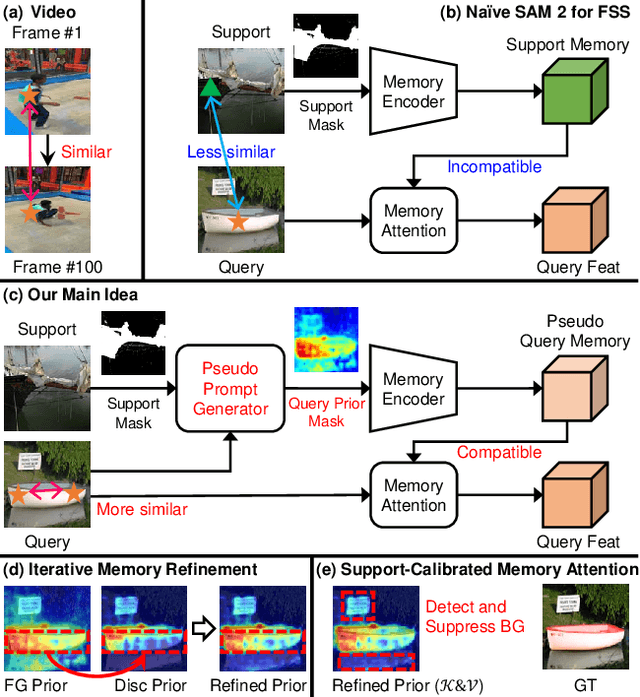
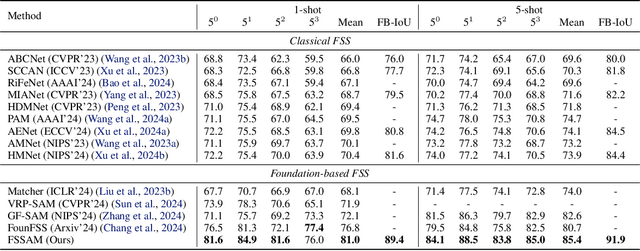
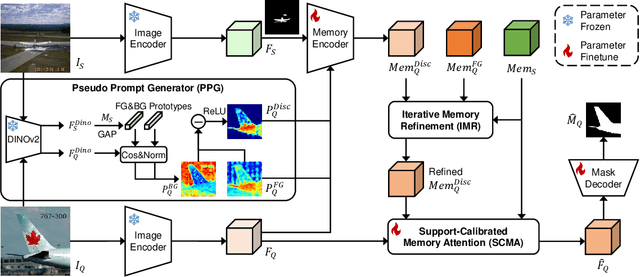
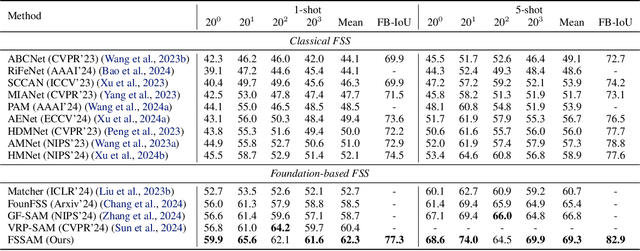
Few-Shot Segmentation (FSS) aims to learn class-agnostic segmentation on few classes to segment arbitrary classes, but at the risk of overfitting. To address this, some methods use the well-learned knowledge of foundation models (e.g., SAM) to simplify the learning process. Recently, SAM 2 has extended SAM by supporting video segmentation, whose class-agnostic matching ability is useful to FSS. A simple idea is to encode support foreground (FG) features as memory, with which query FG features are matched and fused. Unfortunately, the FG objects in different frames of SAM 2's video data are always the same identity, while those in FSS are different identities, i.e., the matching step is incompatible. Therefore, we design Pseudo Prompt Generator to encode pseudo query memory, matching with query features in a compatible way. However, the memories can never be as accurate as the real ones, i.e., they are likely to contain incomplete query FG, and some unexpected query background (BG) features, leading to wrong segmentation. Hence, we further design Iterative Memory Refinement to fuse more query FG features into the memory, and devise a Support-Calibrated Memory Attention to suppress the unexpected query BG features in memory. Extensive experiments have been conducted on PASCAL-5$^i$ and COCO-20$^i$ to validate the effectiveness of our design, e.g., the 1-shot mIoU can be 4.2% better than the best baseline.

Bronchovascular Tree-Guided Weakly Supervised Learning Method for Pulmonary Segment Segmentation
May 20, 2025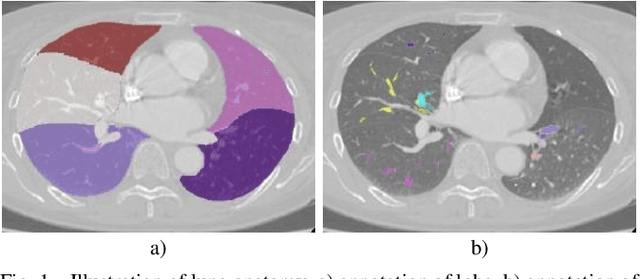
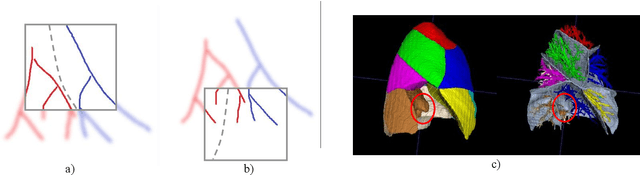
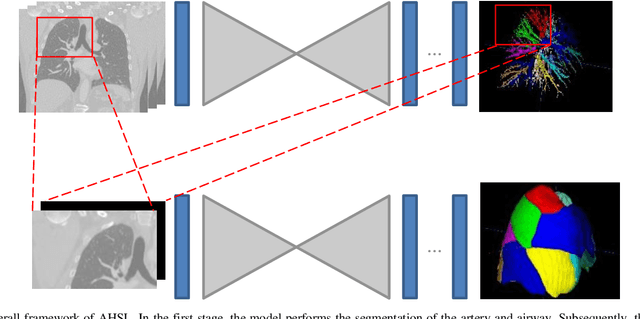
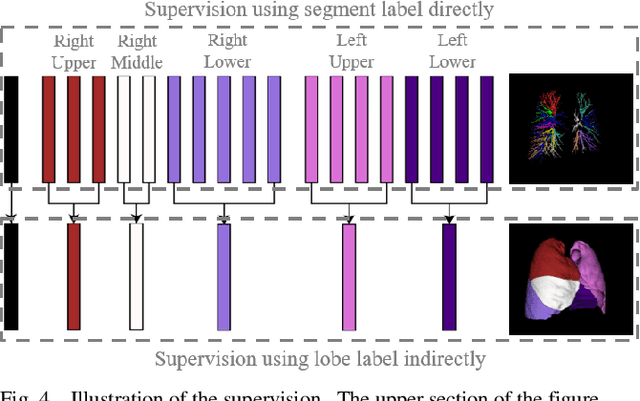
Pulmonary segment segmentation is crucial for cancer localization and surgical planning. However, the pixel-wise annotation of pulmonary segments is laborious, as the boundaries between segments are indistinguishable in medical images. To this end, we propose a weakly supervised learning (WSL) method, termed Anatomy-Hierarchy Supervised Learning (AHSL), which consults the precise clinical anatomical definition of pulmonary segments to perform pulmonary segment segmentation. Since pulmonary segments reside within the lobes and are determined by the bronchovascular tree, i.e., artery, airway and vein, the design of the loss function is founded on two principles. First, segment-level labels are utilized to directly supervise the output of the pulmonary segments, ensuring that they accurately encompass the appropriate bronchovascular tree. Second, lobe-level supervision indirectly oversees the pulmonary segment, ensuring their inclusion within the corresponding lobe. Besides, we introduce a two-stage segmentation strategy that incorporates bronchovascular priori information. Furthermore, a consistency loss is proposed to enhance the smoothness of segment boundaries, along with an evaluation metric designed to measure the smoothness of pulmonary segment boundaries. Visual inspection and evaluation metrics from experiments conducted on a private dataset demonstrate the effectiveness of our method.
Seed1.5-VL Technical Report
May 11, 2025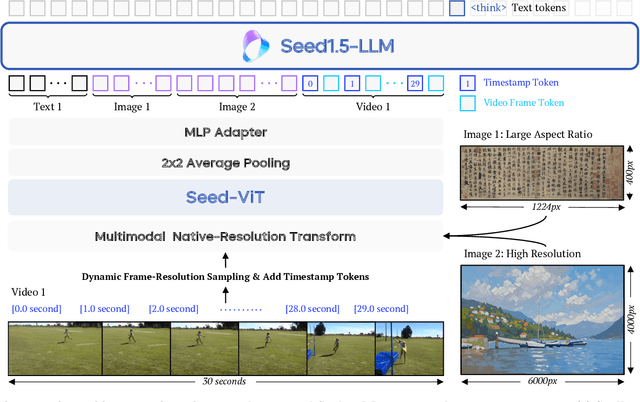

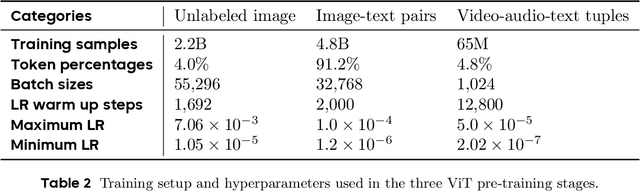
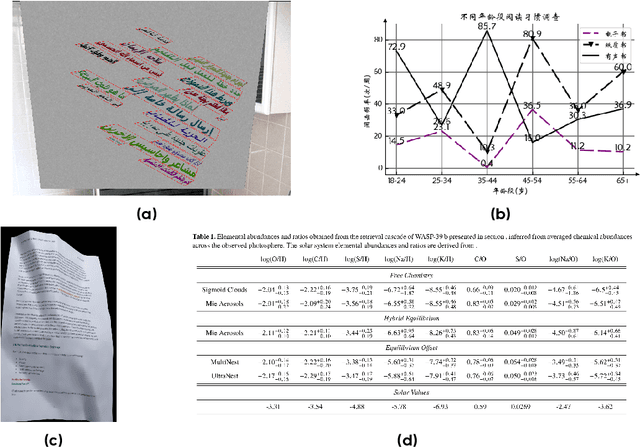
We present Seed1.5-VL, a vision-language foundation model designed to advance general-purpose multimodal understanding and reasoning. Seed1.5-VL is composed with a 532M-parameter vision encoder and a Mixture-of-Experts (MoE) LLM of 20B active parameters. Despite its relatively compact architecture, it delivers strong performance across a wide spectrum of public VLM benchmarks and internal evaluation suites, achieving the state-of-the-art performance on 38 out of 60 public benchmarks. Moreover, in agent-centric tasks such as GUI control and gameplay, Seed1.5-VL outperforms leading multimodal systems, including OpenAI CUA and Claude 3.7. Beyond visual and video understanding, it also demonstrates strong reasoning abilities, making it particularly effective for multimodal reasoning challenges such as visual puzzles. We believe these capabilities will empower broader applications across diverse tasks. In this report, we mainly provide a comprehensive review of our experiences in building Seed1.5-VL across model design, data construction, and training at various stages, hoping that this report can inspire further research. Seed1.5-VL is now accessible at https://www.volcengine.com/ (Volcano Engine Model ID: doubao-1-5-thinking-vision-pro-250428)
Towards Cross-Modality Modeling for Time Series Analytics: A Survey in the LLM Era
May 05, 2025The proliferation of edge devices has generated an unprecedented volume of time series data across different domains, motivating various well-customized methods. Recently, Large Language Models (LLMs) have emerged as a new paradigm for time series analytics by leveraging the shared sequential nature of textual data and time series. However, a fundamental cross-modality gap between time series and LLMs exists, as LLMs are pre-trained on textual corpora and are not inherently optimized for time series. Many recent proposals are designed to address this issue. In this survey, we provide an up-to-date overview of LLMs-based cross-modality modeling for time series analytics. We first introduce a taxonomy that classifies existing approaches into four groups based on the type of textual data employed for time series modeling. We then summarize key cross-modality strategies, e.g., alignment and fusion, and discuss their applications across a range of downstream tasks. Furthermore, we conduct experiments on multimodal datasets from different application domains to investigate effective combinations of textual data and cross-modality strategies for enhancing time series analytics. Finally, we suggest several promising directions for future research. This survey is designed for a range of professionals, researchers, and practitioners interested in LLM-based time series modeling.
Efficient Multivariate Time Series Forecasting via Calibrated Language Models with Privileged Knowledge Distillation
May 04, 2025Multivariate time series forecasting (MTSF) endeavors to predict future observations given historical data, playing a crucial role in time series data management systems. With advancements in large language models (LLMs), recent studies employ textual prompt tuning to infuse the knowledge of LLMs into MTSF. However, the deployment of LLMs often suffers from low efficiency during the inference phase. To address this problem, we introduce TimeKD, an efficient MTSF framework that leverages the calibrated language models and privileged knowledge distillation. TimeKD aims to generate high-quality future representations from the proposed cross-modality teacher model and cultivate an effective student model. The cross-modality teacher model adopts calibrated language models (CLMs) with ground truth prompts, motivated by the paradigm of Learning Under Privileged Information (LUPI). In addition, we design a subtractive cross attention (SCA) mechanism to refine these representations. To cultivate an effective student model, we propose an innovative privileged knowledge distillation (PKD) mechanism including correlation and feature distillation. PKD enables the student to replicate the teacher's behavior while minimizing their output discrepancy. Extensive experiments on real data offer insight into the effectiveness, efficiency, and scalability of the proposed TimeKD.
On the Suitability of Reinforcement Fine-Tuning to Visual Tasks
Apr 08, 2025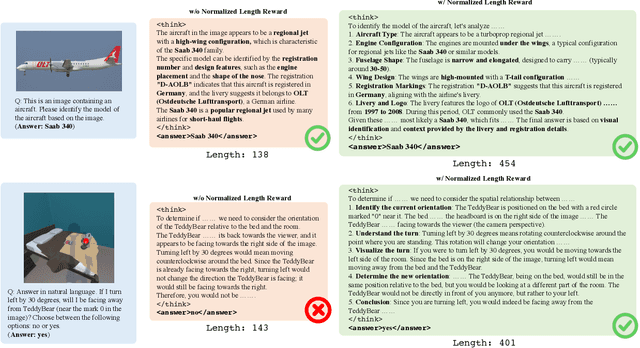
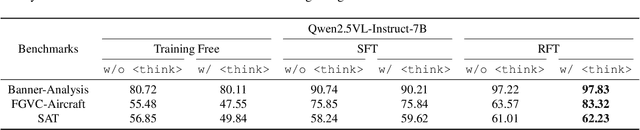
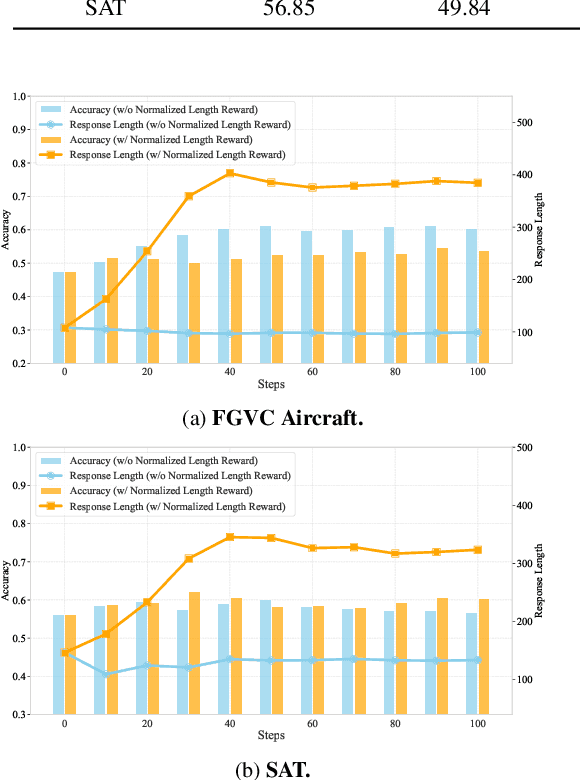
Reinforcement Fine-Tuning (RFT) is proved to be greatly valuable for enhancing the reasoning ability of LLMs. Researchers have been starting to apply RFT to MLLMs, hoping it will also enhance the capabilities of visual understanding. However, these works are at a very early stage and have not examined how suitable RFT actually is for visual tasks. In this work, we endeavor to understand the suitabilities and limitations of RFT for visual tasks, through experimental analysis and observations. We start by quantitative comparisons on various tasks, which shows RFT is generally better than SFT on visual tasks. %especially when the number of training samples are limited. To check whether such advantages are brought up by the reasoning process, we design a new reward that encourages the model to ``think'' more, whose results show more thinking can be beneficial for complicated tasks but harmful for simple tasks. We hope this study can provide more insight for the rapid advancements on this topic.
Re-Aligning Language to Visual Objects with an Agentic Workflow
Mar 30, 2025Language-based object detection (LOD) aims to align visual objects with language expressions. A large amount of paired data is utilized to improve LOD model generalizations. During the training process, recent studies leverage vision-language models (VLMs) to automatically generate human-like expressions for visual objects, facilitating training data scaling up. In this process, we observe that VLM hallucinations bring inaccurate object descriptions (e.g., object name, color, and shape) to deteriorate VL alignment quality. To reduce VLM hallucinations, we propose an agentic workflow controlled by an LLM to re-align language to visual objects via adaptively adjusting image and text prompts. We name this workflow Real-LOD, which includes planning, tool use, and reflection steps. Given an image with detected objects and VLM raw language expressions, Real-LOD reasons its state automatically and arranges action based on our neural symbolic designs (i.e., planning). The action will adaptively adjust the image and text prompts and send them to VLMs for object re-description (i.e., tool use). Then, we use another LLM to analyze these refined expressions for feedback (i.e., reflection). These steps are conducted in a cyclic form to gradually improve language descriptions for re-aligning to visual objects. We construct a dataset that contains a tiny amount of 0.18M images with re-aligned language expression and train a prevalent LOD model to surpass existing LOD methods by around 50% on the standard benchmarks. Our Real-LOD workflow, with automatic VL refinement, reveals a potential to preserve data quality along with scaling up data quantity, which further improves LOD performance from a data-alignment perspective.
Zero-Shot Human-Object Interaction Synthesis with Multimodal Priors
Mar 25, 2025Human-object interaction (HOI) synthesis is important for various applications, ranging from virtual reality to robotics. However, acquiring 3D HOI data is challenging due to its complexity and high cost, limiting existing methods to the narrow diversity of object types and interaction patterns in training datasets. This paper proposes a novel zero-shot HOI synthesis framework without relying on end-to-end training on currently limited 3D HOI datasets. The core idea of our method lies in leveraging extensive HOI knowledge from pre-trained Multimodal Models. Given a text description, our system first obtains temporally consistent 2D HOI image sequences using image or video generation models, which are then uplifted to 3D HOI milestones of human and object poses. We employ pre-trained human pose estimation models to extract human poses and introduce a generalizable category-level 6-DoF estimation method to obtain the object poses from 2D HOI images. Our estimation method is adaptive to various object templates obtained from text-to-3D models or online retrieval. A physics-based tracking of the 3D HOI kinematic milestone is further applied to refine both body motions and object poses, yielding more physically plausible HOI generation results. The experimental results demonstrate that our method is capable of generating open-vocabulary HOIs with physical realism and semantic diversity.
GoT: Unleashing Reasoning Capability of Multimodal Large Language Model for Visual Generation and Editing
Mar 13, 2025Current image generation and editing methods primarily process textual prompts as direct inputs without reasoning about visual composition and explicit operations. We present Generation Chain-of-Thought (GoT), a novel paradigm that enables generation and editing through an explicit language reasoning process before outputting images. This approach transforms conventional text-to-image generation and editing into a reasoning-guided framework that analyzes semantic relationships and spatial arrangements. We define the formulation of GoT and construct large-scale GoT datasets containing over 9M samples with detailed reasoning chains capturing semantic-spatial relationships. To leverage the advantages of GoT, we implement a unified framework that integrates Qwen2.5-VL for reasoning chain generation with an end-to-end diffusion model enhanced by our novel Semantic-Spatial Guidance Module. Experiments show our GoT framework achieves excellent performance on both generation and editing tasks, with significant improvements over baselines. Additionally, our approach enables interactive visual generation, allowing users to explicitly modify reasoning steps for precise image adjustments. GoT pioneers a new direction for reasoning-driven visual generation and editing, producing images that better align with human intent. To facilitate future research, we make our datasets, code, and pretrained models publicly available at https://github.com/rongyaofang/GoT.
Motion Anything: Any to Motion Generation
Mar 10, 2025Conditional motion generation has been extensively studied in computer vision, yet two critical challenges remain. First, while masked autoregressive methods have recently outperformed diffusion-based approaches, existing masking models lack a mechanism to prioritize dynamic frames and body parts based on given conditions. Second, existing methods for different conditioning modalities often fail to integrate multiple modalities effectively, limiting control and coherence in generated motion. To address these challenges, we propose Motion Anything, a multimodal motion generation framework that introduces an Attention-based Mask Modeling approach, enabling fine-grained spatial and temporal control over key frames and actions. Our model adaptively encodes multimodal conditions, including text and music, improving controllability. Additionally, we introduce Text-Motion-Dance (TMD), a new motion dataset consisting of 2,153 pairs of text, music, and dance, making it twice the size of AIST++, thereby filling a critical gap in the community. Extensive experiments demonstrate that Motion Anything surpasses state-of-the-art methods across multiple benchmarks, achieving a 15% improvement in FID on HumanML3D and showing consistent performance gains on AIST++ and TMD. See our project website https://steve-zeyu-zhang.github.io/MotionAnything