 Add to Chrome
 Add to Firefox
 Add to Edge
PAMT: Process-Aligned Reinforcement Learning for Multi-Domain Machine Translation
Aug 04, 2026
Multi-domain machine translation (MDMT) requires more than fluent generation: it demands domain-sensitive translation decisions such as domain disambiguation, terminology control, and stylistic adaptation. Large reasoning models (LRMs) make such decisions explicit through intermediate translation steps, but our analysis across 15 domains and four translation directions shows that this explicit reasoning is double-edged: it improves long-form and high-difficulty translation, yet often drifts in terminology-intensive and stylistically constrained settings. We trace this failure to a credit-assignment bottleneck: existing methods optimize final outputs or coarse trajectories, but cannot identify which translation steps actually help the final translation. To address this, we propose PAMT, a process-aligned training framework that combines cold-start domain-aware Long-CoT supervision with reinforcement learning. PAMT uses sequence-level format and outcome rewards for the final translation, together with a step-level process reward that measures how much each explicit translation step increases the likelihood of the reference translation. Across two backbones, PAMT improves over base models, outperforms MT-specialized baselines on average, and remains competitive with strong LLMs/LRMs across in-domain, OOD, and multilingual settings.

Don't Peek at the Answer: Outcome-Masked Group Relative Policy Optimization for Label-Free RLVR
Aug 04, 2026Reinforcement Learning with Verifiable Rewards (RLVR) improves LLM reasoning but typically relies on ground-truth (GT) answers, limiting scalability. Voting-based label-free RLVR replace gold supervision with answer-level consensus from model samples. However, collapse arises when the same answer-level signal is used both to estimate rewards and to drive token-level policy optimization, encouraging the model to directly reinforce answer tokens rather than improve reasoning. We propose OM-GRPO, a label-free RLVR framework that decouples reward estimation from policy optimization. OM-GRPO masks gradients on the answer span while retaining answer-level rewards through a soft consensus signal, shifting optimization pressure away from answer tokens. We further introduce Contrast-Augmented Reward, which refines reward estimation via low-cost pairwise comparisons over existing trajectories without additional rollouts. Across diverse reasoning benchmarks and three LLM backbones, OM-GRPO consistently outperforms existing label-free RLVR methods and matches supervised GT-reward training with stable optimization. This stability is particularly beneficial in the Test-Time Training setting, where OM-GRPO surpasses majority voting by 4.24 points.
Translation with Thought: Difficulty-Adaptive Reasoning via Reinforcement Learning for Multi-Domain Machine Translation
Jul 31, 2026Multi-domain machine translation (MDMT) poses a unique challenge due to varying levels of linguistic complexity across domains. Inspired by human translators' ability to adapt reasoning effort based on difficulty, we propose TwT (Translation with Thought), a resource-rational framework that learns to modulate inference between intuitive and deliberate reasoning. TwT is trained in two stages: (1) supervised fine-tuning on difficulty-aware long chain-of-thought traces distilled from DeepSeek-R1 and rewritten by GPT-4o to reflect human-like reasoning economy, and (2) reinforcement learning with a hybrid reward to optimize translation quality and reasoning efficiency. Evaluated on 15 benchmarks spanning in-domain and out-of-domain settings, as well as 3 seen and 59 unseen languages, with ablations across three backbone models, TwT-7B and TwT-14B outperform much larger SOTA reasoning models in translation quality, while reducing token usage by 32--60\%. These results confirm that aligning translation behavior with cognitive principles enables robust generalization, high translation quality, and efficient reasoning in MDMT.
JURY-RL: Votes Propose, Proofs Dispose for Label-Free RLVR
Apr 28, 2026Reinforcement learning with verifiable rewards (RLVR) enhances the reasoning of large language models (LLMs), but standard RLVR often depends on human-annotated answers or carefully curated reward specifications. In machine-checkable domains, label-free alternatives such as majority voting or LLM-as-a-judge remove annotation cost but can introduce false positives that destabilize training. We introduce JURY-RL, a label-free RLVR framework that decouples answer proposal from reward disposal: votes from model rollouts propose a candidate answer, and a formal verifier determines whether that candidate can receive positive reward. Concretely, only rollouts matching the plurality-voted answer are rewarded when that answer is successfully verified in Lean. When verification is inconclusive, we invoke ResZero (Residual-Zero), a fallback reward that discards the unverified plurality proposal and redistributes a zero-mean, variance-preserving signal over the residual answers. This design maintains a stable optimization gradient without reinforcing unverifiable consensus. Across three backbone models trained on mathematical data, JURY-RL consistently outperforms other label-free baselines on mathematical reasoning benchmarks and transfers competitively to code generation and general benchmarks. It attains pass@1 performance comparable to supervised ground-truth training, with superior generalization demonstrated by higher pass@k and response diversity.
UMEM: Unified Memory Extraction and Management Framework for Generalizable Memory
Feb 11, 2026Self-evolving memory serves as the trainable parameters for Large Language Models (LLMs)-based agents, where extraction (distilling insights from experience) and management (updating the memory bank) must be tightly coordinated. Existing methods predominately optimize memory management while treating memory extraction as a static process, resulting in poor generalization, where agents accumulate instance-specific noise rather than robust memories. To address this, we propose Unified Memory Extraction and Management (UMEM), a self-evolving agent framework that jointly optimizes a Large Language Model to simultaneous extract and manage memories. To mitigate overfitting to specific instances, we introduce Semantic Neighborhood Modeling and optimize the model with a neighborhood-level marginal utility reward via GRPO. This approach ensures memory generalizability by evaluating memory utility across clusters of semantically related queries. Extensive experiments across five benchmarks demonstrate that UMEM significantly outperforms highly competitive baselines, achieving up to a 10.67% improvement in multi-turn interactive tasks. Futhermore, UMEM maintains a monotonic growth curve during continuous evolution. Codes and models will be publicly released.
From Data-Centric to Sample-Centric: Enhancing LLM Reasoning via Progressive Optimization
Jul 09, 2025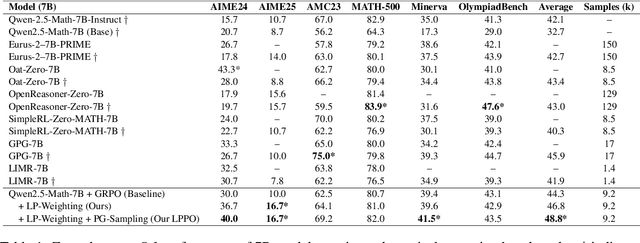
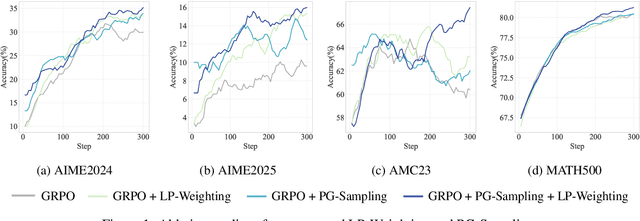
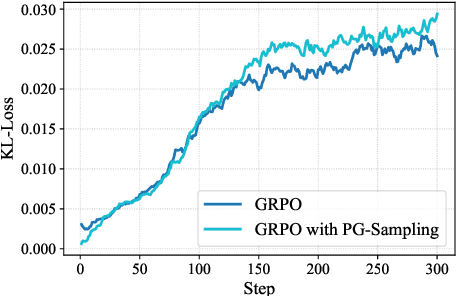
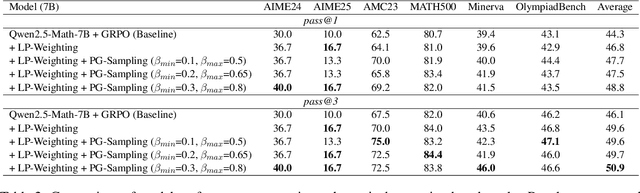
Reinforcement learning with verifiable rewards (RLVR) has recently advanced the reasoning capabilities of large language models (LLMs). While prior work has emphasized algorithmic design, data curation, and reward shaping, we investigate RLVR from a sample-centric perspective and introduce LPPO (Learning-Progress and Prefix-guided Optimization), a framework of progressive optimization techniques. Our work addresses a critical question: how to best leverage a small set of trusted, high-quality demonstrations, rather than simply scaling up data volume. First, motivated by how hints aid human problem-solving, we propose prefix-guided sampling, an online data augmentation method that incorporates partial solution prefixes from expert demonstrations to guide the policy, particularly for challenging instances. Second, inspired by how humans focus on important questions aligned with their current capabilities, we introduce learning-progress weighting, a dynamic strategy that adjusts each training sample's influence based on model progression. We estimate sample-level learning progress via an exponential moving average of per-sample pass rates, promoting samples that foster learning and de-emphasizing stagnant ones. Experiments on mathematical-reasoning benchmarks demonstrate that our methods outperform strong baselines, yielding faster convergence and a higher performance ceiling.
How Well Do Large Reasoning Models Translate? A Comprehensive Evaluation for Multi-Domain Machine Translation
May 26, 2025Large language models (LLMs) have demonstrated strong performance in general-purpose machine translation, but their effectiveness in complex, domain-sensitive translation tasks remains underexplored. Recent advancements in Large Reasoning Models (LRMs), raise the question of whether structured reasoning can enhance translation quality across diverse domains. In this work, we compare the performance of LRMs with traditional LLMs across 15 representative domains and four translation directions. Our evaluation considers various factors, including task difficulty, input length, and terminology density. We use a combination of automatic metrics and an enhanced MQM-based evaluation hierarchy to assess translation quality. Our findings show that LRMs consistently outperform traditional LLMs in semantically complex domains, especially in long-text and high-difficulty translation scenarios. Moreover, domain-adaptive prompting strategies further improve performance by better leveraging the reasoning capabilities of LRMs. These results highlight the potential of structured reasoning in MDMT tasks and provide valuable insights for optimizing translation systems in domain-sensitive contexts.
Efficient and Adaptive Simultaneous Speech Translation with Fully Unidirectional Architecture
Apr 16, 2025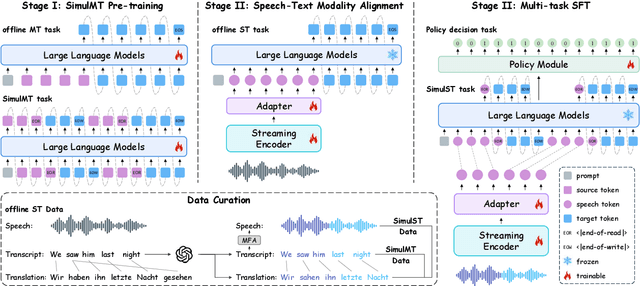
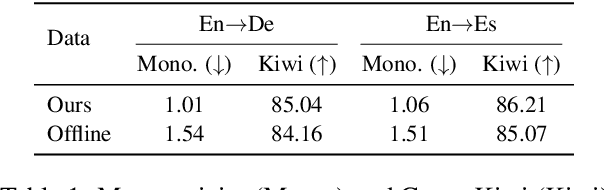
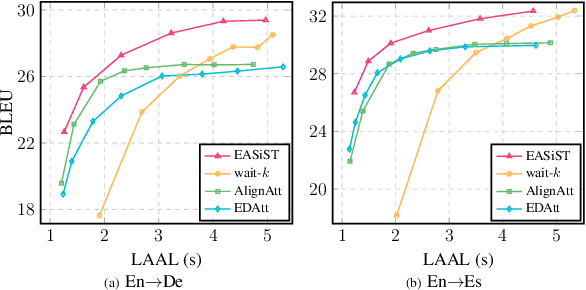
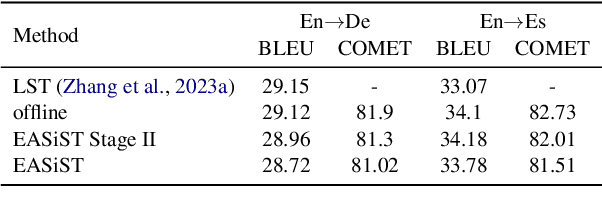
Simultaneous speech translation (SimulST) produces translations incrementally while processing partial speech input. Although large language models (LLMs) have showcased strong capabilities in offline translation tasks, applying them to SimulST poses notable challenges. Existing LLM-based SimulST approaches either incur significant computational overhead due to repeated encoding of bidirectional speech encoder, or they depend on a fixed read/write policy, limiting the efficiency and performance. In this work, we introduce Efficient and Adaptive Simultaneous Speech Translation (EASiST) with fully unidirectional architecture, including both speech encoder and LLM. EASiST includes a multi-latency data curation strategy to generate semantically aligned SimulST training samples and redefines SimulST as an interleaved generation task with explicit read/write tokens. To facilitate adaptive inference, we incorporate a lightweight policy head that dynamically predicts read/write actions. Additionally, we employ a multi-stage training strategy to align speech-text modalities and optimize both translation and policy behavior. Experiments on the MuST-C En$\rightarrow$De and En$\rightarrow$Es datasets demonstrate that EASiST offers superior latency-quality trade-offs compared to several strong baselines.
LLMs Can Achieve High-quality Simultaneous Machine Translation as Efficiently as Offline
Apr 13, 2025
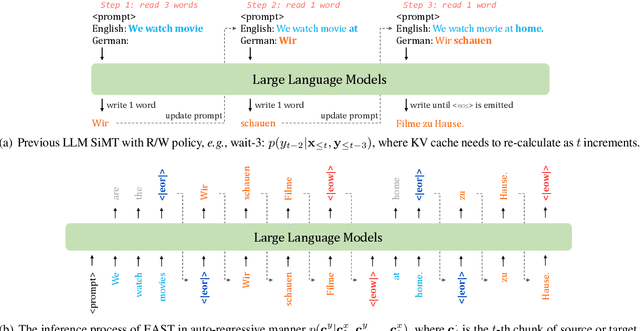


When the complete source sentence is provided, Large Language Models (LLMs) perform excellently in offline machine translation even with a simple prompt "Translate the following sentence from [src lang] into [tgt lang]:". However, in many real scenarios, the source tokens arrive in a streaming manner and simultaneous machine translation (SiMT) is required, then the efficiency and performance of decoder-only LLMs are significantly limited by their auto-regressive nature. To enable LLMs to achieve high-quality SiMT as efficiently as offline translation, we propose a novel paradigm that includes constructing supervised fine-tuning (SFT) data for SiMT, along with new training and inference strategies. To replicate the token input/output stream in SiMT, the source and target tokens are rearranged into an interleaved sequence, separated by special tokens according to varying latency requirements. This enables powerful LLMs to learn read and write operations adaptively, based on varying latency prompts, while still maintaining efficient auto-regressive decoding. Experimental results show that, even with limited SFT data, our approach achieves state-of-the-art performance across various SiMT benchmarks, and preserves the original abilities of offline translation. Moreover, our approach generalizes well to document-level SiMT setting without requiring specific fine-tuning, even beyond the offline translation model.
Conditional Variational Autoencoder for Sign Language Translation with Cross-Modal Alignment
Dec 25, 2023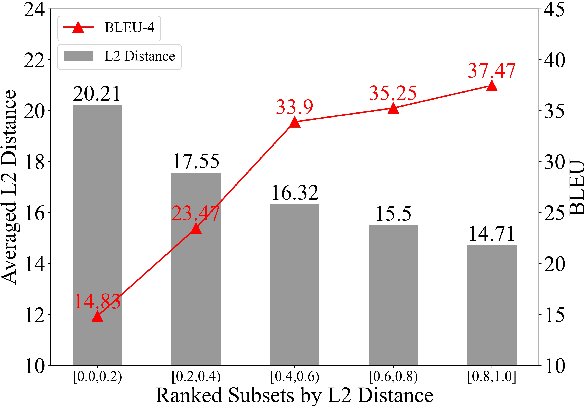


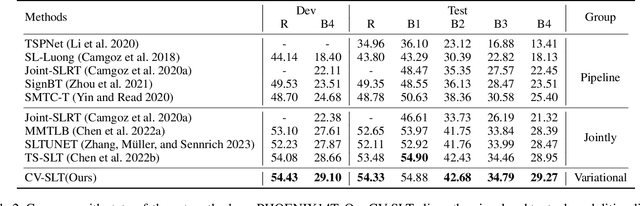
Sign language translation (SLT) aims to convert continuous sign language videos into textual sentences. As a typical multi-modal task, there exists an inherent modality gap between sign language videos and spoken language text, which makes the cross-modal alignment between visual and textual modalities crucial. However, previous studies tend to rely on an intermediate sign gloss representation to help alleviate the cross-modal problem thereby neglecting the alignment across modalities that may lead to compromised results. To address this issue, we propose a novel framework based on Conditional Variational autoencoder for SLT (CV-SLT) that facilitates direct and sufficient cross-modal alignment between sign language videos and spoken language text. Specifically, our CV-SLT consists of two paths with two Kullback-Leibler (KL) divergences to regularize the outputs of the encoder and decoder, respectively. In the prior path, the model solely relies on visual information to predict the target text; whereas in the posterior path, it simultaneously encodes visual information and textual knowledge to reconstruct the target text. The first KL divergence optimizes the conditional variational autoencoder and regularizes the encoder outputs, while the second KL divergence performs a self-distillation from the posterior path to the prior path, ensuring the consistency of decoder outputs. We further enhance the integration of textual information to the posterior path by employing a shared Attention Residual Gaussian Distribution (ARGD), which considers the textual information in the posterior path as a residual component relative to the prior path. Extensive experiments conducted on public datasets (PHOENIX14T and CSL-daily) demonstrate the effectiveness of our framework, achieving new state-of-the-art results while significantly alleviating the cross-modal representation discrepancy.