 Add to Chrome
 Add to Firefox
 Add to Edge
OmniMapBench: Benchmarking Visual-Centric Reasoning on Diverse Map Documents
Jul 10, 2026
Recent advancements in LVLMs necessitate robust benchmarks for complex, visually grounded reasoning. A critical limitation is identified in many document understanding benchmarks: visual content is often reducible to text, enabling high performance without genuine visual grounding. To address this limitation, OmniMapBench is introduced to foster visual-centric reasoning for map documents. The benchmark comprises 2,096 manually annotated question-answer pairs across 1,603 map documents from nine categories. It is designed to probe a hierarchy of skills, ranging from perception to multi-step visual reasoning. To quantify benchmark properties, a simple yet effective benchmark-level metric is proposed: the Visual Dependency Index (VDI), defined as the accuracy drop when images are replaced with question-agnostic descriptions. OmniMapBench exhibits higher VDI than established benchmarks, which quantitatively validates its focus on irreducible visual reasoning. Comprehensive evaluations of 25 leading LVLMs are conducted on OmniMapBench. A significant performance gap is observed, with the top-performing model achieving only 75.03\% accuracy. This result underscores the challenges posed by OmniMapBench to current LVLMs. This work aims to catalyze progress in visual-centric reasoning for document understanding of LVLMs. The dataset and code are publicly available at https://github.com/SIGMME/OmniMapBench.

From swept contact to pose: Probe-aware registration via complementary-shape docking
May 20, 2026Accurate registration between a prior model and the real scene is essential for high-precision robotic manipulation, yet optical methods suffer from long calibration chains, line-of-sight constraints, and fabrication errors. We propose a calibration-free alternative that reformulates contact registration as complementary-shape docking between the object and the probe's swept volume, explicitly accounting for probe geometry and leveraging both contact and non-contact evidence. Our solver integrates a global-to-local search via 3D FFT correlation over low-discrepancy SO(3) samples, then followed by continuous SE(3) refinement using Lie-algebra updates and analytic contact sensitivities. This pipeline yields efficient exploration and metric-grade convergence without fragile point correspondences. Simulation across free-form meshes achieved sub-0.04 mm and sub-0.4° accuracy and robustness to pose noise and contact loss. On a tooth-preparation robot, our method attained 0.42 mm and 3.75°, outperforming an optical tracker registration while requiring no external sensors. These results demonstrate a practical and precise registration strategy for surgical and industrial robots.
Bridging Formal Language with Chain-of-Thought Reasoning to Geometry Problem Solving
Aug 12, 2025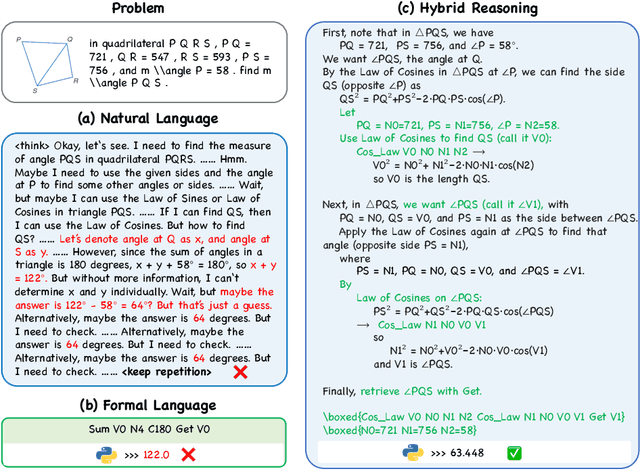
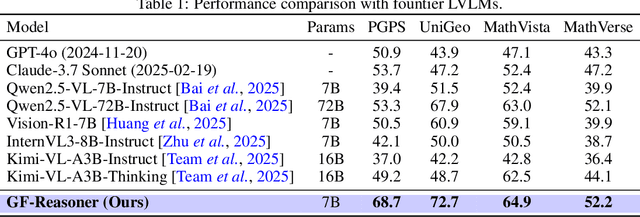
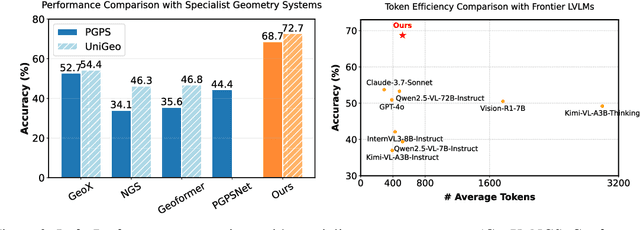
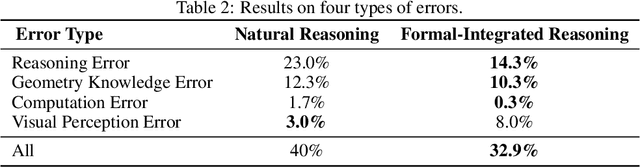
Large vision language models exhibit notable limitations on Geometry Problem Solving (GPS) because of their unreliable diagram interpretation and pure natural-language reasoning. A recent line of work mitigates this by using symbolic solvers: the model directly generates a formal program that a geometry solver can execute. However, this direct program generation lacks intermediate reasoning, making the decision process opaque and prone to errors. In this work, we explore a new approach that integrates Chain-of-Thought (CoT) with formal language. The model interleaves natural language reasoning with incremental emission of solver-executable code, producing a hybrid reasoning trace in which critical derivations are expressed in formal language. To teach this behavior at scale, we combine (1) supervised fine-tuning on an 11K newly developed synthetic dataset with interleaved natural language reasoning and automatic formalization, and (2) solver-in-the-loop reinforcement learning that jointly optimizes both the CoT narrative and the resulting program through outcome-based rewards. Built on Qwen2.5-VL-7B, our new model, named GF-Reasoner, achieves up to 15% accuracy improvements on standard GPS benchmarks, surpassing both 7B-scale peers and the much larger model Qwen2.5-VL-72B. By exploiting high-order geometric knowledge and offloading symbolic computation to the solver, the generated reasoning traces are noticeably shorter and cleaner. Furthermore, we present a comprehensive analysis of method design choices (e.g., reasoning paradigms, data synthesis, training epochs, etc.), providing actionable insights for future research.
COIG-P: A High-Quality and Large-Scale Chinese Preference Dataset for Alignment with Human Values
Apr 07, 2025Aligning large language models (LLMs) with human preferences has achieved remarkable success. However, existing Chinese preference datasets are limited by small scale, narrow domain coverage, and lack of rigorous data validation. Additionally, the reliance on human annotators for instruction and response labeling significantly constrains the scalability of human preference datasets. To address these challenges, we design an LLM-based Chinese preference dataset annotation pipeline with no human intervention. Specifically, we crawled and carefully filtered 92k high-quality Chinese queries and employed 15 mainstream LLMs to generate and score chosen-rejected response pairs. Based on it, we introduce COIG-P (Chinese Open Instruction Generalist - Preference), a high-quality, large-scale Chinese preference dataset, comprises 1,009k Chinese preference pairs spanning 6 diverse domains: Chat, Code, Math, Logic, Novel, and Role. Building upon COIG-P, to reduce the overhead of using LLMs for scoring, we trained a 8B-sized Chinese Reward Model (CRM) and meticulously constructed a Chinese Reward Benchmark (CRBench). Evaluation results based on AlignBench \citep{liu2024alignbenchbenchmarkingchinesealignment} show that that COIG-P significantly outperforms other Chinese preference datasets, and it brings significant performance improvements ranging from 2% to 12% for the Qwen2/2.5 and Infinity-Instruct-3M-0625 model series, respectively. The results on CRBench demonstrate that our CRM has a strong and robust scoring ability. We apply it to filter chosen-rejected response pairs in a test split of COIG-P, and our experiments show that it is comparable to GPT-4o in identifying low-quality samples while maintaining efficiency and cost-effectiveness. Our codes and data are released in https://github.com/multimodal-art-projection/COIG-P.
SuperGPQA: Scaling LLM Evaluation across 285 Graduate Disciplines
Feb 20, 2025Large language models (LLMs) have demonstrated remarkable proficiency in mainstream academic disciplines such as mathematics, physics, and computer science. However, human knowledge encompasses over 200 specialized disciplines, far exceeding the scope of existing benchmarks. The capabilities of LLMs in many of these specialized fields-particularly in light industry, agriculture, and service-oriented disciplines-remain inadequately evaluated. To address this gap, we present SuperGPQA, a comprehensive benchmark that evaluates graduate-level knowledge and reasoning capabilities across 285 disciplines. Our benchmark employs a novel Human-LLM collaborative filtering mechanism to eliminate trivial or ambiguous questions through iterative refinement based on both LLM responses and expert feedback. Our experimental results reveal significant room for improvement in the performance of current state-of-the-art LLMs across diverse knowledge domains (e.g., the reasoning-focused model DeepSeek-R1 achieved the highest accuracy of 61.82% on SuperGPQA), highlighting the considerable gap between current model capabilities and artificial general intelligence. Additionally, we present comprehensive insights from our management of a large-scale annotation process, involving over 80 expert annotators and an interactive Human-LLM collaborative system, offering valuable methodological guidance for future research initiatives of comparable scope.