 Add to Chrome
 Add to Firefox
 Add to Edge
EC^2: Emergent Communication for Embodied Control
Apr 19, 2023
Embodied control requires agents to leverage multi-modal pre-training to quickly learn how to act in new environments, where video demonstrations contain visual and motion details needed for low-level perception and control, and language instructions support generalization with abstract, symbolic structures. While recent approaches apply contrastive learning to force alignment between the two modalities, we hypothesize better modeling their complementary differences can lead to more holistic representations for downstream adaption. To this end, we propose Emergent Communication for Embodied Control (EC^2), a novel scheme to pre-train video-language representations for few-shot embodied control. The key idea is to learn an unsupervised "language" of videos via emergent communication, which bridges the semantics of video details and structures of natural language. We learn embodied representations of video trajectories, emergent language, and natural language using a language model, which is then used to finetune a lightweight policy network for downstream control. Through extensive experiments in Metaworld and Franka Kitchen embodied benchmarks, EC^2 is shown to consistently outperform previous contrastive learning methods for both videos and texts as task inputs. Further ablations confirm the importance of the emergent language, which is beneficial for both video and language learning, and significantly superior to using pre-trained video captions. We also present a quantitative and qualitative analysis of the emergent language and discuss future directions toward better understanding and leveraging emergent communication in embodied tasks.

MetaBEV: Solving Sensor Failures for BEV Detection and Map Segmentation
Apr 19, 2023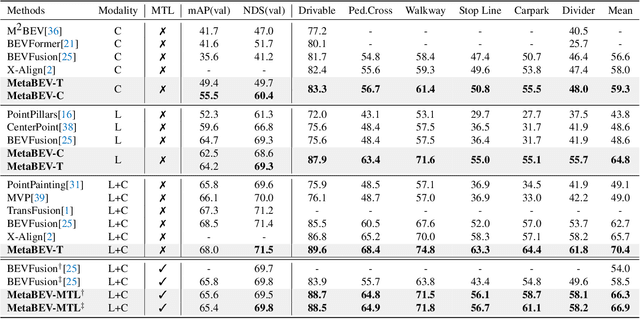
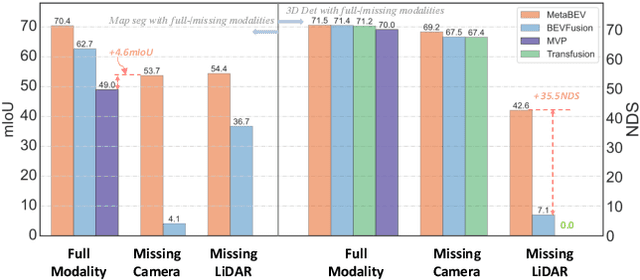

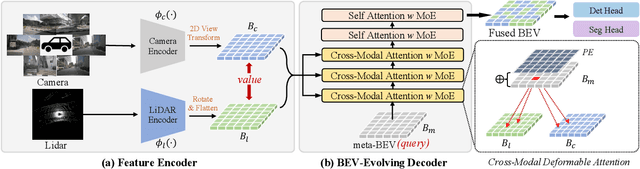
Perception systems in modern autonomous driving vehicles typically take inputs from complementary multi-modal sensors, e.g., LiDAR and cameras. However, in real-world applications, sensor corruptions and failures lead to inferior performances, thus compromising autonomous safety. In this paper, we propose a robust framework, called MetaBEV, to address extreme real-world environments involving overall six sensor corruptions and two extreme sensor-missing situations. In MetaBEV, signals from multiple sensors are first processed by modal-specific encoders. Subsequently, a set of dense BEV queries are initialized, termed meta-BEV. These queries are then processed iteratively by a BEV-Evolving decoder, which selectively aggregates deep features from either LiDAR, cameras, or both modalities. The updated BEV representations are further leveraged for multiple 3D prediction tasks. Additionally, we introduce a new M2oE structure to alleviate the performance drop on distinct tasks in multi-task joint learning. Finally, MetaBEV is evaluated on the nuScenes dataset with 3D object detection and BEV map segmentation tasks. Experiments show MetaBEV outperforms prior arts by a large margin on both full and corrupted modalities. For instance, when the LiDAR signal is missing, MetaBEV improves 35.5% detection NDS and 17.7% segmentation mIoU upon the vanilla BEVFusion model; and when the camera signal is absent, MetaBEV still achieves 69.2% NDS and 53.7% mIoU, which is even higher than previous works that perform on full-modalities. Moreover, MetaBEV performs fairly against previous methods in both canonical perception and multi-task learning settings, refreshing state-of-the-art nuScenes BEV map segmentation with 70.4% mIoU.
EGC: Image Generation and Classification via a Diffusion Energy-Based Model
Apr 13, 2023Learning image classification and image generation using the same set of network parameters is a challenging problem. Recent advanced approaches perform well in one task often exhibit poor performance in the other. This work introduces an energy-based classifier and generator, namely EGC, which can achieve superior performance in both tasks using a single neural network. Unlike a conventional classifier that outputs a label given an image (i.e., a conditional distribution $p(y|\mathbf{x})$), the forward pass in EGC is a classifier that outputs a joint distribution $p(\mathbf{x},y)$, enabling an image generator in its backward pass by marginalizing out the label $y$. This is done by estimating the energy and classification probability given a noisy image in the forward pass, while denoising it using the score function estimated in the backward pass. EGC achieves competitive generation results compared with state-of-the-art approaches on ImageNet-1k, CelebA-HQ and LSUN Church, while achieving superior classification accuracy and robustness against adversarial attacks on CIFAR-10. This work represents the first successful attempt to simultaneously excel in both tasks using a single set of network parameters. We believe that EGC bridges the gap between discriminative and generative learning.
RIFormer: Keep Your Vision Backbone Effective While Removing Token Mixer
Apr 12, 2023This paper studies how to keep a vision backbone effective while removing token mixers in its basic building blocks. Token mixers, as self-attention for vision transformers (ViTs), are intended to perform information communication between different spatial tokens but suffer from considerable computational cost and latency. However, directly removing them will lead to an incomplete model structure prior, and thus brings a significant accuracy drop. To this end, we first develop an RepIdentityFormer base on the re-parameterizing idea, to study the token mixer free model architecture. And we then explore the improved learning paradigm to break the limitation of simple token mixer free backbone, and summarize the empirical practice into 5 guidelines. Equipped with the proposed optimization strategy, we are able to build an extremely simple vision backbone with encouraging performance, while enjoying the high efficiency during inference. Extensive experiments and ablative analysis also demonstrate that the inductive bias of network architecture, can be incorporated into simple network structure with appropriate optimization strategy. We hope this work can serve as a starting point for the exploration of optimization-driven efficient network design. Project page: https://techmonsterwang.github.io/RIFormer/.
Topology Reasoning for Driving Scenes
Apr 11, 2023Understanding the road genome is essential to realize autonomous driving. This highly intelligent problem contains two aspects - the connection relationship of lanes, and the assignment relationship between lanes and traffic elements, where a comprehensive topology reasoning method is vacant. On one hand, previous map learning techniques struggle in deriving lane connectivity with segmentation or laneline paradigms; or prior lane topology-oriented approaches focus on centerline detection and neglect the interaction modeling. On the other hand, the traffic element to lane assignment problem is limited in the image domain, leaving how to construct the correspondence from two views an unexplored challenge. To address these issues, we present TopoNet, the first end-to-end framework capable of abstracting traffic knowledge beyond conventional perception tasks. To capture the driving scene topology, we introduce three key designs: (1) an embedding module to incorporate semantic knowledge from 2D elements into a unified feature space; (2) a curated scene graph neural network to model relationships and enable feature interaction inside the network; (3) instead of transmitting messages arbitrarily, a scene knowledge graph is devised to differentiate prior knowledge from various types of the road genome. We evaluate TopoNet on the challenging scene understanding benchmark, OpenLane-V2, where our approach outperforms all previous works by a great margin on all perceptual and topological metrics. The code would be released soon.
DeepAccident: A Motion and Accident Prediction Benchmark for V2X Autonomous Driving
Apr 10, 2023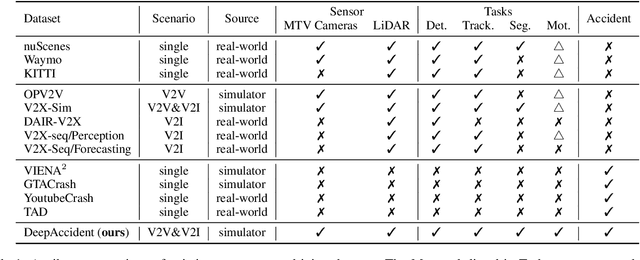



Safety is the primary priority of autonomous driving. Nevertheless, no published dataset currently supports the direct and explainable safety evaluation for autonomous driving. In this work, we propose DeepAccident, a large-scale dataset generated via a realistic simulator containing diverse accident scenarios that frequently occur in real-world driving. The proposed DeepAccident dataset contains 57K annotated frames and 285K annotated samples, approximately 7 times more than the large-scale nuScenes dataset with 40k annotated samples. In addition, we propose a new task, end-to-end motion and accident prediction, based on the proposed dataset, which can be used to directly evaluate the accident prediction ability for different autonomous driving algorithms. Furthermore, for each scenario, we set four vehicles along with one infrastructure to record data, thus providing diverse viewpoints for accident scenarios and enabling V2X (vehicle-to-everything) research on perception and prediction tasks. Finally, we present a baseline V2X model named V2XFormer that demonstrates superior performance for motion and accident prediction and 3D object detection compared to the single-vehicle model.
Embodied Concept Learner: Self-supervised Learning of Concepts and Mapping through Instruction Following
Apr 07, 2023Humans, even at a very early age, can learn visual concepts and understand geometry and layout through active interaction with the environment, and generalize their compositions to complete tasks described by natural languages in novel scenes. To mimic such capability, we propose Embodied Concept Learner (ECL) in an interactive 3D environment. Specifically, a robot agent can ground visual concepts, build semantic maps and plan actions to complete tasks by learning purely from human demonstrations and language instructions, without access to ground-truth semantic and depth supervisions from simulations. ECL consists of: (i) an instruction parser that translates the natural languages into executable programs; (ii) an embodied concept learner that grounds visual concepts based on language descriptions; (iii) a map constructor that estimates depth and constructs semantic maps by leveraging the learned concepts; and (iv) a program executor with deterministic policies to execute each program. ECL has several appealing benefits thanks to its modularized design. Firstly, it enables the robotic agent to learn semantics and depth unsupervisedly acting like babies, e.g., ground concepts through active interaction and perceive depth by disparities when moving forward. Secondly, ECL is fully transparent and step-by-step interpretable in long-term planning. Thirdly, ECL could be beneficial for the embodied instruction following (EIF), outperforming previous works on the ALFRED benchmark when the semantic label is not provided. Also, the learned concept can be reused for other downstream tasks, such as reasoning of object states. Project page: http://ecl.csail.mit.edu/
Visual Dependency Transformers: Dependency Tree Emerges from Reversed Attention
Apr 06, 2023Humans possess a versatile mechanism for extracting structured representations of our visual world. When looking at an image, we can decompose the scene into entities and their parts as well as obtain the dependencies between them. To mimic such capability, we propose Visual Dependency Transformers (DependencyViT) that can induce visual dependencies without any labels. We achieve that with a novel neural operator called \emph{reversed attention} that can naturally capture long-range visual dependencies between image patches. Specifically, we formulate it as a dependency graph where a child token in reversed attention is trained to attend to its parent tokens and send information following a normalized probability distribution rather than gathering information in conventional self-attention. With such a design, hierarchies naturally emerge from reversed attention layers, and a dependency tree is progressively induced from leaf nodes to the root node unsupervisedly. DependencyViT offers several appealing benefits. (i) Entities and their parts in an image are represented by different subtrees, enabling part partitioning from dependencies; (ii) Dynamic visual pooling is made possible. The leaf nodes which rarely send messages can be pruned without hindering the model performance, based on which we propose the lightweight DependencyViT-Lite to reduce the computational and memory footprints; (iii) DependencyViT works well on both self- and weakly-supervised pretraining paradigms on ImageNet, and demonstrates its effectiveness on 8 datasets and 5 tasks, such as unsupervised part and saliency segmentation, recognition, and detection.
Multi-Level Contrastive Learning for Dense Prediction Task
Apr 04, 2023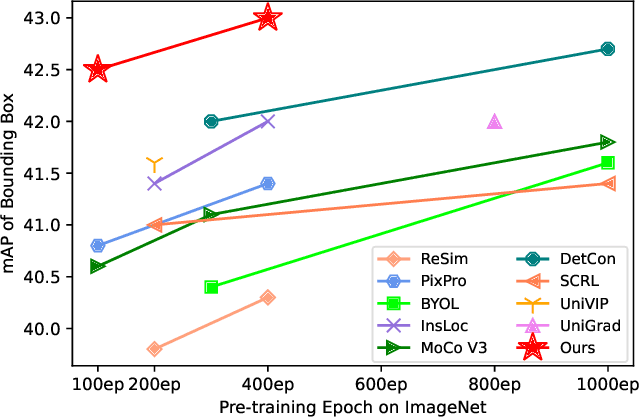
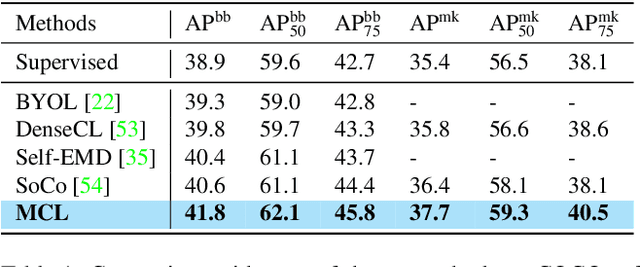
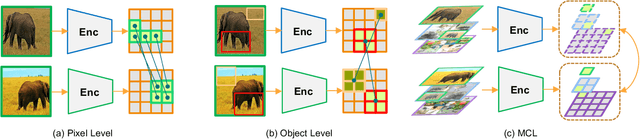
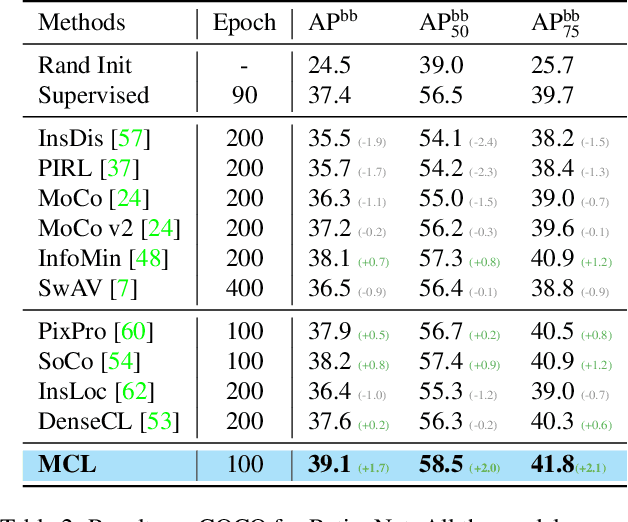
In this work, we present Multi-Level Contrastive Learning for Dense Prediction Task (MCL), an efficient self-supervised method for learning region-level feature representation for dense prediction tasks. Our method is motivated by the three key factors in detection: localization, scale consistency and recognition. To explicitly encode absolute position and scale information, we propose a novel pretext task that assembles multi-scale images in a montage manner to mimic multi-object scenarios. Unlike the existing image-level self-supervised methods, our method constructs a multi-level contrastive loss that considers each sub-region of the montage image as a singleton. Our method enables the neural network to learn regional semantic representations for translation and scale consistency while reducing pre-training epochs to the same as supervised pre-training. Extensive experiments demonstrate that MCL consistently outperforms the recent state-of-the-art methods on various datasets with significant margins. In particular, MCL obtains 42.5 AP$^\mathrm{bb}$ and 38.3 AP$^\mathrm{mk}$ on COCO with the 1x schedule fintuning, when using Mask R-CNN with R50-FPN backbone pre-trained with 100 epochs. In comparison to MoCo, our method surpasses their performance by 4.0 AP$^\mathrm{bb}$ and 3.1 AP$^\mathrm{mk}$. Furthermore, we explore the alignment between pretext task and downstream tasks. We extend our pretext task to supervised pre-training, which achieves a similar performance to self-supervised learning. This result demonstrates the importance of the alignment between pretext task and downstream tasks, indicating the potential for wider applicability of our method beyond self-supervised settings.
Soft Neighbors are Positive Supporters in Contrastive Visual Representation Learning
Mar 30, 2023Contrastive learning methods train visual encoders by comparing views from one instance to others. Typically, the views created from one instance are set as positive, while views from other instances are negative. This binary instance discrimination is studied extensively to improve feature representations in self-supervised learning. In this paper, we rethink the instance discrimination framework and find the binary instance labeling insufficient to measure correlations between different samples. For an intuitive example, given a random image instance, there may exist other images in a mini-batch whose content meanings are the same (i.e., belonging to the same category) or partially related (i.e., belonging to a similar category). How to treat the images that correlate similarly to the current image instance leaves an unexplored problem. We thus propose to support the current image by exploring other correlated instances (i.e., soft neighbors). We first carefully cultivate a candidate neighbor set, which will be further utilized to explore the highly-correlated instances. A cross-attention module is then introduced to predict the correlation score (denoted as positiveness) of other correlated instances with respect to the current one. The positiveness score quantitatively measures the positive support from each correlated instance, and is encoded into the objective for pretext training. To this end, our proposed method benefits in discriminating uncorrelated instances while absorbing correlated instances for SSL. We evaluate our soft neighbor contrastive learning method (SNCLR) on standard visual recognition benchmarks, including image classification, object detection, and instance segmentation. The state-of-the-art recognition performance shows that SNCLR is effective in improving feature representations from both ViT and CNN encoders.