 Add to Chrome
 Add to Firefox
 Add to Edge
Scalable MatMul-free Language Modeling
Jun 04, 2024
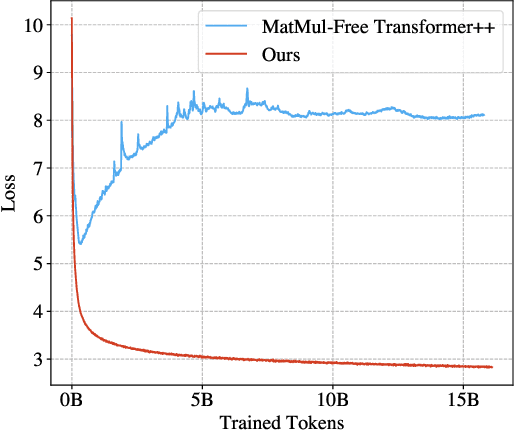
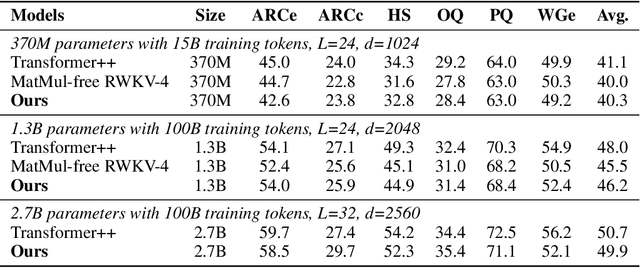
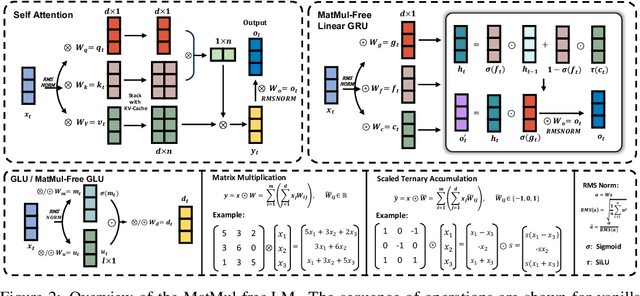
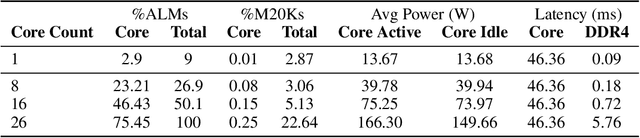
Matrix multiplication (MatMul) typically dominates the overall computational cost of large language models (LLMs). This cost only grows as LLMs scale to larger embedding dimensions and context lengths. In this work, we show that MatMul operations can be completely eliminated from LLMs while maintaining strong performance at billion-parameter scales. Our experiments show that our proposed MatMul-free models achieve performance on-par with state-of-the-art Transformers that require far more memory during inference at a scale up to at least 2.7B parameters. We investigate the scaling laws and find that the performance gap between our MatMul-free models and full precision Transformers narrows as the model size increases. We also provide a GPU-efficient implementation of this model which reduces memory usage by up to 61% over an unoptimized baseline during training. By utilizing an optimized kernel during inference, our model's memory consumption can be reduced by more than 10x compared to unoptimized models. To properly quantify the efficiency of our architecture, we build a custom hardware solution on an FPGA which exploits lightweight operations beyond what GPUs are capable of. We processed billion-parameter scale models at 13W beyond human readable throughput, moving LLMs closer to brain-like efficiency. This work not only shows how far LLMs can be stripped back while still performing effectively, but also points at the types of operations future accelerators should be optimized for in processing the next generation of lightweight LLMs. Our code implementation is available at \url{https://github.com/ridgerchu/matmulfreellm}.

Puff-Net: Efficient Style Transfer with Pure Content and Style Feature Fusion Network
May 30, 2024Style transfer aims to render an image with the artistic features of a style image, while maintaining the original structure. Various methods have been put forward for this task, but some challenges still exist. For instance, it is difficult for CNN-based methods to handle global information and long-range dependencies between input images, for which transformer-based methods have been proposed. Although transformers can better model the relationship between content and style images, they require high-cost hardware and time-consuming inference. To address these issues, we design a novel transformer model that includes only the encoder, thus significantly reducing the computational cost. In addition, we also find that existing style transfer methods may lead to images under-stylied or missing content. In order to achieve better stylization, we design a content feature extractor and a style feature extractor, based on which pure content and style images can be fed to the transformer. Finally, we propose a novel network termed Puff-Net, i.e., pure content and style feature fusion network. Through qualitative and quantitative experiments, we demonstrate the advantages of our model compared to state-of-the-art ones in the literature.
Sparse Sampling is All You Need for Fast Wrong-way Cycling Detection in CCTV Videos
May 12, 2024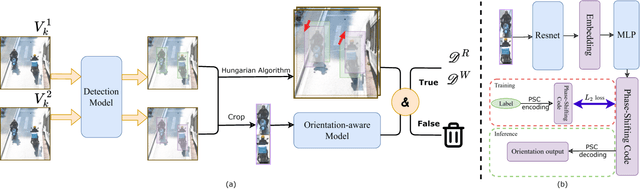
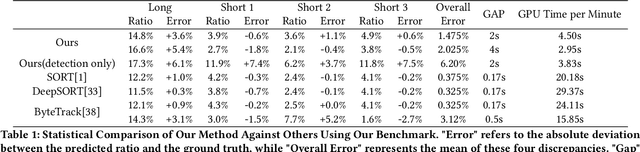
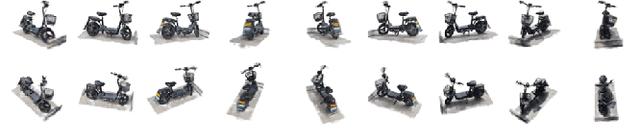
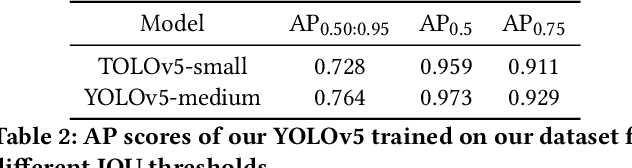
In the field of transportation, it is of paramount importance to address and mitigate illegal actions committed by both motor and non-motor vehicles. Among those actions, wrong-way cycling (i.e., riding a bicycle or e-bike in the opposite direction of the designated traffic flow) poses significant risks to both cyclists and other road users. To this end, this paper formulates a problem of detecting wrong-way cycling ratios in CCTV videos. Specifically, we propose a sparse sampling method called WWC-Predictor to efficiently solve this problem, addressing the inefficiencies of direct tracking methods. Our approach leverages both detection-based information, which utilizes the information from bounding boxes, and orientation-based information, which provides insights into the image itself, to enhance instantaneous information capture capability. On our proposed benchmark dataset consisting of 35 minutes of video sequences and minute-level annotation, our method achieves an average error rate of a mere 1.475% while taking only 19.12% GPU time of straightforward tracking methods under the same detection model. This remarkable performance demonstrates the effectiveness of our approach in identifying and predicting instances of wrong-way cycling.
Eagle and Finch: RWKV with Matrix-Valued States and Dynamic Recurrence
Apr 10, 2024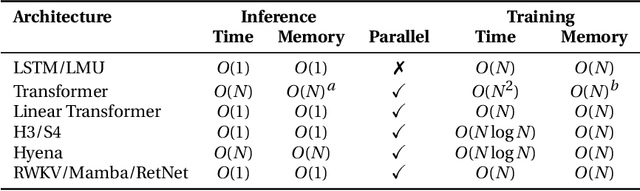

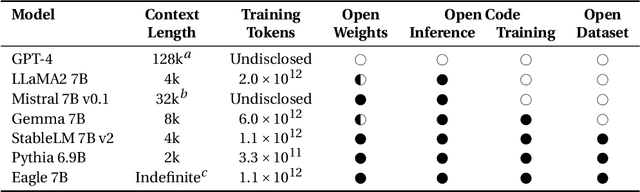
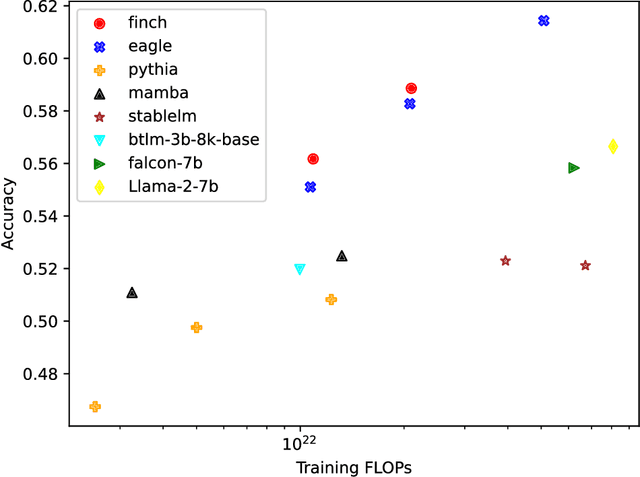
We present Eagle (RWKV-5) and Finch (RWKV-6), sequence models improving upon the RWKV (RWKV-4) architecture. Our architectural design advancements include multi-headed matrix-valued states and a dynamic recurrence mechanism that improve expressivity while maintaining the inference efficiency characteristics of RNNs. We introduce a new multilingual corpus with 1.12 trillion tokens and a fast tokenizer based on greedy matching for enhanced multilinguality. We trained four Eagle models, ranging from 0.46 to 7.5 billion parameters, and two Finch models with 1.6 and 3.1 billion parameters and find that they achieve competitive performance across a wide variety of benchmarks. We release all our models on HuggingFace under the Apache 2.0 license. Models at: https://huggingface.co/RWKV Training code at: https://github.com/RWKV/RWKV-LM Inference code at: https://github.com/RWKV/ChatRWKV Time-parallel training code at: https://github.com/RWKV/RWKV-infctx-trainer
Learning to Rank Patches for Unbiased Image Redundancy Reduction
Mar 31, 2024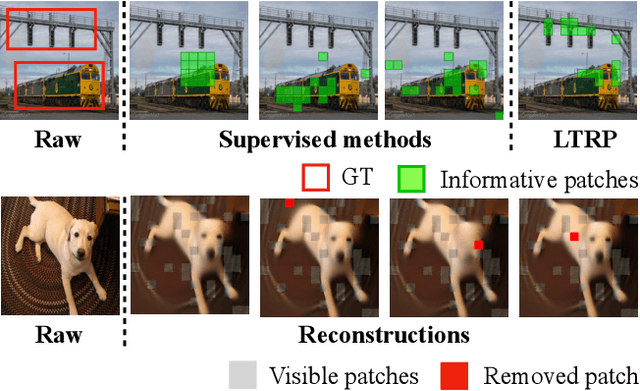
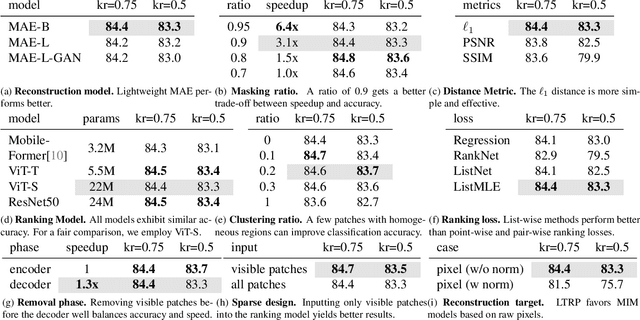
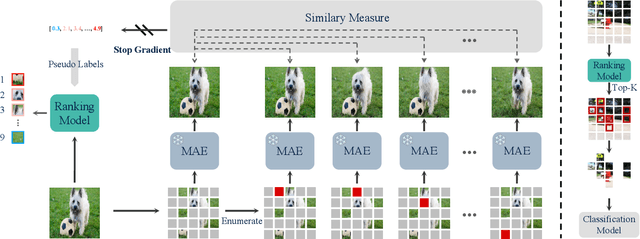
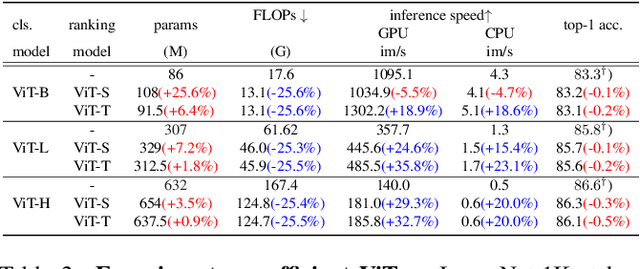
Images suffer from heavy spatial redundancy because pixels in neighboring regions are spatially correlated. Existing approaches strive to overcome this limitation by reducing less meaningful image regions. However, current leading methods rely on supervisory signals. They may compel models to preserve content that aligns with labeled categories and discard content belonging to unlabeled categories. This categorical inductive bias makes these methods less effective in real-world scenarios. To address this issue, we propose a self-supervised framework for image redundancy reduction called Learning to Rank Patches (LTRP). We observe that image reconstruction of masked image modeling models is sensitive to the removal of visible patches when the masking ratio is high (e.g., 90\%). Building upon it, we implement LTRP via two steps: inferring the semantic density score of each patch by quantifying variation between reconstructions with and without this patch, and learning to rank the patches with the pseudo score. The entire process is self-supervised, thus getting out of the dilemma of categorical inductive bias. We design extensive experiments on different datasets and tasks. The results demonstrate that LTRP outperforms both supervised and other self-supervised methods due to the fair assessment of image content.
Instruction Multi-Constraint Molecular Generation Using a Teacher-Student Large Language Model
Mar 20, 2024While various models and computational tools have been proposed for structure and property analysis of molecules, generating molecules that conform to all desired structures and properties remains a challenge. Here, we introduce a multi-constraint molecular generation large language model, TSMMG, which, akin to a student, incorporates knowledge from various small models and tools, namely, the 'teachers'. To train TSMMG, we construct a large set of text-molecule pairs by extracting molecular knowledge from these 'teachers', enabling it to generate novel molecules that conform to the descriptions through various text prompts. We experimentally show that TSMMG remarkably performs in generating molecules meeting complex, natural language-described property requirements across two-, three-, and four-constraint tasks, with an average molecular validity of over 99% and success ratio of 88.08%, 65.27%, and 61.44%, respectively. The model also exhibits adaptability through zero-shot testing, creating molecules that satisfy combinations of properties that have not been encountered. It can comprehend text inputs with various language styles, extending beyond the confines of outlined prompts, as confirmed through empirical validation. Additionally, the knowledge distillation feature of TSMMG contributes to the continuous enhancement of small models, while the innovative approach to dataset construction effectively addresses the issues of data scarcity and quality, which positions TSMMG as a promising tool in the domains of drug discovery and materials science. Code is available at https://github.com/HHW-zhou/TSMMG.
Revolutionizing Packaging: A Robotic Bagging Pipeline with Constraint-aware Structure-of-Interest Planning
Mar 15, 2024
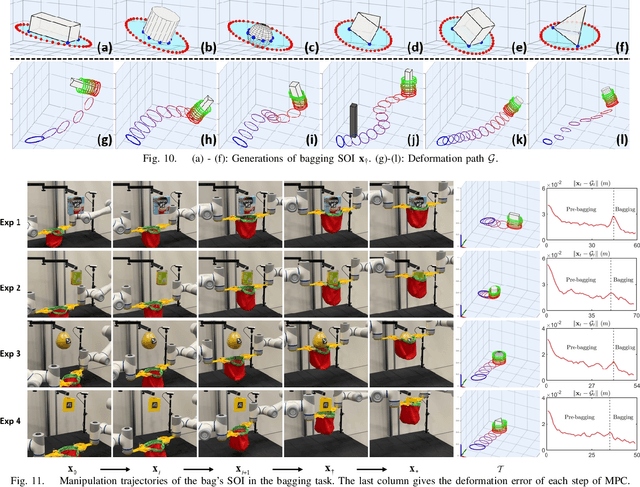


Bagging operations, common in packaging and assisted living applications, are challenging due to a bag's complex deformable properties. To address this, we develop a robotic system for automated bagging tasks using an adaptive structure-of-interest (SOI) manipulation approach. Our method relies on real-time visual feedback to dynamically adjust manipulation without requiring prior knowledge of bag materials or dynamics. We present a robust pipeline featuring state estimation for SOIs using Gaussian Mixture Models (GMM), SOI generation via optimization-based bagging techniques, SOI motion planning with Constrained Bidirectional Rapidly-exploring Random Trees (CBiRRT), and dual-arm manipulation coordinated by Model Predictive Control (MPC). Experiments demonstrate the system's ability to achieve precise, stable bagging of various objects using adaptive coordination of the manipulators. The proposed framework advances the capability of dual-arm robots to perform more sophisticated automation of common tasks involving interactions with deformable objects.
Interactive Perception for Deformable Object Manipulation
Mar 08, 2024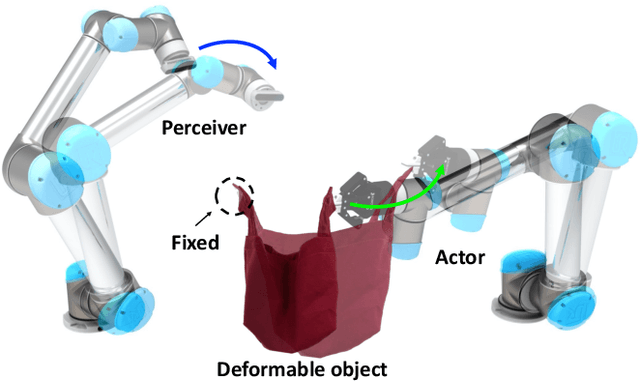
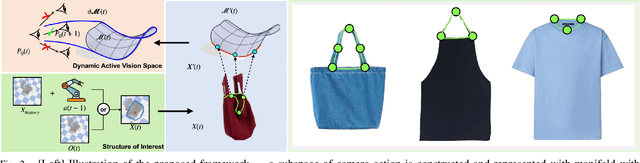
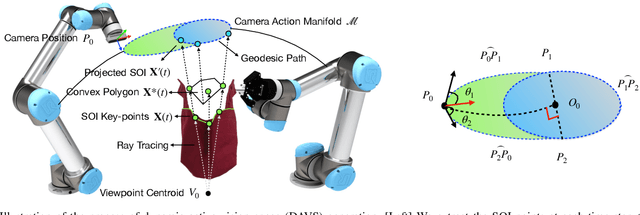
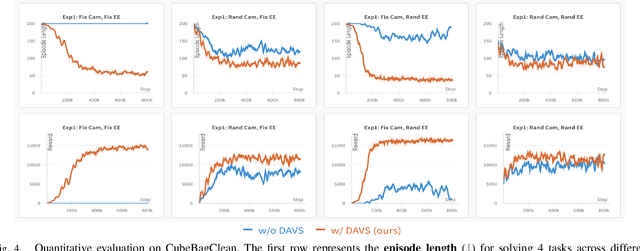
Interactive perception enables robots to manipulate the environment and objects to bring them into states that benefit the perception process. Deformable objects pose challenges to this due to significant manipulation difficulty and occlusion in vision-based perception. In this work, we address such a problem with a setup involving both an active camera and an object manipulator. Our approach is based on a sequential decision-making framework and explicitly considers the motion regularity and structure in coupling the camera and manipulator. We contribute a method for constructing and computing a subspace, called Dynamic Active Vision Space (DAVS), for effectively utilizing the regularity in motion exploration. The effectiveness of the framework and approach are validated in both a simulation and a real dual-arm robot setup. Our results confirm the necessity of an active camera and coordinative motion in interactive perception for deformable objects.
MV2MAE: Multi-View Video Masked Autoencoders
Jan 29, 2024Videos captured from multiple viewpoints can help in perceiving the 3D structure of the world and benefit computer vision tasks such as action recognition, tracking, etc. In this paper, we present a method for self-supervised learning from synchronized multi-view videos. We use a cross-view reconstruction task to inject geometry information in the model. Our approach is based on the masked autoencoder (MAE) framework. In addition to the same-view decoder, we introduce a separate cross-view decoder which leverages cross-attention mechanism to reconstruct a target viewpoint video using a video from source viewpoint, to help representations robust to viewpoint changes. For videos, static regions can be reconstructed trivially which hinders learning meaningful representations. To tackle this, we introduce a motion-weighted reconstruction loss which improves temporal modeling. We report state-of-the-art results on the NTU-60, NTU-120 and ETRI datasets, as well as in the transfer learning setting on NUCLA, PKU-MMD-II and ROCOG-v2 datasets, demonstrating the robustness of our approach. Code will be made available.
Bimanual Deformable Bag Manipulation Using a Structure-of-Interest Based Latent Dynamics Model
Jan 21, 2024The manipulation of deformable objects by robotic systems presents a significant challenge due to their complex and infinite-dimensional configuration spaces. This paper introduces a novel approach to Deformable Object Manipulation (DOM) by emphasizing the identification and manipulation of Structures of Interest (SOIs) in deformable fabric bags. We propose a bimanual manipulation framework that leverages a Graph Neural Network (GNN)-based latent dynamics model to succinctly represent and predict the behavior of these SOIs. Our approach involves constructing a graph representation from partial point cloud data of the object and learning the latent dynamics model that effectively captures the essential deformations of the fabric bag within a reduced computational space. By integrating this latent dynamics model with Model Predictive Control (MPC), we empower robotic manipulators to perform precise and stable manipulation tasks focused on the SOIs. We have validated our framework through various empirical experiments demonstrating its efficacy in bimanual manipulation of fabric bags. Our contributions not only address the complexities inherent in DOM but also provide new perspectives and methodologies for enhancing robotic interactions with deformable objects by concentrating on their critical structural elements. Experimental videos can be obtained from https://sites.google.com/view/bagbot.