 Add to Chrome
 Add to Firefox
 Add to Edge
Rethinking Normalization Placement for LLMs: Post-Norm under Curriculum Depth Growing
Aug 13, 2026
Pre-norm is the standard normalization placement in modern Transformers because it facilitates joint optimization of full-depth models. We ask whether this preference persists when depth is introduced through a curriculum. In curriculum depth growth, each appended block receives the boundary representation produced by a trained prefix, making normalization placement relevant to forward conditioning. We therefore test whether placement and training curriculum interact. In a controlled distillation study with a Qwen3-8B teacher and a nine-layer student, pre-norm and post-norm are indistinguishable under joint training, differing by $0.0004$ validation CE, while post-norm improves over pre-norm by $0.0328$ under curriculum growth, an order of magnitude larger. A post-joint control matched by student active-layer tokens remains worse than post-grow, which rules out compute as the sole explanation. The ranking crosses over during the curriculum: post-norm takes the lead once blocks are appended. Single-block and freeze controls localize the ranking change to block appending rather than shallow-block quality or retraining. Boundary diagnostics associate post-norm with stable residual scales and pre-norm with structural-token scale drift; on a fixed batch, the final pre-grow block is also nearly identity-mapped. Together with the phase-wise crossover, these observations are consistent with boundary-scale conditioning after new blocks are appended. The results motivate treating normalization placement and training curriculum as coupled design choices in this distillation setting.

Compress the Easy, Explore the Hard: Difficulty-Aware Entropy Regularization for Efficient LLM Reasoning
Feb 26, 2026Chain-of-Thought (CoT) has substantially empowered Large Language Models (LLMs) to tackle complex reasoning tasks, yet the verbose nature of explicit reasoning steps incurs prohibitive inference latency and computational costs, limiting real-world deployment. While existing compression methods - ranging from self-training to Reinforcement Learning (RL) with length constraints - attempt to mitigate this, they often sacrifice reasoning capability for brevity. We identify a critical failure mode in these approaches: explicitly optimizing for shorter trajectories triggers rapid entropy collapse, which prematurely shrinks the exploration space and stifles the discovery of valid reasoning paths, particularly for challenging questions requiring extensive deduction. To address this issue, we propose Compress responses for Easy questions and Explore Hard ones (CEEH), a difficulty-aware approach to RL-based efficient reasoning. CEEH dynamically assesses instance difficulty to apply selective entropy regularization: it preserves a diverse search space for currently hard questions to ensure robustness, while permitting aggressive compression on easier instances where the reasoning path is well-established. In addition, we introduce a dynamic optimal-length penalty anchored to the historically shortest correct response, which effectively counteracts entropy-induced length inflation and stabilizes the reward signal. Across six reasoning benchmarks, CEEH consistently reduces response length while maintaining accuracy comparable to the base model, and improves Pass@k relative to length-only optimization.
Sparse Sampling is All You Need for Fast Wrong-way Cycling Detection in CCTV Videos
May 12, 2024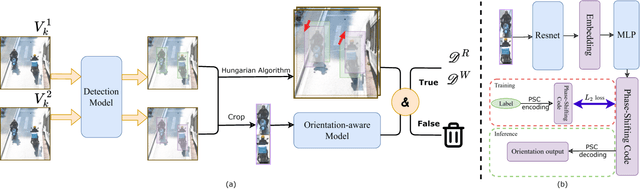
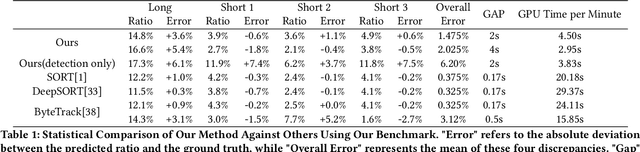

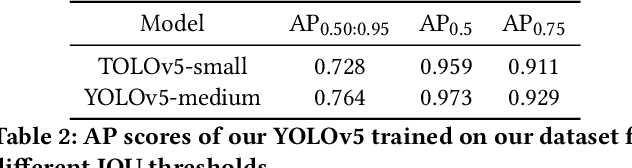
In the field of transportation, it is of paramount importance to address and mitigate illegal actions committed by both motor and non-motor vehicles. Among those actions, wrong-way cycling (i.e., riding a bicycle or e-bike in the opposite direction of the designated traffic flow) poses significant risks to both cyclists and other road users. To this end, this paper formulates a problem of detecting wrong-way cycling ratios in CCTV videos. Specifically, we propose a sparse sampling method called WWC-Predictor to efficiently solve this problem, addressing the inefficiencies of direct tracking methods. Our approach leverages both detection-based information, which utilizes the information from bounding boxes, and orientation-based information, which provides insights into the image itself, to enhance instantaneous information capture capability. On our proposed benchmark dataset consisting of 35 minutes of video sequences and minute-level annotation, our method achieves an average error rate of a mere 1.475% while taking only 19.12% GPU time of straightforward tracking methods under the same detection model. This remarkable performance demonstrates the effectiveness of our approach in identifying and predicting instances of wrong-way cycling.
Towards Class-incremental Object Detection with Nearest Mean of Exemplars
Aug 19, 2020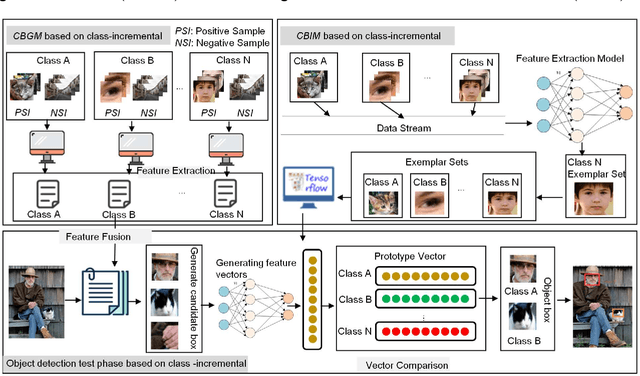
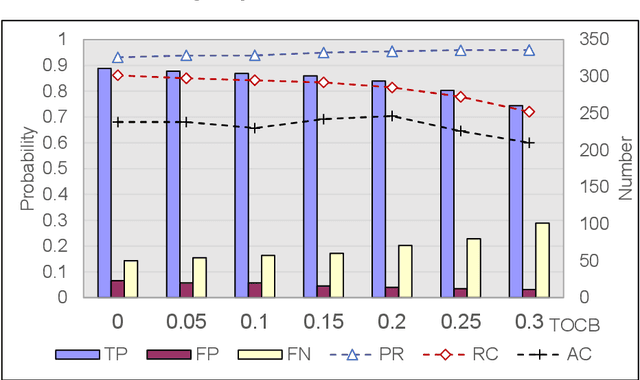
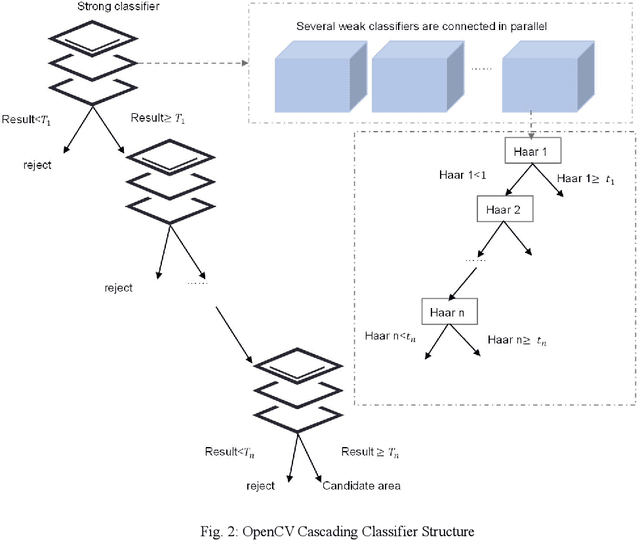
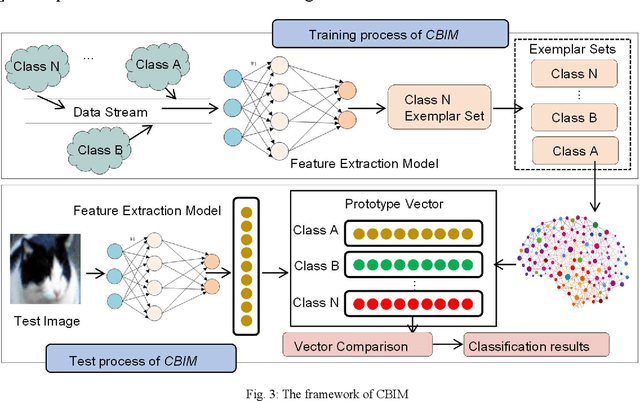
Object detection has been widely used in the field of Internet, and deep learning plays a very important role in object detection. However, the existing object detection methods need to be trained in the static setting, which requires obtaining all the data at one time, and it does not support training in the way of class-incremental. In this paper, an object detection framework named class-incremental object detection (CIOD) is proposed. CIOD divides object detection into two stages. Firstly, the traditional OpenCV cascade classifier is improved in the object candidate box generation stage to meet the needs of class increment. Secondly, we use the concept of prototype vector on the basis of deep learning to train a classifier based on class-incremental to identify the generated object candidate box, so as to extract the real object box. A large number of experiments on CIOD have been carried out to verify that CIOD can detect the object in the way of class-incremental and can control the training time and memory capacity.