 Add to Chrome
 Add to Firefox
 Add to Edge
MultiCompose: Multi-Concept Personalized Composition with Per-Subject Attribute Binding
Aug 04, 2026
Text-to-image diffusion models enable personalization of specific visual concepts from a small number of reference images. However, generating a single image that contains multiple personalized subjects, each bound to user-specified attributes such as clothing, accessories, and held objects, remains largely unaddressed. Without explicit spatial constraints, concurrently activated concept checkpoints produce overlapping cross-attention responses, causing per-subject identity degradation and attribute misalignment. Moreover, no established benchmark jointly evaluates these two failure modes in the personalized multi-subject setting. We present MultiCompose, a composition framework that decouples per-concept personalization from multi-subject inference. A semantic preservation regularization maintains attribute binding capacity during fine-tuning, while a two-phase inference procedure automatically establishes subject layout and composes per-concept predictions through spatially exclusive masks. We further introduce MSP-Bench, a benchmark that jointly evaluates identity fidelity (ID), attribute binding accuracy (BIND), and attribute misalignment (MIS) through a dual-pathway protocol. Experiments show that MultiCompose outperforms existing methods on both conventional metrics and MSP-Bench, confirming the benchmark's ability to reveal failure modes that conventional metrics overlook. Code is available at https://github.com/I2-Multimedia-Lab/MultiCompose

GrainGS: Gradient-Decoupled Gaussian Splatting for Efficient Dynamic Novel View Synthesis
Jul 24, 2026Dynamic scene reconstruction with 3D Gaussian Splatting requires a balance between fine-grained motion modeling, structural stability, and compact representation. Existing per-primitive methods provide flexible local deformation but often suffer from redundant primitive growth, while anchor-based methods improve spatial regularity at the cost of suppressing locally varying motion. To address these issues, we present GrainGS, a dynamic Gaussian framework that combines a hierarchical anchor scaffold with per-Gaussian deformation. A static warm-up stage first establishes a time-invariant canonical representation from observations across all timestamps. During joint training, a stop-gradient operation blocks the deformation-mediated gradient pathway to the canonical positions while preserving their direct refinement through the reconstruction objective. Each Gaussian then predicts independent temporal offsets for position, rotation, and scale, enabling detailed local motion within a structurally constrained scaffold. A canonical-residual appearance decomposition further models frame-dependent photometric changes without forcing them into geometric deformation. Experiments on synthetic monocular and real-world multiview benchmarks show that GrainGS achieves high reconstruction quality, real-time novel view synthesis, and compact storage. Under the synthetic benchmark setting, it reaches an average peak signal-to-noise ratio of 36.98 decibels, renders at 435.6 frames per second, and requires 4.67 megabytes of storage.
Frequency-Aware Dual-Stream Learning for Balanced Realism and Fidelity in Electron Microscopy Imaging
Jul 24, 2026Electron microscopy enables nanoscale cellular visualization but faces a trade-off between imaging resolution and acquisition speed. Existing learning-based methods rely on single-stream architectures that struggle to balance perceptual realism and quantitative fidelity, either over-smoothing details or generating unrealistic hallucinations. This work introduces a frequency-adaptive dual-stream architecture to resolve this conflict. Using discrete wavelet transform, we decompose images into low-frequency structures and high-frequency details, then employ a conditional diffusion model for realistic global synthesis and a transformer network for precise detail recovery. Experiments on the EMDiffuse dataset show the method achieves superior LPIPS and resolution ratio, substantially outperforming existing approaches. The method also shows strong generalization across diverse biological samples, supporting fast and reliable electron microscopy imaging for structural biology and nanotechnology applications. The source code and associated dataset are publicly available to facilitate further research.
The Eleventh NTIRE 2026 Efficient Super-Resolution Challenge Report
Apr 03, 2026This paper reviews the NTIRE 2026 challenge on efficient single-image super-resolution with a focus on the proposed solutions and results. The aim of this challenge is to devise a network that reduces one or several aspects, such as runtime, parameters, and FLOPs, while maintaining PSNR of around 26.90 dB on the DIV2K_LSDIR_valid dataset, and 26.99 dB on the DIV2K_LSDIR_test dataset. The challenge had 95 registered participants, and 15 teams made valid submissions. They gauge the state-of-the-art results for efficient single-image super-resolution.
VEMamba: Efficient Isotropic Reconstruction of Volume Electron Microscopy with Axial-Lateral Consistent Mamba
Mar 01, 2026Volume Electron Microscopy (VEM) is crucial for 3D tissue imaging but often produces anisotropic data with poor axial resolution, hindering visualization and downstream analysis. Existing methods for isotropic reconstruction often suffer from neglecting abundant axial information and employing simple downsampling to simulate anisotropic data. To address these limitations, we propose VEMamba, an efficient framework for isotropic reconstruction. The core of VEMamba is a novel 3D Dependency Reordering paradigm, implemented via two key components: an Axial-Lateral Chunking Selective Scan Module (ALCSSM), which intelligently re-maps complex 3D spatial dependencies (both axial and lateral) into optimized 1D sequences for efficient Mamba-based modeling, explicitly enforcing axial-lateral consistency; and a Dynamic Weights Aggregation Module (DWAM) to adaptively aggregate these reordered sequence outputs for enhanced representational power. Furthermore, we introduce a realistic degradation simulation and then leverage Momentum Contrast (MoCo) to integrate this degradation-aware knowledge into the network for superior reconstruction. Extensive experiments on both simulated and real-world anisotropic VEM datasets demonstrate that VEMamba achieves highly competitive performance across various metrics while maintaining a lower computational footprint. The source code is available on GitHub: https://github.com/I2-Multimedia-Lab/VEMamba
CloudMamba: Grouped Selective State Spaces for Point Cloud Analysis
Nov 11, 2025Due to the long-range modeling ability and linear complexity property, Mamba has attracted considerable attention in point cloud analysis. Despite some interesting progress, related work still suffers from imperfect point cloud serialization, insufficient high-level geometric perception, and overfitting of the selective state space model (S6) at the core of Mamba. To this end, we resort to an SSM-based point cloud network termed CloudMamba to address the above challenges. Specifically, we propose sequence expanding and sequence merging, where the former serializes points along each axis separately and the latter serves to fuse the corresponding higher-order features causally inferred from different sequences, enabling unordered point sets to adapt more stably to the causal nature of Mamba without parameters. Meanwhile, we design chainedMamba that chains the forward and backward processes in the parallel bidirectional Mamba, capturing high-level geometric information during scanning. In addition, we propose a grouped selective state space model (GS6) via parameter sharing on S6, alleviating the overfitting problem caused by the computational mode in S6. Experiments on various point cloud tasks validate CloudMamba's ability to achieve state-of-the-art results with significantly less complexity.
HyperDiff: Hypergraph Guided Diffusion Model for 3D Human Pose Estimation
Aug 20, 2025Monocular 3D human pose estimation (HPE) often encounters challenges such as depth ambiguity and occlusion during the 2D-to-3D lifting process. Additionally, traditional methods may overlook multi-scale skeleton features when utilizing skeleton structure information, which can negatively impact the accuracy of pose estimation. To address these challenges, this paper introduces a novel 3D pose estimation method, HyperDiff, which integrates diffusion models with HyperGCN. The diffusion model effectively captures data uncertainty, alleviating depth ambiguity and occlusion. Meanwhile, HyperGCN, serving as a denoiser, employs multi-granularity structures to accurately model high-order correlations between joints. This improves the model's denoising capability especially for complex poses. Experimental results demonstrate that HyperDiff achieves state-of-the-art performance on the Human3.6M and MPI-INF-3DHP datasets and can flexibly adapt to varying computational resources to balance performance and efficiency.
PiCo: Enhancing Text-Image Alignment with Improved Noise Selection and Precise Mask Control in Diffusion Models
May 06, 2025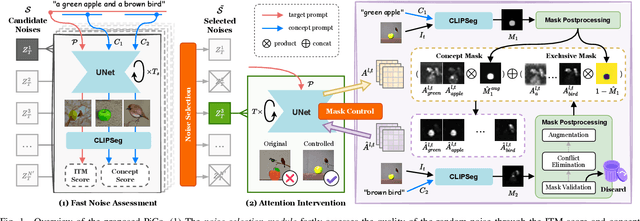
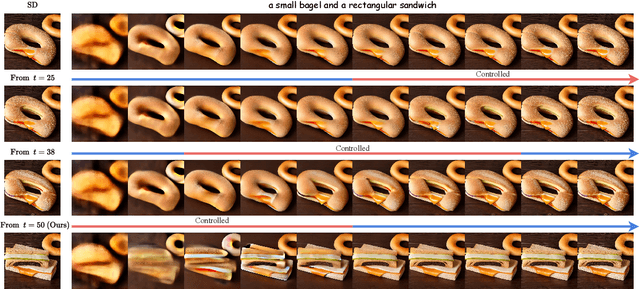
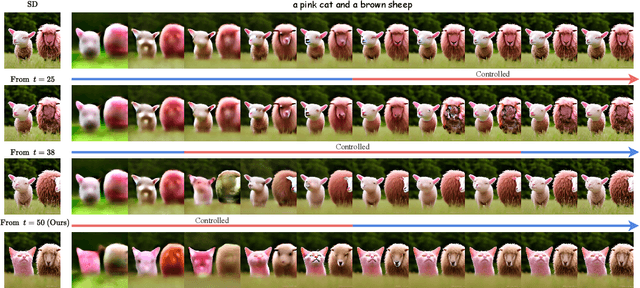
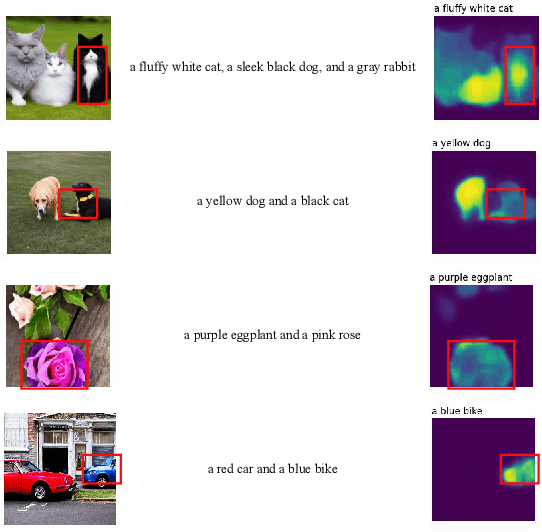
Advanced diffusion models have made notable progress in text-to-image compositional generation. However, it is still a challenge for existing models to achieve text-image alignment when confronted with complex text prompts. In this work, we highlight two factors that affect this alignment: the quality of the randomly initialized noise and the reliability of the generated controlling mask. We then propose PiCo (Pick-and-Control), a novel training-free approach with two key components to tackle these two factors. First, we develop a noise selection module to assess the quality of the random noise and determine whether the noise is suitable for the target text. A fast sampling strategy is utilized to ensure efficiency in the noise selection stage. Second, we introduce a referring mask module to generate pixel-level masks and to precisely modulate the cross-attention maps. The referring mask is applied to the standard diffusion process to guide the reasonable interaction between text and image features. Extensive experiments have been conducted to verify the effectiveness of PiCo in liberating users from the tedious process of random generation and in enhancing the text-image alignment for diverse text descriptions.
Uncertainty Guided Refinement for Fine-Grained Salient Object Detection
Apr 13, 2025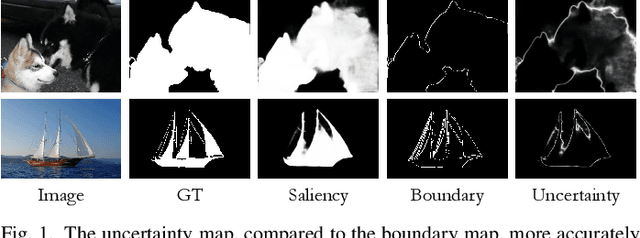
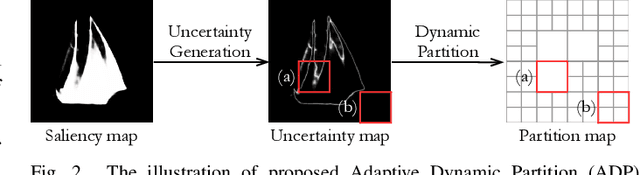
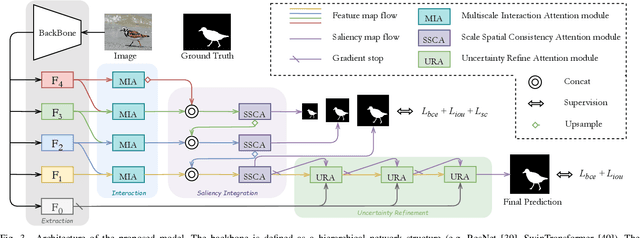
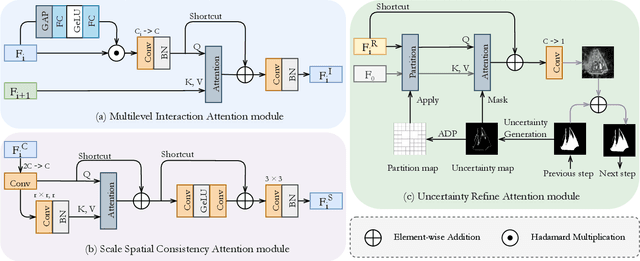
Recently, salient object detection (SOD) methods have achieved impressive performance. However, salient regions predicted by existing methods usually contain unsaturated regions and shadows, which limits the model for reliable fine-grained predictions. To address this, we introduce the uncertainty guidance learning approach to SOD, intended to enhance the model's perception of uncertain regions. Specifically, we design a novel Uncertainty Guided Refinement Attention Network (UGRAN), which incorporates three important components, i.e., the Multilevel Interaction Attention (MIA) module, the Scale Spatial-Consistent Attention (SSCA) module, and the Uncertainty Refinement Attention (URA) module. Unlike conventional methods dedicated to enhancing features, the proposed MIA facilitates the interaction and perception of multilevel features, leveraging the complementary characteristics among multilevel features. Then, through the proposed SSCA, the salient information across diverse scales within the aggregated features can be integrated more comprehensively and integrally. In the subsequent steps, we utilize the uncertainty map generated from the saliency prediction map to enhance the model's perception capability of uncertain regions, generating a highly-saturated fine-grained saliency prediction map. Additionally, we devise an adaptive dynamic partition (ADP) mechanism to minimize the computational overhead of the URA module and improve the utilization of uncertainty guidance. Experiments on seven benchmark datasets demonstrate the superiority of the proposed UGRAN over the state-of-the-art methodologies. Codes will be released at https://github.com/I2-Multimedia-Lab/UGRAN.
Uni4D: A Unified Self-Supervised Learning Framework for Point Cloud Videos
Apr 07, 2025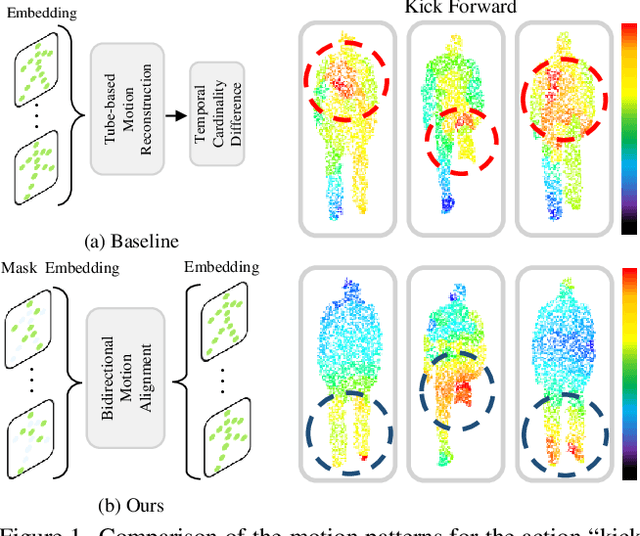
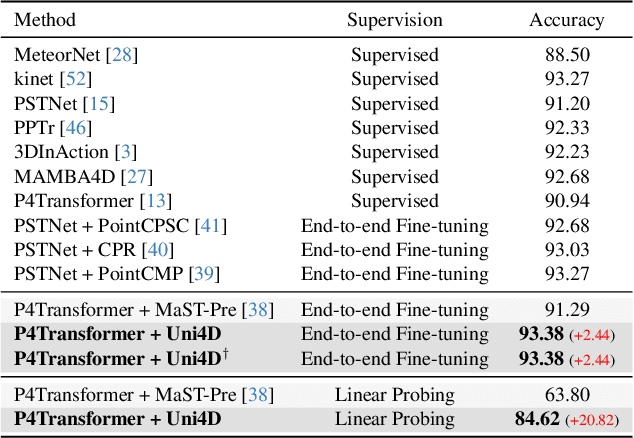
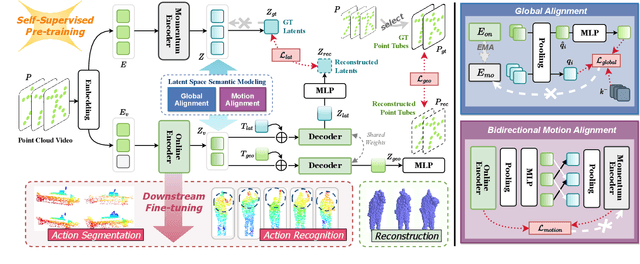
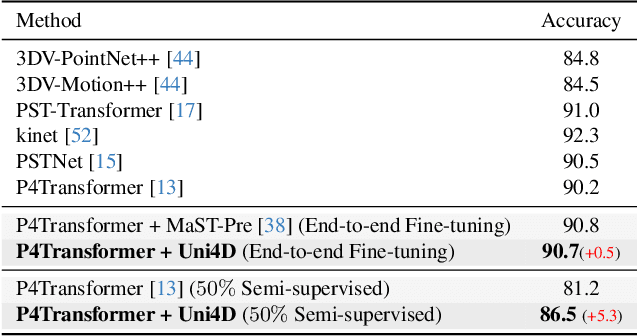
Point cloud video representation learning is primarily built upon the masking strategy in a self-supervised manner. However, the progress is slow due to several significant challenges: (1) existing methods learn the motion particularly with hand-crafted designs, leading to unsatisfactory motion patterns during pre-training which are non-transferable on fine-tuning scenarios. (2) previous Masked AutoEncoder (MAE) frameworks are limited in resolving the huge representation gap inherent in 4D data. In this study, we introduce the first self-disentangled MAE for learning discriminative 4D representations in the pre-training stage. To address the first challenge, we propose to model the motion representation in a latent space. The second issue is resolved by introducing the latent tokens along with the typical geometry tokens to disentangle high-level and low-level features during decoding. Extensive experiments on MSR-Action3D, NTU-RGBD, HOI4D, NvGesture, and SHREC'17 verify this self-disentangled learning framework. We demonstrate that it can boost the fine-tuning performance on all 4D tasks, which we term Uni4D. Our pre-trained model presents discriminative and meaningful 4D representations, particularly benefits processing long videos, as Uni4D gets $+3.8\%$ segmentation accuracy on HOI4D, significantly outperforming either self-supervised or fully-supervised methods after end-to-end fine-tuning.