 Add to Chrome
 Add to Firefox
 Add to Edge
On the Performance of Malware Detection Classifiers Using Hardware Performance Counters
Aug 02, 2026
Malware detection using Hardware Performance Counters (HPC) has emerged as a promising solution to improve the security of computing systems as a complement to antivirus software. Hardware-based malware detectors (HMD) use Machine Learning (ML) classifiers to detect malicious application patterns. The inputs to ML classifiers are low-level performance features known as HPCs, hardware-related activity data collected from a processor at run time to profile the low-level microarchitectural behavior of an application. This paper proposes malware detection using HPCs and machine learning classifiers and highlights the effectiveness of malware detection at run-time. We use ensemble learning techniques to improve the performance of the hardware-based malware detectors, which reduces the number of necessary micro-architectural events. This improves the processor's efficiency by eliminating the need to run an application several times since a processor can measure only 2 to 8 events at a cycle. We use 18 machine-learning models along with two ensemble learning methods to evaluate the malware detection performance, creating a total of 144 different configurations. The experimental results show that the ensemble learning-based malware detection with 2 HPCs using the ensemble technique outperforms standard classifiers with 8 HPCs by up to 10%. It also matches the performance of standard ML-based detectors that use 16 HPCs while requiring only 4 HPCs, thereby enabling effective run-time malware detection.

Scalable MatMul-free Language Modeling
Jun 04, 2024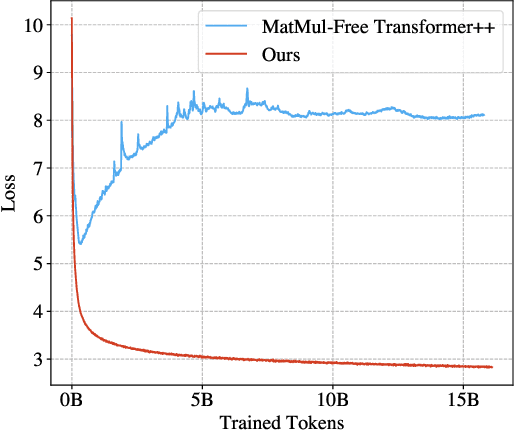
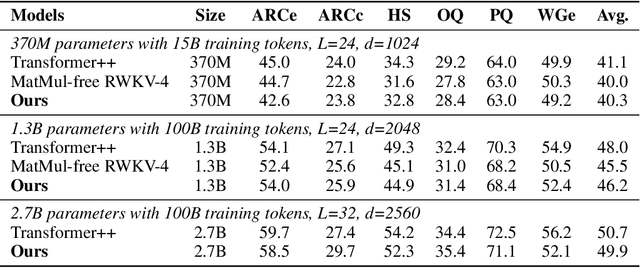
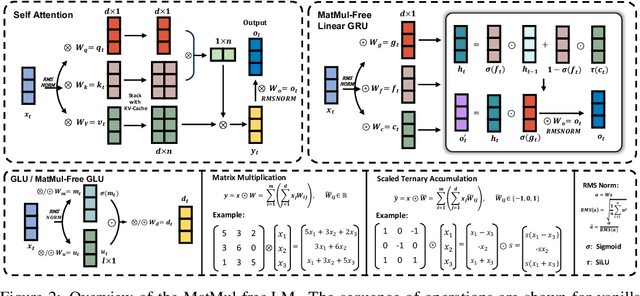
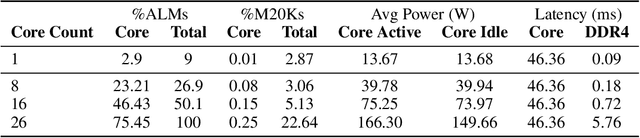
Matrix multiplication (MatMul) typically dominates the overall computational cost of large language models (LLMs). This cost only grows as LLMs scale to larger embedding dimensions and context lengths. In this work, we show that MatMul operations can be completely eliminated from LLMs while maintaining strong performance at billion-parameter scales. Our experiments show that our proposed MatMul-free models achieve performance on-par with state-of-the-art Transformers that require far more memory during inference at a scale up to at least 2.7B parameters. We investigate the scaling laws and find that the performance gap between our MatMul-free models and full precision Transformers narrows as the model size increases. We also provide a GPU-efficient implementation of this model which reduces memory usage by up to 61% over an unoptimized baseline during training. By utilizing an optimized kernel during inference, our model's memory consumption can be reduced by more than 10x compared to unoptimized models. To properly quantify the efficiency of our architecture, we build a custom hardware solution on an FPGA which exploits lightweight operations beyond what GPUs are capable of. We processed billion-parameter scale models at 13W beyond human readable throughput, moving LLMs closer to brain-like efficiency. This work not only shows how far LLMs can be stripped back while still performing effectively, but also points at the types of operations future accelerators should be optimized for in processing the next generation of lightweight LLMs. Our code implementation is available at \url{https://github.com/ridgerchu/matmulfreellm}.