 Add to Chrome
 Add to Firefox
 Add to Edge
Vision-Based Tactile Intelligence for Robotics: Sensing, Learning, and Embodied Manipulation
Aug 16, 2026
Tactile sensing is essential for robots in contact-rich tasks, yet many tactile sensors still provide sparse, low-dimensional signals that do not capture sufficient information for complex robotic perception and interaction. Vision-based tactile sensors (VBTSs) offer a powerful alternative by con-verting contact-induced deformation of a soft interface into im-ages. The image-based formulation gives VBTSs high-resolution, information-rich tactile observations that enable complex robotic tasks. This review surveys the full VBTS pipeline and treats sensing hardware, learning methods, simulation, and datasets as an integrated sensing-and-learning system. We 1) organize representative VBTSs into a hardware taxonomy structured by deformable elastomer design, sensor size and shape, and optical system design to guide future sensor development; 2) present a hierarchical view of learning-based tactile intelligence from low-level signal understanding to task-level policies and foundation models; and 3) examine simulation platforms and tactile datasets as a scaling layer, together with sim-to-real transfer and cross-sensor adaptation for training, benchmarking, and deployment. Finally, we identify open challenges and future directions for VBTSs in robotics. By providing a holistic view of how hardware, AI architectures, simulation, and datasets interact, this review aims to advance tactile intelligence for contact-rich robotic tasks.

PhysV2A: Reachability-Gated and Semantic-Mask-Constrained Feasibility Completion for Video-to-Robot Manipulation
Jul 10, 2026Video-based manipulation provides object-centric motion priors from human demonstrations, generated videos, or RGB-D observations, but such priors are typically embodiment-agnostic and cannot be directly executed by a specific robot. This paper presents \textbf{PhysV2A}, a reachability-gated and semantic-mask-constrained feasibility-completion framework for converting video-derived 6D object motion into robot-executable manipulation trajectories. The key idea is to treat grasp feasibility as trajectory-conditioned rather than local: each RGB-D-generated 6-DoF grasp candidate is rigidly coupled with the recovered object motion to form a grasp-conditioned TCP trajectory hypothesis. PhysV2A then performs hierarchical reachability-gated selection, where infeasible grasp--trajectory pairs are rejected by robot-centric kinematic checks and surviving candidates are ranked by downstream execution suitability. For the selected reachable trajectory, a VLM-assisted and rule-validated S-Mask identifies task-critical and relaxable Cartesian components, enabling semantic-mask-constrained manipulability refinement through redundancy-first optimization and bounded Cartesian relaxation. Real-robot experiments on four tabletop manipulation tasks show that PhysV2A improves task success over representative video-prior and IK-only baselines, reduces kinematic-feasibility failures, and produces better-conditioned trajectories with bounded semantic deviations.
GenVid2Robot: From Video Generation to Robot Manipulation via Rigid-Geometric Consistency
Jul 10, 2026Generated videos provide useful visual motion priors for robot manipulation, but their visual plausibility does not imply physical executability. A generated video usually lacks metric geometry, grasp grounding, robot kinematic feasibility, and execution-time feedback, which makes direct trajectory replay unreliable in real-world manipulation. This paper presents GenVid2Robot, a rigid-geometric consistency framework that converts generated video motion into executable real-robot manipulation trajectories. Given an initial RGB-D observation and a task instruction, GenVid2Robot samples task-relevant semantic anchors from the real first frame, tracks these anchors through generated video candidates, and verifies whether the resulting 2D motion can be explained by first-frame RGB-D anchors under a sparse relative $SE(3)$ model. In this way, generated videos are treated as uncertain visual motion hypotheses rather than direct robot demonstrations. Only geometrically consistent motion is transferred to the robot. The accepted relative motion is then applied to the real grasp-time TCP pose selected by mask-constrained grasping, producing a grasp-conditioned execution trajectory that is consistent with both the visual motion prior and the physical grasp configuration. To reduce execution mismatch caused by RGB-D noise, calibration residuals, and small contact-induced displacement, a bounded depth-compensation module corrects local depth-direction errors without assuming full online replanning. Real-robot experiments demonstrate that GenVid2Robot improves the reliability of generated-video-guided manipulation by grounding visual motion priors with sparse metric geometry, grasp constraints, robot feasibility checking, and bounded execution feedback.
RTE-FM-Dehazer: Radiative Transfer Equation Inspired Flow Matching for Real-World Image Dehazing
Jul 02, 2026Single-image dehazing aims to recover a clear scene from a hazy image and is generally formulated as an image-to-image translation task; however, it faces two limitations. Its performance depends heavily on the haze-formation priors embedded in the model. Prevailing methods adopt the Atmospheric Scattering Model (ASM), whose assumptions of single scattering and homogeneous media are often violated, leading to residual haze and color drift. Moreover, large-scale real hazy/clear pairs are impractical to collect, and existing synthesis approaches fail to reproduce the full complexity of natural haze. To address these issues, we present RTE-FM-Dehazer, a novel dehazing approach, together with a scalable data pipeline. Unlike the ASM, the Radiative Transfer Equation (RTE) jointly accounts for both scattering and absorption, naturally accommodating the non-homogeneous, multiple-scattering media that characterize real hazy scenes. Motivated by the structural similarity between the RTE diffusion-absorption term and the ODE in flow matching, we introduce a diffusion-absorption regularizer derived from a reduced RTE, to steer the flow matching trajectory at each step. Next, leveraging modern vision-language models, we build an automated pipeline and release P-HAZE, a dataset of 50000 realistic hazy/clear pairs. Extensive evaluations demonstrate that RTE-FM-Dehazer, trained solely on P-HAZE, effectively eliminates artifacts like residual haze and color drift, exhibits strong cross-domain generalization, and achieves leading results on five real-world dehazing benchmarks.
DreamKG: A KG-Augmented Conversational System for People Experiencing Homelessness
Apr 13, 2026People experiencing homelessness (PEH) face substantial barriers to accessing timely, accurate information about community services. DreamKG addresses this through a knowledge graph-augmented conversational system that grounds responses in verified, up-to-date data about Philadelphia organizations, services, locations, and hours. Unlike standard large language models (LLMs) prone to hallucinations, DreamKG combines Neo4j knowledge graphs with structured query understanding to handle location-aware and time-sensitive queries reliably. The system performs spatial reasoning for distance-based recommendations and temporal filtering for operating hours. Preliminary evaluation shows 59% superiority over Google Search AI on relevant queries and 84% rejection of irrelevant queries. This demonstration highlights the potential of hybrid architectures that combines LLM flexibility with knowledge graph reliability to improve service accessibility for vulnerable populations effectively.
UPETrack: Unidirectional Position Estimation for Tracking Occluded Deformable Linear Objects
Dec 10, 2025Real-time state tracking of Deformable Linear Objects (DLOs) is critical for enabling robotic manipulation of DLOs in industrial assembly, medical procedures, and daily-life applications. However, the high-dimensional configuration space, nonlinear dynamics, and frequent partial occlusions present fundamental barriers to robust real-time DLO tracking. To address these limitations, this study introduces UPETrack, a geometry-driven framework based on Unidirectional Position Estimation (UPE), which facilitates tracking without the requirement for physical modeling, virtual simulation, or visual markers. The framework operates in two phases: (1) visible segment tracking is based on a Gaussian Mixture Model (GMM) fitted via the Expectation Maximization (EM) algorithm, and (2) occlusion region prediction employing UPE algorithm we proposed. UPE leverages the geometric continuity inherent in DLO shapes and their temporal evolution patterns to derive a closed-form positional estimator through three principal mechanisms: (i) local linear combination displacement term, (ii) proximal linear constraint term, and (iii) historical curvature term. This analytical formulation allows efficient and stable estimation of occluded nodes through explicit linear combinations of geometric components, eliminating the need for additional iterative optimization. Experimental results demonstrate that UPETrack surpasses two state-of-the-art tracking algorithms, including TrackDLO and CDCPD2, in both positioning accuracy and computational efficiency.
A Fast Method for Planning All Optimal Homotopic Configurations for Tethered Robots and Its Extended Applications
Jul 16, 2025Tethered robots play a pivotal role in specialized environments such as disaster response and underground exploration, where their stable power supply and reliable communication offer unparalleled advantages. However, their motion planning is severely constrained by tether length limitations and entanglement risks, posing significant challenges to achieving optimal path planning. To address these challenges, this study introduces CDT-TCS (Convex Dissection Topology-based Tethered Configuration Search), a novel algorithm that leverages CDT Encoding as a homotopy invariant to represent topological states of paths. By integrating algebraic topology with geometric optimization, CDT-TCS efficiently computes the complete set of optimal feasible configurations for tethered robots at all positions in 2D environments through a single computation. Building on this foundation, we further propose three application-specific algorithms: i) CDT-TPP for optimal tethered path planning, ii) CDT-TMV for multi-goal visiting with tether constraints, iii) CDT-UTPP for distance-optimal path planning of untethered robots. All theoretical results and propositions underlying these algorithms are rigorously proven and thoroughly discussed in this paper. Extensive simulations demonstrate that the proposed algorithms significantly outperform state-of-the-art methods in their respective problem domains. Furthermore, real-world experiments on robotic platforms validate the practicality and engineering value of the proposed framework.
PCF-Grasp: Converting Point Completion to Geometry Feature to Enhance 6-DoF Grasp
Apr 22, 2025The 6-Degree of Freedom (DoF) grasp method based on point clouds has shown significant potential in enabling robots to grasp target objects. However, most existing methods are based on the point clouds (2.5D points) generated from single-view depth images. These point clouds only have one surface side of the object providing incomplete geometry information, which mislead the grasping algorithm to judge the shape of the target object, resulting in low grasping accuracy. Humans can accurately grasp objects from a single view by leveraging their geometry experience to estimate object shapes. Inspired by humans, we propose a novel 6-DoF grasping framework that converts the point completion results as object shape features to train the 6-DoF grasp network. Here, point completion can generate approximate complete points from the 2.5D points similar to the human geometry experience, and converting it as shape features is the way to utilize it to improve grasp efficiency. Furthermore, due to the gap between the network generation and actual execution, we integrate a score filter into our framework to select more executable grasp proposals for the real robot. This enables our method to maintain a high grasp quality in any camera viewpoint. Extensive experiments demonstrate that utilizing complete point features enables the generation of significantly more accurate grasp proposals and the inclusion of a score filter greatly enhances the credibility of real-world robot grasping. Our method achieves a 17.8\% success rate higher than the state-of-the-art method in real-world experiments.
Non-Prehensile Tool-Object Manipulation by Integrating LLM-Based Planning and Manoeuvrability-Driven Controls
Dec 09, 2024The ability to wield tools was once considered exclusive to human intelligence, but it's now known that many other animals, like crows, possess this capability. Yet, robotic systems still fall short of matching biological dexterity. In this paper, we investigate the use of Large Language Models (LLMs), tool affordances, and object manoeuvrability for non-prehensile tool-based manipulation tasks. Our novel method leverages LLMs based on scene information and natural language instructions to enable symbolic task planning for tool-object manipulation. This approach allows the system to convert the human language sentence into a sequence of feasible motion functions. We have developed a novel manoeuvrability-driven controller using a new tool affordance model derived from visual feedback. This controller helps guide the robot's tool utilization and manipulation actions, even within confined areas, using a stepping incremental approach. The proposed methodology is evaluated with experiments to prove its effectiveness under various manipulation scenarios.
Fine-Grained Alignment in Vision-and-Language Navigation through Bayesian Optimization
Nov 22, 2024
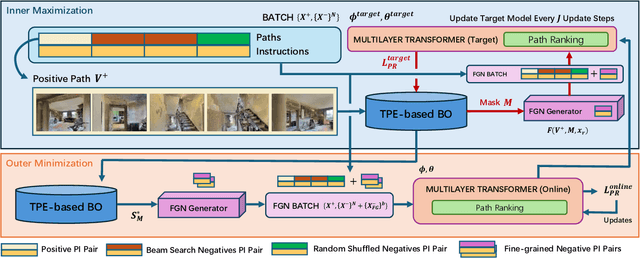


This paper addresses the challenge of fine-grained alignment in Vision-and-Language Navigation (VLN) tasks, where robots navigate realistic 3D environments based on natural language instructions. Current approaches use contrastive learning to align language with visual trajectory sequences. Nevertheless, they encounter difficulties with fine-grained vision negatives. To enhance cross-modal embeddings, we introduce a novel Bayesian Optimization-based adversarial optimization framework for creating fine-grained contrastive vision samples. To validate the proposed methodology, we conduct a series of experiments to assess the effectiveness of the enriched embeddings on fine-grained vision negatives. We conduct experiments on two common VLN benchmarks R2R and REVERIE, experiments on the them demonstrate that these embeddings benefit navigation, and can lead to a promising performance enhancement. Our source code and trained models are available at: https://anonymous.4open.science/r/FGVLN.