 Add to Chrome
 Add to Firefox
 Add to Edge
Detecting Voice Cloning Attacks via Timbre Watermarking
Dec 06, 2023
Nowadays, it is common to release audio content to the public. However, with the rise of voice cloning technology, attackers have the potential to easily impersonate a specific person by utilizing his publicly released audio without any permission. Therefore, it becomes significant to detect any potential misuse of the released audio content and protect its timbre from being impersonated. To this end, we introduce a novel concept, "Timbre Watermarking", which embeds watermark information into the target individual's speech, eventually defeating the voice cloning attacks. To ensure the watermark is robust to the voice cloning model's learning process, we design an end-to-end voice cloning-resistant detection framework. The core idea of our solution is to embed and extract the watermark in the frequency domain in a temporally invariant manner. To acquire generalization across different voice cloning attacks, we modulate their shared process and integrate it into our framework as a distortion layer. Experiments demonstrate that the proposed timbre watermarking can defend against different voice cloning attacks, exhibit strong resistance against various adaptive attacks (e.g., reconstruction-based removal attacks, watermark overwriting attacks), and achieve practicality in real-world services such as PaddleSpeech, Voice-Cloning-App, and so-vits-svc. In addition, ablation studies are also conducted to verify the effectiveness of our design. Some audio samples are available at https://timbrewatermarking.github.io/samples.

Towards More Unified In-context Visual Understanding
Dec 05, 2023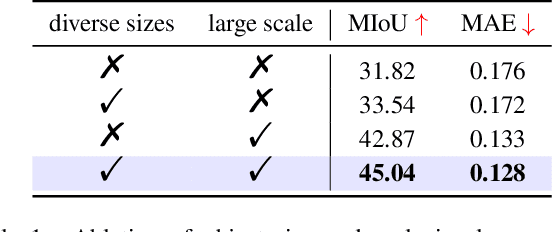
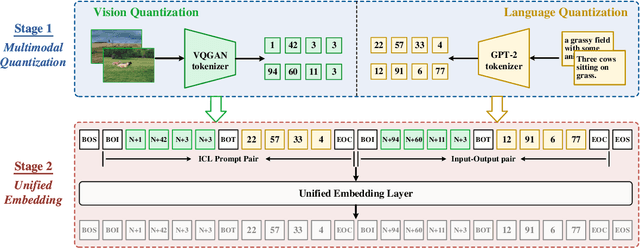
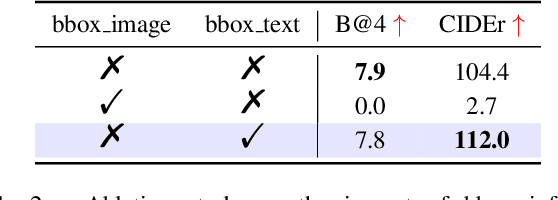
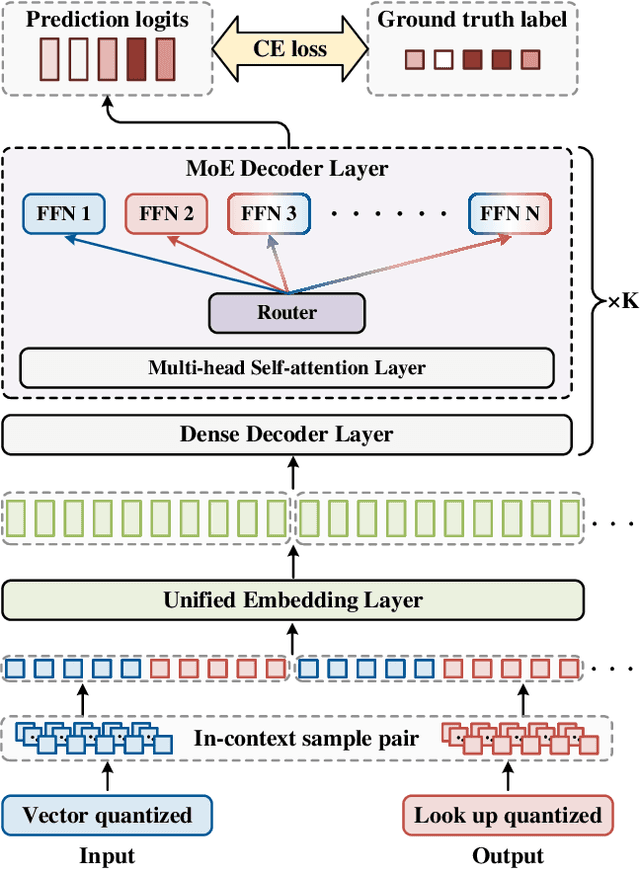
The rapid advancement of large language models (LLMs) has accelerated the emergence of in-context learning (ICL) as a cutting-edge approach in the natural language processing domain. Recently, ICL has been employed in visual understanding tasks, such as semantic segmentation and image captioning, yielding promising results. However, existing visual ICL framework can not enable producing content across multiple modalities, which limits their potential usage scenarios. To address this issue, we present a new ICL framework for visual understanding with multi-modal output enabled. First, we quantize and embed both text and visual prompt into a unified representational space, structured as interleaved in-context sequences. Then a decoder-only sparse transformer architecture is employed to perform generative modeling on them, facilitating in-context learning. Thanks to this design, the model is capable of handling in-context vision understanding tasks with multimodal output in a unified pipeline. Experimental results demonstrate that our model achieves competitive performance compared with specialized models and previous ICL baselines. Overall, our research takes a further step toward unified multimodal in-context learning.
OPERA: Alleviating Hallucination in Multi-Modal Large Language Models via Over-Trust Penalty and Retrospection-Allocation
Nov 29, 2023Hallucination, posed as a pervasive challenge of multi-modal large language models (MLLMs), has significantly impeded their real-world usage that demands precise judgment. Existing methods mitigate this issue with either training with specific designed data or inferencing with external knowledge from other sources, incurring inevitable additional costs. In this paper, we present OPERA, a novel MLLM decoding method grounded in an Over-trust Penalty and a Retrospection-Allocation strategy, serving as a nearly free lunch to alleviate the hallucination issue without additional data, knowledge, or training. Our approach begins with an interesting observation that, most hallucinations are closely tied to the knowledge aggregation patterns manifested in the self-attention matrix, i.e., MLLMs tend to generate new tokens by focusing on a few summary tokens, but not all the previous tokens. Such partial over-trust inclination results in the neglecting of image tokens and describes the image content with hallucination. Statistically, we observe an 80%$\sim$95% co-currency rate between hallucination contents and such knowledge aggregation patterns. Based on the observation, OPERA introduces a penalty term on the model logits during the beam-search decoding to mitigate the over-trust issue, along with a rollback strategy that retrospects the presence of summary tokens in the previously generated tokens, and re-allocate the token selection if necessary. With extensive experiments, OPERA shows significant hallucination-mitigating performance on different MLLMs and metrics, proving its effectiveness and generality. Our code is available at: https://github.com/shikiw/OPERA.
CMFDFormer: Transformer-based Copy-Move Forgery Detection with Continual Learning
Nov 22, 2023Copy-move forgery detection aims at detecting duplicated regions in a suspected forged image, and deep learning based copy-move forgery detection methods are in the ascendant. These deep learning based methods heavily rely on synthetic training data, and the performance will degrade when facing new tasks. In this paper, we propose a Transformer-style copy-move forgery detection network named as CMFDFormer, and provide a novel PCSD (Pooled Cube and Strip Distillation) continual learning framework to help CMFDFormer handle new tasks. CMFDFormer consists of a MiT (Mix Transformer) backbone network and a PHD (Pluggable Hybrid Decoder) mask prediction network. The MiT backbone network is a Transformer-style network which is adopted on the basis of comprehensive analyses with CNN-style and MLP-style backbones. The PHD network is constructed based on self-correlation computation, hierarchical feature integration, a multi-scale cycle fully-connected block and a mask reconstruction block. The PHD network is applicable to feature extractors of different styles for hierarchical multi-scale information extraction, achieving comparable performance. Last but not least, we propose a PCSD continual learning framework to improve the forgery detectability and avoid catastrophic forgetting when handling new tasks. Our continual learning framework restricts intermediate features from the PHD network, and takes advantage of both cube pooling and strip pooling. Extensive experiments on publicly available datasets demonstrate the good performance of CMFDFormer and the effectiveness of the PCSD continual learning framework.
Segue: Side-information Guided Generative Unlearnable Examples for Facial Privacy Protection in Real World
Oct 24, 2023The widespread use of face recognition technology has given rise to privacy concerns, as many individuals are worried about the collection and utilization of their facial data. To address these concerns, researchers are actively exploring the concept of ``unlearnable examples", by adding imperceptible perturbation to data in the model training stage, which aims to prevent the model from learning discriminate features of the target face. However, current methods are inefficient and cannot guarantee transferability and robustness at the same time, causing impracticality in the real world. To remedy it, we propose a novel method called Segue: Side-information guided generative unlearnable examples. Specifically, we leverage a once-trained multiple-used model to generate the desired perturbation rather than the time-consuming gradient-based method. To improve transferability, we introduce side information such as true labels and pseudo labels, which are inherently consistent across different scenarios. For robustness enhancement, a distortion layer is integrated into the training pipeline. Extensive experiments demonstrate that the proposed Segue is much faster than previous methods (1000$\times$) and achieves transferable effectiveness across different datasets and model architectures. Furthermore, it can resist JPEG compression, adversarial training, and some standard data augmentations.
HairCLIPv2: Unifying Hair Editing via Proxy Feature Blending
Oct 16, 2023
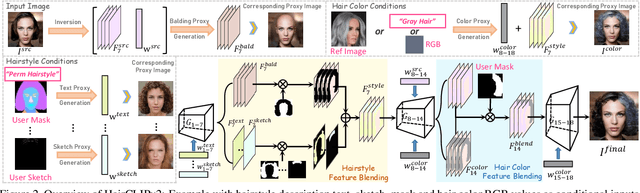
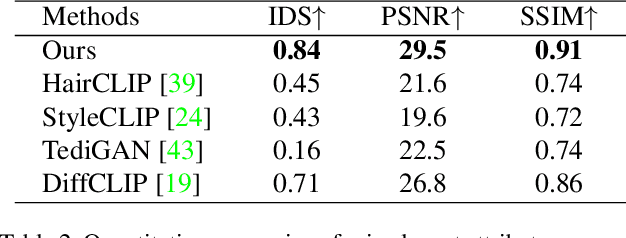

Hair editing has made tremendous progress in recent years. Early hair editing methods use well-drawn sketches or masks to specify the editing conditions. Even though they can enable very fine-grained local control, such interaction modes are inefficient for the editing conditions that can be easily specified by language descriptions or reference images. Thanks to the recent breakthrough of cross-modal models (e.g., CLIP), HairCLIP is the first work that enables hair editing based on text descriptions or reference images. However, such text-driven and reference-driven interaction modes make HairCLIP unable to support fine-grained controls specified by sketch or mask. In this paper, we propose HairCLIPv2, aiming to support all the aforementioned interactions with one unified framework. Simultaneously, it improves upon HairCLIP with better irrelevant attributes (e.g., identity, background) preservation and unseen text descriptions support. The key idea is to convert all the hair editing tasks into hair transfer tasks, with editing conditions converted into different proxies accordingly. The editing effects are added upon the input image by blending the corresponding proxy features within the hairstyle or hair color feature spaces. Besides the unprecedented user interaction mode support, quantitative and qualitative experiments demonstrate the superiority of HairCLIPv2 in terms of editing effects, irrelevant attribute preservation and visual naturalness. Our code is available at \url{https://github.com/wty-ustc/HairCLIPv2}.
Exploiting Modality-Specific Features For Multi-Modal Manipulation Detection And Grounding
Sep 22, 2023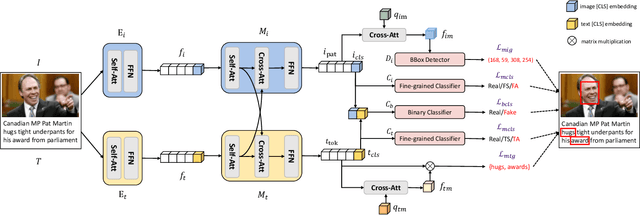
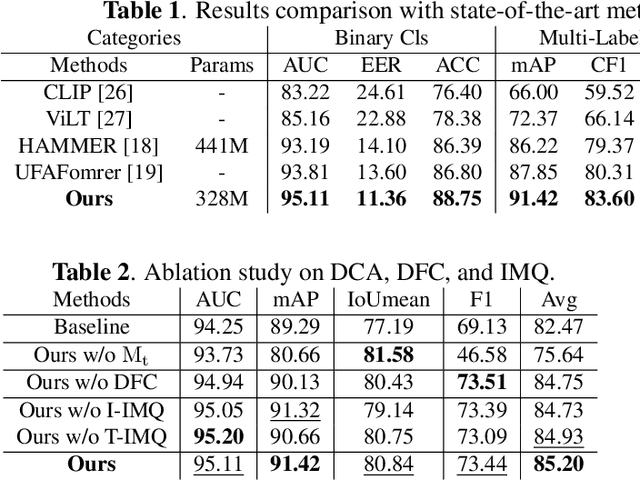
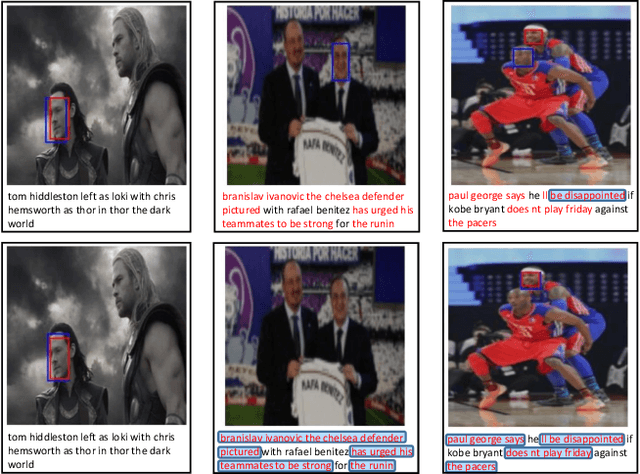
AI-synthesized text and images have gained significant attention, particularly due to the widespread dissemination of multi-modal manipulations on the internet, which has resulted in numerous negative impacts on society. Existing methods for multi-modal manipulation detection and grounding primarily focus on fusing vision-language features to make predictions, while overlooking the importance of modality-specific features, leading to sub-optimal results. In this paper, we construct a simple and novel transformer-based framework for multi-modal manipulation detection and grounding tasks. Our framework simultaneously explores modality-specific features while preserving the capability for multi-modal alignment. To achieve this, we introduce visual/language pre-trained encoders and dual-branch cross-attention (DCA) to extract and fuse modality-unique features. Furthermore, we design decoupled fine-grained classifiers (DFC) to enhance modality-specific feature mining and mitigate modality competition. Moreover, we propose an implicit manipulation query (IMQ) that adaptively aggregates global contextual cues within each modality using learnable queries, thereby improving the discovery of forged details. Extensive experiments on the $\rm DGM^4$ dataset demonstrate the superior performance of our proposed model compared to state-of-the-art approaches.
Improving Adversarial Robustness of Masked Autoencoders via Test-time Frequency-domain Prompting
Aug 22, 2023In this paper, we investigate the adversarial robustness of vision transformers that are equipped with BERT pretraining (e.g., BEiT, MAE). A surprising observation is that MAE has significantly worse adversarial robustness than other BERT pretraining methods. This observation drives us to rethink the basic differences between these BERT pretraining methods and how these differences affect the robustness against adversarial perturbations. Our empirical analysis reveals that the adversarial robustness of BERT pretraining is highly related to the reconstruction target, i.e., predicting the raw pixels of masked image patches will degrade more adversarial robustness of the model than predicting the semantic context, since it guides the model to concentrate more on medium-/high-frequency components of images. Based on our analysis, we provide a simple yet effective way to boost the adversarial robustness of MAE. The basic idea is using the dataset-extracted domain knowledge to occupy the medium-/high-frequency of images, thus narrowing the optimization space of adversarial perturbations. Specifically, we group the distribution of pretraining data and optimize a set of cluster-specific visual prompts on frequency domain. These prompts are incorporated with input images through prototype-based prompt selection during test period. Extensive evaluation shows that our method clearly boost MAE's adversarial robustness while maintaining its clean performance on ImageNet-1k classification. Our code is available at: https://github.com/shikiw/RobustMAE.
MotionGPT: Finetuned LLMs are General-Purpose Motion Generators
Jun 19, 2023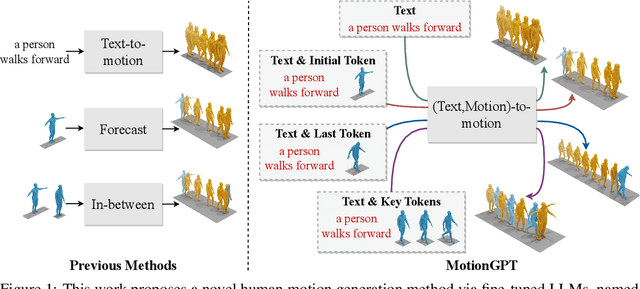
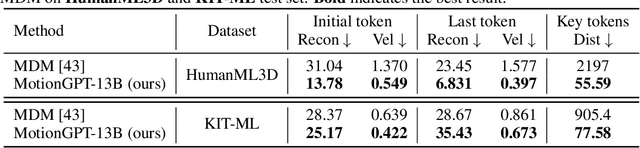
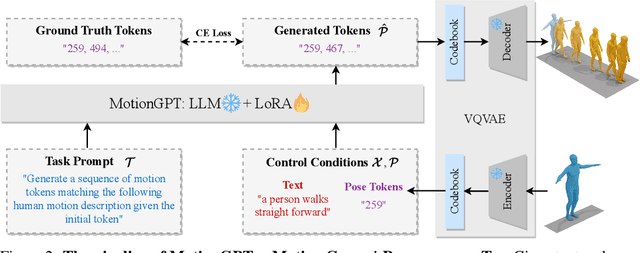
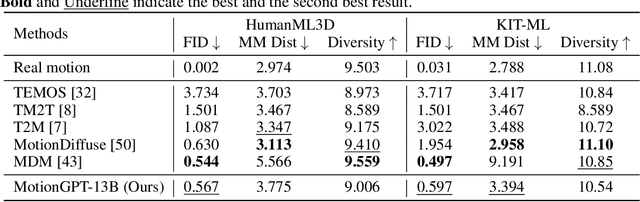
Generating realistic human motion from given action descriptions has experienced significant advancements because of the emerging requirement of digital humans. While recent works have achieved impressive results in generating motion directly from textual action descriptions, they often support only a single modality of the control signal, which limits their application in the real digital human industry. This paper presents a Motion General-Purpose generaTor (MotionGPT) that can use multimodal control signals, e.g., text and single-frame poses, for generating consecutive human motions by treating multimodal signals as special input tokens in large language models (LLMs). Specifically, we first quantize multimodal control signals into discrete codes and then formulate them in a unified prompt instruction to ask the LLMs to generate the motion answer. Our MotionGPT demonstrates a unified human motion generation model with multimodal control signals by tuning a mere 0.4% of LLM parameters. To the best of our knowledge, MotionGPT is the first method to generate human motion by multimodal control signals, which we hope can shed light on this new direction. Codes shall be released upon acceptance.
EVOPOSE: A Recursive Transformer For 3D Human Pose Estimation With Kinematic Structure Priors
Jun 16, 2023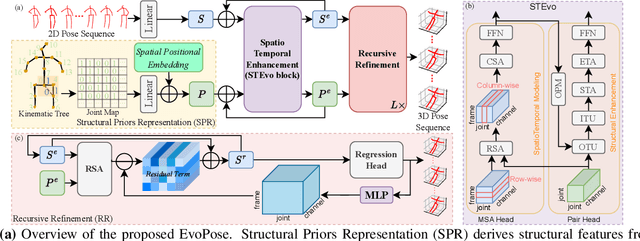
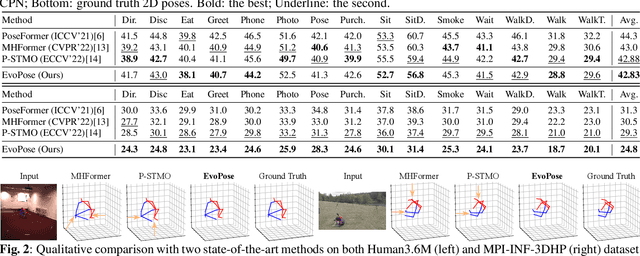
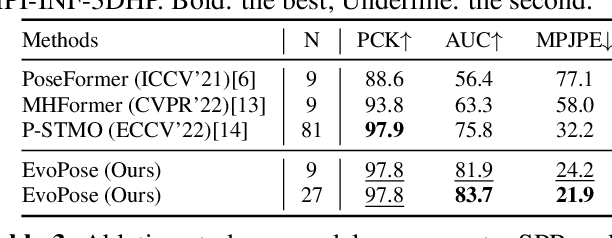
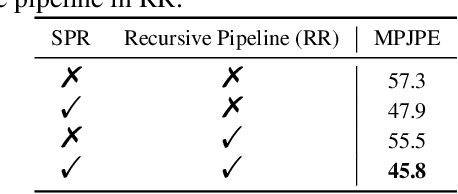
Transformer is popular in recent 3D human pose estimation, which utilizes long-term modeling to lift 2D keypoints into the 3D space. However, current transformer-based methods do not fully exploit the prior knowledge of the human skeleton provided by the kinematic structure. In this paper, we propose a novel transformer-based model EvoPose to introduce the human body prior knowledge for 3D human pose estimation effectively. Specifically, a Structural Priors Representation (SPR) module represents human priors as structural features carrying rich body patterns, e.g. joint relationships. The structural features are interacted with 2D pose sequences and help the model to achieve more informative spatiotemporal features. Moreover, a Recursive Refinement (RR) module is applied to refine the 3D pose outputs by utilizing estimated results and further injects human priors simultaneously. Extensive experiments demonstrate the effectiveness of EvoPose which achieves a new state of the art on two most popular benchmarks, Human3.6M and MPI-INF-3DHP.