 Add to Chrome
 Add to Firefox
 Add to Edge
Advancing Aesthetic Image Generation via Composition Transfer
May 06, 2026
Composition is a cornerstone of visual aesthetics, influencing the appeal of an image. While its principles operate independently of specific content, in practice, composition is often coupled with semantics. As a result, existing methods often enhance composition either through implicit learning or by semantics-based layout control, rather than explicitly modeling composition itself. To address this gap, we introduce Composer, a framework rooted in aesthetic theory, designed to model composition in a semantic-agnostic manner. First, it supports composition transfer by extracting key composition-aware representations from a reference image and leveraging a tailored conditional guidance module to control composition based on pre-trained diffusion models. Second, when users specify only text themes without a composition reference, Composer supports theme-driven composition retrieval by leveraging the in-context learning capabilities of Large Vision-Language Models (LVLMs), achieving explicit composition planning. To enhance composition in a reference-free mode, we conduct text-to-composition fine-tuning on the trained control module to enable implicit composition planning. Furthermore, we curated a high-quality dataset comprising 2 million image-text pairs using state-of-the-art generative models to support model training. Experimental results demonstrate that Composer significantly enhances aesthetic quality in text-to-image tasks and facilitates personalized composition control and transfer, offering users precision and flexibility in the creative process.

EchoGen: Cycle-Consistent Learning for Unified Layout-Image Generation and Understanding
Mar 18, 2026In this work, we present EchoGen, a unified framework for layout-to-image generation and image grounding, capable of generating images with accurate layouts and high fidelity to text descriptions (e.g., spatial relationships), while grounding the image robustly at the same time. We believe that image grounding possesses strong text and layout understanding abilities, which can compensate for the corresponding limitations in layout-to-image generation. At the same time, images generated from layouts exhibit high diversity in content, thereby enhancing the robustness of image grounding. Jointly training both tasks within a unified model can promote performance improvements for each. However, we identify that this joint training paradigm encounters several optimization challenges and results in restricted performance. To address these issues, we propose progressive training strategies. First, the Parallel Multi-Task Pre-training (PMTP) stage equips the model with basic abilities for both tasks, leveraging shared tokens to accelerate training. Next, the Dual Joint Optimization (DJO) stage exploits task duality to sequentially integrate the two tasks, enabling unified optimization. Finally, the Cycle RL stage eliminates reliance on visual supervision by using consistency constraints as rewards, significantly enhancing the model's unified capabilities via the GRPO strategy. Extensive experiments demonstrate state-of-the-art results on both layout-to-image generation and image grounding benchmarks, and reveal clear synergistic gains from optimizing the two tasks together.
* 9 pages, Accepted at the 40th AAAI Conference on Artificial Intelligence (AAAI 2026)
A scalable neural bundle map for multiphysics prediction in lithium-ion battery across varying configurations
Mar 17, 2026Efficient and accurate prediction of Multiphysics evolution across diverse cell geometries is fundamental to the design, management and safety of lithium-ion batteries. However, existing computational frameworks struggle to capture the coupled electrochemical, thermal, and mechanical dynamics across diverse cell geometries and varying operating conditions. Here, we present a Neural Bundle Map (NBM), a mathematically rigorous framework that reformulates multiphysics evolution as a bundle map over a geometric base manifold. This approach enables the complete decoupling of geometric complexity from underlying physical laws, ensuring strong operator continuity across varying domains. Our framework achieves high-fidelity spatiotemporal predictions with a normalized mean absolute error of less than 1% across varying configurations, while maintaining stability during long-horizon forecasting far beyond the training window and reducing computational costs by two orders of magnitude compared with conventional solvers. Leveraging this capability, we rapidly explored a vast configurational space to identify an optimal battery design that yields a 38% increase in energy density while adhering to thermal safety constraints. Furthermore, the NBM demonstrates remarkable scalability to multi-cell systems through few-shot transfer learning, providing a foundational paradigm for the intelligent design and real-time monitoring of complex energy storage infrastructures.
The Llama 4 Herd: Architecture, Training, Evaluation, and Deployment Notes
Jan 15, 2026This document consolidates publicly reported technical details about Metas Llama 4 model family. It summarizes (i) released variants (Scout and Maverick) and the broader herd context including the previewed Behemoth teacher model, (ii) architectural characteristics beyond a high-level MoE description covering routed/shared-expert structure, early-fusion multimodality, and long-context design elements reported for Scout (iRoPE and length generalization strategies), (iii) training disclosures spanning pre-training, mid-training for long-context extension, and post-training methodology (lightweight SFT, online RL, and lightweight DPO) as described in release materials, (iv) developer-reported benchmark results for both base and instruction-tuned checkpoints, and (v) practical deployment constraints observed across major serving environments, including provider-specific context limits and quantization packaging. The manuscript also summarizes licensing obligations relevant to redistribution and derivative naming, and reviews publicly described safeguards and evaluation practices. The goal is to provide a compact technical reference for researchers and practitioners who need precise, source-backed facts about Llama 4.
Efficient Speculative Decoding for Llama at Scale: Challenges and Solutions
Aug 11, 2025Speculative decoding is a standard method for accelerating the inference speed of large language models. However, scaling it for production environments poses several engineering challenges, including efficiently implementing different operations (e.g., tree attention and multi-round speculative decoding) on GPU. In this paper, we detail the training and inference optimization techniques that we have implemented to enable EAGLE-based speculative decoding at a production scale for Llama models. With these changes, we achieve a new state-of-the-art inference latency for Llama models. For example, Llama4 Maverick decodes at a speed of about 4 ms per token (with a batch size of one) on 8 NVIDIA H100 GPUs, which is 10% faster than the previously best known method. Furthermore, for EAGLE-based speculative decoding, our optimizations enable us to achieve a speed-up for large batch sizes between 1.4x and 2.0x at production scale.
VAEmo: Efficient Representation Learning for Visual-Audio Emotion with Knowledge Injection
May 05, 2025
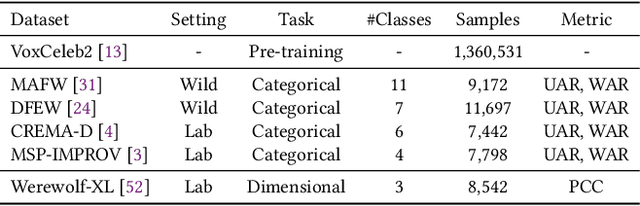
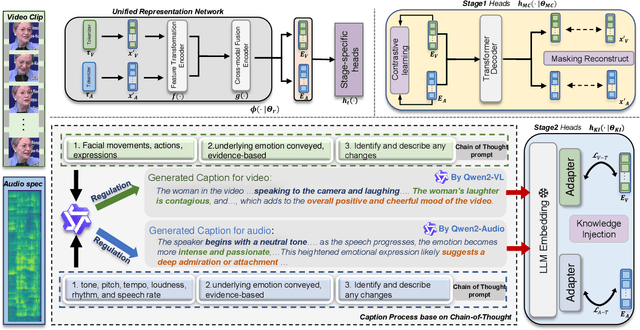
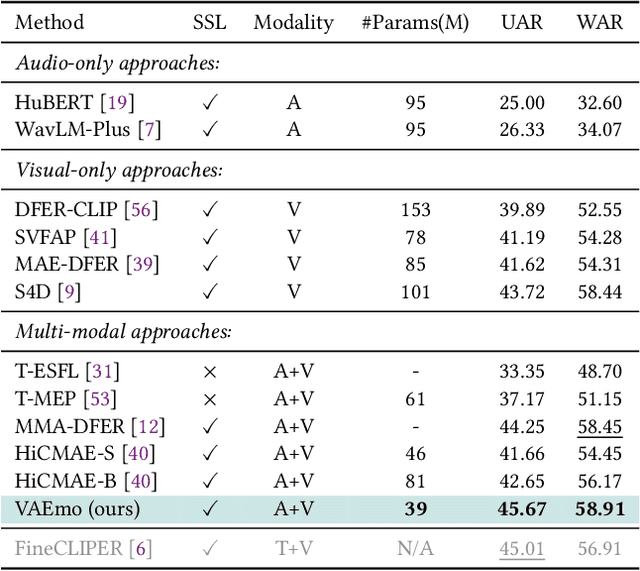
Audiovisual emotion recognition (AVER) aims to infer human emotions from nonverbal visual-audio (VA) cues, offering modality-complementary and language-agnostic advantages. However, AVER remains challenging due to the inherent ambiguity of emotional expressions, cross-modal expressive disparities, and the scarcity of reliably annotated data. Recent self-supervised AVER approaches have introduced strong multimodal representations, yet they predominantly rely on modality-specific encoders and coarse content-level alignment, limiting fine-grained emotional semantic modeling. To address these issues, we propose VAEmo, an efficient two-stage framework for emotion-centric joint VA representation learning with external knowledge injection. In Stage 1, a unified and lightweight representation network is pre-trained on large-scale speaker-centric VA corpora via masked reconstruction and contrastive objectives, mitigating the modality gap and learning expressive, complementary representations without emotion labels. In Stage 2, multimodal large language models automatically generate detailed affective descriptions according to our well-designed chain-of-thought prompting for only a small subset of VA samples; these rich textual semantics are then injected by aligning their corresponding embeddings with VA representations through dual-path contrastive learning, further bridging the emotion gap. Extensive experiments on multiple downstream AVER benchmarks show that VAEmo achieves state-of-the-art performance with a compact design, highlighting the benefit of unified cross-modal encoding and emotion-aware semantic guidance for efficient, generalizable VA emotion representations.
The Llama 3 Herd of Models
Jul 31, 2024Modern artificial intelligence (AI) systems are powered by foundation models. This paper presents a new set of foundation models, called Llama 3. It is a herd of language models that natively support multilinguality, coding, reasoning, and tool usage. Our largest model is a dense Transformer with 405B parameters and a context window of up to 128K tokens. This paper presents an extensive empirical evaluation of Llama 3. We find that Llama 3 delivers comparable quality to leading language models such as GPT-4 on a plethora of tasks. We publicly release Llama 3, including pre-trained and post-trained versions of the 405B parameter language model and our Llama Guard 3 model for input and output safety. The paper also presents the results of experiments in which we integrate image, video, and speech capabilities into Llama 3 via a compositional approach. We observe this approach performs competitively with the state-of-the-art on image, video, and speech recognition tasks. The resulting models are not yet being broadly released as they are still under development.
A Physics-embedded Deep Learning Framework for Cloth Simulation
Mar 27, 2024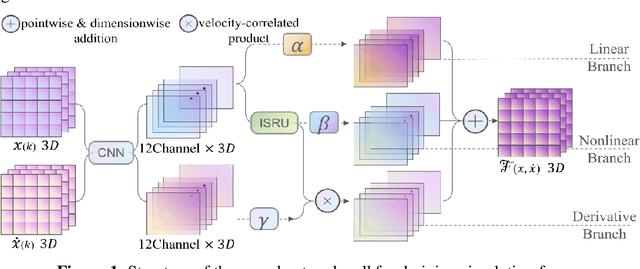
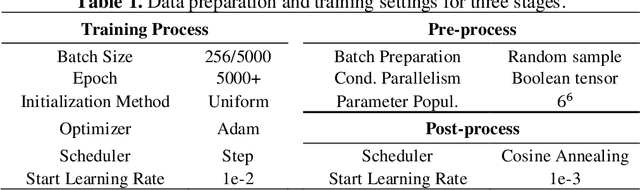
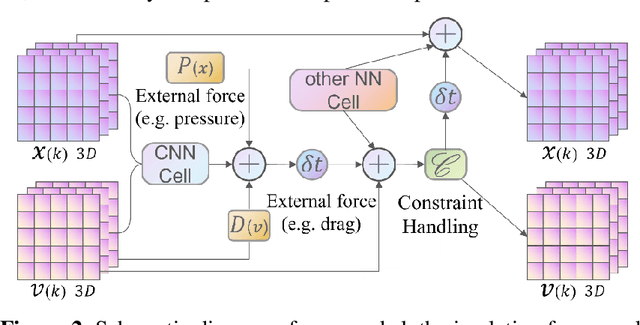
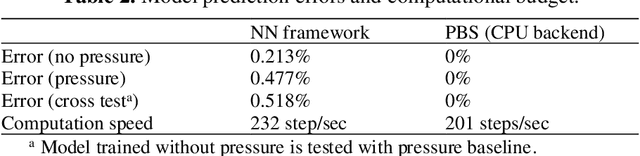
Delicate cloth simulations have long been desired in computer graphics. Various methods were proposed to improve engaged force interactions, collision handling, and numerical integrations. Deep learning has the potential to achieve fast and real-time simulation, but common neural network structures often demand many parameters to capture cloth dynamics. This paper proposes a physics-embedded learning framework that directly encodes physical features of cloth simulation. The convolutional neural network is used to represent spatial correlations of the mass-spring system, after which three branches are designed to learn linear, nonlinear, and time derivate features of cloth physics. The framework can also integrate with other external forces and collision handling through either traditional simulators or sub neural networks. The model is tested across different cloth animation cases, without training with new data. Agreement with baselines and predictive realism successfully validate its generalization ability. Inference efficiency of the proposed model also defeats traditional physics simulation. This framework is also designed to easily integrate with other visual refinement techniques like wrinkle carving, which leaves significant chances to incorporate prevailing macing learning techniques in 3D cloth amination.
Diffeomorphism Neural Operator for various domains and parameters of partial differential equations
Feb 19, 2024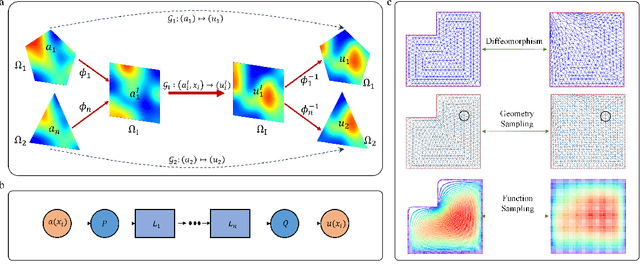


Many science and engineering applications demand partial differential equations (PDE) evaluations that are traditionally computed with resource-intensive numerical solvers. Neural operator models provide an efficient alternative by learning the governing physical laws directly from data in a class of PDEs with different parameters, but constrained in a fixed boundary (domain). Many applications, such as design and manufacturing, would benefit from neural operators with flexible domains when studied at scale. Here we present a diffeomorphism neural operator learning framework towards developing domain-flexible models for physical systems with various and complex domains. Specifically, a neural operator trained in a shared domain mapped from various domains of fields by diffeomorphism is proposed, which transformed the problem of learning function mappings in varying domains (spaces) into the problem of learning operators on a shared diffeomorphic domain. Meanwhile, an index is provided to evaluate the generalization of diffeomorphism neural operators in different domains by the domain diffeomorphism similarity. Experiments on statics scenarios (Darcy flow, mechanics) and dynamic scenarios (pipe flow, airfoil flow) demonstrate the advantages of our approach for neural operator learning under various domains, where harmonic and volume parameterization are used as the diffeomorphism for 2D and 3D domains. Our diffeomorphism neural operator approach enables strong learning capability and robust generalization across varying domains and parameters.
Exploiting Modality-Specific Features For Multi-Modal Manipulation Detection And Grounding
Sep 22, 2023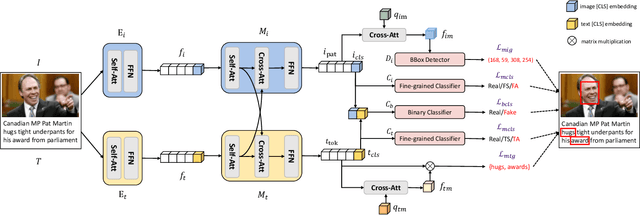
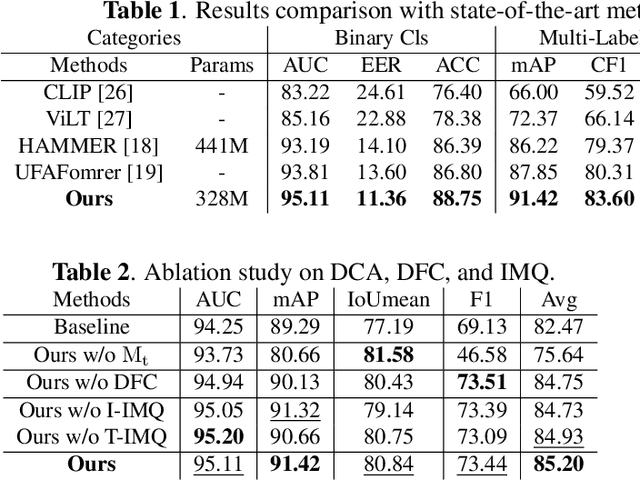
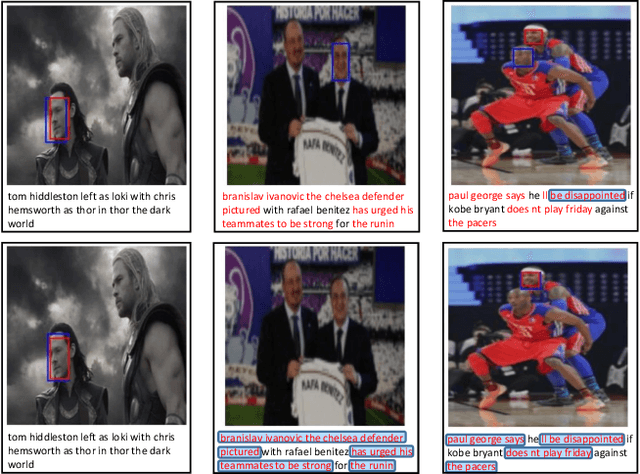
AI-synthesized text and images have gained significant attention, particularly due to the widespread dissemination of multi-modal manipulations on the internet, which has resulted in numerous negative impacts on society. Existing methods for multi-modal manipulation detection and grounding primarily focus on fusing vision-language features to make predictions, while overlooking the importance of modality-specific features, leading to sub-optimal results. In this paper, we construct a simple and novel transformer-based framework for multi-modal manipulation detection and grounding tasks. Our framework simultaneously explores modality-specific features while preserving the capability for multi-modal alignment. To achieve this, we introduce visual/language pre-trained encoders and dual-branch cross-attention (DCA) to extract and fuse modality-unique features. Furthermore, we design decoupled fine-grained classifiers (DFC) to enhance modality-specific feature mining and mitigate modality competition. Moreover, we propose an implicit manipulation query (IMQ) that adaptively aggregates global contextual cues within each modality using learnable queries, thereby improving the discovery of forged details. Extensive experiments on the $\rm DGM^4$ dataset demonstrate the superior performance of our proposed model compared to state-of-the-art approaches.