 Add to Chrome
 Add to Firefox
 Add to Edge
Geometry-Instructed Video Editing
Jun 23, 2026
Object-level geometric edits, including translating, rotating, scaling, duplicating, or removing an object, are routine operations in digital content creation (DCC) workflows, yet they remain unreliable in generative video editing. The key challenge lies in specifying the target object's 3D state change unambiguously across viewpoint and time, while consistently updating geometry-dependent secondary effects such as shadows and reflections. We introduce GIVE, a geometry-instructed video editing framework that represents edits through a unified object-state formulation. Two video-aligned geometry streams describe the target object before and after editing: a depth-box encoding coarse 3D placement and extent, and an orientation-box providing an appearance-agnostic orientation cue. Together, these streams provide a compact pre/post geometric specification for object-state transitions. To provide paired supervision for learning these edits, we build a scalable graphics-engine pipeline that executes object-level edit programs and renders controlled before/after pairs, isolating the intended geometric edit while keeping secondary effects consistent with the transformation. Experimental results demonstrate that GIVE produces faithful geometric edits with temporal coherence and consistent secondary effects across operators in a unified framework, and shows promising transfer to in-the-wild videos. Project page: https://geometry-instructed-video-editing.github.io/give/

A Comprehensive Ecosystem for Open-Domain Customized Video Generation
Jun 10, 2026Recent progress in video generation has shown impressive visual synthesis capabilities. However, open-domain customized video generation remains limited by the lack of large-scale, annotated datasets capturing diverse identity-specific attributes. To address this, we introduce PexelsCustom-1M, the first publicly available million-scale dataset for identity-preserving video generation, containing one million curated <identity, text, video> triplets across 8,000+ categories. Leveraging this, we propose CustoMDiT, a parameter-efficient framework that adapts a pretrained multimodal Diffusion Transformer into a customized video generator with only 8% additional learnable parameters. Our method surpasses prior state-of-the-art. However, benchmarks such as DreamBooth cover only 100 classes, which is insufficient for real-world applications. To overcome this, we construct OpenCustom, a new benchmark with 1,000+ categories, created via cross-dataset knowledge fusion from ImageNet and MS-COCO. Extensive experiments confirm the advantages of both our dataset and model. We will open-source the entire ecosystem--including dataset, pipeline, benchmark, and implementations--to support further research.
Lens: Rethinking Training Efficiency for Foundational Text-to-Image Models
May 20, 2026We introduce Lens, a 3.8B-parameter T2I model that achieves performance competitive with, and in several cases surpassing, state-of-the-art models with more than 6B parameters across various benchmarks, while requiring significantly less training compute. For example, Lens requires only about 19.3% of the training compute used by Z-Image. The training efficiency of Lens stems from two key strategies beyond its compact model size. First, we maximize data information density per training batch by (i) training on Lens-800M, a dataset of 800M densely captioned image-text pairs whose captions are generated by GPT-4.1 and contain approximately 109 words on average, providing richer semantic supervision than conventional short captions, and (ii) constructing each batch from images with multiple resolutions and diverse aspect ratios, thereby enlarging the effective visual coverage of each optimization step. Second, we improve convergence speed through careful architectural choices, including adopting a semantic VAE that provides better latent representations and employing a strong language encoder that accelerates optimization while enabling multilingual generalization from English-only training data. After pre-training, we apply RL with taxonomy-driven prompts (Lens-RL-8K) and structured reward rubrics to suppress artifacts and improve visual quality, a reasoner module with training-free system prompt search to better align user requests with the model, and distillation-based acceleration for 4-step inference. Through efficient training and systematic optimization, Lens generalizes to arbitrary aspect ratios from 1:2 to 2:1 and resolutions up to 1440^2, and supports prompts in several commonly used languages. Thanks to its compact size, Lens generates a 1024^2 image in 3.15 seconds on a single NVIDIA H100 GPU, while its distilled turbo version performs 4-step generation in 0.84 seconds.
GlobalPaint: Spatiotemporal Coherent Video Outpainting with Global Feature Guidance
Jan 10, 2026Video outpainting extends a video beyond its original boundaries by synthesizing missing border content. Compared with image outpainting, it requires not only per-frame spatial plausibility but also long-range temporal coherence, especially when outpainted content becomes visible across time under camera or object motion. We propose GlobalPaint, a diffusion-based framework for spatiotemporal coherent video outpainting. Our approach adopts a hierarchical pipeline that first outpaints key frames and then completes intermediate frames via an interpolation model conditioned on the completed boundaries, reducing error accumulation in sequential processing. At the model level, we augment a pretrained image inpainting backbone with (i) an Enhanced Spatial-Temporal module featuring 3D windowed attention for stronger spatiotemporal interaction, and (ii) global feature guidance that distills OpenCLIP features from observed regions across all frames into compact global tokens using a dedicated extractor. Comprehensive evaluations on benchmark datasets demonstrate improved reconstruction quality and more natural motion compared to prior methods. Our demo page is https://yuemingpan.github.io/GlobalPaint/
ReasonGen-R1: CoT for Autoregressive Image generation models through SFT and RL
May 30, 2025Although chain-of-thought reasoning and reinforcement learning (RL) have driven breakthroughs in NLP, their integration into generative vision models remains underexplored. We introduce ReasonGen-R1, a two-stage framework that first imbues an autoregressive image generator with explicit text-based "thinking" skills via supervised fine-tuning on a newly generated reasoning dataset of written rationales, and then refines its outputs using Group Relative Policy Optimization. To enable the model to reason through text before generating images, We automatically generate and release a corpus of model crafted rationales paired with visual prompts, enabling controlled planning of object layouts, styles, and scene compositions. Our GRPO algorithm uses reward signals from a pretrained vision language model to assess overall visual quality, optimizing the policy in each update. Evaluations on GenEval, DPG, and the T2I benchmark demonstrate that ReasonGen-R1 consistently outperforms strong baselines and prior state-of-the-art models. More: aka.ms/reasongen.
Fast Autoregressive Models for Continuous Latent Generation
Apr 24, 2025Autoregressive models have demonstrated remarkable success in sequential data generation, particularly in NLP, but their extension to continuous-domain image generation presents significant challenges. Recent work, the masked autoregressive model (MAR), bypasses quantization by modeling per-token distributions in continuous spaces using a diffusion head but suffers from slow inference due to the high computational cost of the iterative denoising process. To address this, we propose the Fast AutoRegressive model (FAR), a novel framework that replaces MAR's diffusion head with a lightweight shortcut head, enabling efficient few-step sampling while preserving autoregressive principles. Additionally, FAR seamlessly integrates with causal Transformers, extending them from discrete to continuous token generation without requiring architectural modifications. Experiments demonstrate that FAR achieves $2.3\times$ faster inference than MAR while maintaining competitive FID and IS scores. This work establishes the first efficient autoregressive paradigm for high-fidelity continuous-space image generation, bridging the critical gap between quality and scalability in visual autoregressive modeling.
DesignDiffusion: High-Quality Text-to-Design Image Generation with Diffusion Models
Mar 03, 2025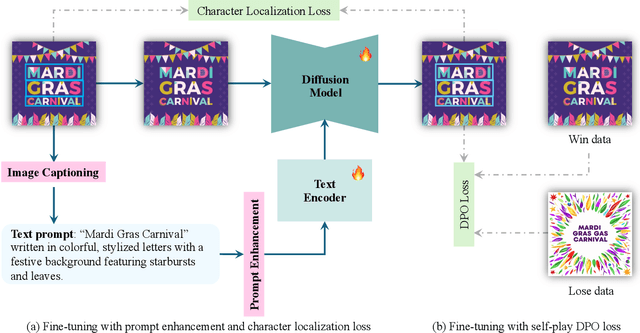
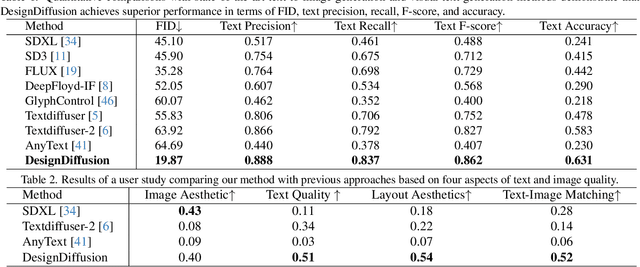
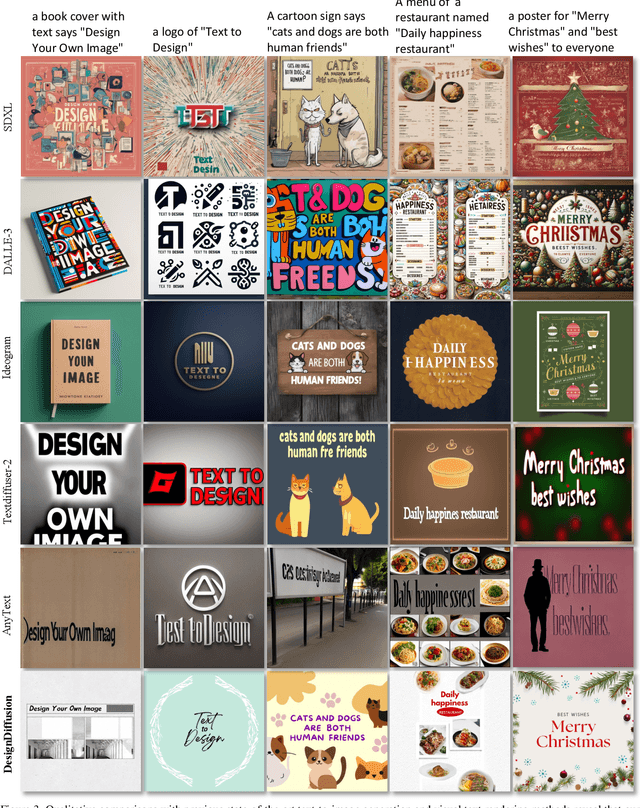
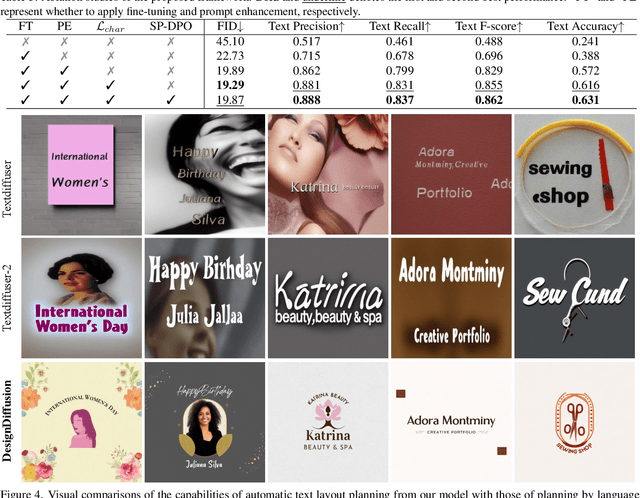
In this paper, we present DesignDiffusion, a simple yet effective framework for the novel task of synthesizing design images from textual descriptions. A primary challenge lies in generating accurate and style-consistent textual and visual content. Existing works in a related task of visual text generation often focus on generating text within given specific regions, which limits the creativity of generation models, resulting in style or color inconsistencies between textual and visual elements if applied to design image generation. To address this issue, we propose an end-to-end, one-stage diffusion-based framework that avoids intricate components like position and layout modeling. Specifically, the proposed framework directly synthesizes textual and visual design elements from user prompts. It utilizes a distinctive character embedding derived from the visual text to enhance the input prompt, along with a character localization loss for enhanced supervision during text generation. Furthermore, we employ a self-play Direct Preference Optimization fine-tuning strategy to improve the quality and accuracy of the synthesized visual text. Extensive experiments demonstrate that DesignDiffusion achieves state-of-the-art performance in design image generation.
Phi-4-Mini Technical Report: Compact yet Powerful Multimodal Language Models via Mixture-of-LoRAs
Mar 03, 2025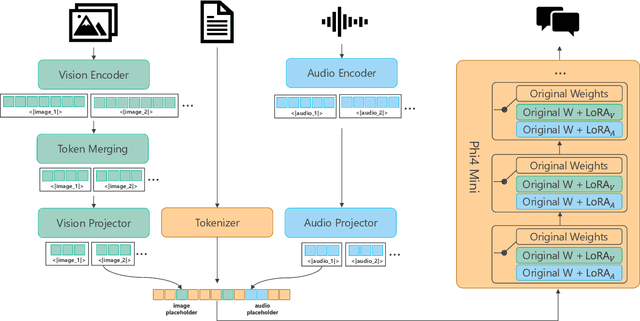
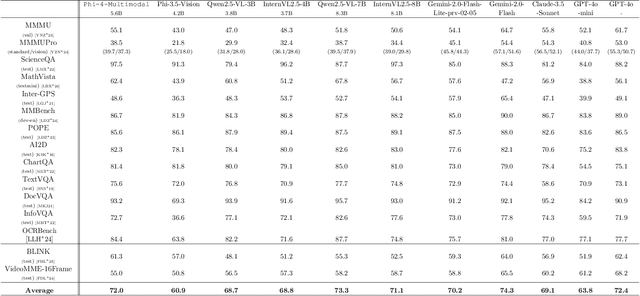
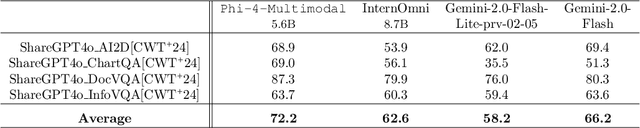
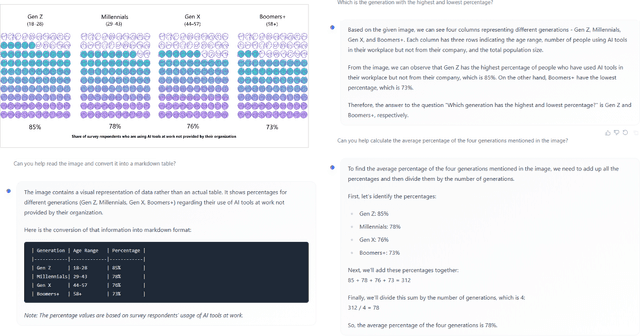
We introduce Phi-4-Mini and Phi-4-Multimodal, compact yet highly capable language and multimodal models. Phi-4-Mini is a 3.8-billion-parameter language model trained on high-quality web and synthetic data, significantly outperforming recent open-source models of similar size and matching the performance of models twice its size on math and coding tasks requiring complex reasoning. This achievement is driven by a carefully curated synthetic data recipe emphasizing high-quality math and coding datasets. Compared to its predecessor, Phi-3.5-Mini, Phi-4-Mini features an expanded vocabulary size of 200K tokens to better support multilingual applications, as well as group query attention for more efficient long-sequence generation. Phi-4-Multimodal is a multimodal model that integrates text, vision, and speech/audio input modalities into a single model. Its novel modality extension approach leverages LoRA adapters and modality-specific routers to allow multiple inference modes combining various modalities without interference. For example, it now ranks first in the OpenASR leaderboard to date, although the LoRA component of the speech/audio modality has just 460 million parameters. Phi-4-Multimodal supports scenarios involving (vision + language), (vision + speech), and (speech/audio) inputs, outperforming larger vision-language and speech-language models on a wide range of tasks. Additionally, we experiment to further train Phi-4-Mini to enhance its reasoning capabilities. Despite its compact 3.8-billion-parameter size, this experimental version achieves reasoning performance on par with or surpassing significantly larger models, including DeepSeek-R1-Distill-Qwen-7B and DeepSeek-R1-Distill-Llama-8B.
ART: Anonymous Region Transformer for Variable Multi-Layer Transparent Image Generation
Feb 25, 2025Multi-layer image generation is a fundamental task that enables users to isolate, select, and edit specific image layers, thereby revolutionizing interactions with generative models. In this paper, we introduce the Anonymous Region Transformer (ART), which facilitates the direct generation of variable multi-layer transparent images based on a global text prompt and an anonymous region layout. Inspired by Schema theory suggests that knowledge is organized in frameworks (schemas) that enable people to interpret and learn from new information by linking it to prior knowledge.}, this anonymous region layout allows the generative model to autonomously determine which set of visual tokens should align with which text tokens, which is in contrast to the previously dominant semantic layout for the image generation task. In addition, the layer-wise region crop mechanism, which only selects the visual tokens belonging to each anonymous region, significantly reduces attention computation costs and enables the efficient generation of images with numerous distinct layers (e.g., 50+). When compared to the full attention approach, our method is over 12 times faster and exhibits fewer layer conflicts. Furthermore, we propose a high-quality multi-layer transparent image autoencoder that supports the direct encoding and decoding of the transparency of variable multi-layer images in a joint manner. By enabling precise control and scalable layer generation, ART establishes a new paradigm for interactive content creation.
Diffusion Models without Classifier-free Guidance
Feb 17, 2025This paper presents Model-guidance (MG), a novel objective for training diffusion model that addresses and removes of the commonly used Classifier-free guidance (CFG). Our innovative approach transcends the standard modeling of solely data distribution to incorporating the posterior probability of conditions. The proposed technique originates from the idea of CFG and is easy yet effective, making it a plug-and-play module for existing models. Our method significantly accelerates the training process, doubles the inference speed, and achieve exceptional quality that parallel and even surpass concurrent diffusion models with CFG. Extensive experiments demonstrate the effectiveness, efficiency, scalability on different models and datasets. Finally, we establish state-of-the-art performance on ImageNet 256 benchmarks with an FID of 1.34. Our code is available at https://github.com/tzco/Diffusion-wo-CFG.