 Add to Chrome
 Add to Firefox
 Add to Edge
From Points to Edges: Edge-Conditioned Spectral Operators for Physics-Sensitive PDE Learning
Aug 07, 2026
Neural operators have become a central tool for solving partial differential equations (PDEs), with spectral operators offering efficient global mixing across spatial locations. However, many PDEs contain physics-sensitive local structures that are critical to the underlying physical behavior. For example, in Darcy flow, local material interfaces are often reflected by sharp changes in the permeability field and can strongly influence the solution. Existing spectral operators primarily adapt modal mixing based on center-point representations, making them insufficiently responsive to such localized structural variations. We propose the Edge-Conditioned Spectral Operator (ESO), a novel spectral operator framework that modulates global spectral mixing using local edge-wise variations. By incorporating the Pairwise-Variation Modal Mixer (PVMM) to inject local edge information into spectral mode selection, ESO preserves the global approximation capability of spectral neural operators while enabling the learned kernel to adapt to physics-sensitive local structures. Furthermore, we introduce a task-adaptive Physics-Aware Reweighting (PAR) that emphasizes physically important regions, identified by taskspecific physical quantities. Across nine PDE benchmarks, ESO consistently achieves state-of-the-art performance. Visual and region-wise analyses further demonstrate that ESO reduces solution errors near coefficient jumps, high-gradient flow structures, and other physically sensitive regions. The code is available at https://github.com/Tanpig-X/ESO.

HydraHead: From Head-Level Functional Heterogeneity to Specialized Attention Hybridization
Jun 18, 2026The quadratic complexity of attention poses a critical bottleneck for long-context processing, spurring interest in hybrid attention designs. Most open-source hybrid models adopt a layer-wise strategy. Yet, prior work has noted the inherent difficulty of integrating Linear Attention (LA) with Full Attention (FA), suggesting that the design space of attention hybridization remains underexplored. To probe this space, we conduct interpretability analysis and observe that layers exhibit block-wise functional similarity, while individual heads within the same layer display distinct functional specialization despite sharing input features. This head-level heterogeneity suggests that the head dimension provides a natural and principled granularity for fusing heterogeneous attention signals. Building on this insight, we introduce HydraHead, a novel architecture that hybridizes FA and LA along the head axis. HydraHead features two key innovations: (1) an interpretability-driven selection strategy that identifies retrieval-critical heads and preserves FA only for them, and (2) a scale-normalized fusion module that reconciles the distributional gap between FA and LA head outputs. By leveraging a three-stage transfer pipeline with parameter reuse and distillation, we achieve high-performance hybrid models with minimal training overhead. Under a unified training setup, HydraHead outperforms other hybrid designs in long-context tasks while maintaining strong general reasoning. With interpretability-driven head selection, it matches a 3:1 layer-wise hybrid's long-context performance at a 7:1 LA-to-FA ratio. Crucially, trained on only 15B tokens, HydraHead achieves over 69% improvement over the baseline at 512K context length, approaching Qwen3.5, a leading model of comparable size with a native context length of 256K. This highlights the significant scaling potential of head-level hybridization.
Learning to Focus and Precise Cropping: A Reinforcement Learning Framework with Information Gaps and Grounding Loss for MLLMs
Mar 29, 2026To enhance the perception and reasoning capabilities of multimodal large language models in complex visual scenes, recent research has introduced agent-based workflows. In these works, MLLMs autonomously utilize image cropping tool to analyze regions of interest for question answering. While existing training strategies, such as those employing supervised fine-tuning and reinforcement learning, have made significant progress, our empirical analysis reveals a key limitation. We demonstrate the model's strong reliance on global input and its weak dependence on the details within the cropped region. To address this issue, we propose a novel two-stage reinforcement learning framework that does not require trajectory supervision. In the first stage, we introduce the ``Information Gap" mechanism by adjusting the granularity of the global image. This mechanism trains the model to answer questions by focusing on cropped key regions, driven by the information gain these regions provide. The second stage further enhances cropping precision by incorporating a grounding loss, using a small number of bounding box annotations. Experiments show that our method significantly enhances the model's attention to cropped regions, enabling it to achieve state-of-the-art performance on high-resolution visual question-answering benchmarks. Our method provides a more efficient approach for perceiving and reasoning fine-grained details in MLLMs. Code is available at: https://github.com/XuanPu-Z/LFPC.
FunAudio-ASR Technical Report
Sep 15, 2025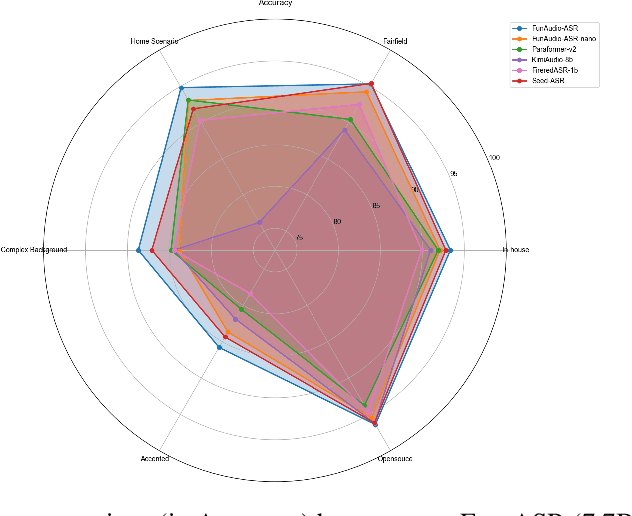
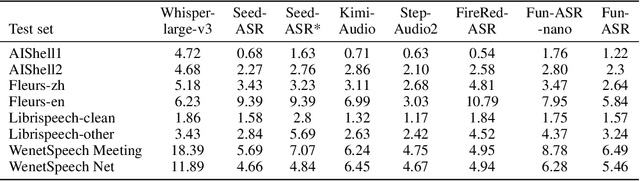
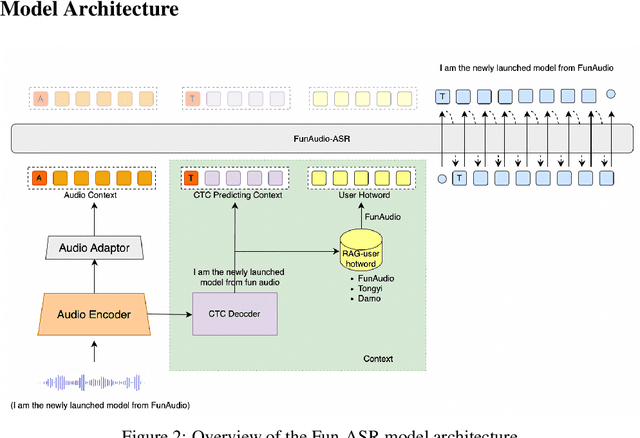
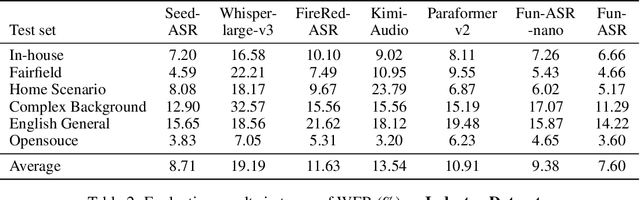
In recent years, automatic speech recognition (ASR) has witnessed transformative advancements driven by three complementary paradigms: data scaling, model size scaling, and deep integration with large language models (LLMs). However, LLMs are prone to hallucination, which can significantly degrade user experience in real-world ASR applications. In this paper, we present FunAudio-ASR, a large-scale, LLM-based ASR system that synergistically combines massive data, large model capacity, LLM integration, and reinforcement learning to achieve state-of-the-art performance across diverse and complex speech recognition scenarios. Moreover, FunAudio-ASR is specifically optimized for practical deployment, with enhancements in streaming capability, noise robustness, code-switching, hotword customization, and satisfying other real-world application requirements. Experimental results show that while most LLM-based ASR systems achieve strong performance on open-source benchmarks, they often underperform on real industry evaluation sets. Thanks to production-oriented optimizations, FunAudio-ASR achieves SOTA performance on real application datasets, demonstrating its effectiveness and robustness in practical settings.
Generalizable Origin Identification for Text-Guided Image-to-Image Diffusion Models
Jan 04, 2025
Text-guided image-to-image diffusion models excel in translating images based on textual prompts, allowing for precise and creative visual modifications. However, such a powerful technique can be misused for spreading misinformation, infringing on copyrights, and evading content tracing. This motivates us to introduce the task of origin IDentification for text-guided Image-to-image Diffusion models (ID$^2$), aiming to retrieve the original image of a given translated query. A straightforward solution to ID$^2$ involves training a specialized deep embedding model to extract and compare features from both query and reference images. However, due to visual discrepancy across generations produced by different diffusion models, this similarity-based approach fails when training on images from one model and testing on those from another, limiting its effectiveness in real-world applications. To solve this challenge of the proposed ID$^2$ task, we contribute the first dataset and a theoretically guaranteed method, both emphasizing generalizability. The curated dataset, OriPID, contains abundant Origins and guided Prompts, which can be used to train and test potential IDentification models across various diffusion models. In the method section, we first prove the existence of a linear transformation that minimizes the distance between the pre-trained Variational Autoencoder (VAE) embeddings of generated samples and their origins. Subsequently, it is demonstrated that such a simple linear transformation can be generalized across different diffusion models. Experimental results show that the proposed method achieves satisfying generalization performance, significantly surpassing similarity-based methods ($+31.6\%$ mAP), even those with generalization designs.
SweetTokenizer: Semantic-Aware Spatial-Temporal Tokenizer for Compact Visual Discretization
Dec 17, 2024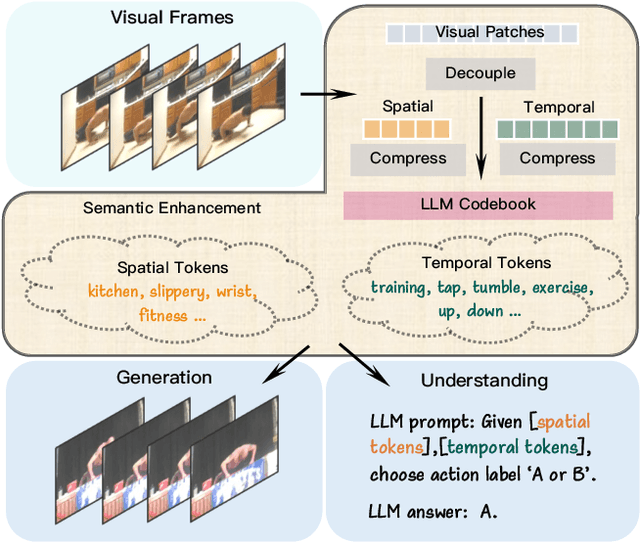


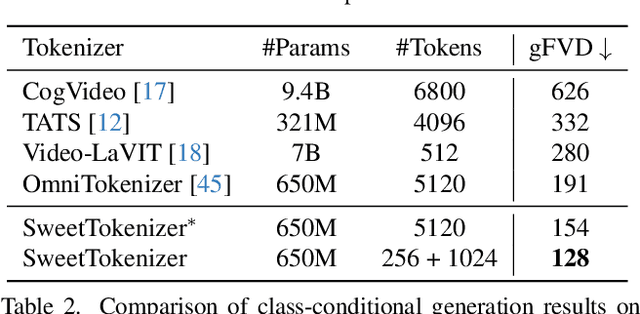
This paper presents the \textbf{S}emantic-a\textbf{W}ar\textbf{E} spatial-t\textbf{E}mporal \textbf{T}okenizer (SweetTokenizer), a compact yet effective discretization approach for vision data. Our goal is to boost tokenizers' compression ratio while maintaining reconstruction fidelity in the VQ-VAE paradigm. Firstly, to obtain compact latent representations, we decouple images or videos into spatial-temporal dimensions, translating visual information into learnable querying spatial and temporal tokens through a \textbf{C}ross-attention \textbf{Q}uery \textbf{A}uto\textbf{E}ncoder (CQAE). Secondly, to complement visual information during compression, we quantize these tokens via a specialized codebook derived from off-the-shelf LLM embeddings to leverage the rich semantics from language modality. Finally, to enhance training stability and convergence, we also introduce a curriculum learning strategy, which proves critical for effective discrete visual representation learning. SweetTokenizer achieves comparable video reconstruction fidelity with only \textbf{25\%} of the tokens used in previous state-of-the-art video tokenizers, and boost video generation results by \textbf{32.9\%} w.r.t gFVD. When using the same token number, we significantly improves video and image reconstruction results by \textbf{57.1\%} w.r.t rFVD on UCF-101 and \textbf{37.2\%} w.r.t rFID on ImageNet-1K. Additionally, the compressed tokens are imbued with semantic information, enabling few-shot recognition capabilities powered by LLMs in downstream applications.
Llama SLayer 8B: Shallow Layers Hold the Key to Knowledge Injection
Oct 03, 2024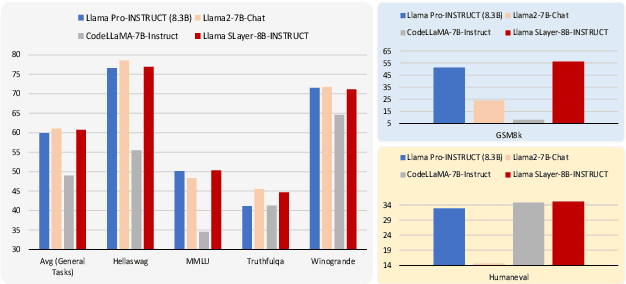

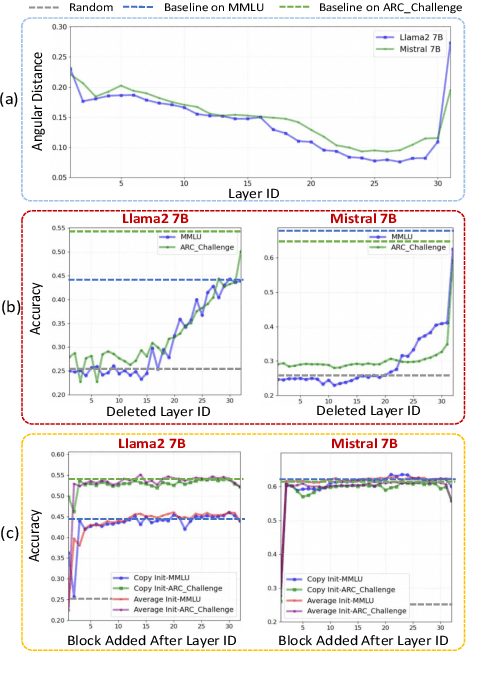
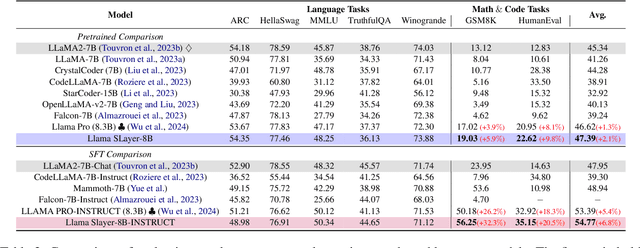
As a manner to augment pre-trained large language models (LLM), knowledge injection is critical to develop vertical domain large models and has been widely studied. Although most current approaches, including parameter-efficient fine-tuning (PEFT) and block expansion methods, uniformly apply knowledge across all LLM layers, it raises the question: are all layers equally crucial for knowledge injection? We begin by evaluating the importance of each layer in finding the optimal layer range for knowledge injection. Intuitively, the more important layers should play a more critical role in knowledge injection and deserve a denser injection. We observe performance dips in question-answering benchmarks after the removal or expansion of the shallow layers, and the degradation shrinks as the layer gets deeper, indicating that the shallow layers hold the key to knowledge injection. This insight leads us to propose the S strategy, a post-pretraining strategy of selectively enhancing shallow layers while pruning the less effective deep ones. Based on this strategy, we introduce Llama Slayer-8B and Llama Slayer-8B-Instruct. We experimented on the corpus of code $\&$ math and demonstrated the effectiveness of our strategy. Further experiments across different LLM, Mistral-7B, and a legal corpus confirmed the general applicability of the approach, underscoring its wide-ranging efficacy. Our code is available at: \https://github.com/txchen-USTC/Llama-Slayer
Image Copy Detection for Diffusion Models
Sep 30, 2024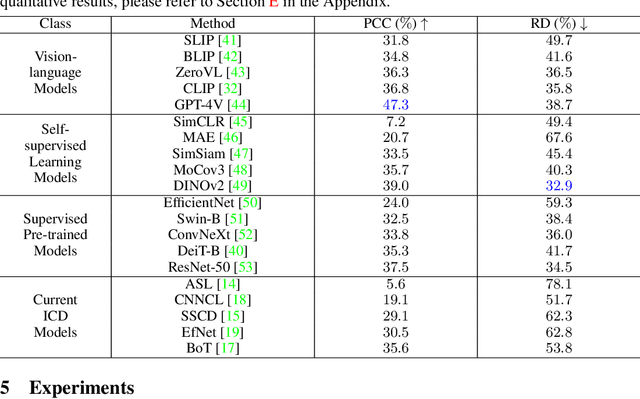
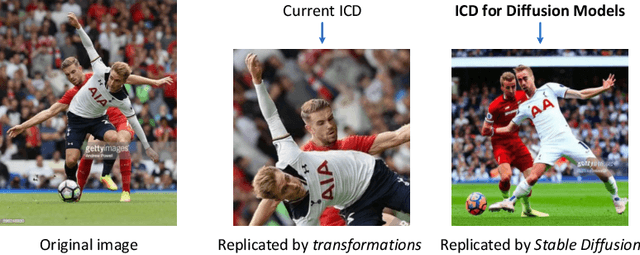
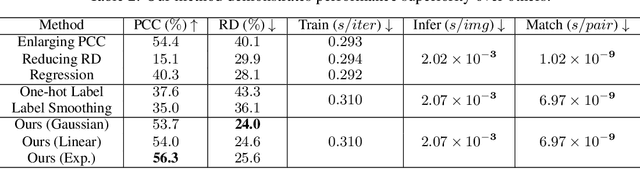
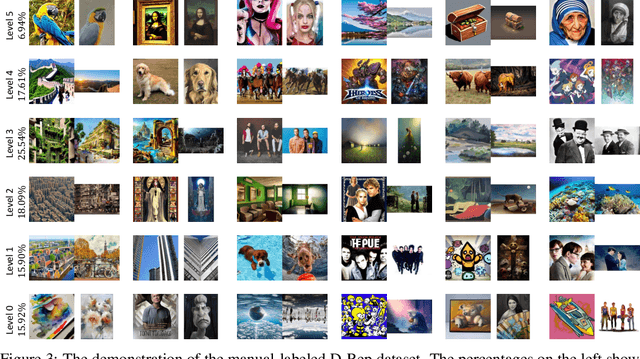
Images produced by diffusion models are increasingly popular in digital artwork and visual marketing. However, such generated images might replicate content from existing ones and pose the challenge of content originality. Existing Image Copy Detection (ICD) models, though accurate in detecting hand-crafted replicas, overlook the challenge from diffusion models. This motivates us to introduce ICDiff, the first ICD specialized for diffusion models. To this end, we construct a Diffusion-Replication (D-Rep) dataset and correspondingly propose a novel deep embedding method. D-Rep uses a state-of-the-art diffusion model (Stable Diffusion V1.5) to generate 40, 000 image-replica pairs, which are manually annotated into 6 replication levels ranging from 0 (no replication) to 5 (total replication). Our method, PDF-Embedding, transforms the replication level of each image-replica pair into a probability density function (PDF) as the supervision signal. The intuition is that the probability of neighboring replication levels should be continuous and smooth. Experimental results show that PDF-Embedding surpasses protocol-driven methods and non-PDF choices on the D-Rep test set. Moreover, by utilizing PDF-Embedding, we find that the replication ratios of well-known diffusion models against an open-source gallery range from 10% to 20%.
Mixture-of-Noises Enhanced Forgery-Aware Predictor for Multi-Face Manipulation Detection and Localization
Aug 05, 2024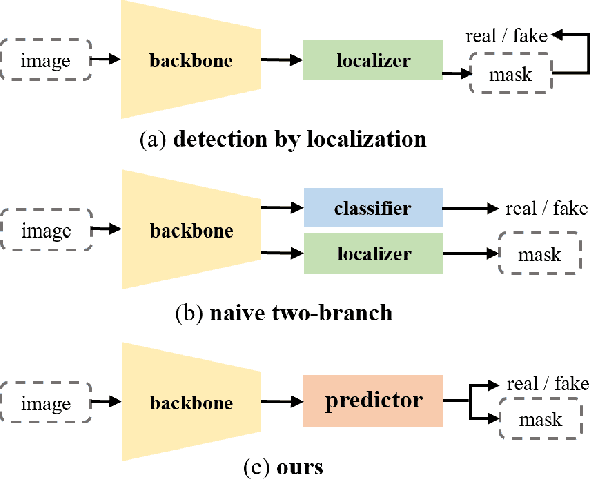
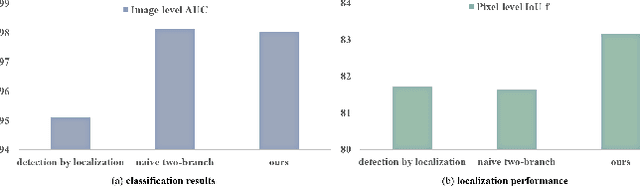
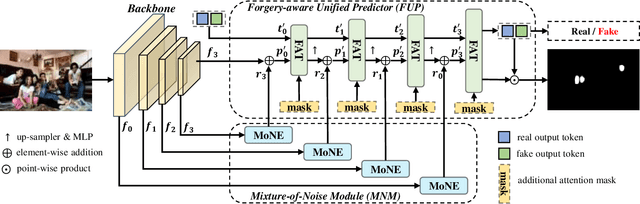

With the advancement of face manipulation technology, forgery images in multi-face scenarios are gradually becoming a more complex and realistic challenge. Despite this, detection and localization methods for such multi-face manipulations remain underdeveloped. Traditional manipulation localization methods either indirectly derive detection results from localization masks, resulting in limited detection performance, or employ a naive two-branch structure to simultaneously obtain detection and localization results, which cannot effectively benefit the localization capability due to limited interaction between two tasks. This paper proposes a new framework, namely MoNFAP, specifically tailored for multi-face manipulation detection and localization. The MoNFAP primarily introduces two novel modules: the Forgery-aware Unified Predictor (FUP) Module and the Mixture-of-Noises Module (MNM). The FUP integrates detection and localization tasks using a token learning strategy and multiple forgery-aware transformers, which facilitates the use of classification information to enhance localization capability. Besides, motivated by the crucial role of noise information in forgery detection, the MNM leverages multiple noise extractors based on the concept of the mixture of experts to enhance the general RGB features, further boosting the performance of our framework. Finally, we establish a comprehensive benchmark for multi-face detection and localization and the proposed \textit{MoNFAP} achieves significant performance. The codes will be made available.
Learning Solution-Aware Transformers for Efficiently Solving Quadratic Assignment Problem
Jun 14, 2024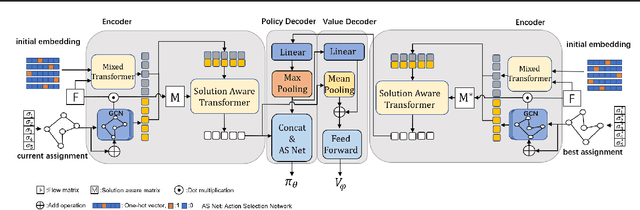
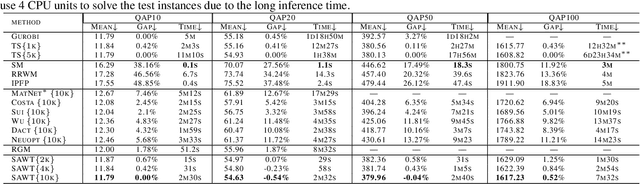
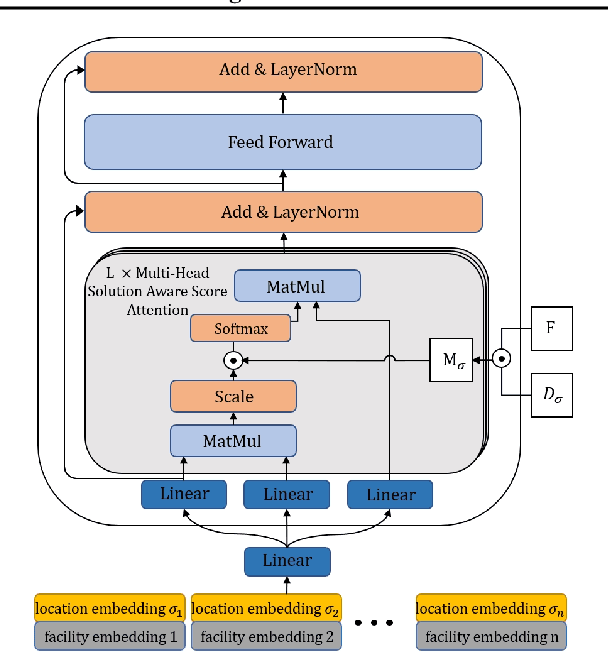
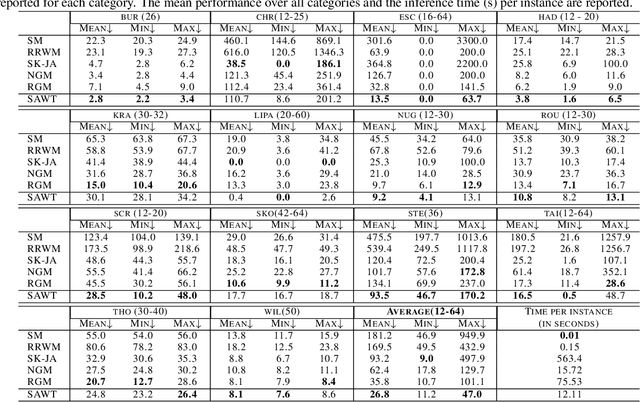
Recently various optimization problems, such as Mixed Integer Linear Programming Problems (MILPs), have undergone comprehensive investigation, leveraging the capabilities of machine learning. This work focuses on learning-based solutions for efficiently solving the Quadratic Assignment Problem (QAPs), which stands as a formidable challenge in combinatorial optimization. While many instances of simpler problems admit fully polynomial-time approximate solution (FPTAS), QAP is shown to be strongly NP-hard. Even finding a FPTAS for QAP is difficult, in the sense that the existence of a FPTAS implies $P = NP$. Current research on QAPs suffer from limited scale and computational inefficiency. To attack the aforementioned issues, we here propose the first solution of its kind for QAP in the learn-to-improve category. This work encodes facility and location nodes separately, instead of forming computationally intensive association graphs prevalent in current approaches. This design choice enables scalability to larger problem sizes. Furthermore, a \textbf{S}olution \textbf{AW}are \textbf{T}ransformer (SAWT) architecture integrates the incumbent solution matrix with the attention score to effectively capture higher-order information of the QAPs. Our model's effectiveness is validated through extensive experiments on self-generated QAP instances of varying sizes and the QAPLIB benchmark.