 Add to Chrome
 Add to Firefox
 Add to Edge
Self-regulating Prompts: Foundational Model Adaptation without Forgetting
Jul 13, 2023
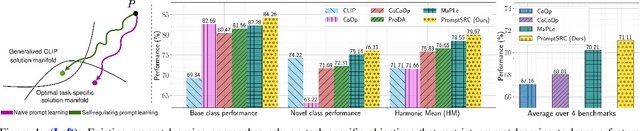
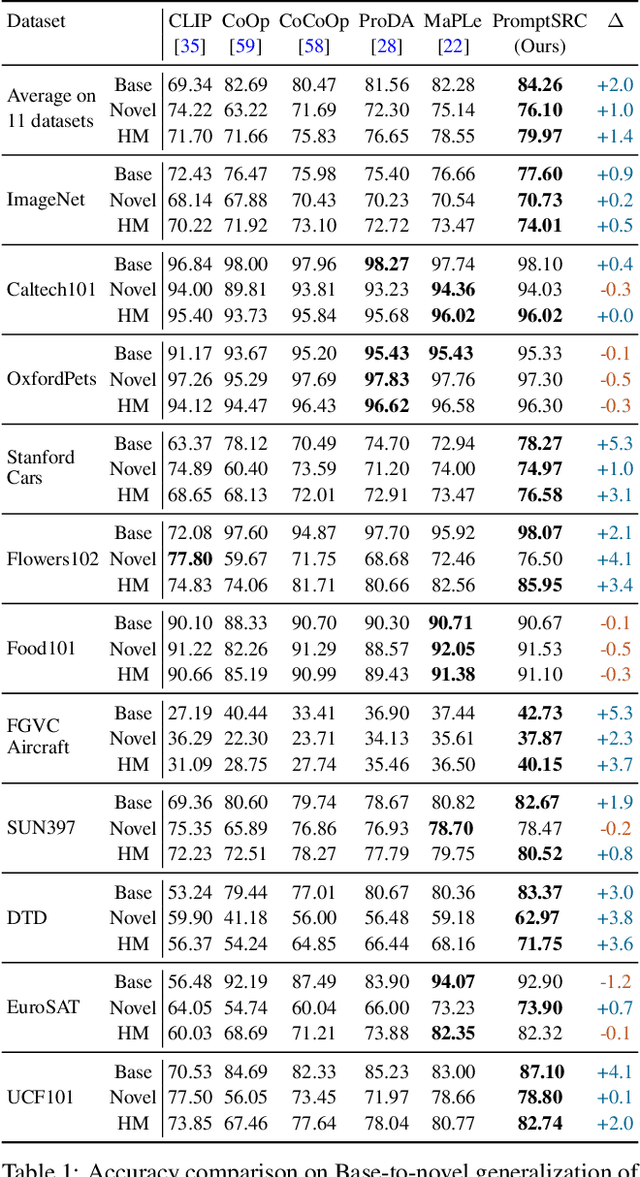
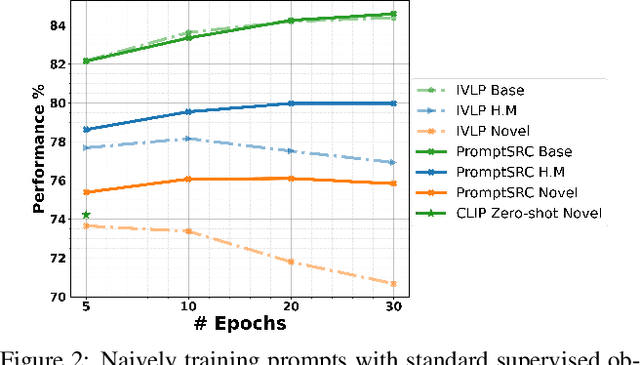
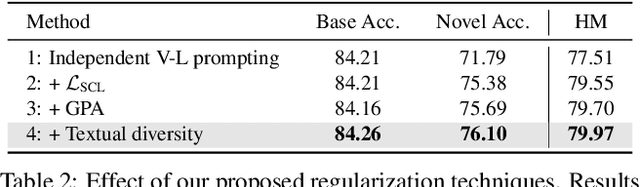
Prompt learning has emerged as an efficient alternative for fine-tuning foundational models, such as CLIP, for various downstream tasks. Conventionally trained using the task-specific objective, i.e., cross-entropy loss, prompts tend to overfit downstream data distributions and find it challenging to capture task-agnostic general features from the frozen CLIP. This leads to the loss of the model's original generalization capability. To address this issue, our work introduces a self-regularization framework for prompting called PromptSRC (Prompting with Self-regulating Constraints). PromptSRC guides the prompts to optimize for both task-specific and task-agnostic general representations using a three-pronged approach by: (a) regulating {prompted} representations via mutual agreement maximization with the frozen model, (b) regulating with self-ensemble of prompts over the training trajectory to encode their complementary strengths, and (c) regulating with textual diversity to mitigate sample diversity imbalance with the visual branch. To the best of our knowledge, this is the first regularization framework for prompt learning that avoids overfitting by jointly attending to pre-trained model features, the training trajectory during prompting, and the textual diversity. PromptSRC explicitly steers the prompts to learn a representation space that maximizes performance on downstream tasks without compromising CLIP generalization. We perform extensive experiments on 4 benchmarks where PromptSRC overall performs favorably well compared to the existing methods. Our code and pre-trained models are publicly available at: https://github.com/muzairkhattak/PromptSRC.

VideoGLUE: Video General Understanding Evaluation of Foundation Models
Jul 06, 2023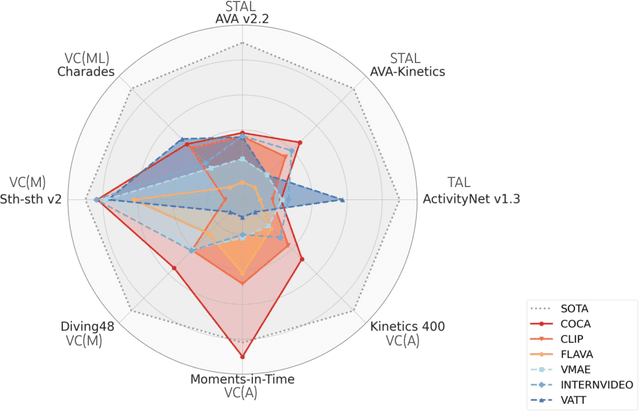


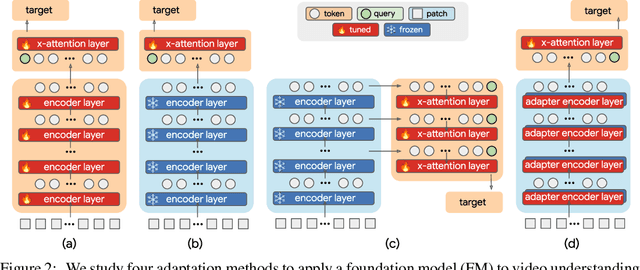
We evaluate existing foundation models video understanding capabilities using a carefully designed experiment protocol consisting of three hallmark tasks (action recognition, temporal localization, and spatiotemporal localization), eight datasets well received by the community, and four adaptation methods tailoring a foundation model (FM) for a downstream task. Moreover, we propose a scalar VideoGLUE score (VGS) to measure an FMs efficacy and efficiency when adapting to general video understanding tasks. Our main findings are as follows. First, task-specialized models significantly outperform the six FMs studied in this work, in sharp contrast to what FMs have achieved in natural language and image understanding. Second,video-native FMs, whose pretraining data contains the video modality, are generally better than image-native FMs in classifying motion-rich videos, localizing actions in time, and understanding a video of more than one action. Third, the video-native FMs can perform well on video tasks under light adaptations to downstream tasks(e.g., freezing the FM backbones), while image-native FMs win in full end-to-end finetuning. The first two observations reveal the need and tremendous opportunities to conduct research on video-focused FMs, and the last confirms that both tasks and adaptation methods matter when it comes to the evaluation of FMs.
SPAE: Semantic Pyramid AutoEncoder for Multimodal Generation with Frozen LLMs
Jul 03, 2023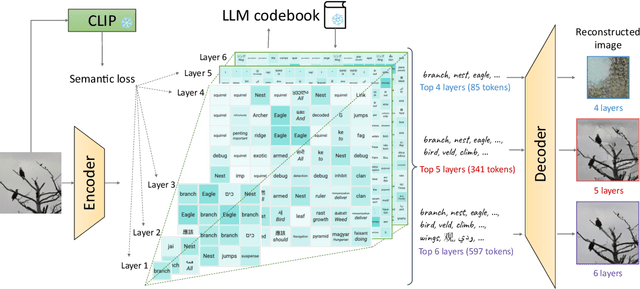

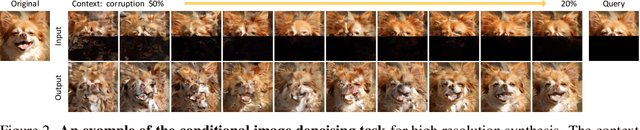
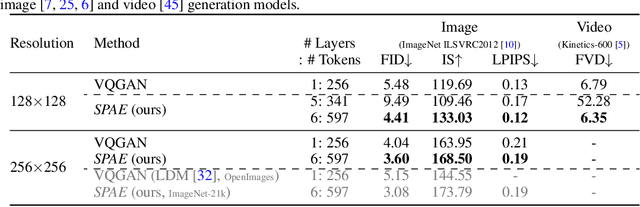
In this work, we introduce Semantic Pyramid AutoEncoder (SPAE) for enabling frozen LLMs to perform both understanding and generation tasks involving non-linguistic modalities such as images or videos. SPAE converts between raw pixels and interpretable lexical tokens (or words) extracted from the LLM's vocabulary. The resulting tokens capture both the semantic meaning and the fine-grained details needed for visual reconstruction, effectively translating the visual content into a language comprehensible to the LLM, and empowering it to perform a wide array of multimodal tasks. Our approach is validated through in-context learning experiments with frozen PaLM 2 and GPT 3.5 on a diverse set of image understanding and generation tasks. Our method marks the first successful attempt to enable a frozen LLM to generate image content while surpassing state-of-the-art performance in image understanding tasks, under the same setting, by over 25%.
ARTIC3D: Learning Robust Articulated 3D Shapes from Noisy Web Image Collections
Jun 07, 2023


Estimating 3D articulated shapes like animal bodies from monocular images is inherently challenging due to the ambiguities of camera viewpoint, pose, texture, lighting, etc. We propose ARTIC3D, a self-supervised framework to reconstruct per-instance 3D shapes from a sparse image collection in-the-wild. Specifically, ARTIC3D is built upon a skeleton-based surface representation and is further guided by 2D diffusion priors from Stable Diffusion. First, we enhance the input images with occlusions/truncation via 2D diffusion to obtain cleaner mask estimates and semantic features. Second, we perform diffusion-guided 3D optimization to estimate shape and texture that are of high-fidelity and faithful to input images. We also propose a novel technique to calculate more stable image-level gradients via diffusion models compared to existing alternatives. Finally, we produce realistic animations by fine-tuning the rendered shape and texture under rigid part transformations. Extensive evaluations on multiple existing datasets as well as newly introduced noisy web image collections with occlusions and truncation demonstrate that ARTIC3D outputs are more robust to noisy images, higher quality in terms of shape and texture details, and more realistic when animated. Project page: https://chhankyao.github.io/artic3d/
Counting Crowds in Bad Weather
Jun 02, 2023Crowd counting has recently attracted significant attention in the field of computer vision due to its wide applications to image understanding. Numerous methods have been proposed and achieved state-of-the-art performance for real-world tasks. However, existing approaches do not perform well under adverse weather such as haze, rain, and snow since the visual appearances of crowds in such scenes are drastically different from those images in clear weather of typical datasets. In this paper, we propose a method for robust crowd counting in adverse weather scenarios. Instead of using a two-stage approach that involves image restoration and crowd counting modules, our model learns effective features and adaptive queries to account for large appearance variations. With these weather queries, the proposed model can learn the weather information according to the degradation of the input image and optimize with the crowd counting module simultaneously. Experimental results show that the proposed algorithm is effective in counting crowds under different weather types on benchmark datasets. The source code and trained models will be made available to the public.
AIMS: All-Inclusive Multi-Level Segmentation
May 28, 2023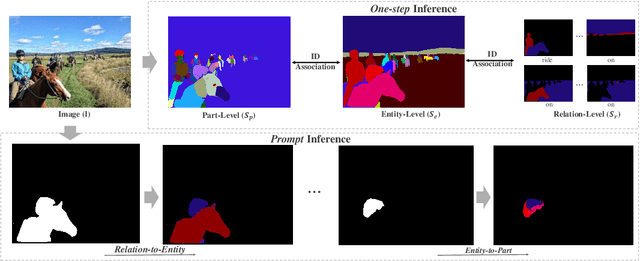

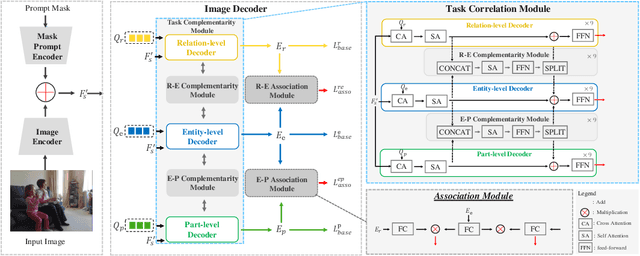

Despite the progress of image segmentation for accurate visual entity segmentation, completing the diverse requirements of image editing applications for different-level region-of-interest selections remains unsolved. In this paper, we propose a new task, All-Inclusive Multi-Level Segmentation (AIMS), which segments visual regions into three levels: part, entity, and relation (two entities with some semantic relationships). We also build a unified AIMS model through multi-dataset multi-task training to address the two major challenges of annotation inconsistency and task correlation. Specifically, we propose task complementarity, association, and prompt mask encoder for three-level predictions. Extensive experiments demonstrate the effectiveness and generalization capacity of our method compared to other state-of-the-art methods on a single dataset or the concurrent work on segmenting anything. We will make our code and training model publicly available.
A Tale of Two Features: Stable Diffusion Complements DINO for Zero-Shot Semantic Correspondence
May 24, 2023Text-to-image diffusion models have made significant advances in generating and editing high-quality images. As a result, numerous approaches have explored the ability of diffusion model features to understand and process single images for downstream tasks, e.g., classification, semantic segmentation, and stylization. However, significantly less is known about what these features reveal across multiple, different images and objects. In this work, we exploit Stable Diffusion (SD) features for semantic and dense correspondence and discover that with simple post-processing, SD features can perform quantitatively similar to SOTA representations. Interestingly, the qualitative analysis reveals that SD features have very different properties compared to existing representation learning features, such as the recently released DINOv2: while DINOv2 provides sparse but accurate matches, SD features provide high-quality spatial information but sometimes inaccurate semantic matches. We demonstrate that a simple fusion of these two features works surprisingly well, and a zero-shot evaluation using nearest neighbors on these fused features provides a significant performance gain over state-of-the-art methods on benchmark datasets, e.g., SPair-71k, PF-Pascal, and TSS. We also show that these correspondences can enable interesting applications such as instance swapping in two images.
Motion-Conditioned Diffusion Model for Controllable Video Synthesis
Apr 27, 2023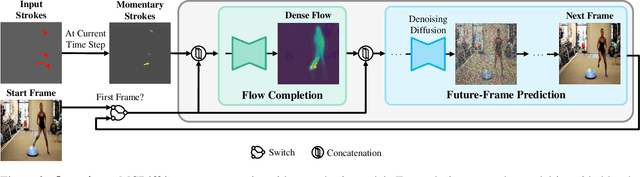
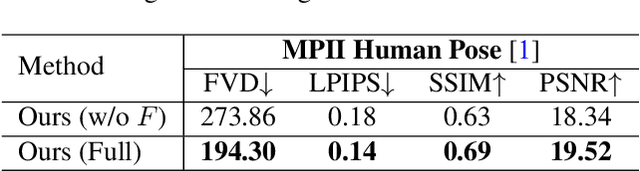
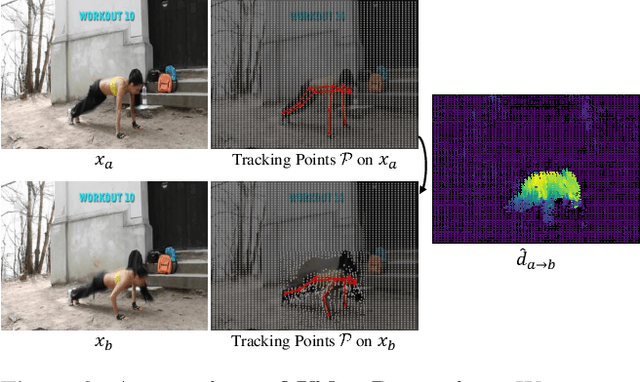

Recent advancements in diffusion models have greatly improved the quality and diversity of synthesized content. To harness the expressive power of diffusion models, researchers have explored various controllable mechanisms that allow users to intuitively guide the content synthesis process. Although the latest efforts have primarily focused on video synthesis, there has been a lack of effective methods for controlling and describing desired content and motion. In response to this gap, we introduce MCDiff, a conditional diffusion model that generates a video from a starting image frame and a set of strokes, which allow users to specify the intended content and dynamics for synthesis. To tackle the ambiguity of sparse motion inputs and achieve better synthesis quality, MCDiff first utilizes a flow completion model to predict the dense video motion based on the semantic understanding of the video frame and the sparse motion control. Then, the diffusion model synthesizes high-quality future frames to form the output video. We qualitatively and quantitatively show that MCDiff achieves the state-the-of-art visual quality in stroke-guided controllable video synthesis. Additional experiments on MPII Human Pose further exhibit the capability of our model on diverse content and motion synthesis.
Video Generation Beyond a Single Clip
Apr 15, 2023We tackle the long video generation problem, i.e.~generating videos beyond the output length of video generation models. Due to the computation resource constraints, video generation models can only generate video clips that are relatively short compared with the length of real videos. Existing works apply a sliding window approach to generate long videos at inference time, which is often limited to generating recurrent events or homogeneous content. To generate long videos covering diverse content and multiple events, we propose to use additional guidance to control the video generation process. We further present a two-stage approach to the problem, which allows us to utilize existing video generation models to generate high-quality videos within a small time window while modeling the video holistically based on the input guidance. The proposed approach is complementary to existing efforts on video generation, which focus on generating realistic video within a fixed time window. Extensive experiments on challenging real-world videos validate the benefit of the proposed method, which improves over state-of-the-art by up to 9.5% in objective metrics and is preferred by users more than 80% of time.
Generative Multiplane Neural Radiance for 3D-Aware Image Generation
Apr 03, 2023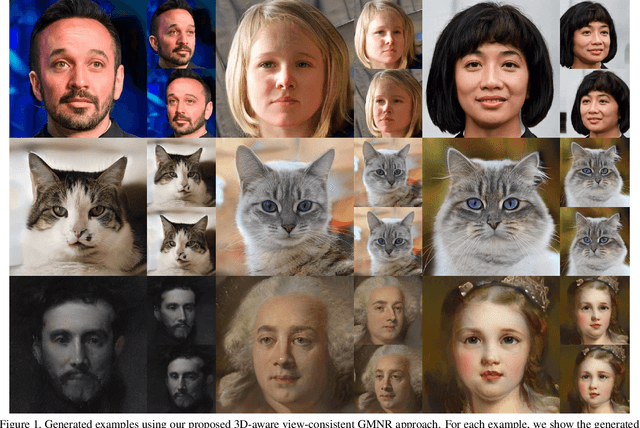
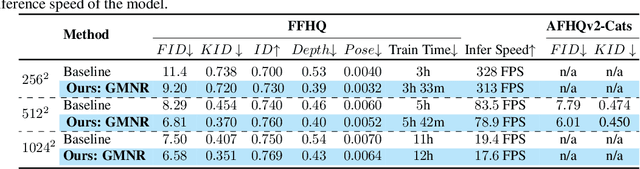
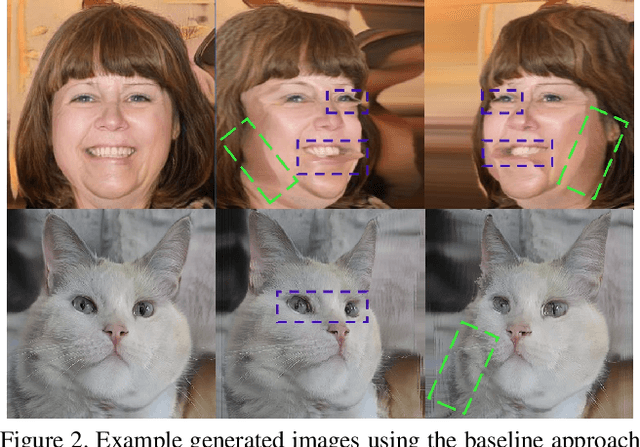
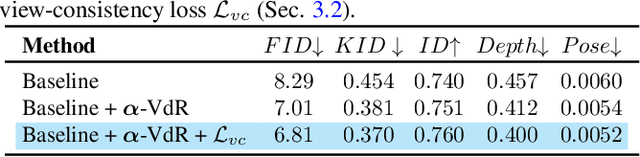
We present a method to efficiently generate 3D-aware high-resolution images that are view-consistent across multiple target views. The proposed multiplane neural radiance model, named GMNR, consists of a novel {\alpha}-guided view-dependent representation ({\alpha}-VdR) module for learning view-dependent information. The {\alpha}-VdR module, faciliated by an {\alpha}-guided pixel sampling technique, computes the view-dependent representation efficiently by learning viewing direction and position coefficients. Moreover, we propose a view-consistency loss to enforce photometric similarity across multiple views. The GMNR model can generate 3D-aware high-resolution images that are viewconsistent across multiple camera poses, while maintaining the computational efficiency in terms of both training and inference time. Experiments on three datasets demonstrate the effectiveness of the proposed modules, leading to favorable results in terms of both generation quality and inference time, compared to existing approaches. Our GMNR model generates 3D-aware images of 1024 X 1024 pixels with 17.6 FPS on a single V100. Code : https://github.com/VIROBO-15/GMNR