 Add to Chrome
 Add to Firefox
 Add to Edge
Calibrated Speculative Decoding: Frequency-Guided Candidate Selection for Efficient Inference
Apr 15, 2026
Speculative decoding accelerates autoregressive generation by letting draft tokens bypass full verification, but conventional frameworks suffer from frequent false rejections, particularly when draft models produce semantically correct but lexically divergent outputs. In this paper, we present Calibrated Speculative Decoding (CSD), a training-free framework that recovers valid tokens discarded by standard verification. Guided by the principle of "Frequency-Guided Candidate Selection and Probability-Guarded Acceptance," CSD incorporates two lightweight modules: Online Correction Memory, which aggregates historical rejections to propose recurring divergence patterns as rescue candidates, and Semantic Consistency Gating, which verifies candidate admissibility using probability ratios instead of exact token matching. Our evaluation across diverse large language models demonstrates that CSD outperforms existing methods, achieving a peak throughput speedup of 2.33x. CSD preserves model accuracy across all tasks while further boosting performance on complex reasoning datasets. These results establish CSD as a highly effective, lightweight solution for practical LLM deployments.

P^2O: Joint Policy and Prompt Optimization
Mar 23, 2026Reinforcement Learning with Verifiable Rewards (RLVR) has emerged as a powerful paradigm for enhancing the reasoning capabilities of Large Language Models (LLMs). However, vanilla RLVR suffers from inefficient exploration, particularly when confronting "hard samples" that yield nearzero success rates. In such scenarios, the reliance on sparse outcome rewards typically results in zero-advantage estimates, effectively starving the model of supervision signals despite the high informational value of these instances. To address this, we propose P^2O, a novel framework that synergizes Prompt Optimization with Policy Optimization. P^2O identifies hard samples during training iterations and leverages the GeneticPareto (GEPA) prompt optimization algorithm to evolve prompt templates that guide the model toward discovering successful trajectories. Crucially, unlike traditional prompt engineering methods that rely on input augmentation, P^2O distills the reasoning gains induced by these optimized prompts directly into the model parameters. This mechanism provides denser positive supervision signals for hard samples and accelerates convergence. Extensive experiments demonstrate that P^2O not only achieves superior performance on in-distribution datasets but also exhibits strong generalization, yielding substantial improvements on out-of-distribution benchmarks (+4.7% avg.).
OmniVLN: Omnidirectional 3D Perception and Token-Efficient LLM Reasoning for Visual-Language Navigation across Air and Ground Platforms
Mar 18, 2026Language-guided embodied navigation requires an agent to interpret object-referential instructions, search across multiple rooms, localize the referenced target, and execute reliable motion toward it. Existing systems remain limited in real indoor environments because narrow field-of-view sensing exposes only a partial local scene at each step, often forcing repeated rotations, delaying target discovery, and producing fragmented spatial understanding; meanwhile, directly prompting LLMs with dense 3D maps or exhaustive object lists quickly exceeds the context budget. We present OmniVLN, a zero-shot visual-language navigation framework that couples omnidirectional 3D perception with token-efficient hierarchical reasoning for both aerial and ground robots. OmniVLN fuses a rotating LiDAR and panoramic vision into a hardware-agnostic mapping stack, incrementally constructs a five-layer Dynamic Scene Graph (DSG) from mesh geometry to room- and building-level structure, and stabilizes high-level topology through persistent-homology-based room partitioning and hybrid geometric/VLM relation verification. For navigation, the global DSG is transformed into an agent-centric 3D octant representation with multi-resolution spatial attention prompting, enabling the LLM to progressively filter candidate rooms, infer egocentric orientation, localize target objects, and emit executable navigation primitives while preserving fine local detail and compact long-range memory. Experiments show that the proposed hierarchical interface improves spatial referring accuracy from 77.27\% to 93.18\%, reduces cumulative prompt tokens by up to 61.7\% in cluttered multi-room settings, and improves navigation success by up to 11.68\% over a flat-list baseline. We will release the code and an omnidirectional multimodal dataset to support reproducible research.
Decoupling Reasoning and Confidence: Resurrecting Calibration in Reinforcement Learning from Verifiable Rewards
Mar 10, 2026Reinforcement Learning from Verifiable Rewards (RLVR) significantly enhances large language models (LLMs) reasoning but severely suffers from calibration degeneration, where models become excessively over-confident in incorrect answers. Previous studies devote to directly incorporating calibration objective into existing optimization target. However, our theoretical analysis demonstrates that there exists a fundamental gradient conflict between the optimization for maximizing policy accuracy and minimizing calibration error. Building on this insight, we propose DCPO, a simple yet effective framework that systematically decouples reasoning and calibration objectives. Extensive experiments demonstrate that our DCPO not only preserves accuracy on par with GRPO but also achieves the best calibration performance and substantially mitigates the over-confidence issue. Our study provides valuable insights and practical solution for more reliable LLM deployment.
Root Cause Analysis Method Based on Large Language Models with Residual Connection Structures
Feb 09, 2026Root cause localization remain challenging in complex and large-scale microservice architectures. The complex fault propagation among microservices and the high dimensionality of telemetry data, including metrics, logs, and traces, limit the effectiveness of existing root cause analysis (RCA) methods. In this paper, a residual-connection-based RCA method using large language model (LLM), named RC-LLM, is proposed. A residual-like hierarchical fusion structure is designed to integrate multi-source telemetry data, while the contextual reasoning capability of large language models is leveraged to model temporal and cross-microservice causal dependencies. Experimental results on CCF-AIOps microservice datasets demonstrate that RC-LLM achieves strong accuracy and efficiency in root cause analysis.
StarWhisper Telescope: Agent-Based Observation Assistant System to Approach AI Astrophysicist
Dec 09, 2024
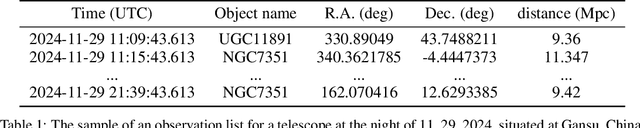


With the rapid advancements in Large Language Models (LLMs), LLM-based agents have introduced convenient and user-friendly methods for leveraging tools across various domains. In the field of astronomical observation, the construction of new telescopes has significantly increased astronomers' workload. Deploying LLM-powered agents can effectively alleviate this burden and reduce the costs associated with training personnel. Within the Nearby Galaxy Supernovae Survey (NGSS) project, which encompasses eight telescopes across three observation sites, aiming to find the transients from the galaxies in 50 mpc, we have developed the \textbf{StarWhisper Telescope System} to manage the entire observation process. This system automates tasks such as generating observation lists, conducting observations, analyzing data, and providing feedback to the observer. Observation lists are customized for different sites and strategies to ensure comprehensive coverage of celestial objects. After manual verification, these lists are uploaded to the telescopes via the agents in the system, which initiates observations upon neutral language. The observed images are analyzed in real-time, and the transients are promptly communicated to the observer. The agent modifies them into a real-time follow-up observation proposal and send to the Xinglong observatory group chat, then add them to the next-day observation lists. Additionally, the integration of AI agents within the system provides online accessibility, saving astronomers' time and encouraging greater participation from amateur astronomers in the NGSS project.
M4: Multi-Proxy Multi-Gate Mixture of Experts Network for Multiple Instance Learning in Histopathology Image Analysis
Jul 24, 2024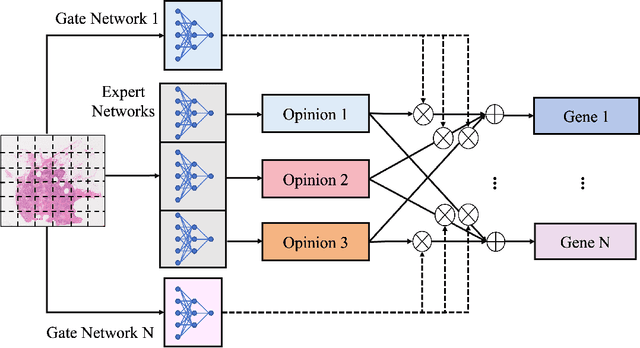


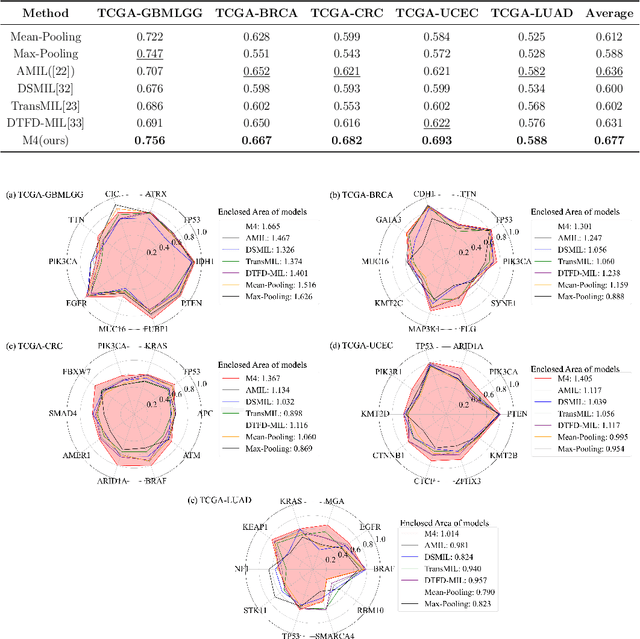
Multiple instance learning (MIL) has been successfully applied for whole slide images (WSIs) analysis in computational pathology, enabling a wide range of prediction tasks from tumor subtyping to inferring genetic mutations and multi-omics biomarkers. However, existing MIL methods predominantly focus on single-task learning, resulting in not only overall low efficiency but also the overlook of inter-task relatedness. To address these issues, we proposed an adapted architecture of Multi-gate Mixture-of-experts with Multi-proxy for Multiple instance learning (M4), and applied this framework for simultaneous prediction of multiple genetic mutations from WSIs. The proposed M4 model has two main innovations: (1) utilizing a mixture of experts with multiple gating strategies for multi-genetic mutation prediction on a single pathological slide; (2) constructing multi-proxy expert network and gate network for comprehensive and effective modeling of pathological image information. Our model achieved significant improvements across five tested TCGA datasets in comparison to current state-of-the-art single-task methods. The code is available at:https://github.com/Bigyehahaha/M4.
Hypergraph Multi-modal Large Language Model: Exploiting EEG and Eye-tracking Modalities to Evaluate Heterogeneous Responses for Video Understanding
Jul 11, 2024


Understanding of video creativity and content often varies among individuals, with differences in focal points and cognitive levels across different ages, experiences, and genders. There is currently a lack of research in this area, and most existing benchmarks suffer from several drawbacks: 1) a limited number of modalities and answers with restrictive length; 2) the content and scenarios within the videos are excessively monotonous, transmitting allegories and emotions that are overly simplistic. To bridge the gap to real-world applications, we introduce a large-scale \textbf{S}ubjective \textbf{R}esponse \textbf{I}ndicators for \textbf{A}dvertisement \textbf{V}ideos dataset, namely SRI-ADV. Specifically, we collected real changes in Electroencephalographic (EEG) and eye-tracking regions from different demographics while they viewed identical video content. Utilizing this multi-modal dataset, we developed tasks and protocols to analyze and evaluate the extent of cognitive understanding of video content among different users. Along with the dataset, we designed a \textbf{H}ypergraph \textbf{M}ulti-modal \textbf{L}arge \textbf{L}anguage \textbf{M}odel (HMLLM) to explore the associations among different demographics, video elements, EEG and eye-tracking indicators. HMLLM could bridge semantic gaps across rich modalities and integrate information beyond different modalities to perform logical reasoning. Extensive experimental evaluations on SRI-ADV and other additional video-based generative performance benchmarks demonstrate the effectiveness of our method. The codes and dataset will be released at \url{https://github.com/suay1113/HMLLM}.
BatmanNet: Bi-branch Masked Graph Transformer Autoencoder for Molecular Representation
Nov 29, 2022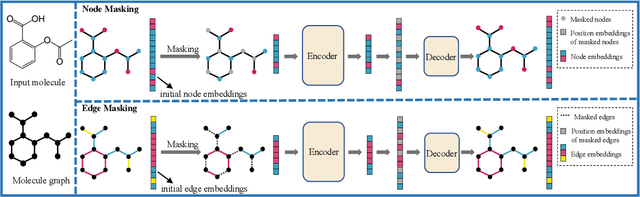
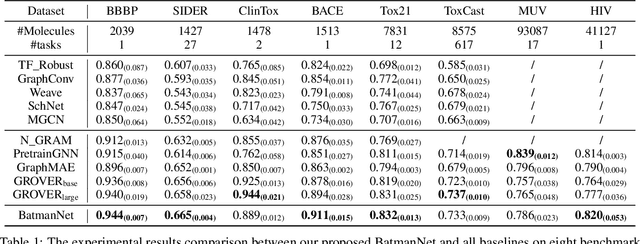
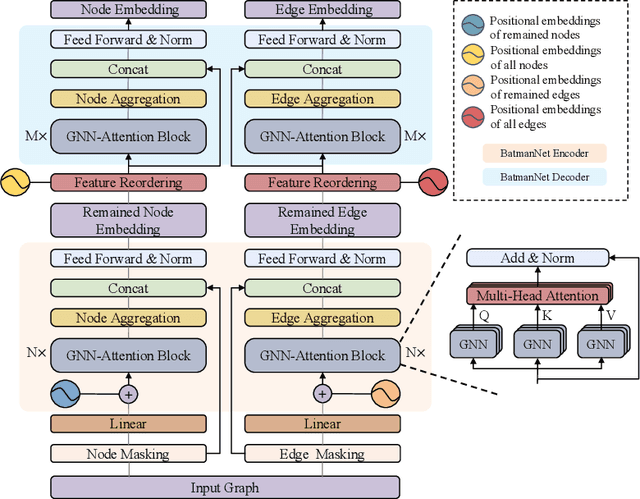

Although substantial efforts have been made using graph neural networks (GNNs) for AI-driven drug discovery (AIDD), effective molecular representation learning remains an open challenge, especially in the case of insufficient labeled molecules. Recent studies suggest that big GNN models pre-trained by self-supervised learning on unlabeled datasets enable better transfer performance in downstream molecular property prediction tasks. However, they often require large-scale datasets and considerable computational resources, which is time-consuming, computationally expensive, and environmentally unfriendly. To alleviate these limitations, we propose a novel pre-training model for molecular representation learning, Bi-branch Masked Graph Transformer Autoencoder (BatmanNet). BatmanNet features two tailored and complementary graph autoencoders to reconstruct the missing nodes and edges from a masked molecular graph. To our surprise, BatmanNet discovered that the highly masked proportion (60%) of the atoms and bonds achieved the best performance. We further propose an asymmetric graph-based encoder-decoder architecture for either nodes and edges, where a transformer-based encoder only takes the visible subset of nodes or edges, and a lightweight decoder reconstructs the original molecule from the latent representation and mask tokens. With this simple yet effective asymmetrical design, our BatmanNet can learn efficiently even from a much smaller-scale unlabeled molecular dataset to capture the underlying structural and semantic information, overcoming a major limitation of current deep neural networks for molecular representation learning. For instance, using only 250K unlabelled molecules as pre-training data, our BatmanNet with 2.575M parameters achieves a 0.5% improvement on the average AUC compared with the current state-of-the-art method with 100M parameters pre-trained on 11M molecules.