 Add to Chrome
 Add to Firefox
 Add to Edge
Root Cause Analysis Method Based on Large Language Models with Residual Connection Structures
Feb 09, 2026
Root cause localization remain challenging in complex and large-scale microservice architectures. The complex fault propagation among microservices and the high dimensionality of telemetry data, including metrics, logs, and traces, limit the effectiveness of existing root cause analysis (RCA) methods. In this paper, a residual-connection-based RCA method using large language model (LLM), named RC-LLM, is proposed. A residual-like hierarchical fusion structure is designed to integrate multi-source telemetry data, while the contextual reasoning capability of large language models is leveraged to model temporal and cross-microservice causal dependencies. Experimental results on CCF-AIOps microservice datasets demonstrate that RC-LLM achieves strong accuracy and efficiency in root cause analysis.

BNS-Net: A Dual-channel Sarcasm Detection Method Considering Behavior-level and Sentence-level Conflicts
Sep 07, 2023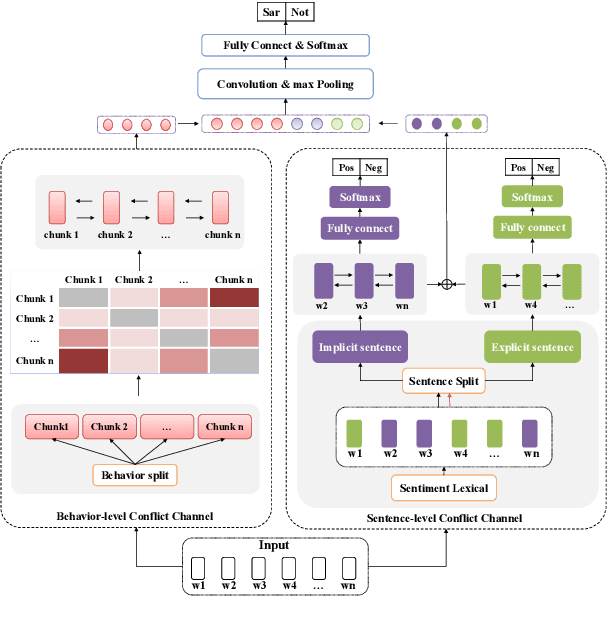
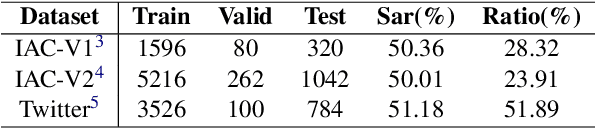
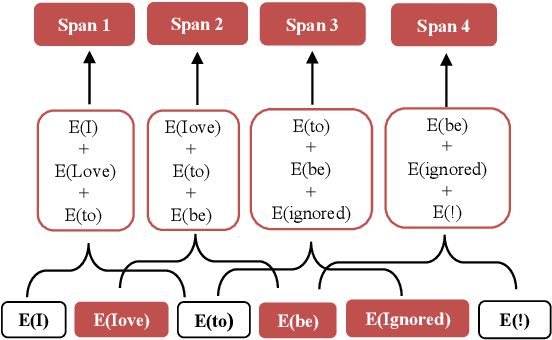
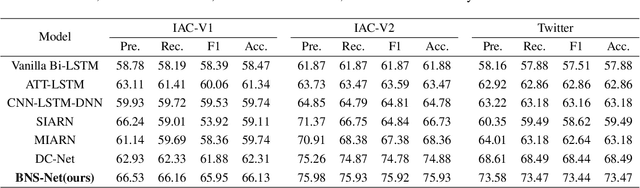
Sarcasm detection is a binary classification task that aims to determine whether a given utterance is sarcastic. Over the past decade, sarcasm detection has evolved from classical pattern recognition to deep learning approaches, where features such as user profile, punctuation and sentiment words have been commonly employed for sarcasm detection. In real-life sarcastic expressions, behaviors without explicit sentimental cues often serve as carriers of implicit sentimental meanings. Motivated by this observation, we proposed a dual-channel sarcasm detection model named BNS-Net. The model considers behavior and sentence conflicts in two channels. Channel 1: Behavior-level Conflict Channel reconstructs the text based on core verbs while leveraging the modified attention mechanism to highlight conflict information. Channel 2: Sentence-level Conflict Channel introduces external sentiment knowledge to segment the text into explicit and implicit sentences, capturing conflicts between them. To validate the effectiveness of BNS-Net, several comparative and ablation experiments are conducted on three public sarcasm datasets. The analysis and evaluation of experimental results demonstrate that the BNS-Net effectively identifies sarcasm in text and achieves the state-of-the-art performance.
Complex Spectral Mapping With Attention Based Convolution Recurrent Neural Network for Speech Enhancement
Apr 15, 2021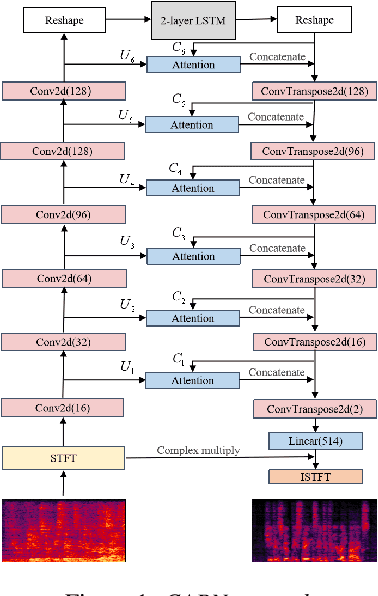
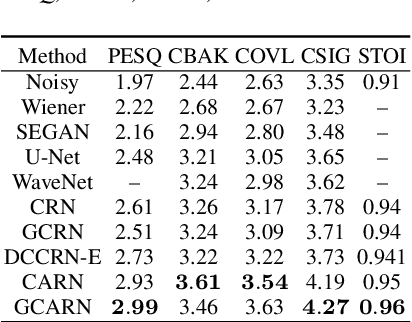
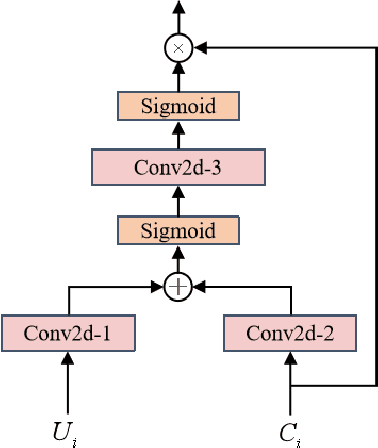
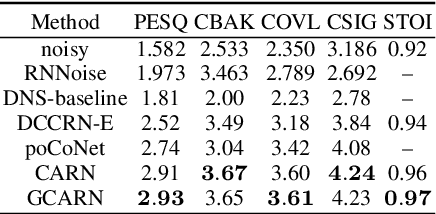
Speech enhancement has benefited from the success of deep learning in terms of intelligibility and perceptual quality. Conventional time-frequency (TF) domain methods focus on predicting TF-masks or speech spectrum,via a naive convolution neural network or recurrent neural network.Some recent studies were based on Complex spectral Mapping convolution recurrent neural network (CRN) . These models skiped directly from encoder layers' output and decoder layers' input ,which maybe thoughtless. We proposed an attention mechanism based skip connection between encoder and decoder layers,namely Complex Spectral Mapping With Attention Based Convolution Recurrent Neural Network (CARN).Compared with CRN model,the proposed CARN model improved more than 10% relatively at several metrics such as PESQ,CBAK,COVL,CSIG and son,and outperformed the place 1st model in both real time and non-real time track of the DNS Challenge 2020 at these metrics.