 Add to Chrome
 Add to Firefox
 Add to Edge
P^2O: Joint Policy and Prompt Optimization
Mar 23, 2026
Reinforcement Learning with Verifiable Rewards (RLVR) has emerged as a powerful paradigm for enhancing the reasoning capabilities of Large Language Models (LLMs). However, vanilla RLVR suffers from inefficient exploration, particularly when confronting "hard samples" that yield nearzero success rates. In such scenarios, the reliance on sparse outcome rewards typically results in zero-advantage estimates, effectively starving the model of supervision signals despite the high informational value of these instances. To address this, we propose P^2O, a novel framework that synergizes Prompt Optimization with Policy Optimization. P^2O identifies hard samples during training iterations and leverages the GeneticPareto (GEPA) prompt optimization algorithm to evolve prompt templates that guide the model toward discovering successful trajectories. Crucially, unlike traditional prompt engineering methods that rely on input augmentation, P^2O distills the reasoning gains induced by these optimized prompts directly into the model parameters. This mechanism provides denser positive supervision signals for hard samples and accelerates convergence. Extensive experiments demonstrate that P^2O not only achieves superior performance on in-distribution datasets but also exhibits strong generalization, yielding substantial improvements on out-of-distribution benchmarks (+4.7% avg.).

Decoupling Reasoning and Confidence: Resurrecting Calibration in Reinforcement Learning from Verifiable Rewards
Mar 10, 2026Reinforcement Learning from Verifiable Rewards (RLVR) significantly enhances large language models (LLMs) reasoning but severely suffers from calibration degeneration, where models become excessively over-confident in incorrect answers. Previous studies devote to directly incorporating calibration objective into existing optimization target. However, our theoretical analysis demonstrates that there exists a fundamental gradient conflict between the optimization for maximizing policy accuracy and minimizing calibration error. Building on this insight, we propose DCPO, a simple yet effective framework that systematically decouples reasoning and calibration objectives. Extensive experiments demonstrate that our DCPO not only preserves accuracy on par with GRPO but also achieves the best calibration performance and substantially mitigates the over-confidence issue. Our study provides valuable insights and practical solution for more reliable LLM deployment.
Data Contamination Report from the 2024 CONDA Shared Task
Jul 31, 2024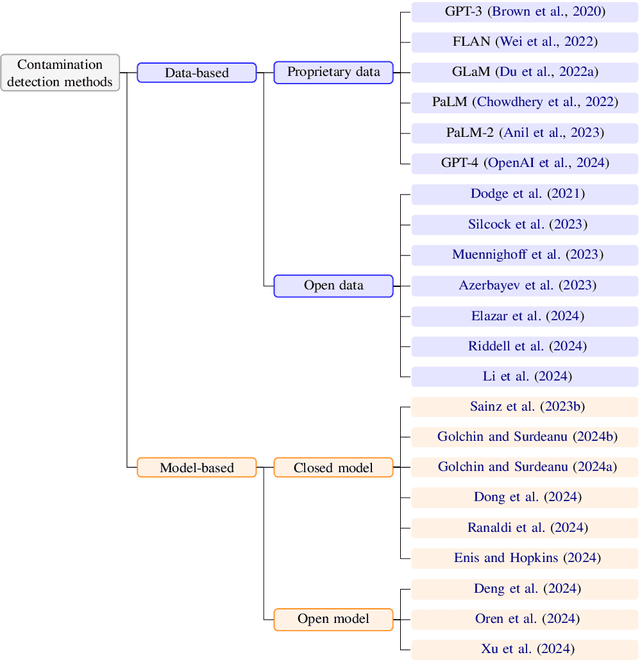

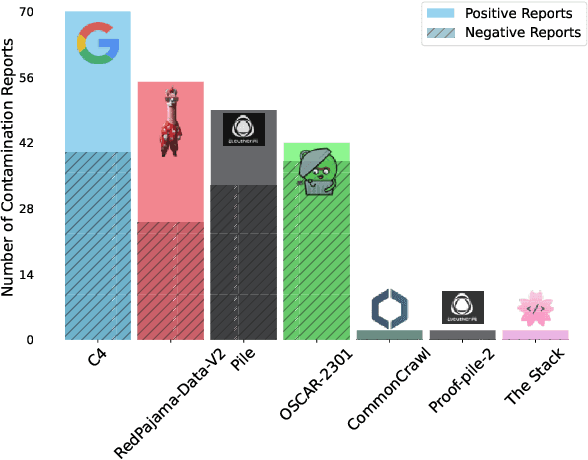
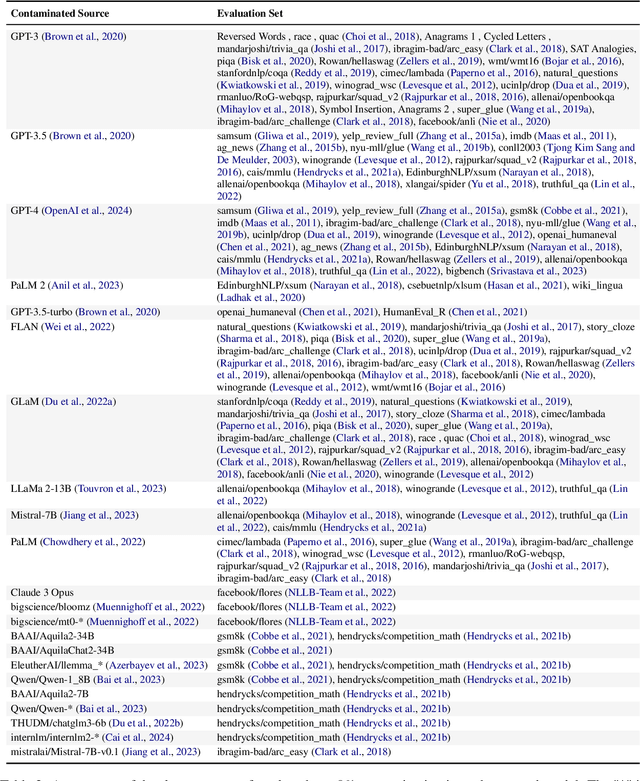
The 1st Workshop on Data Contamination (CONDA 2024) focuses on all relevant aspects of data contamination in natural language processing, where data contamination is understood as situations where evaluation data is included in pre-training corpora used to train large scale models, compromising evaluation results. The workshop fostered a shared task to collect evidence on data contamination in current available datasets and models. The goal of the shared task and associated database is to assist the community in understanding the extent of the problem and to assist researchers in avoiding reporting evaluation results on known contaminated resources. The shared task provides a structured, centralized public database for the collection of contamination evidence, open to contributions from the community via GitHub pool requests. This first compilation paper is based on 566 reported entries over 91 contaminated sources from a total of 23 contributors. The details of the individual contamination events are available in the platform. The platform continues to be online, open to contributions from the community.
Noise-Robust De-Duplication at Scale
Oct 09, 2022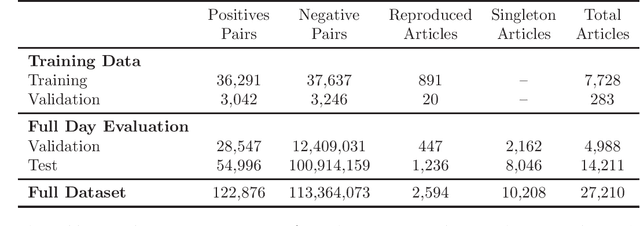



Identifying near duplicates within large, noisy text corpora has a myriad of applications that range from de-duplicating training datasets, reducing privacy risk, and evaluating test set leakage, to identifying reproduced news articles and literature within large corpora. Across these diverse applications, the overwhelming majority of work relies on N-grams. Limited efforts have been made to evaluate how well N-gram methods perform, in part because it is unclear how one could create an unbiased evaluation dataset for a massive corpus. This study uses the unique timeliness of historical news wires to create a 27,210 document dataset, with 122,876 positive duplicate pairs, for studying noise-robust de-duplication. The time-sensitivity of news makes comprehensive hand labelling feasible - despite the massive overall size of the corpus - as duplicates occur within a narrow date range. The study then develops and evaluates a range of de-duplication methods: hashing and N-gram overlap (which predominate in the literature), a contrastively trained bi-encoder, and a re-rank style approach combining a bi- and cross-encoder. The neural approaches significantly outperform hashing and N-gram overlap. We show that the bi-encoder scales well, de-duplicating a 10 million article corpus on a single GPU card in a matter of hours. The public release of our NEWS-COPY de-duplication dataset will facilitate further research and applications.