 Add to Chrome
 Add to Firefox
 Add to Edge
Decoupling Reasoning and Confidence: Resurrecting Calibration in Reinforcement Learning from Verifiable Rewards
Mar 10, 2026
Reinforcement Learning from Verifiable Rewards (RLVR) significantly enhances large language models (LLMs) reasoning but severely suffers from calibration degeneration, where models become excessively over-confident in incorrect answers. Previous studies devote to directly incorporating calibration objective into existing optimization target. However, our theoretical analysis demonstrates that there exists a fundamental gradient conflict between the optimization for maximizing policy accuracy and minimizing calibration error. Building on this insight, we propose DCPO, a simple yet effective framework that systematically decouples reasoning and calibration objectives. Extensive experiments demonstrate that our DCPO not only preserves accuracy on par with GRPO but also achieves the best calibration performance and substantially mitigates the over-confidence issue. Our study provides valuable insights and practical solution for more reliable LLM deployment.

Beyond Correctness: Benchmarking Multi-dimensional Code Generation for Large Language Models
Jul 16, 2024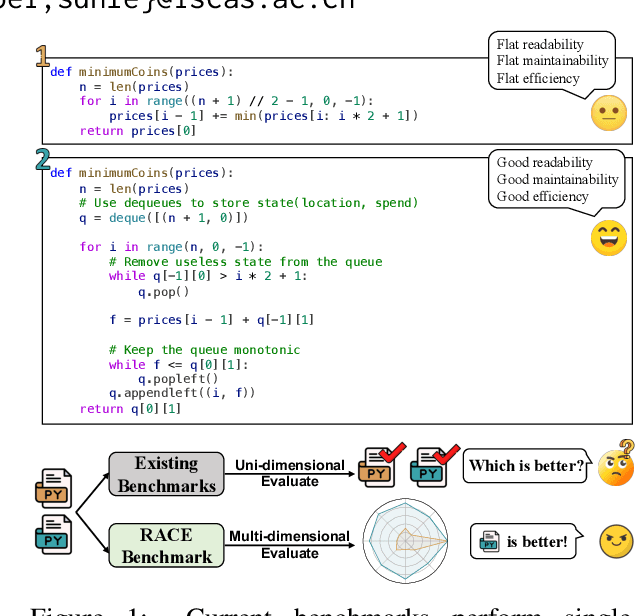


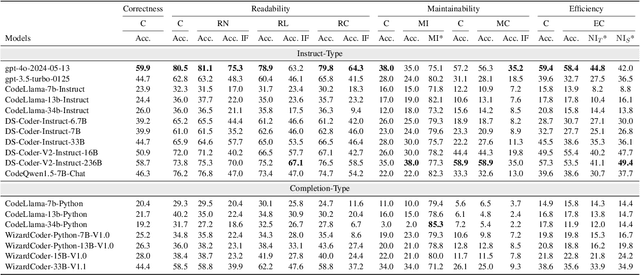
In recent years, researchers have proposed numerous benchmarks to evaluate the impressive coding capabilities of large language models (LLMs). However, existing benchmarks primarily focus on assessing the correctness of code generated by LLMs, while neglecting other critical dimensions that also significantly impact code quality. Therefore, this paper proposes the RACE benchmark, which comprehensively evaluates the quality of code generated by LLMs across 4 dimensions: Readability, mAintainability, Correctness, and Efficiency. Specifically, considering the demand-dependent nature of dimensions beyond correctness, we design various types of user requirements for each dimension to assess the model's ability to generate correct code that also meets user demands. We evaluate 18 representative LLMs on RACE and find that: 1) the current LLMs' ability to generate high-quality code on demand does not yet meet the requirements of software development; 2) readability serves as a critical indicator of the overall quality of generated code; 3) most LLMs exhibit an inherent preference for specific coding style. These findings can help researchers gain a deeper understanding of the coding capabilities of current LLMs and shed light on future directions for model improvement.