 Add to Chrome
 Add to Firefox
 Add to Edge
Generalizable Long-Horizon Manipulations with Large Language Models
Oct 03, 2023
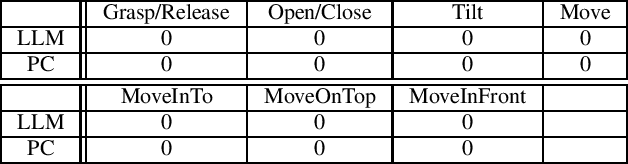
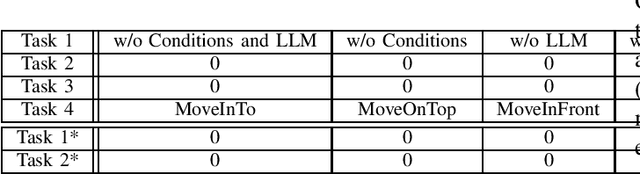
This work introduces a framework harnessing the capabilities of Large Language Models (LLMs) to generate primitive task conditions for generalizable long-horizon manipulations with novel objects and unseen tasks. These task conditions serve as guides for the generation and adjustment of Dynamic Movement Primitives (DMP) trajectories for long-horizon task execution. We further create a challenging robotic manipulation task suite based on Pybullet for long-horizon task evaluation. Extensive experiments in both simulated and real-world environments demonstrate the effectiveness of our framework on both familiar tasks involving new objects and novel but related tasks, highlighting the potential of LLMs in enhancing robotic system versatility and adaptability. Project website: https://object814.github.io/Task-Condition-With-LLM/

RSRD: A Road Surface Reconstruction Dataset and Benchmark for Safe and Comfortable Autonomous Driving
Oct 03, 2023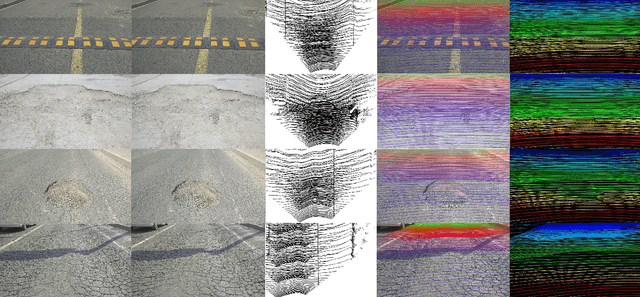
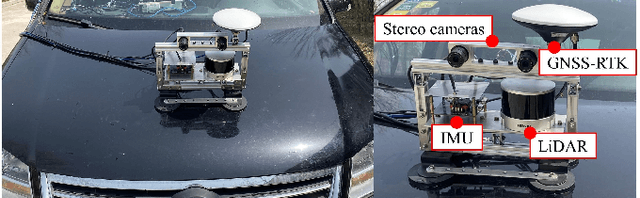
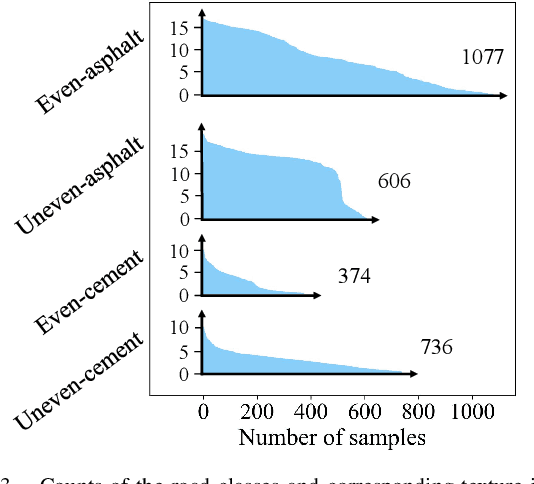
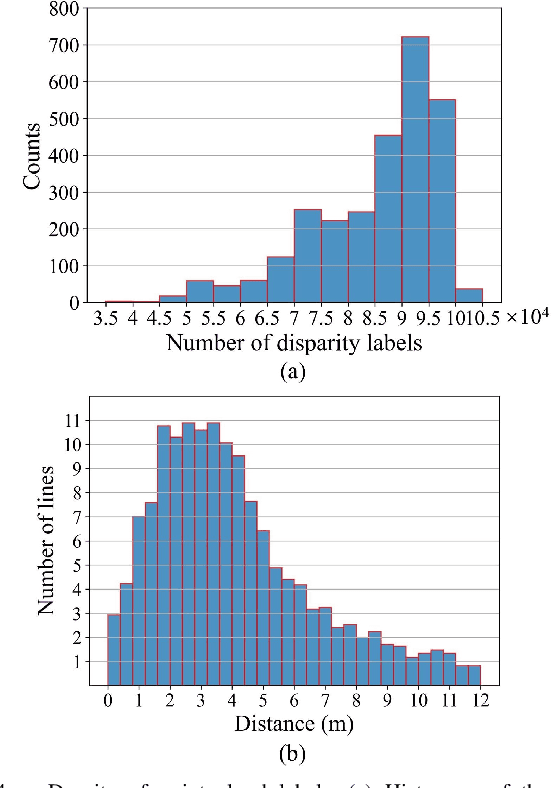
This paper addresses the growing demands for safety and comfort in intelligent robot systems, particularly autonomous vehicles, where road conditions play a pivotal role in overall driving performance. For example, reconstructing road surfaces helps to enhance the analysis and prediction of vehicle responses for motion planning and control systems. We introduce the Road Surface Reconstruction Dataset (RSRD), a real-world, high-resolution, and high-precision dataset collected with a specialized platform in diverse driving conditions. It covers common road types containing approximately 16,000 pairs of stereo images, original point clouds, and ground-truth depth/disparity maps, with accurate post-processing pipelines to ensure its quality. Based on RSRD, we further build a comprehensive benchmark for recovering road profiles through depth estimation and stereo matching. Preliminary evaluations with various state-of-the-art methods reveal the effectiveness of our dataset and the challenge of the task, underscoring substantial opportunities of RSRD as a valuable resource for advancing techniques, e.g., multi-view stereo towards safe autonomous driving. The dataset and demo videos are available at https://thu-rsxd.com/rsrd/
Distributed Multi-agent Interaction Generation with Imagined Potential Games
Oct 02, 2023Interactive behavior modeling of multiple agents is an essential challenge in simulation, especially in scenarios when agents need to avoid collisions and cooperate at the same time. Humans can interact with others without explicit communication and navigate in scenarios when cooperation is required. In this work, we aim to model human interactions in this realistic setting, where each agent acts based on its observation and does not communicate with others. We propose a framework based on distributed potential games, where each agent imagines a cooperative game with other agents and solves the game using its estimation of their behavior. We utilize iLQR to solve the games and closed-loop simulate the interactions. We demonstrate the benefits of utilizing distributed imagined games in our framework through various simulation experiments. We show the high success rate, the increased navigation efficiency, and the ability to generate rich and realistic interactions with interpretable parameters. Illustrative examples are available at https://sites.google.com/berkeley.edu/distributed-interaction.
Pre-training on Synthetic Driving Data for Trajectory Prediction
Sep 20, 2023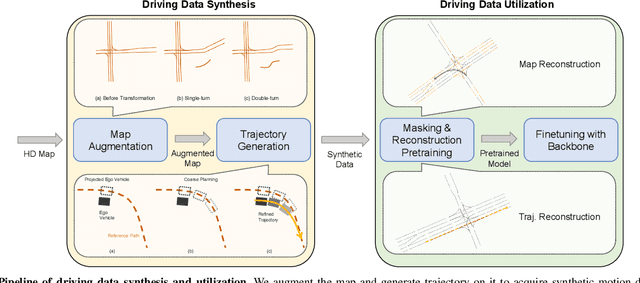
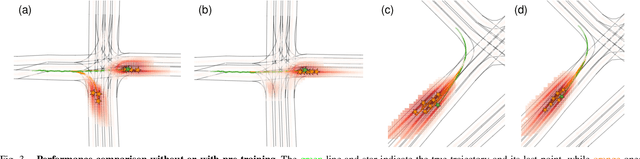
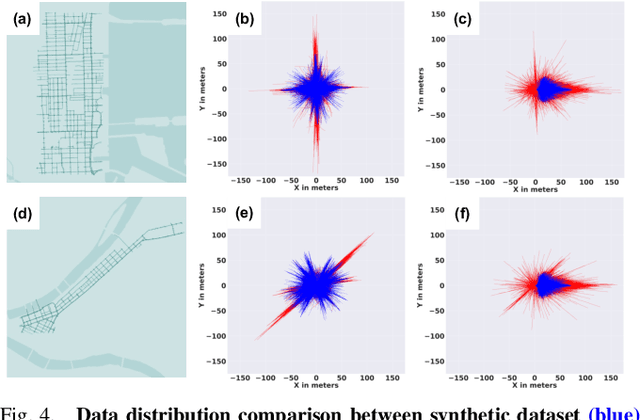
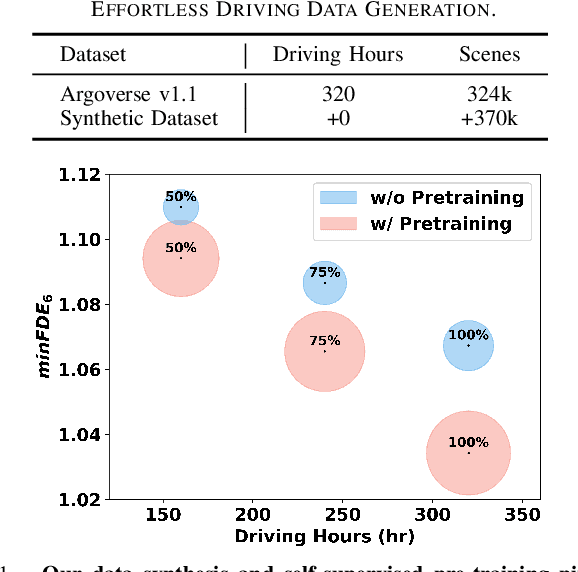
Accumulating substantial volumes of real-world driving data proves pivotal in the realm of trajectory forecasting for autonomous driving. Given the heavy reliance of current trajectory forecasting models on data-driven methodologies, we aim to tackle the challenge of learning general trajectory forecasting representations under limited data availability. We propose to augment both HD maps and trajectories and apply pre-training strategies on top of them. Specifically, we take advantage of graph representations of HD-map and apply vector transformations to reshape the maps, to easily enrich the limited number of scenes. Additionally, we employ a rule-based model to generate trajectories based on augmented scenes; thus enlarging the trajectories beyond the collected real ones. To foster the learning of general representations within this augmented dataset, we comprehensively explore the different pre-training strategies, including extending the concept of a Masked AutoEncoder (MAE) for trajectory forecasting. Extensive experiments demonstrate the effectiveness of our data expansion and pre-training strategies, which outperform the baseline prediction model by large margins, e.g. 5.04%, 3.84% and 8.30% in terms of $MR_6$, $minADE_6$ and $minFDE_6$.
Guided Online Distillation: Promoting Safe Reinforcement Learning by Offline Demonstration
Sep 18, 2023

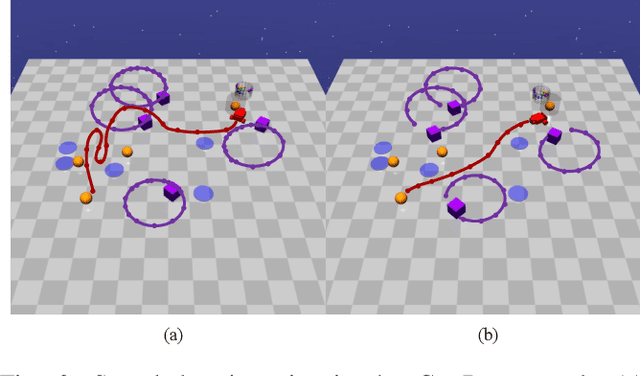
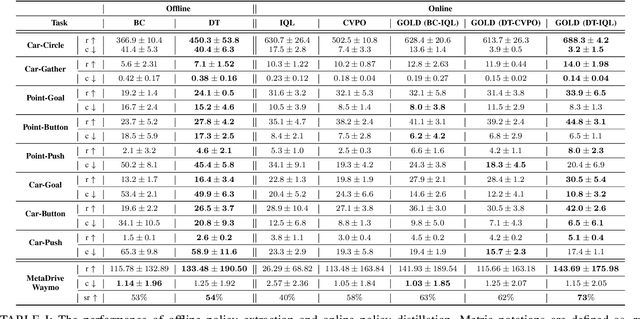
Safe Reinforcement Learning (RL) aims to find a policy that achieves high rewards while satisfying cost constraints. When learning from scratch, safe RL agents tend to be overly conservative, which impedes exploration and restrains the overall performance. In many realistic tasks, e.g. autonomous driving, large-scale expert demonstration data are available. We argue that extracting expert policy from offline data to guide online exploration is a promising solution to mitigate the conserveness issue. Large-capacity models, e.g. decision transformers (DT), have been proven to be competent in offline policy learning. However, data collected in real-world scenarios rarely contain dangerous cases (e.g., collisions), which makes it prohibitive for the policies to learn safety concepts. Besides, these bulk policy networks cannot meet the computation speed requirements at inference time on real-world tasks such as autonomous driving. To this end, we propose Guided Online Distillation (GOLD), an offline-to-online safe RL framework. GOLD distills an offline DT policy into a lightweight policy network through guided online safe RL training, which outperforms both the offline DT policy and online safe RL algorithms. Experiments in both benchmark safe RL tasks and real-world driving tasks based on the Waymo Open Motion Dataset (WOMD) demonstrate that GOLD can successfully distill lightweight policies and solve decision-making problems in challenging safety-critical scenarios.
Robot Manipulation Task Learning by Leveraging SE(3) Group Invariance and Equivariance
Aug 29, 2023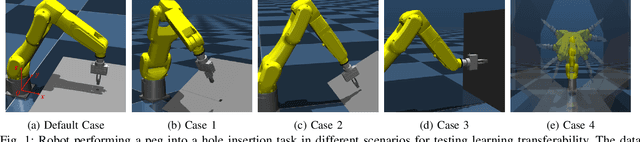
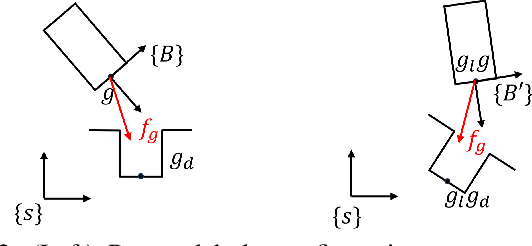
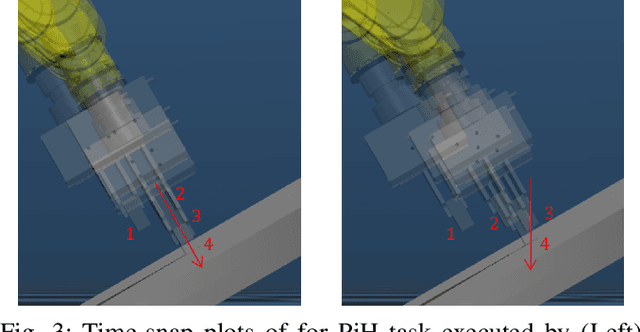
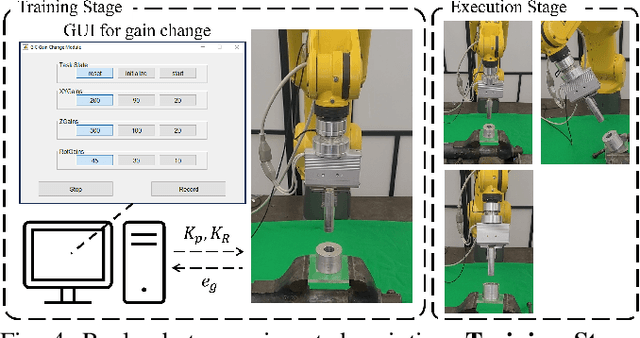
This paper presents a differential geometric control approach that leverages SE(3) group invariance and equivariance to increase transferability in learning robot manipulation tasks that involve interaction with the environment. Specifically, we employ a control law and a learning representation framework that remain invariant under arbitrary SE(3) transformations of the manipulation task definition. Furthermore, the control law and learning representation framework are shown to be SE(3) equivariant when represented relative to the spatial frame. The proposed approach is based on utilizing a recently presented geometric impedance control (GIC) combined with a learning variable impedance control framework, where the gain scheduling policy is trained in a supervised learning fashion from expert demonstrations. A geometrically consistent error vector (GCEV) is fed to a neural network to achieve a gain scheduling policy that remains invariant to arbitrary translation and rotations. A comparison of our proposed control and learning framework with a well-known Cartesian space learning impedance control, equipped with a Cartesian error vector-based gain scheduling policy, confirms the significantly superior learning transferability of our proposed approach. A hardware implementation on a peg-in-hole task is conducted to validate the learning transferability and feasibility of the proposed approach.
DELFlow: Dense Efficient Learning of Scene Flow for Large-Scale Point Clouds
Aug 09, 2023


Point clouds are naturally sparse, while image pixels are dense. The inconsistency limits feature fusion from both modalities for point-wise scene flow estimation. Previous methods rarely predict scene flow from the entire point clouds of the scene with one-time inference due to the memory inefficiency and heavy overhead from distance calculation and sorting involved in commonly used farthest point sampling, KNN, and ball query algorithms for local feature aggregation. To mitigate these issues in scene flow learning, we regularize raw points to a dense format by storing 3D coordinates in 2D grids. Unlike the sampling operation commonly used in existing works, the dense 2D representation 1) preserves most points in the given scene, 2) brings in a significant boost of efficiency, and 3) eliminates the density gap between points and pixels, allowing us to perform effective feature fusion. We also present a novel warping projection technique to alleviate the information loss problem resulting from the fact that multiple points could be mapped into one grid during projection when computing cost volume. Sufficient experiments demonstrate the efficiency and effectiveness of our method, outperforming the prior-arts on the FlyingThings3D and KITTI dataset.
NeRF-Det: Learning Geometry-Aware Volumetric Representation for Multi-View 3D Object Detection
Jul 27, 2023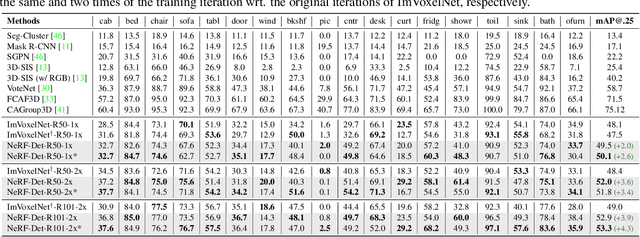
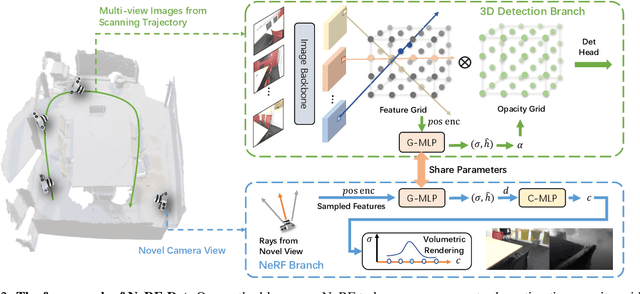
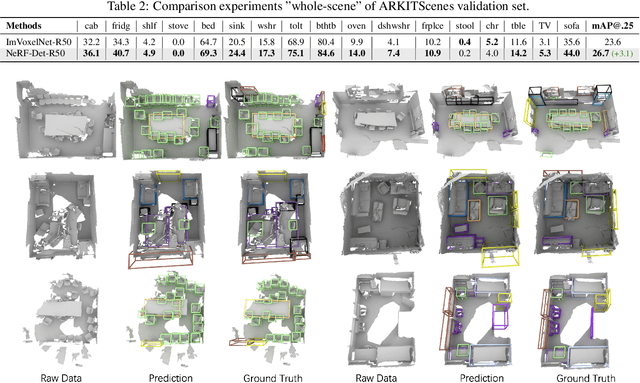
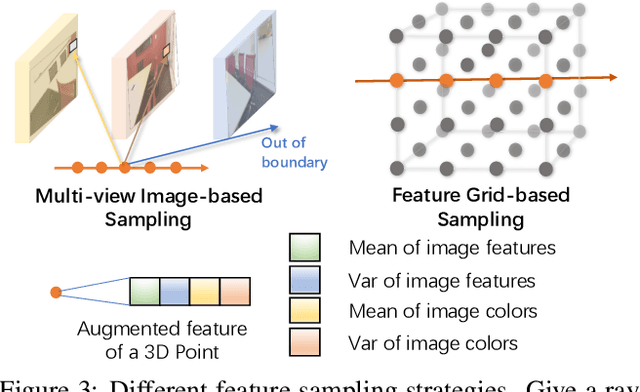
We present NeRF-Det, a novel method for indoor 3D detection with posed RGB images as input. Unlike existing indoor 3D detection methods that struggle to model scene geometry, our method makes novel use of NeRF in an end-to-end manner to explicitly estimate 3D geometry, thereby improving 3D detection performance. Specifically, to avoid the significant extra latency associated with per-scene optimization of NeRF, we introduce sufficient geometry priors to enhance the generalizability of NeRF-MLP. Furthermore, we subtly connect the detection and NeRF branches through a shared MLP, enabling an efficient adaptation of NeRF to detection and yielding geometry-aware volumetric representations for 3D detection. Our method outperforms state-of-the-arts by 3.9 mAP and 3.1 mAP on the ScanNet and ARKITScenes benchmarks, respectively. We provide extensive analysis to shed light on how NeRF-Det works. As a result of our joint-training design, NeRF-Det is able to generalize well to unseen scenes for object detection, view synthesis, and depth estimation tasks without requiring per-scene optimization. Code is available at \url{https://github.com/facebookresearch/NeRF-Det}.
An Efficient General-Purpose Modular Vision Model via Multi-Task Heterogeneous Training
Jun 29, 2023We present a model that can perform multiple vision tasks and can be adapted to other downstream tasks efficiently. Despite considerable progress in multi-task learning, most efforts focus on learning from multi-label data: a single image set with multiple task labels. Such multi-label data sets are rare, small, and expensive. We say heterogeneous to refer to image sets with different task labels, or to combinations of single-task datasets. Few have explored training on such heterogeneous datasets. General-purpose vision models are still dominated by single-task pretraining, and it remains unclear how to scale up multi-task models by leveraging mainstream vision datasets designed for different purposes. The challenges lie in managing large intrinsic differences among vision tasks, including data distribution, architectures, task-specific modules, dataset scales, and sampling strategies. To address these challenges, we propose to modify and scale up mixture-of-experts (MoE) vision transformers, so that they can simultaneously learn classification, detection, and segmentation on diverse mainstream vision datasets including ImageNet, COCO, and ADE20K. Our approach achieves comparable results to single-task state-of-the-art models and demonstrates strong generalization on downstream tasks. Due to its emergent modularity, this general-purpose model decomposes into high-performing components, efficiently adapting to downstream tasks. We can fine-tune it with fewer training parameters, fewer model parameters, and less computation. Additionally, its modularity allows for easy expansion in continual-learning-without-forgetting scenarios. Finally, these functions can be controlled and combined to meet various demands of downstream tasks.
Skill-Critic: Refining Learned Skills for Reinforcement Learning
Jun 16, 2023Hierarchical reinforcement learning (RL) can accelerate long-horizon decision-making by temporally abstracting a policy into multiple levels. Promising results in sparse reward environments have been seen with skills, i.e. sequences of primitive actions. Typically, a skill latent space and policy are discovered from offline data, but the resulting low-level policy can be unreliable due to low-coverage demonstrations or distribution shifts. As a solution, we propose fine-tuning the low-level policy in conjunction with high-level skill selection. Our Skill-Critic algorithm optimizes both the low and high-level policies; these policies are also initialized and regularized by the latent space learned from offline demonstrations to guide the joint policy optimization. We validate our approach in multiple sparse RL environments, including a new sparse reward autonomous racing task in Gran Turismo Sport. The experiments show that Skill-Critic's low-level policy fine-tuning and demonstration-guided regularization are essential for optimal performance. Images and videos are available at https://sites.google.com/view/skill-critic. We plan to open source the code with the final version.