 Add to Chrome
 Add to Firefox
 Add to Edge
On the Order-Conditional Optimality of Gaffke's Bound
Jul 25, 2026
Let $X = (X_1, \ldots, X_n)$ be a random vector from any Borel probability law on $\mathbb{R}_+^n$. We revisit the problem of deriving a lower confidence bound (LCB) on a scalar parameter of that law. We recast classical work, beginning with Buehler, in purely probabilistic terms to form a more accessible and extensible framework. We then specialize the framework to the case where the components of $X$ are independent. In this context, we prove that Gaffke's bound is Buehler optimal for the order that it induces with respect to the maximum marginal mean parameter: $max_{i \in [n]} E_Q[X_i]$, which reduces to the common mean when the $X_i$ are independent and identically distributed. That is to say, no other valid LCB that orders samples in the same way as Gaffke's bound can improve on it with respect to this parameter.

FLIGHT: Fibonacci Lattice-based Inference for Geometric Heading in real-Time
Feb 26, 2026Estimating camera motion from monocular video is a fundamental problem in computer vision, central to tasks such as SLAM, visual odometry, and structure-from-motion. Existing methods that recover the camera's heading under known rotation, whether from an IMU or an optimization algorithm, tend to perform well in low-noise, low-outlier conditions, but often decrease in accuracy or become computationally expensive as noise and outlier levels increase. To address these limitations, we propose a novel generalization of the Hough transform on the unit sphere (S(2)) to estimate the camera's heading. First, the method extracts correspondences between two frames and generates a great circle of directions compatible with each pair of correspondences. Then, by discretizing the unit sphere using a Fibonacci lattice as bin centers, each great circle casts votes for a range of directions, ensuring that features unaffected by noise or dynamic objects vote consistently for the correct motion direction. Experimental results on three datasets demonstrate that the proposed method is on the Pareto frontier of accuracy versus efficiency. Additionally, experiments on SLAM show that the proposed method reduces RMSE by correcting the heading during camera pose initialization.
Radial-VCReg: More Informative Representation Learning Through Radial Gaussianization
Feb 15, 2026Self-supervised learning aims to learn maximally informative representations, but explicit information maximization is hindered by the curse of dimensionality. Existing methods like VCReg address this by regularizing first and second-order feature statistics, which cannot fully achieve maximum entropy. We propose Radial-VCReg, which augments VCReg with a radial Gaussianization loss that aligns feature norms with the Chi distribution-a defining property of high-dimensional Gaussians. We prove that Radial-VCReg transforms a broader class of distributions towards normality compared to VCReg and show on synthetic and real-world datasets that it consistently improves performance by reducing higher-order dependencies and promoting more diverse and informative representations.
Improving Open-World Object Localization by Discovering Background
Apr 24, 2025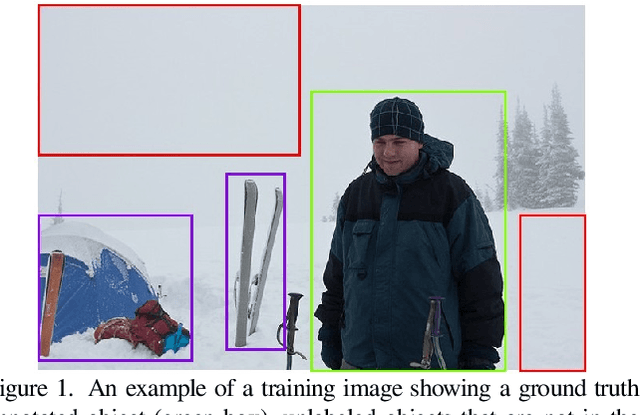
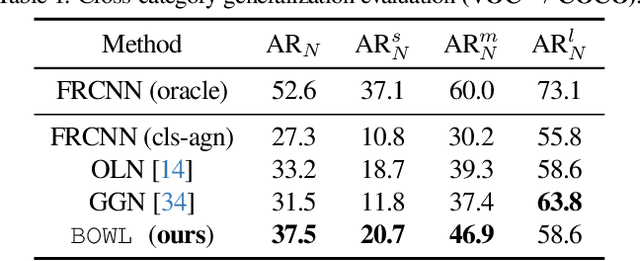
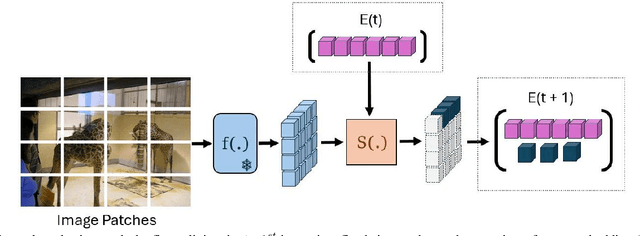
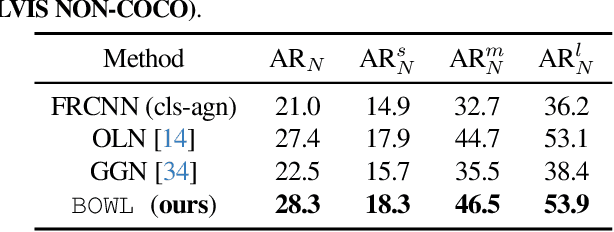
Our work addresses the problem of learning to localize objects in an open-world setting, i.e., given the bounding box information of a limited number of object classes during training, the goal is to localize all objects, belonging to both the training and unseen classes in an image, during inference. Towards this end, recent work in this area has focused on improving the characterization of objects either explicitly by proposing new objective functions (localization quality) or implicitly using object-centric auxiliary-information, such as depth information, pixel/region affinity map etc. In this work, we address this problem by incorporating background information to guide the learning of the notion of objectness. Specifically, we propose a novel framework to discover background regions in an image and train an object proposal network to not detect any objects in these regions. We formulate the background discovery task as that of identifying image regions that are not discriminative, i.e., those that are redundant and constitute low information content. We conduct experiments on standard benchmarks to showcase the effectiveness of our proposed approach and observe significant improvements over the previous state-of-the-art approaches for this task.
Improving Pre-Trained Self-Supervised Embeddings Through Effective Entropy Maximization
Nov 24, 2024
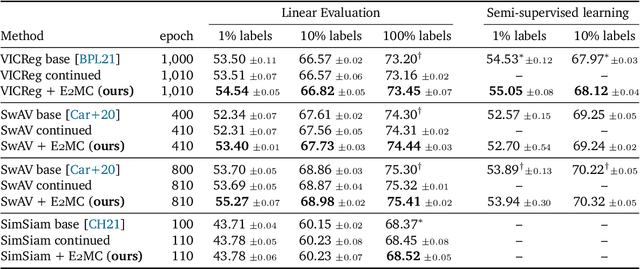

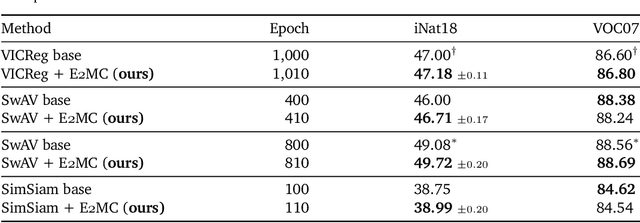
A number of different architectures and loss functions have been applied to the problem of self-supervised learning (SSL), with the goal of developing embeddings that provide the best possible pre-training for as-yet-unknown, lightly supervised downstream tasks. One of these SSL criteria is to maximize the entropy of a set of embeddings in some compact space. But the goal of maximizing the embedding entropy often depends--whether explicitly or implicitly--upon high dimensional entropy estimates, which typically perform poorly in more than a few dimensions. In this paper, we motivate an effective entropy maximization criterion (E2MC), defined in terms of easy-to-estimate, low-dimensional constraints. We demonstrate that using it to continue training an already-trained SSL model for only a handful of epochs leads to a consistent and, in some cases, significant improvement in downstream performance. We perform careful ablation studies to show that the improved performance is due to the proposed add-on criterion. We also show that continued pre-training with alternative criteria does not lead to notable improvements, and in some cases, even degrades performance.
Log-Concavity of Multinomial Likelihood Functions Under Interval Censoring Constraints on Frequencies or Their Partial Sums
Nov 05, 2023We show that the likelihood function for a multinomial vector observed under arbitrary interval censoring constraints on the frequencies or their partial sums is completely log-concave by proving that the constrained sample spaces comprise M-convex subsets of the discrete simplex.
Machine Learning for Automated Mitral Regurgitation Detection from Cardiac Imaging
Oct 07, 2023Mitral regurgitation (MR) is a heart valve disease with potentially fatal consequences that can only be forestalled through timely diagnosis and treatment. Traditional diagnosis methods are expensive, labor-intensive and require clinical expertise, posing a barrier to screening for MR. To overcome this impediment, we propose a new semi-supervised model for MR classification called CUSSP. CUSSP operates on cardiac imaging slices of the 4-chamber view of the heart. It uses standard computer vision techniques and contrastive models to learn from large amounts of unlabeled data, in conjunction with specialized classifiers to establish the first ever automated MR classification system. Evaluated on a test set of 179 labeled -- 154 non-MR and 25 MR -- sequences, CUSSP attains an F1 score of 0.69 and a ROC-AUC score of 0.88, setting the first benchmark result for this new task.
* 12 pages including references and the appendix. 9 Figures, 2 tables. Accepted at MICCAI (Machine Learning for Automated Mitral Regurgitation Detection from Cardiac Imaging) 2023, Link to Springer at https://link.springer.com/chapter/10.1007/978-3-031-43990-2_23
Robust Frame-to-Frame Camera Rotation Estimation in Crowded Scenes
Sep 15, 2023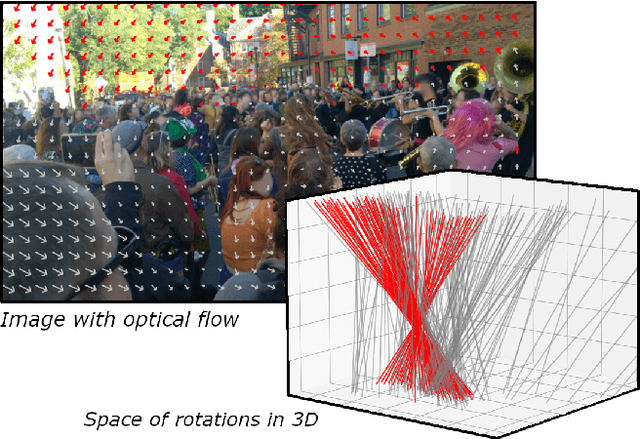
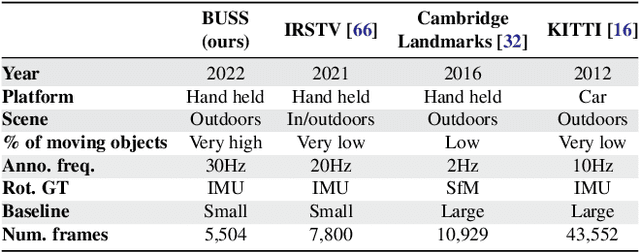

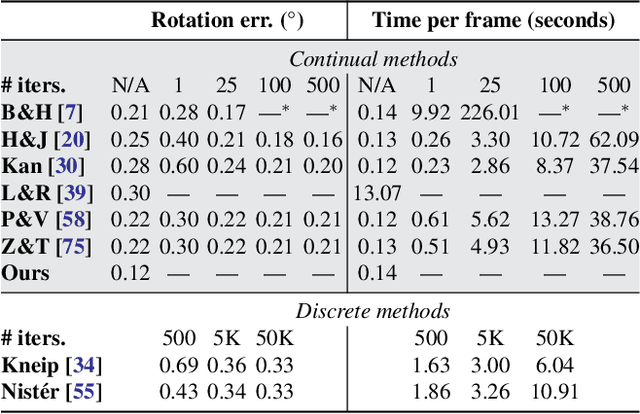
We present an approach to estimating camera rotation in crowded, real-world scenes from handheld monocular video. While camera rotation estimation is a well-studied problem, no previous methods exhibit both high accuracy and acceptable speed in this setting. Because the setting is not addressed well by other datasets, we provide a new dataset and benchmark, with high-accuracy, rigorously verified ground truth, on 17 video sequences. Methods developed for wide baseline stereo (e.g., 5-point methods) perform poorly on monocular video. On the other hand, methods used in autonomous driving (e.g., SLAM) leverage specific sensor setups, specific motion models, or local optimization strategies (lagging batch processing) and do not generalize well to handheld video. Finally, for dynamic scenes, commonly used robustification techniques like RANSAC require large numbers of iterations, and become prohibitively slow. We introduce a novel generalization of the Hough transform on SO(3) to efficiently and robustly find the camera rotation most compatible with optical flow. Among comparably fast methods, ours reduces error by almost 50\% over the next best, and is more accurate than any method, irrespective of speed. This represents a strong new performance point for crowded scenes, an important setting for computer vision. The code and the dataset are available at https://fabiendelattre.com/robust-rotation-estimation.
An Efficient General-Purpose Modular Vision Model via Multi-Task Heterogeneous Training
Jun 29, 2023We present a model that can perform multiple vision tasks and can be adapted to other downstream tasks efficiently. Despite considerable progress in multi-task learning, most efforts focus on learning from multi-label data: a single image set with multiple task labels. Such multi-label data sets are rare, small, and expensive. We say heterogeneous to refer to image sets with different task labels, or to combinations of single-task datasets. Few have explored training on such heterogeneous datasets. General-purpose vision models are still dominated by single-task pretraining, and it remains unclear how to scale up multi-task models by leveraging mainstream vision datasets designed for different purposes. The challenges lie in managing large intrinsic differences among vision tasks, including data distribution, architectures, task-specific modules, dataset scales, and sampling strategies. To address these challenges, we propose to modify and scale up mixture-of-experts (MoE) vision transformers, so that they can simultaneously learn classification, detection, and segmentation on diverse mainstream vision datasets including ImageNet, COCO, and ADE20K. Our approach achieves comparable results to single-task state-of-the-art models and demonstrates strong generalization on downstream tasks. Due to its emergent modularity, this general-purpose model decomposes into high-performing components, efficiently adapting to downstream tasks. We can fine-tune it with fewer training parameters, fewer model parameters, and less computation. Additionally, its modularity allows for easy expansion in continual-learning-without-forgetting scenarios. Finally, these functions can be controlled and combined to meet various demands of downstream tasks.
Event Camera-based Visual Odometry for Dynamic Motion Tracking of a Legged Robot Using Adaptive Time Surface
May 15, 2023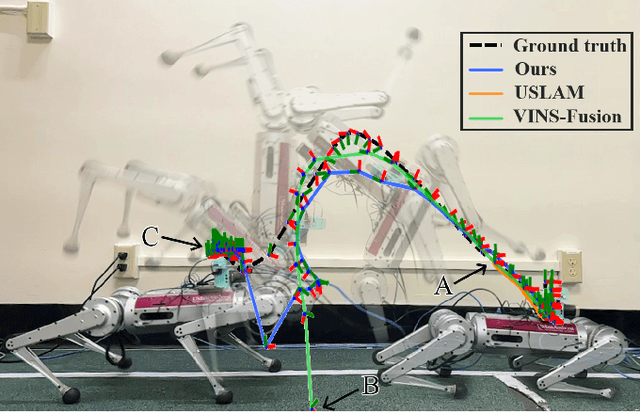
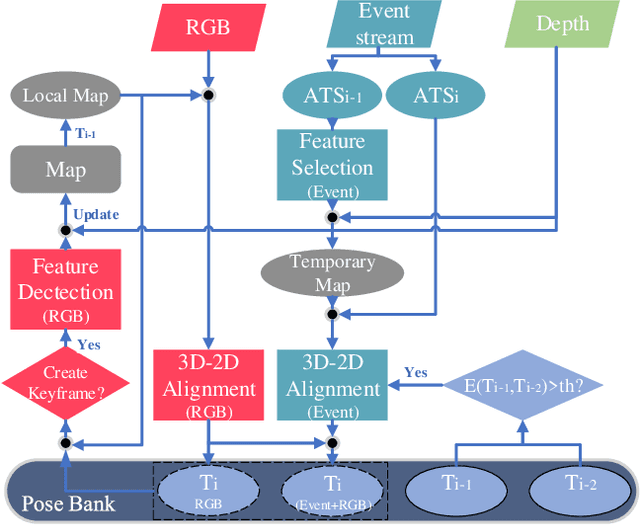
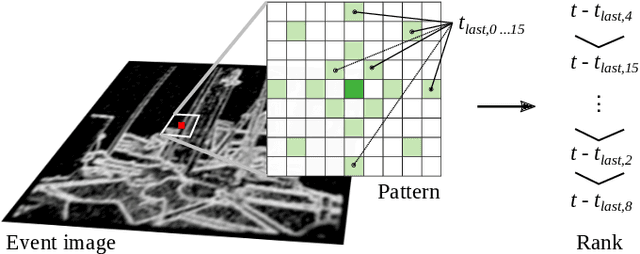
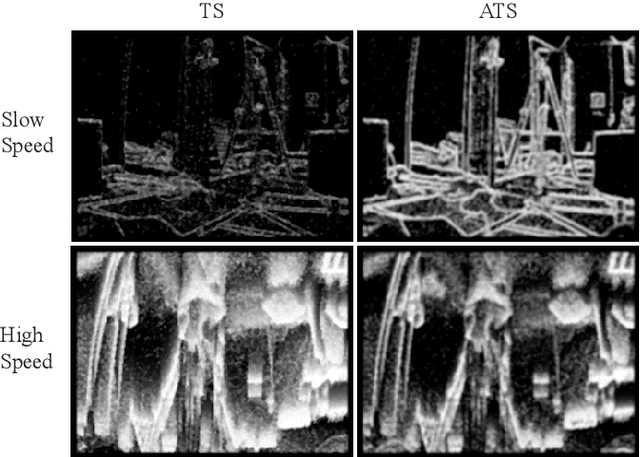
Our paper proposes a direct sparse visual odometry method that combines event and RGB-D data to estimate the pose of agile-legged robots during dynamic locomotion and acrobatic behaviors. Event cameras offer high temporal resolution and dynamic range, which can eliminate the issue of blurred RGB images during fast movements. This unique strength holds a potential for accurate pose estimation of agile-legged robots, which has been a challenging problem to tackle. Our framework leverages the benefits of both RGB-D and event cameras to achieve robust and accurate pose estimation, even during dynamic maneuvers such as jumping and landing a quadruped robot, the Mini-Cheetah. Our major contributions are threefold: Firstly, we introduce an adaptive time surface (ATS) method that addresses the whiteout and blackout issue in conventional time surfaces by formulating pixel-wise decay rates based on scene complexity and motion speed. Secondly, we develop an effective pixel selection method that directly samples from event data and applies sample filtering through ATS, enabling us to pick pixels on distinct features. Lastly, we propose a nonlinear pose optimization formula that simultaneously performs 3D-2D alignment on both RGB-based and event-based maps and images, allowing the algorithm to fully exploit the benefits of both data streams. We extensively evaluate the performance of our framework on both public datasets and our own quadruped robot dataset, demonstrating its effectiveness in accurately estimating the pose of agile robots during dynamic movements.