 Add to Chrome
 Add to Firefox
 Add to Edge
To Go Far, Go Together: Diverse Preferences Induce a Curriculum for Reward Optimization
Aug 19, 2026
Learning a reward model from human feedback and optimizing a policy against it is one approach to aligning AI systems with individual users. From a fairness perspective, existing work improves such alignment by developing data-efficient and accurate reward models that capture minority preferences despite scarce data. We push this line of inquiry one step further and argue that data-efficient and accurate per-user reward models are not sufficient: users whose reward models are difficult to \textit{optimize} at the policy level can become a new underserved group. We start from the observation that one user's reward model can be easy to optimize from the initial policy while another's is not. We argue that, given a sufficiently diverse user population, a curriculum naturally emerges between easy- and hard-to-optimize reward models. Building on this insight, we propose CurriPO, which grows a tree-structured curriculum to accommodate diverse user-specific objectives, covering the population in a single traversal. Specifically, CurriPO automatically constructs a curriculum over diverse user reward models, allowing it to branch from the existing curriculum and reuse reward models previously incorporated into the curriculum. To the best of our knowledge, this is the first work to explicitly exploit multi-user structure to address optimization in AI alignment. Extensive experiments on personalized continuous control in a simulated environment show that CurriPO achieves $1.2$--$2.1\times$ the population satisfaction of the strongest baseline while substantially reducing training time. Additional analysis attributes much of this improvement to the users left underserved by conventional optimization.

Deployable Human Preference Alignment in Robotics: Learning Representative Rewards from Diverse Human Preferences
Jul 14, 2026Aligning robot policies with human preferences is essential for deployment to diverse end users. In per-user alignment approach, preference feedback is often sparse, so learning becomes unstable and vulnerable to human preference noise, and a growing number of individualized policies makes validation difficult before deployment. A single shared policy approach to user alignment avoids this cost but fails to capture heterogeneous preferences and often neglects minority preferences. To address these challenges, we introduce Preference-based REward Clustering (PREC), a novel framework that learns a compact set of policies from binary preference labels provided by diverse users. From a dataset of user trajectories and their preference labels, PREC first sets the labels aside and aggregates trajectories across users to learn a population-level shared trajectory encoder, alleviating limited per-user coverage and avoiding label noise during representation learning. Using this representation, PREC jointly assigns users to preference-coherent clusters and learns a representative reward model per cluster using preference labels, from which a policy is optimized for each cluster. Clustering similar users compensates for the limited number of labels available from each user and mitigates the effect of label noise. At the same time, maintaining a manageable number of reward models reduces the validation burden at deployment. Experiments across diverse simulated locomotion environments show that PREC groups users who label different trajectory subsets into preference-coherent clusters more accurately than baseline methods. Under sparse and noisy feedback, policies trained with PREC improve all three social welfare metrics over an existing single shared-policy user-alignment approach and even outperform per-user alignment approaches.
GPU-Accelerated Polygonal Signed Distance Functions for Real-Time Collision Avoidance
Jul 05, 2026Optimization-based local planning and control require high-rate collision-avoidance constraint evaluation over a prediction horizon. In obstacle-dense environments, where feasible space is limited and the constraints become increasingly complex, the computational workload often dominates the control-cycle runtime. The resulting bottleneck motivates collision-avoidance constraints that combine computational efficiency with geometric fidelity. The proposed Polygonal Signed Distance Function (PSDF) is a geometry-exact signed distance function between a convex polygonal robot footprint and obstacles represented by their boundary edges. It is implemented as a weight-free, branch-free tensorized geometric pipeline enabling batched GPU execution and automatic differentiation. The PSDF is embedded into model predictive control by locally linearizing the stage-wise safety constraints within a sequential quadratic programming-based real-time iteration scheme, yielding the PSDF-embedded model predictive controller (PSDF-MPC). The design separates CPU/GPU computation so that the GPU evaluates batched PSDF values and gradients while the CPU solves a sparse quadratic program whose dimension is determined by system dimensions and horizon length, not by obstacle features. Microbenchmarks show that PSDF scales favorably against signed-distance query baselines. Closed-loop simulated and real-world navigation experiments, including comparisons with optimization-based baselines, demonstrate that PSDF-MPC maintains real-time feasibility and robust collision avoidance in dense polygonal environments.
Group-Invariant Unsupervised Skill Discovery: Symmetry-aware Skill Representations for Generalizable Behavior
Jan 20, 2026Unsupervised skill discovery aims to acquire behavior primitives that improve exploration and accelerate downstream task learning. However, existing approaches often ignore the geometric symmetries of physical environments, leading to redundant behaviors and sample inefficiency. To address this, we introduce Group-Invariant Skill Discovery (GISD), a framework that explicitly embeds group structure into the skill discovery objective. Our approach is grounded in a theoretical guarantee: we prove that in group-symmetric environments, the standard Wasserstein dependency measure admits a globally optimal solution comprised of an equivariant policy and a group-invariant scoring function. Motivated by this, we formulate the Group-Invariant Wasserstein dependency measure, which restricts the optimization to this symmetry-aware subspace without loss of optimality. Practically, we parameterize the scoring function using a group Fourier representation and define the intrinsic reward via the alignment of equivariant latent features, ensuring that the discovered skills generalize systematically under group transformations. Experiments on state-based and pixel-based locomotion benchmarks demonstrate that GISD achieves broader state-space coverage and improved efficiency in downstream task learning compared to a strong baseline.
Multi-Robot Motion Planning from Vision and Language using Heat-Inspired Diffusion
Dec 15, 2025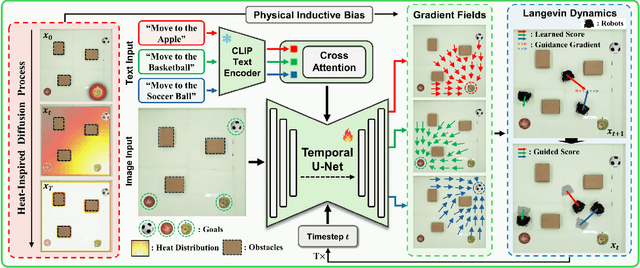
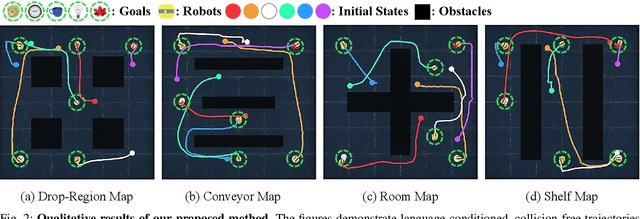
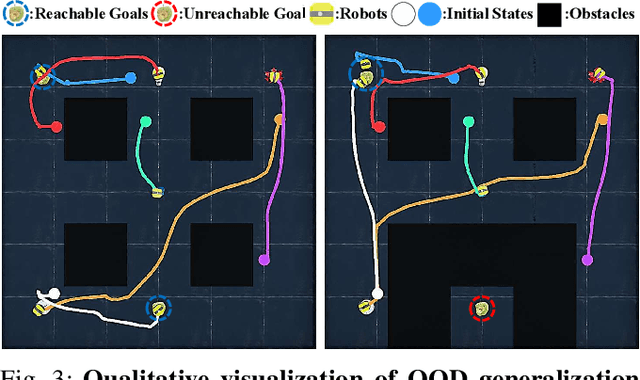
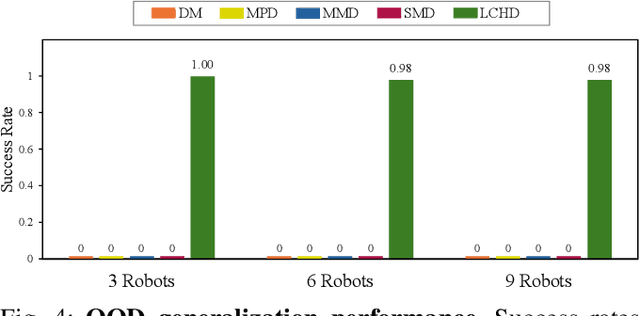
Diffusion models have recently emerged as powerful tools for robot motion planning by capturing the multi-modal distribution of feasible trajectories. However, their extension to multi-robot settings with flexible, language-conditioned task specifications remains limited. Furthermore, current diffusion-based approaches incur high computational cost during inference and struggle with generalization because they require explicit construction of environment representations and lack mechanisms for reasoning about geometric reachability. To address these limitations, we present Language-Conditioned Heat-Inspired Diffusion (LCHD), an end-to-end vision-based framework that generates language-conditioned, collision-free trajectories. LCHD integrates CLIP-based semantic priors with a collision-avoiding diffusion kernel serving as a physical inductive bias that enables the planner to interpret language commands strictly within the reachable workspace. This naturally handles out-of-distribution scenarios -- in terms of reachability -- by guiding robots toward accessible alternatives that match the semantic intent, while eliminating the need for explicit obstacle information at inference time. Extensive evaluations on diverse real-world-inspired maps, along with real-robot experiments, show that LCHD consistently outperforms prior diffusion-based planners in success rate, while reducing planning latency.
Symmetry-Aware Steering of Equivariant Diffusion Policies: Benefits and Limits
Dec 12, 2025Equivariant diffusion policies (EDPs) combine the generative expressivity of diffusion models with the strong generalization and sample efficiency afforded by geometric symmetries. While steering these policies with reinforcement learning (RL) offers a promising mechanism for fine-tuning beyond demonstration data, directly applying standard (non-equivariant) RL can be sample-inefficient and unstable, as it ignores the symmetries that EDPs are designed to exploit. In this paper, we theoretically establish that the diffusion process of an EDP is equivariant, which in turn induces a group-invariant latent-noise MDP that is well-suited for equivariant diffusion steering. Building on this theory, we introduce a principled symmetry-aware steering framework and compare standard, equivariant, and approximately equivariant RL strategies through comprehensive experiments across tasks with varying degrees of symmetry. While we identify the practical boundaries of strict equivariance under symmetry breaking, we show that exploiting symmetry during the steering process yields substantial benefits-enhancing sample efficiency, preventing value divergence, and achieving strong policy improvements even when EDPs are trained from extremely limited demonstrations.
Geometric Formulation of Unified Force-Impedance Control on SE(3) for Robotic Manipulators
Apr 23, 2025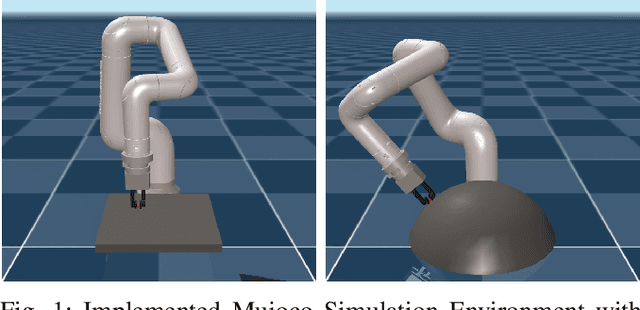
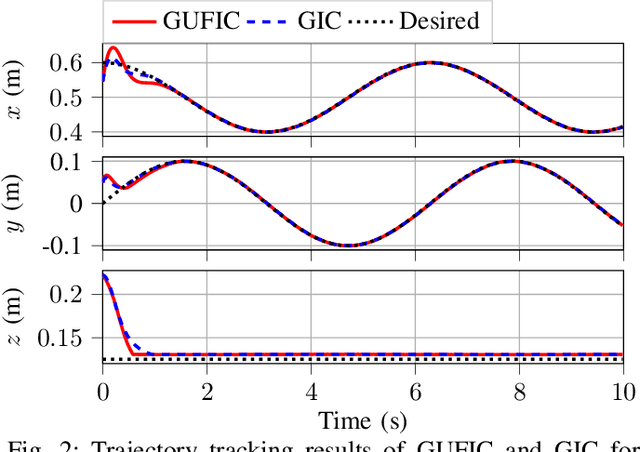
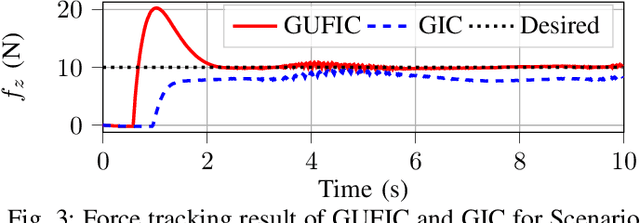
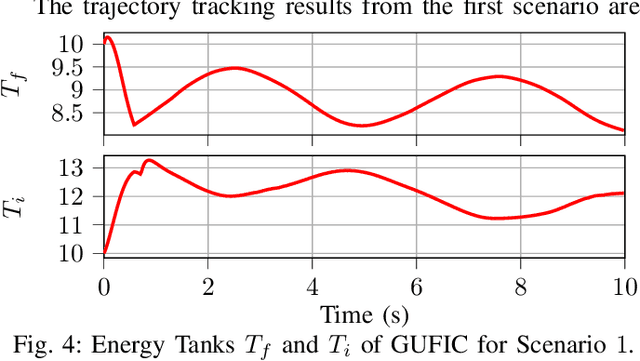
In this paper, we present an impedance control framework on the SE(3) manifold, which enables force tracking while guaranteeing passivity. Building upon the unified force-impedance control (UFIC) and our previous work on geometric impedance control (GIC), we develop the geometric unified force impedance control (GUFIC) to account for the SE(3) manifold structure in the controller formulation using a differential geometric perspective. As in the case of the UFIC, the GUFIC utilizes energy tank augmentation for both force-tracking and impedance control to guarantee the manipulator's passivity relative to external forces. This ensures that the end effector maintains safe contact interaction with uncertain environments and tracks a desired interaction force. Moreover, we resolve a non-causal implementation problem in the UFIC formulation by introducing velocity and force fields. Due to its formulation on SE(3), the proposed GUFIC inherits the desirable SE(3) invariance and equivariance properties of the GIC, which helps increase sample efficiency in machine learning applications where a learning algorithm is incorporated into the control law. The proposed control law is validated in a simulation environment under scenarios requiring tracking an SE(3) trajectory, incorporating both position and orientation, while exerting a force on a surface. The codes are available at https://github.com/Joohwan-Seo/GUFIC_mujoco.
A Comparison Between Lie Group- and Lie Algebra- Based Potential Functions for Geometric Impedance Control
Jan 24, 2024


In this paper, a comparison analysis between geometric impedance controls (GICs) derived from two different potential functions on SE(3) for robotic manipulators is presented. The first potential function is defined on the Lie group, utilizing the Frobenius norm of the configuration error matrix. The second potential function is defined utilizing the Lie algebra, i.e., log-map of the configuration error. Using a differential geometric approach, the detailed derivation of the distance metric and potential function on SE(3) is introduced. The GIC laws are respectively derived from the two potential functions, followed by extensive comparison analyses. In the qualitative analysis, the properties of the error function and control laws are analyzed, while the performances of the controllers are quantitatively compared using numerical simulation.
AdvMT: Adversarial Motion Transformer for Long-term Human Motion Prediction
Jan 10, 2024To achieve seamless collaboration between robots and humans in a shared environment, accurately predicting future human movements is essential. Human motion prediction has traditionally been approached as a sequence prediction problem, leveraging historical human motion data to estimate future poses. Beginning with vanilla recurrent networks, the research community has investigated a variety of methods for learning human motion dynamics, encompassing graph-based and generative approaches. Despite these efforts, achieving accurate long-term predictions continues to be a significant challenge. In this regard, we present the Adversarial Motion Transformer (AdvMT), a novel model that integrates a transformer-based motion encoder and a temporal continuity discriminator. This combination effectively captures spatial and temporal dependencies simultaneously within frames. With adversarial training, our method effectively reduces the unwanted artifacts in predictions, thereby ensuring the learning of more realistic and fluid human motions. The evaluation results indicate that AdvMT greatly enhances the accuracy of long-term predictions while also delivering robust short-term predictions
Clustering Techniques for Stable Linear Dynamical Systems with applications to Hard Disk Drives
Nov 17, 2023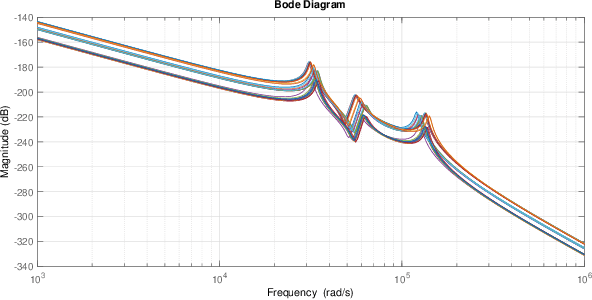
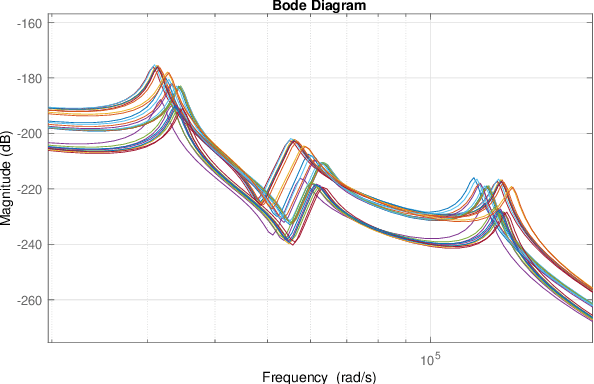
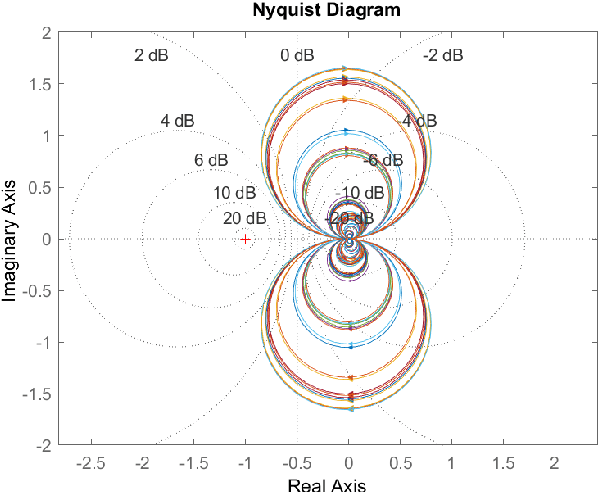
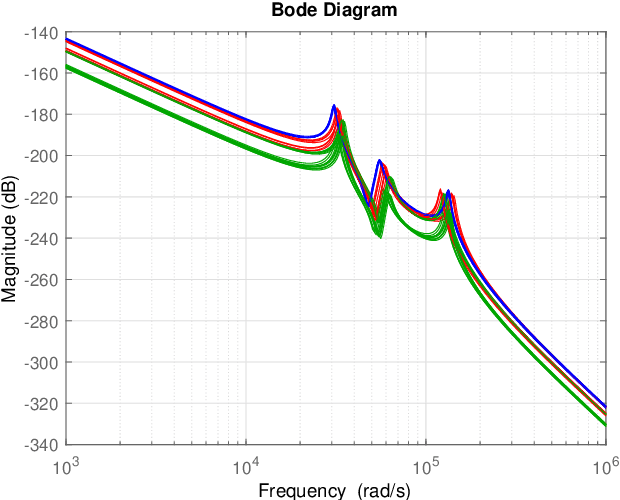
In Robust Control and Data Driven Robust Control design methodologies, multiple plant transfer functions or a family of transfer functions are considered and a common controller is designed such that all the plants that fall into this family are stabilized. Though the plants are stabilized, the controller might be sub-optimal for each of the plants when the variations in the plants are large. This paper presents a way of clustering stable linear dynamical systems for the design of robust controllers within each of the clusters such that the controllers are optimal for each of the clusters. First a k-medoids algorithm for hard clustering will be presented for stable Linear Time Invariant (LTI) systems and then a Gaussian Mixture Models (GMM) clustering for a special class of LTI systems, common for Hard Disk Drive plants, will be presented.