 Add to Chrome
 Add to Firefox
 Add to Edge
ACE-Data-0: Human-Centric Ambient Capture as Embodied Data Engine
Jul 30, 2026
Embodied intelligence faces a fundamental data bottleneck. Models must capture how first-person perception, whole-body motion, dexterous manipulation, object state, sound, and touch evolve together as humans pursue goals over time. Existing datasets fragment this experience across viewpoints, modalities, or spatial scales, leaving the full perception-action loop only partially observed. We introduce the Ambient Capture Engine (ACE), a human-centric data engine that transforms real home environments into spatially calibrated, temporally synchronized recording studios. ACE operates at two complementary scales: a table-scale configuration resolves hand-object manipulation, while a room-scale configuration captures whole-body motion, locomotion, and interactions across a furnished home. ACE records egocentric and multi-view exocentric video, full-body and articulated hand motion, object geometry and 6-DoF trajectories, audio, and tactile signals as a unified multisensory stream. Using ACE, we build ACE-Data-0, comprising 150 hours and 17M video frames across 200 task categories, performed by 50 participants in 2 environments, for a total of 75,000 interaction episodes. The dataset spans atomic manipulation, long-horizon chains of household activities, and human-scene interaction, while preserving natural behavioral variation through goal-level rather than step-by-step instructions. We further introduce a hierarchical benchmark that progresses from signals to scene components and then to interactions. Evaluations of state-of-the-art methods expose substantial gaps under contact, occlusion, egomotion, and long temporal horizons. ACE-Data-0 provides synchronized human demonstrations with aligned perceptual, kinematic, and contact supervision, offering a scalable foundation for imitation learning, world models, vision-language-action systems, and embodied AI.

Diffusion Language Model for Recommendation
Jul 23, 2026Large language model (LLM)-empowered recommender systems have emerged as a promising paradigm for generative recommendation, leveraging their strong semantic reasoning and generative capacity to model complex, diverse user preferences. However, most existing approaches rely on an autoregressive paradigm that is suboptimal for recommendation. The next-token objective emphasizes sequential order rather than the structural inter-item dependencies underlying user preferences. In addition, prefix-constrained generation restricts bidirectional context and commits to left-to-right decoding, causing early errors to accumulate without correction. Inspired by the success of diffusion language models, we propose \textbf{DLMRec}, a discrete diffusion language model tailored for recommendation that offers a compelling alternative to autoregressive generation. Specifically, DLMRec introduces three key components to bridge diffusion language modeling with recommendation. First, a collaborative-aware stochastic tokenizer encodes multi-hop collaborative signals into expressive discrete tokens compatible with diffusion modeling. Second, a curriculum-driven training strategy aligns the denoising process with preference recovery through progressive item- and token-level learning. Third, a stability-aware voting mechanism aggregates iterative predictions to improve generation consistency and robustness.
PhysX-Omni: Unified Simulation-Ready Physical 3D Generation for Rigid, Deformable, and Articulated Objects
May 20, 2026Simulation-ready physical 3D assets have emerged as a promising direction owing to their broad applicability in downstream tasks. However, most existing 3D generation methods either neglect physical properties or are limited to a single asset category, e.g., rigid, deformable, or articulated objects. To address these limitations, we introduce PhysX-Omni, a unified framework for simulation-ready physical 3D generation across diverse asset types. Specifically, we develop a novel and efficient geometry representation tailored for Vision-Language Models, which directly encodes high-resolution 3D structures without compression, significantly improving generation performance. In addition, we construct the first general simulation-ready 3D dataset, PhysXVerse, covering diverse indoor and outdoor categories. Furthermore, to comprehensively and flexibly evaluate both generative and understanding capabilities in the wild, we propose PhysX-Bench, which encompasses six key attributes: geometry, absolute scale, material, affordance, kinematics, and function description. Extensive experiments with conventional metrics and PhysX-Bench show that PhysX-Omni performs strongly in both generation and understanding. Moreover, additional studies further validate the potential of PhysX-Omni for applications in simulation-ready scene generation and robotic policy learning. We believe PhysX-Omni can significantly advance a wide range of downstream applications, particularly in embodied AI and physics-based simulation.
A Hybrid Discriminative and Generative System for Universal Speech Enhancement
Jan 27, 2026Universal speech enhancement aims at handling inputs with various speech distortions and recording conditions. In this work, we propose a novel hybrid architecture that synergizes the signal fidelity of discriminative modeling with the reconstruction capabilities of generative modeling. Our system utilizes the discriminative TF-GridNet model with the Sampling-Frequency-Independent strategy to handle variable sampling rates universally. In parallel, an autoregressive model combined with spectral mapping modeling generates detail-rich speech while effectively suppressing generative artifacts. Finally, a fusion network learns adaptive weights of the two outputs under the optimization of signal-level losses and the comprehensive Speech Quality Assessment (SQA) loss. Our proposed system is evaluated in the ICASSP 2026 URGENT Challenge (Track 1) and ranks the third place.
UltraLight VM-UNet: Parallel Vision Mamba Significantly Reduces Parameters for Skin Lesion Segmentation
Apr 09, 2024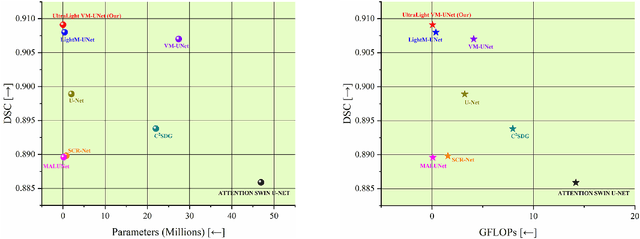
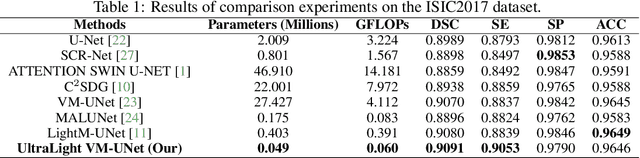
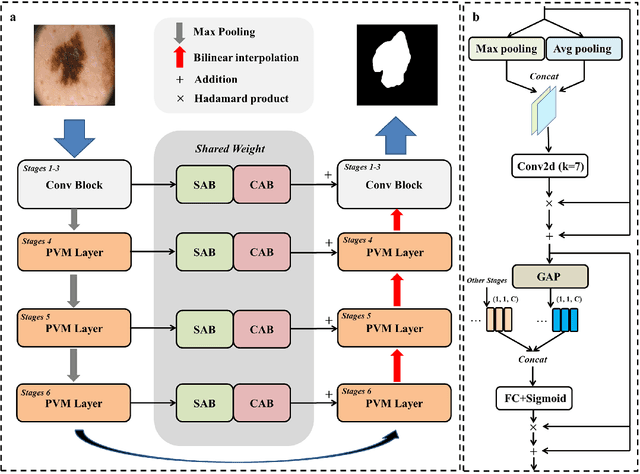
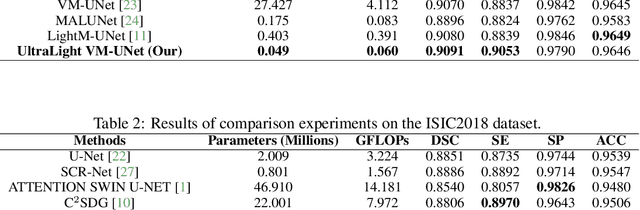
Traditionally for improving the segmentation performance of models, most approaches prefer to use adding more complex modules. And this is not suitable for the medical field, especially for mobile medical devices, where computationally loaded models are not suitable for real clinical environments due to computational resource constraints. Recently, state-space models (SSMs), represented by Mamba, have become a strong competitor to traditional CNNs and Transformers. In this paper, we deeply explore the key elements of parameter influence in Mamba and propose an UltraLight Vision Mamba UNet (UltraLight VM-UNet) based on this. Specifically, we propose a method for processing features in parallel Vision Mamba, named PVM Layer, which achieves excellent performance with the lowest computational load while keeping the overall number of processing channels constant. We conducted comparisons and ablation experiments with several state-of-the-art lightweight models on three skin lesion public datasets and demonstrated that the UltraLight VM-UNet exhibits the same strong performance competitiveness with parameters of only 0.049M and GFLOPs of 0.060. In addition, this study deeply explores the key elements of parameter influence in Mamba, which will lay a theoretical foundation for Mamba to possibly become a new mainstream module for lightweighting in the future. The code is available from https://github.com/wurenkai/UltraLight-VM-UNet .
H-vmunet: High-order Vision Mamba UNet for Medical Image Segmentation
Mar 20, 2024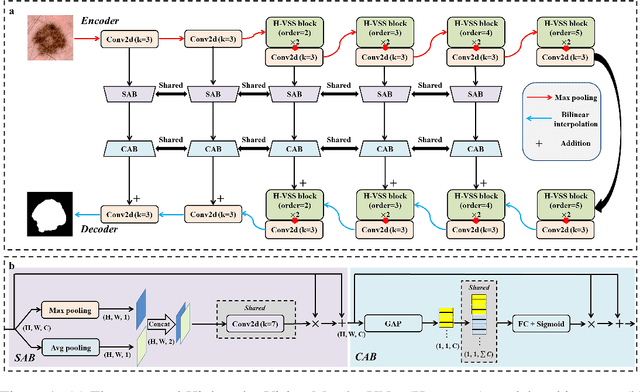
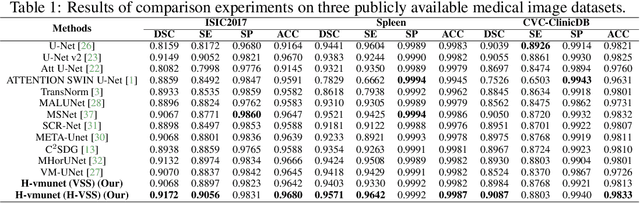
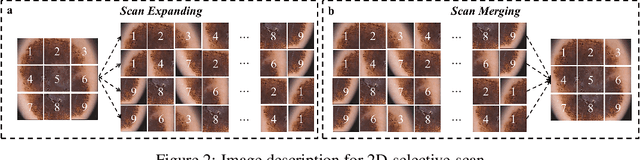
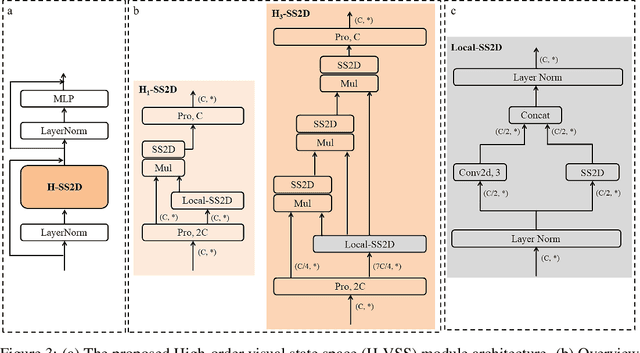
In the field of medical image segmentation, variant models based on Convolutional Neural Networks (CNNs) and Visual Transformers (ViTs) as the base modules have been very widely developed and applied. However, CNNs are often limited in their ability to deal with long sequences of information, while the low sensitivity of ViTs to local feature information and the problem of secondary computational complexity limit their development. Recently, the emergence of state-space models (SSMs), especially 2D-selective-scan (SS2D), has had an impact on the longtime dominance of traditional CNNs and ViTs as the foundational modules of visual neural networks. In this paper, we extend the adaptability of SS2D by proposing a High-order Vision Mamba UNet (H-vmunet) for medical image segmentation. Among them, the proposed High-order 2D-selective-scan (H-SS2D) progressively reduces the introduction of redundant information during SS2D operations through higher-order interactions. In addition, the proposed Local-SS2D module improves the learning ability of local features of SS2D at each order of interaction. We conducted comparison and ablation experiments on three publicly available medical image datasets (ISIC2017, Spleen, and CVC-ClinicDB), and the results all demonstrate the strong competitiveness of H-vmunet in medical image segmentation tasks. The code is available from https://github.com/wurenkai/H-vmunet .
Only Positive Cases: 5-fold High-order Attention Interaction Model for Skin Segmentation Derived Classification
Nov 27, 2023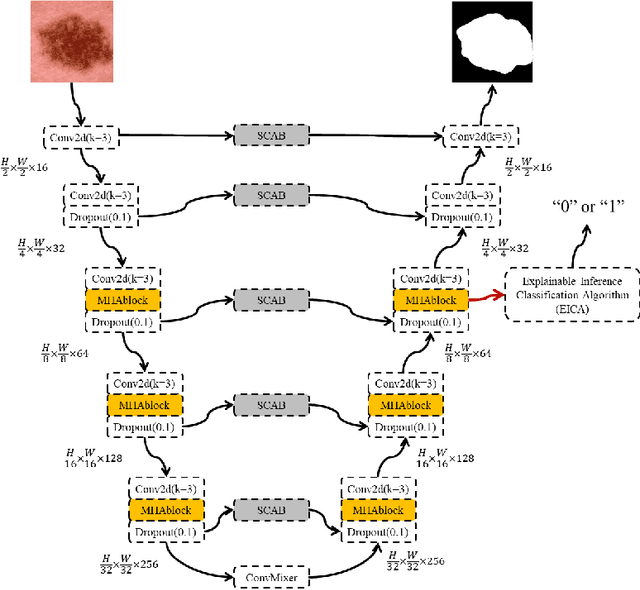
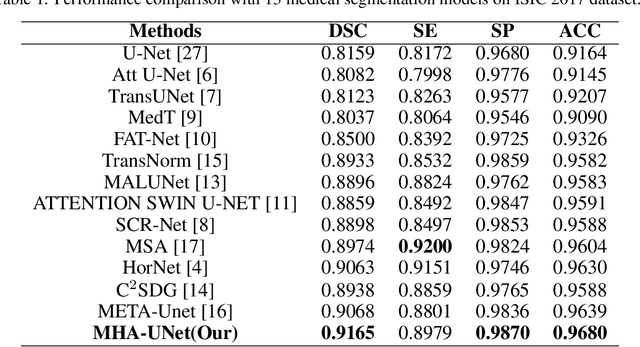
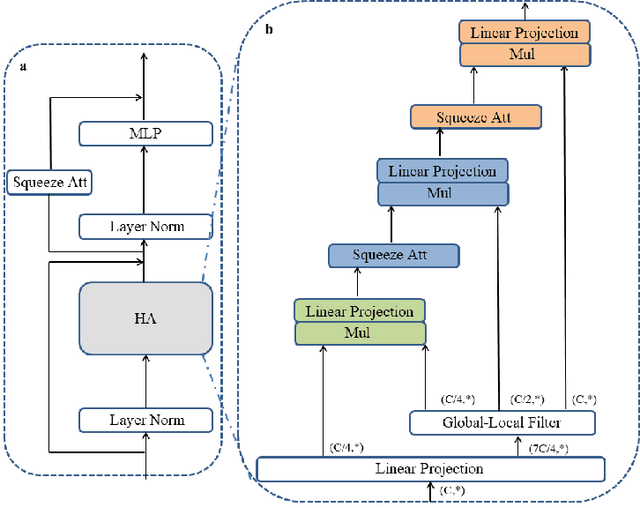
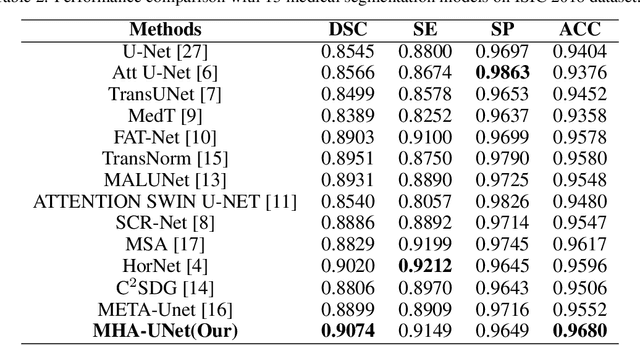
Computer-aided diagnosis of skin diseases is an important tool. However, the interpretability of computer-aided diagnosis is currently poor. Dermatologists and patients cannot intuitively understand the learning and prediction process of neural networks, which will lead to a decrease in the credibility of computer-aided diagnosis. In addition, traditional methods need to be trained using negative samples in order to predict the presence or absence of a lesion, but medical data is often in short supply. In this paper, we propose a multiple high-order attention interaction model (MHA-UNet) for use in a highly explainable skin lesion segmentation task. MHA-UNet is able to obtain the presence or absence of a lesion by explainable reasoning without the need for training on negative samples. Specifically, we propose a high-order attention interaction mechanism that introduces squeeze attention to a higher level for feature attention. In addition, a multiple high-order attention interaction (MHAblock) module is proposed by combining the different features of different orders. For classifying the presence or absence of lesions, we conducted classification experiments on several publicly available datasets in the absence of negative samples, based on explainable reasoning about the interaction of 5 attention orders of MHAblock. The highest positive detection rate obtained from the experiments was 81.0% and the highest negative detection rate was 83.5%. For segmentation experiments, comparison experiments of the proposed method with 13 medical segmentation models and external validation experiments with 8 state-of-the-art models in three public datasets and our clinical dataset demonstrate the state-of-the-art performance of our model. The code is available from https://github.com/wurenkai/MHA-UNet.