 Add to Chrome
 Add to Firefox
 Add to Edge
Interest Entanglement: The Hidden Barrier to Blind Super-Resolution Optimization
Jun 21, 2026
Fidelity and perceptual quality are two inherently competing and conflicting objectives in the image super-resolution (SR) task. Different loss functions focus on these objectives to varying extents. Regression losses enhance the model's fidelity but lack sufficient attention to high-frequency details, resulting in a loss of fine details. In contrast, perception losses improve the model's visual quality but may introduce undesirable artifacts. Balancing these two optimization goals can be viewed as a Multi-Objective Optimization problem. Existing methods are limited to cautiously adjusting weight parameters between these losses, overlooking the underlying Interest Entanglement problem. To address this problem, we explore the inherent frequency-domain conflict between the regression objective and the perceptual objective, and analyze the causes of Interest Entanglement in SR tasks. According to our findings, we propose the Shared-Feature-Representation based Super-Resolution framework (SFR), which decouples the learning process of different optimization objectives, allowing the model to explore a common optimization direction for both goals and achieve an effective balance between them. To better leverage shared features, we also proposed the InfoSqueeze module, which filters redundant information through a dimensionality reduction and expansion process, effectively transforming features into a consistent space. Quantitative and qualitative experiments across five representative datasets affirm the superiority of SFR.

Customizing Video Portraits via Identity-ActionDecoupling
Jun 21, 2026Identity-Preserving Text-to-Video Generation (IPT2V) seeks to synthesize a temporally coherent video from a reference image and a textual description, while simultaneously preserving the subject's identity and allowing fine-grained control over facial dynamics. Although recent methods such as ID-Animator and ConsisID inject identity features only at inference time, they ignored the ID-irrelevant information contained in Facial embedding, leading to monotonous or inaccurate facial movements that poorly follow the prompt. We introduce Identity-Action Decoupling (IaD) framework as well as two loss function Identity Decoupling Loss and Text Alignment Loss to solve this problem. Without any subject-specific fine-tuning, IaD yields videos that (1) maintain cross-temporal identity consistency and (2) exhibit rich, controllable expressions and scene variations that closely match the input text.
Cognition-Inspired Dual-Stream Semantic Enhancement for Vision-Based Dynamic Emotion Modeling
Apr 14, 2026The human brain constructs emotional percepts not by processing facial expressions in isolation, but through a dynamic, hierarchical integration of sensory input with semantic and contextual knowledge. However, existing vision-based dynamic emotion modeling approaches often neglect emotion perception and cognitive theories. To bridge this gap between machine and human emotion perception, we propose cognition-inspired Dual-stream Semantic Enhancement (DuSE). Our model instantiates a dual-stream cognitive architecture. The first stream, a Hierarchical Temporal Prompt Cluster (HTPC), operationalizes the cognitive priming effect. It simulates how linguistic cues pre-sensitize neural pathways, modulating the processing of incoming visual stimuli by aligning textual semantics with fine-grained temporal features of facial dynamics. The second stream, a Latent Semantic Emotion Aggregator (LSEA), computationally models the knowledge integration process, akin to the mechanism described by the Conceptual Act Theory. It aggregates sensory inputs and synthesizes them with learned conceptual knowledge, reflecting the role of the hippocampus and default mode network in constructing a coherent emotional experience. By explicitly modeling these neuro-cognitive mechanisms, DuSE provides a more neurally plausible and robust framework for dynamic facial expression recognition (DFER). Extensive experiments on challenging in-the-wild benchmarks validate our cognition-centric approach, demonstrating that emulating the brain's strategies for emotion processing yields state-of-the-art performance and enhances model interpretability.
DressWild: Feed-Forward Pose-Agnostic Garment Sewing Pattern Generation from In-the-Wild Images
Feb 18, 2026Recent advances in garment pattern generation have shown promising progress. However, existing feed-forward methods struggle with diverse poses and viewpoints, while optimization-based approaches are computationally expensive and difficult to scale. This paper focuses on sewing pattern generation for garment modeling and fabrication applications that demand editable, separable, and simulation-ready garments. We propose DressWild, a novel feed-forward pipeline that reconstructs physics-consistent 2D sewing patterns and the corresponding 3D garments from a single in-the-wild image. Given an input image, our method leverages vision-language models (VLMs) to normalize pose variations at the image level, then extract pose-aware, 3D-informed garment features. These features are fused through a transformer-based encoder and subsequently used to predict sewing pattern parameters, which can be directly applied to physical simulation, texture synthesis, and multi-layer virtual try-on. Extensive experiments demonstrate that our approach robustly recovers diverse sewing patterns and the corresponding 3D garments from in-the-wild images without requiring multi-view inputs or iterative optimization, offering an efficient and scalable solution for realistic garment simulation and animation.
C3Editor: Achieving Controllable Consistency in 2D Model for 3D Editing
Oct 06, 2025Existing 2D-lifting-based 3D editing methods often encounter challenges related to inconsistency, stemming from the lack of view-consistent 2D editing models and the difficulty of ensuring consistent editing across multiple views. To address these issues, we propose C3Editor, a controllable and consistent 2D-lifting-based 3D editing framework. Given an original 3D representation and a text-based editing prompt, our method selectively establishes a view-consistent 2D editing model to achieve superior 3D editing results. The process begins with the controlled selection of a ground truth (GT) view and its corresponding edited image as the optimization target, allowing for user-defined manual edits. Next, we fine-tune the 2D editing model within the GT view and across multiple views to align with the GT-edited image while ensuring multi-view consistency. To meet the distinct requirements of GT view fitting and multi-view consistency, we introduce separate LoRA modules for targeted fine-tuning. Our approach delivers more consistent and controllable 2D and 3D editing results than existing 2D-lifting-based methods, outperforming them in both qualitative and quantitative evaluations.
4DNeX: Feed-Forward 4D Generative Modeling Made Easy
Aug 18, 2025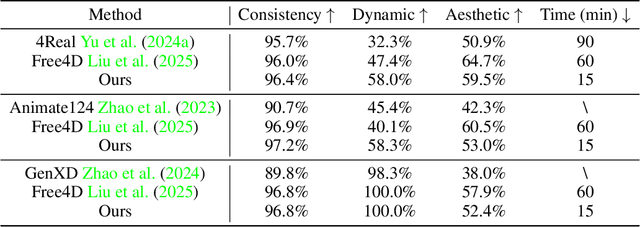
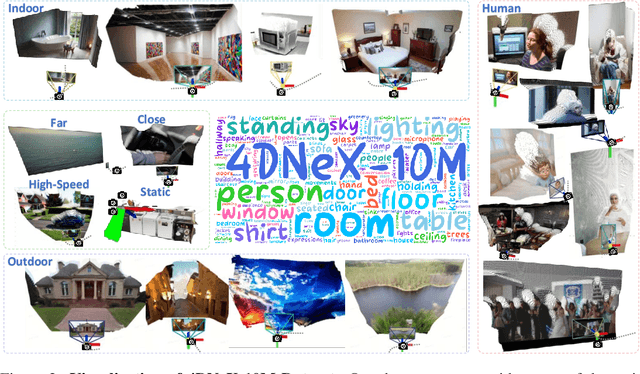

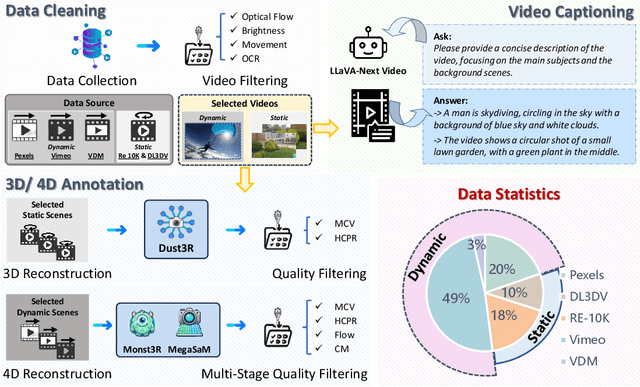
We present 4DNeX, the first feed-forward framework for generating 4D (i.e., dynamic 3D) scene representations from a single image. In contrast to existing methods that rely on computationally intensive optimization or require multi-frame video inputs, 4DNeX enables efficient, end-to-end image-to-4D generation by fine-tuning a pretrained video diffusion model. Specifically, 1) to alleviate the scarcity of 4D data, we construct 4DNeX-10M, a large-scale dataset with high-quality 4D annotations generated using advanced reconstruction approaches. 2) we introduce a unified 6D video representation that jointly models RGB and XYZ sequences, facilitating structured learning of both appearance and geometry. 3) we propose a set of simple yet effective adaptation strategies to repurpose pretrained video diffusion models for 4D modeling. 4DNeX produces high-quality dynamic point clouds that enable novel-view video synthesis. Extensive experiments demonstrate that 4DNeX outperforms existing 4D generation methods in efficiency and generalizability, offering a scalable solution for image-to-4D modeling and laying the foundation for generative 4D world models that simulate dynamic scene evolution.
Component-aware Unsupervised Logical Anomaly Generation for Industrial Anomaly Detection
Feb 17, 2025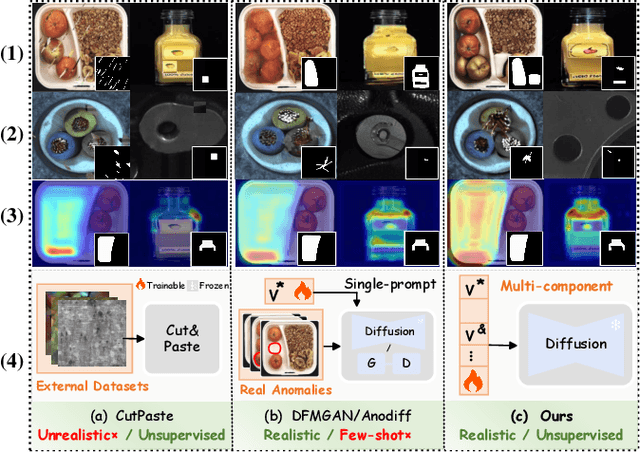
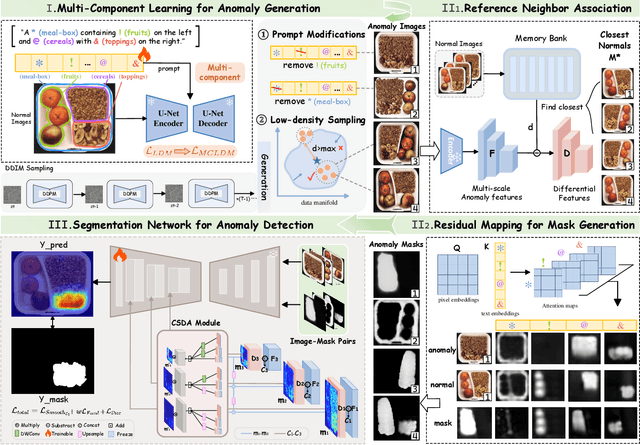
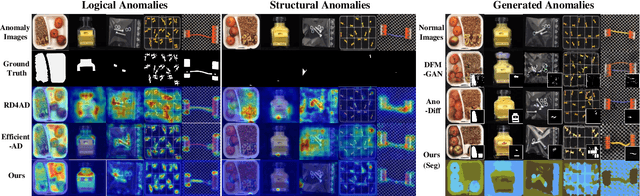
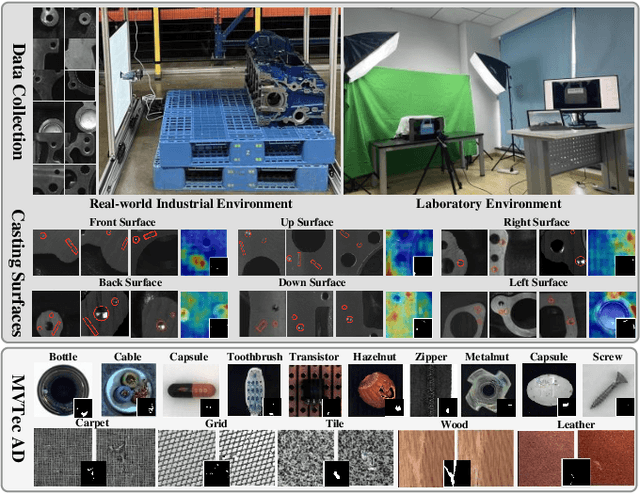
Anomaly detection is critical in industrial manufacturing for ensuring product quality and improving efficiency in automated processes. The scarcity of anomalous samples limits traditional detection methods, making anomaly generation essential for expanding the data repository. However, recent generative models often produce unrealistic anomalies increasing false positives, or require real-world anomaly samples for training. In this work, we treat anomaly generation as a compositional problem and propose ComGEN, a component-aware and unsupervised framework that addresses the gap in logical anomaly generation. Our method comprises a multi-component learning strategy to disentangle visual components, followed by subsequent generation editing procedures. Disentangled text-to-component pairs, revealing intrinsic logical constraints, conduct attention-guided residual mapping and model training with iteratively matched references across multiple scales. Experiments on the MVTecLOCO dataset confirm the efficacy of ComGEN, achieving the best AUROC score of 91.2%. Additional experiments on the real-world scenario of Diesel Engine and widely-used MVTecAD dataset demonstrate significant performance improvements when integrating simulated anomalies generated by ComGEN into automated production workflows.
Hi-EF: Benchmarking Emotion Forecasting in Human-interaction
Jul 23, 2024
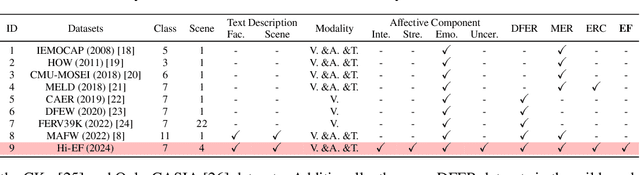
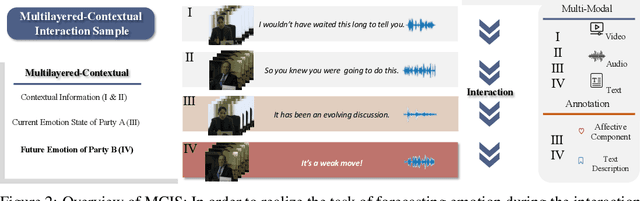
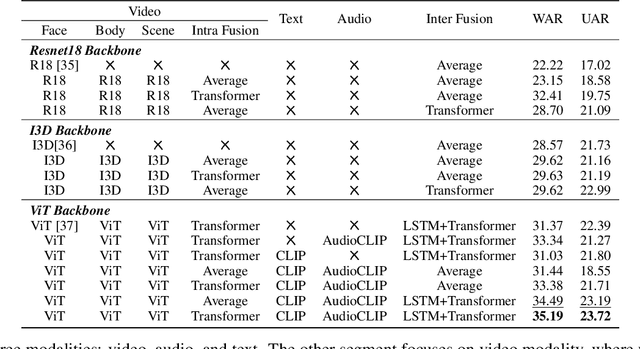
Affective Forecasting, a research direction in psychology that predicts individuals future emotions, is often constrained by numerous external factors like social influence and temporal distance. To address this, we transform Affective Forecasting into a Deep Learning problem by designing an Emotion Forecasting paradigm based on two-party interactions. We propose a novel Emotion Forecasting (EF) task grounded in the theory that an individuals emotions are easily influenced by the emotions or other information conveyed during interactions with another person. To tackle this task, we have developed a specialized dataset, Human-interaction-based Emotion Forecasting (Hi-EF), which contains 3069 two-party Multilayered-Contextual Interaction Samples (MCIS) with abundant affective-relevant labels and three modalities. Hi-EF not only demonstrates the feasibility of the EF task but also highlights its potential. Additionally, we propose a methodology that establishes a foundational and referential baseline model for the EF task and extensive experiments are provided. The dataset and code is available at https://github.com/Anonymize-Author/Hi-EF.
All rivers run into the sea: Unified Modality Brain-like Emotional Central Mechanism
Jul 22, 2024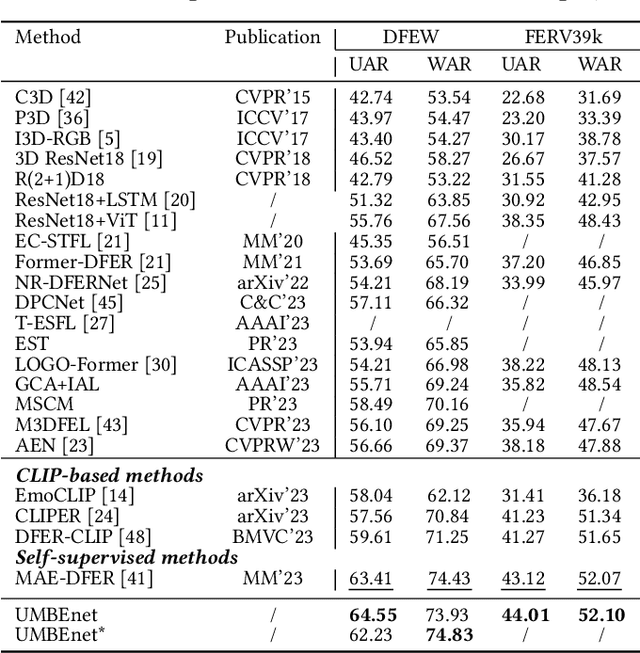
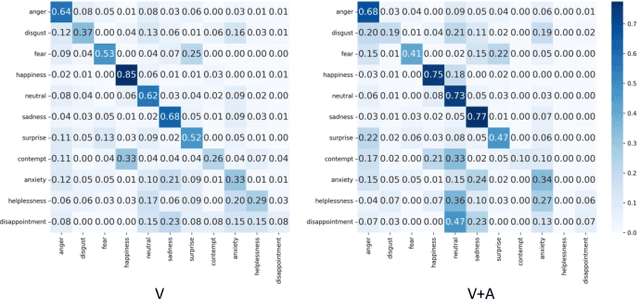
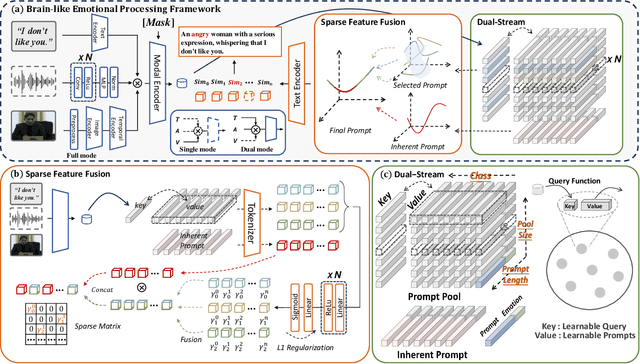
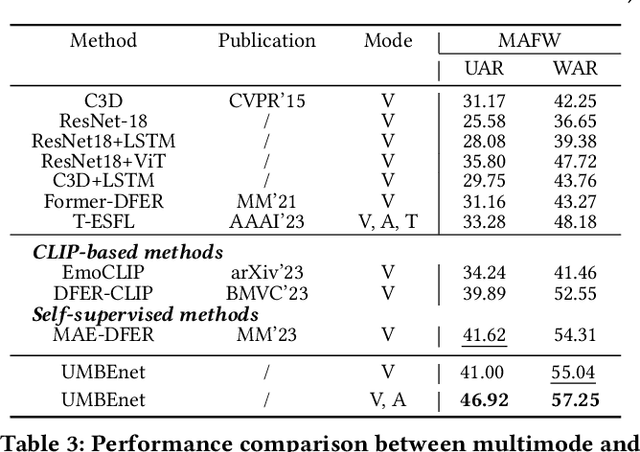
In the field of affective computing, fully leveraging information from a variety of sensory modalities is essential for the comprehensive understanding and processing of human emotions. Inspired by the process through which the human brain handles emotions and the theory of cross-modal plasticity, we propose UMBEnet, a brain-like unified modal affective processing network. The primary design of UMBEnet includes a Dual-Stream (DS) structure that fuses inherent prompts with a Prompt Pool and a Sparse Feature Fusion (SFF) module. The design of the Prompt Pool is aimed at integrating information from different modalities, while inherent prompts are intended to enhance the system's predictive guidance capabilities and effectively manage knowledge related to emotion classification. Moreover, considering the sparsity of effective information across different modalities, the SSF module aims to make full use of all available sensory data through the sparse integration of modality fusion prompts and inherent prompts, maintaining high adaptability and sensitivity to complex emotional states. Extensive experiments on the largest benchmark datasets in the Dynamic Facial Expression Recognition (DFER) field, including DFEW, FERV39k, and MAFW, have proven that UMBEnet consistently outperforms the current state-of-the-art methods. Notably, in scenarios of Modality Missingness and multimodal contexts, UMBEnet significantly surpasses the leading current methods, demonstrating outstanding performance and adaptability in tasks that involve complex emotional understanding with rich multimodal information.
From Efficient Multimodal Models to World Models: A Survey
Jun 27, 2024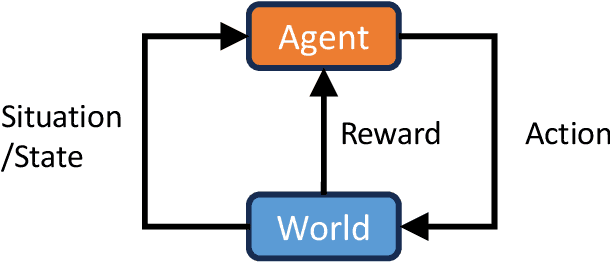


Multimodal Large Models (MLMs) are becoming a significant research focus, combining powerful large language models with multimodal learning to perform complex tasks across different data modalities. This review explores the latest developments and challenges in MLMs, emphasizing their potential in achieving artificial general intelligence and as a pathway to world models. We provide an overview of key techniques such as Multimodal Chain of Thought (M-COT), Multimodal Instruction Tuning (M-IT), and Multimodal In-Context Learning (M-ICL). Additionally, we discuss both the fundamental and specific technologies of multimodal models, highlighting their applications, input/output modalities, and design characteristics. Despite significant advancements, the development of a unified multimodal model remains elusive. We discuss the integration of 3D generation and embodied intelligence to enhance world simulation capabilities and propose incorporating external rule systems for improved reasoning and decision-making. Finally, we outline future research directions to address these challenges and advance the field.