 Add to Chrome
 Add to Firefox
 Add to Edge
SIGMA: Semantic-Difference Instruction-Grounding Mask Annotator for Text-Driven Image Manipulation Localization
May 27, 2026
Text-driven image editing has advanced rapidly, but reliably localizing these manipulations requires image manipulation localization (IML) models trained on large pixel-annotated datasets, and there is still no low-cost way to obtain such training data at scale. We observe that these data already exist in disguise: public editing datasets contain millions of structurally identical (original, edited) pairs to IML training samples, lacking only pixel-level masks. Recovering these masks automatically is non-trivial: pixel differencing is overwhelmed by diffusion-induced perturbations across all pixels, and instruction-only grounding localizes only what the prompt describes, missing unintended editor side-effects. We propose SIGMA (Semantic-difference Instruction-Grounding Mask Annotator), which performs semantic-feature differencing in a vision foundation backbone and injects an instruction-derived spatial prior into this visual stream via bidirectional cross-modal refinement, amplifying the difference signal at intended-edit regions when the editor faithfully realizes user intent. SIGMA is trained in two complementary stages: Stage I supervises on inpainting masks; Stage II closes the diffusion-domain shift via VAE-roundtrip noise calibration, EMA self-training, and an edit-noise disentanglement loss. SIGMA outperforms existing automatic mask generators on five benchmarks (+12.20% F1, +11.16% IoU). When applied to public editing corpora, it produces a ~1.1M IML training set that improves six diverse detectors by +18.34% F1 across five datasets, turning previously unused editing data into a model-agnostic supervisory resource for IML. We'll release the full codebase as soon as the paper is accepted.

Adversarial Attacks Against MLLMs via Progressive Resolution Processing and Adaptive Feature Alignment
May 11, 2026Adversarial perturbations can mislead Multimodal Large Language Models (MLLMs) recognize a benign image as a specific target object, posing serious risks in safety-critical scenarios such as autonomous driving and medical diagnosis. This makes transfer-based targeted attacks crucial for understanding and improving black-box MLLM robustness. Existing transfer-based targeted attack methods typically rely on the final global features of the surrogate encoder and anchor optimization to original-resolution target crops, leading to their limited transferability and robustness. To address these challenges, we propose Progressive Resolution Processing and Adaptive Feature Alignment (PRAF-Attack), a targeted transfer-based attack framework that integrates multi-scale global semantic guidance with robust intermediate-layer local alignment. Unlike prior methods that align only the surrogate encoder's final layer, we design an adaptive feature alignment strategy that leverages intermediate representations to enhance transferability. Specifically, we introduce an adaptive intermediate layer selection mechanism to identify transferable hierarchical features across surrogate ensembles via gradient consistency, along with an adaptive patch-level optimization strategy that preserves highly correlated local regions through efficient patch filtering. To overcome the reliance on fixed original-resolution target crops, we propose a progressive resolution processing strategy that gradually refines optimization from coarse to fine, enabling the attack to better exploit target information at multiple scales and achieve stronger transferability. We evaluate PRAF-Attack on a diverse suite of black-box MLLMs, including six open-source models and six closed-source commercial APIs. Compared with seven state-of-the-art targeted attack baselines, the proposed PRAF-Attack consistently achieves superior transferability.
AttDiff-GAN: A Hybrid Diffusion-GAN Framework for Facial Attribute Editing
Apr 23, 2026Facial attribute editing aims to modify target attributes while preserving attribute-irrelevant content and overall image fidelity. Existing GAN-based methods provide favorable controllability, but often suffer from weak alignment between style codes and attribute semantics. Diffusion-based methods can synthesize highly realistic images; however, their editing precision is limited by the entanglement of semantic directions among different attributes. In this paper, we propose AttDiff-GAN, a hybrid framework that combines GAN-based attribute manipulation with diffusion-based image generation. A key challenge in such integration lies in the inconsistency between one-step adversarial learning and multi-step diffusion denoising, which makes effective optimization difficult. To address this issue, we decouple attribute editing from image synthesis by introducing a feature-level adversarial learning scheme to learn explicit attribute manipulation, and then using the manipulated features to guide the diffusion process for image generation, while also removing the reliance on semantic direction-based editing. Moreover, we enhance style-attribute alignment by introducing PriorMapper, which incorporates facial priors into style generation, and RefineExtractor, which captures global semantic relationships through a Transformer for more precise style extraction. Experimental results on CelebA-HQ show that the proposed method achieves more accurate facial attribute editing and better preservation of non-target attributes than state-of-the-art methods in both qualitative and quantitative evaluations.
LatRef-Diff: Latent and Reference-Guided Diffusion for Facial Attribute Editing and Style Manipulation
Apr 23, 2026Facial attribute editing and style manipulation are crucial for applications like virtual avatars and photo editing. However, achieving precise control over facial attributes without altering unrelated features is challenging due to the complexity of facial structures and the strong correlations between attributes. While conditional GANs have shown progress, they are limited by accuracy issues and training instability. Diffusion models, though promising, face challenges in style manipulation due to the limited expressiveness of semantic directions. In this paper, we propose LatRef-Diff, a novel diffusion-based framework that addresses these limitations. We replace the traditional semantic directions in diffusion models with style codes and propose two methods for generating them: latent and reference guidance. Based on these style codes, we design a style modulation module that integrates them into the target image, enabling both random and customized style manipulation. This module incorporates learnable vectors, cross-attention mechanisms, and a hierarchical design to improve accuracy and image quality. Additionally, to enhance training stability while eliminating the need for paired images (e.g., before and after editing), we propose a forward-backward consistency training strategy. This strategy first removes the target attribute approximately using image-specific semantic directions and then restores it via style modulation, guided by perceptual and classification losses. Extensive experiments on CelebA-HQ demonstrate that LatRef-Diff achieves state-of-the-art performance in both qualitative and quantitative evaluations. Ablation studies validate the effectiveness of our model's design choices.
BreathNet: Generalizable Audio Deepfake Detection via Breath-Cue-Guided Feature Refinement
Feb 14, 2026As deepfake audio becomes more realistic and diverse, developing generalizable countermeasure systems has become crucial. Existing detection methods primarily depend on XLS-R front-end features to improve generalization. Nonetheless, their performance remains limited, partly due to insufficient attention to fine-grained information, such as physiological cues or frequency-domain features. In this paper, we propose BreathNet, a novel audio deepfake detection framework that integrates fine-grained breath information to improve generalization. Specifically, we design BreathFiLM, a feature-wise linear modulation mechanism that selectively amplifies temporal representations based on the presence of breathing sounds. BreathFiLM is trained jointly with the XLS-R extractor, in turn encouraging the extractor to learn and encode breath-related cues into the temporal features. Then, we use the frequency front-end to extract spectral features, which are then fused with temporal features to provide complementary information introduced by vocoders or compression artifacts. Additionally, we propose a group of feature losses comprising Positive-only Supervised Contrastive Loss (PSCL), center loss, and contrast loss. These losses jointly enhance the discriminative ability, encouraging the model to separate bona fide and deepfake samples more effectively in the feature space. Extensive experiments on five benchmark datasets demonstrate state-of-the-art (SOTA) performance. Using the ASVspoof 2019 LA training set, our method attains 1.99% average EER across four related eval benchmarks, with particularly strong performance on the In-the-Wild dataset, where it achieves 4.70% EER. Moreover, under the ASVspoof5 evaluation protocol, our method achieves an EER of 4.94% on this latest benchmark.
Toward Real-world Text Image Forgery Localization: Structured and Interpretable Data Synthesis
Nov 16, 2025Existing Text Image Forgery Localization (T-IFL) methods often suffer from poor generalization due to the limited scale of real-world datasets and the distribution gap caused by synthetic data that fails to capture the complexity of real-world tampering. To tackle this issue, we propose Fourier Series-based Tampering Synthesis (FSTS), a structured and interpretable framework for synthesizing tampered text images. FSTS first collects 16,750 real-world tampering instances from five representative tampering types, using a structured pipeline that records human-performed editing traces via multi-format logs (e.g., video, PSD, and editing logs). By analyzing these collected parameters and identifying recurring behavioral patterns at both individual and population levels, we formulate a hierarchical modeling framework. Specifically, each individual tampering parameter is represented as a compact combination of basis operation-parameter configurations, while the population-level distribution is constructed by aggregating these behaviors. Since this formulation draws inspiration from the Fourier series, it enables an interpretable approximation using basis functions and their learned weights. By sampling from this modeled distribution, FSTS synthesizes diverse and realistic training data that better reflect real-world forgery traces. Extensive experiments across four evaluation protocols demonstrate that models trained with FSTS data achieve significantly improved generalization on real-world datasets. Dataset is available at \href{https://github.com/ZeqinYu/FSTS}{Project Page}.
ForensicsSAM: Toward Robust and Unified Image Forgery Detection and Localization Resisting to Adversarial Attack
Aug 10, 2025Parameter-efficient fine-tuning (PEFT) has emerged as a popular strategy for adapting large vision foundation models, such as the Segment Anything Model (SAM) and LLaVA, to downstream tasks like image forgery detection and localization (IFDL). However, existing PEFT-based approaches overlook their vulnerability to adversarial attacks. In this paper, we show that highly transferable adversarial images can be crafted solely via the upstream model, without accessing the downstream model or training data, significantly degrading the IFDL performance. To address this, we propose ForensicsSAM, a unified IFDL framework with built-in adversarial robustness. Our design is guided by three key ideas: (1) To compensate for the lack of forgery-relevant knowledge in the frozen image encoder, we inject forgery experts into each transformer block to enhance its ability to capture forgery artifacts. These forgery experts are always activated and shared across any input images. (2) To detect adversarial images, we design an light-weight adversary detector that learns to capture structured, task-specific artifact in RGB domain, enabling reliable discrimination across various attack methods. (3) To resist adversarial attacks, we inject adversary experts into the global attention layers and MLP modules to progressively correct feature shifts induced by adversarial noise. These adversary experts are adaptively activated by the adversary detector, thereby avoiding unnecessary interference with clean images. Extensive experiments across multiple benchmarks demonstrate that ForensicsSAM achieves superior resistance to various adversarial attack methods, while also delivering state-of-the-art performance in image-level forgery detection and pixel-level forgery localization. The resource is available at https://github.com/siriusPRX/ForensicsSAM.
CLUE: Leveraging Low-Rank Adaptation to Capture Latent Uncovered Evidence for Image Forgery Localization
Aug 10, 2025The increasing accessibility of image editing tools and generative AI has led to a proliferation of visually convincing forgeries, compromising the authenticity of digital media. In this paper, in addition to leveraging distortions from conventional forgeries, we repurpose the mechanism of a state-of-the-art (SOTA) text-to-image synthesis model by exploiting its internal generative process, turning it into a high-fidelity forgery localization tool. To this end, we propose CLUE (Capture Latent Uncovered Evidence), a framework that employs Low- Rank Adaptation (LoRA) to parameter-efficiently reconfigure Stable Diffusion 3 (SD3) as a forensic feature extractor. Our approach begins with the strategic use of SD3's Rectified Flow (RF) mechanism to inject noise at varying intensities into the latent representation, thereby steering the LoRAtuned denoising process to amplify subtle statistical inconsistencies indicative of a forgery. To complement the latent analysis with high-level semantic context and precise spatial details, our method incorporates contextual features from the image encoder of the Segment Anything Model (SAM), which is parameter-efficiently adapted to better trace the boundaries of forged regions. Extensive evaluations demonstrate CLUE's SOTA generalization performance, significantly outperforming prior methods. Furthermore, CLUE shows superior robustness against common post-processing attacks and Online Social Networks (OSNs). Code is publicly available at https://github.com/SZAISEC/CLUE.
Active Adversarial Noise Suppression for Image Forgery Localization
Jun 15, 2025Recent advances in deep learning have significantly propelled the development of image forgery localization. However, existing models remain highly vulnerable to adversarial attacks: imperceptible noise added to forged images can severely mislead these models. In this paper, we address this challenge with an Adversarial Noise Suppression Module (ANSM) that generate a defensive perturbation to suppress the attack effect of adversarial noise. We observe that forgery-relevant features extracted from adversarial and original forged images exhibit distinct distributions. To bridge this gap, we introduce Forgery-relevant Features Alignment (FFA) as a first-stage training strategy, which reduces distributional discrepancies by minimizing the channel-wise Kullback-Leibler divergence between these features. To further refine the defensive perturbation, we design a second-stage training strategy, termed Mask-guided Refinement (MgR), which incorporates a dual-mask constraint. MgR ensures that the perturbation remains effective for both adversarial and original forged images, recovering forgery localization accuracy to their original level. Extensive experiments across various attack algorithms demonstrate that our method significantly restores the forgery localization model's performance on adversarial images. Notably, when ANSM is applied to original forged images, the performance remains nearly unaffected. To our best knowledge, this is the first report of adversarial defense in image forgery localization tasks. We have released the source code and anti-forensics dataset.
Prompt Engineering-assisted Malware Dynamic Analysis Using GPT-4
Dec 13, 2023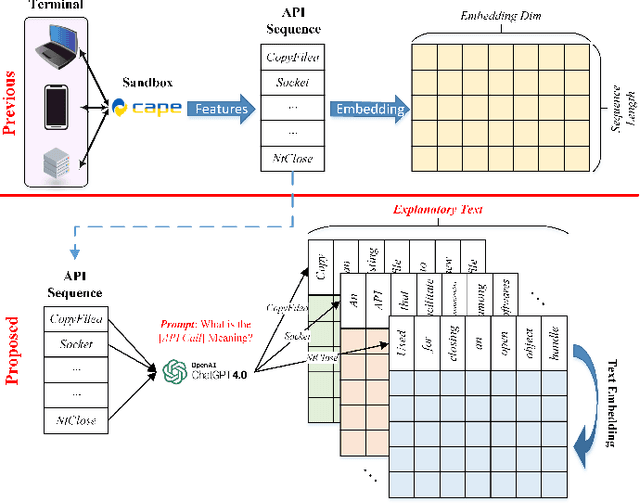
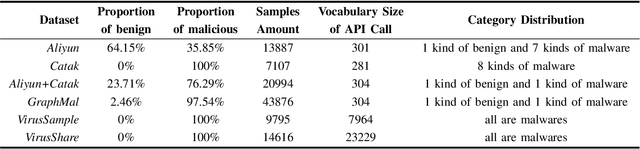
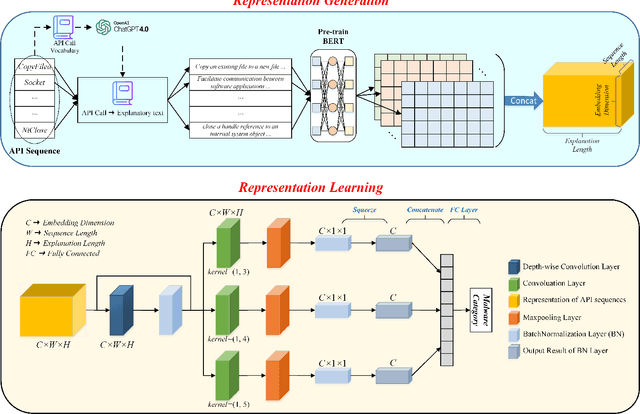

Dynamic analysis methods effectively identify shelled, wrapped, or obfuscated malware, thereby preventing them from invading computers. As a significant representation of dynamic malware behavior, the API (Application Programming Interface) sequence, comprised of consecutive API calls, has progressively become the dominant feature of dynamic analysis methods. Though there have been numerous deep learning models for malware detection based on API sequences, the quality of API call representations produced by those models is limited. These models cannot generate representations for unknown API calls, which weakens both the detection performance and the generalization. Further, the concept drift phenomenon of API calls is prominent. To tackle these issues, we introduce a prompt engineering-assisted malware dynamic analysis using GPT-4. In this method, GPT-4 is employed to create explanatory text for each API call within the API sequence. Afterward, the pre-trained language model BERT is used to obtain the representation of the text, from which we derive the representation of the API sequence. Theoretically, this proposed method is capable of generating representations for all API calls, excluding the necessity for dataset training during the generation process. Utilizing the representation, a CNN-based detection model is designed to extract the feature. We adopt five benchmark datasets to validate the performance of the proposed model. The experimental results reveal that the proposed detection algorithm performs better than the state-of-the-art method (TextCNN). Specifically, in cross-database experiments and few-shot learning experiments, the proposed model achieves excellent detection performance and almost a 100% recall rate for malware, verifying its superior generalization performance. The code is available at: github.com/yan-scnu/Prompted_Dynamic_Detection.