 Add to Chrome
 Add to Firefox
 Add to Edge
InternLM2 Technical Report
Mar 26, 2024


The evolution of Large Language Models (LLMs) like ChatGPT and GPT-4 has sparked discussions on the advent of Artificial General Intelligence (AGI). However, replicating such advancements in open-source models has been challenging. This paper introduces InternLM2, an open-source LLM that outperforms its predecessors in comprehensive evaluations across 6 dimensions and 30 benchmarks, long-context modeling, and open-ended subjective evaluations through innovative pre-training and optimization techniques. The pre-training process of InternLM2 is meticulously detailed, highlighting the preparation of diverse data types including text, code, and long-context data. InternLM2 efficiently captures long-term dependencies, initially trained on 4k tokens before advancing to 32k tokens in pre-training and fine-tuning stages, exhibiting remarkable performance on the 200k ``Needle-in-a-Haystack" test. InternLM2 is further aligned using Supervised Fine-Tuning (SFT) and a novel Conditional Online Reinforcement Learning from Human Feedback (COOL RLHF) strategy that addresses conflicting human preferences and reward hacking. By releasing InternLM2 models in different training stages and model sizes, we provide the community with insights into the model's evolution.

STEntConv: Predicting Disagreement with Stance Detection and a Signed Graph Convolutional Network
Mar 26, 2024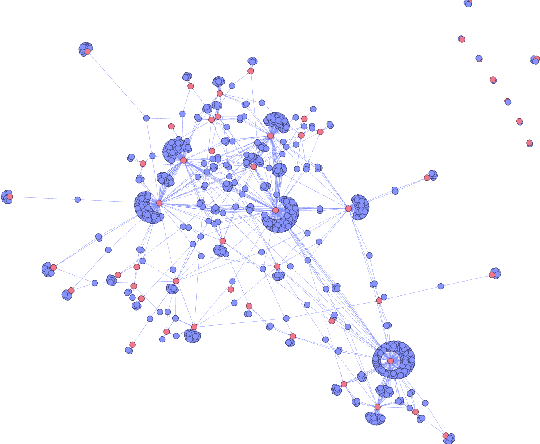

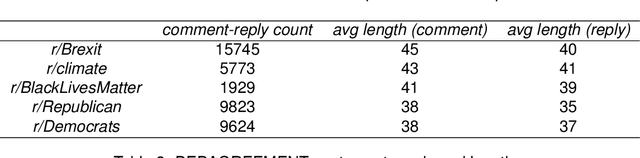
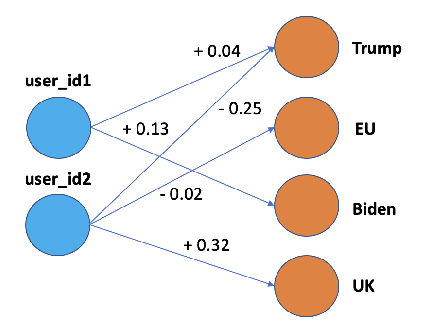
The rise of social media platforms has led to an increase in polarised online discussions, especially on political and socio-cultural topics such as elections and climate change. We propose a simple and novel unsupervised method to predict whether the authors of two posts agree or disagree, leveraging user stances about named entities obtained from their posts. We present STEntConv, a model which builds a graph of users and named entities weighted by stance and trains a Signed Graph Convolutional Network (SGCN) to detect disagreement between comment and reply posts. We run experiments and ablation studies and show that including this information improves disagreement detection performance on a dataset of Reddit posts for a range of controversial subreddit topics, without the need for platform-specific features or user history.
Generalizable and Stable Finetuning of Pretrained Language Models on Low-Resource Texts
Mar 19, 2024Pretrained Language Models (PLMs) have advanced Natural Language Processing (NLP) tasks significantly, but finetuning PLMs on low-resource datasets poses significant challenges such as instability and overfitting. Previous methods tackle these issues by finetuning a strategically chosen subnetwork on a downstream task, while keeping the remaining weights fixed to the pretrained weights. However, they rely on a suboptimal criteria for sub-network selection, leading to suboptimal solutions. To address these limitations, we propose a regularization method based on attention-guided weight mixup for finetuning PLMs. Our approach represents each network weight as a mixup of task-specific weight and pretrained weight, controlled by a learnable attention parameter, providing finer control over sub-network selection. Furthermore, we employ a bi-level optimization (BLO) based framework on two separate splits of the training dataset, improving generalization and combating overfitting. We validate the efficacy of our proposed method through extensive experiments, demonstrating its superiority over previous methods, particularly in the context of finetuning PLMs on low-resource datasets.
Urban Scene Diffusion through Semantic Occupancy Map
Mar 19, 2024Generating unbounded 3D scenes is crucial for large-scale scene understanding and simulation. Urban scenes, unlike natural landscapes, consist of various complex man-made objects and structures such as roads, traffic signs, vehicles, and buildings. To create a realistic and detailed urban scene, it is crucial to accurately represent the geometry and semantics of the underlying objects, going beyond their visual appearance. In this work, we propose UrbanDiffusion, a 3D diffusion model that is conditioned on a Bird's-Eye View (BEV) map and generates an urban scene with geometry and semantics in the form of semantic occupancy map. Our model introduces a novel paradigm that learns the data distribution of scene-level structures within a latent space and further enables the expansion of the synthesized scene into an arbitrary scale. After training on real-world driving datasets, our model can generate a wide range of diverse urban scenes given the BEV maps from the held-out set and also generalize to the synthesized maps from a driving simulator. We further demonstrate its application to scene image synthesis with a pretrained image generator as a prior.
OpenOcc: Open Vocabulary 3D Scene Reconstruction via Occupancy Representation
Mar 18, 20243D reconstruction has been widely used in autonomous navigation fields of mobile robotics. However, the former research can only provide the basic geometry structure without the capability of open-world scene understanding, limiting advanced tasks like human interaction and visual navigation. Moreover, traditional 3D scene understanding approaches rely on expensive labeled 3D datasets to train a model for a single task with supervision. Thus, geometric reconstruction with zero-shot scene understanding i.e. Open vocabulary 3D Understanding and Reconstruction, is crucial for the future development of mobile robots. In this paper, we propose OpenOcc, a novel framework unifying the 3D scene reconstruction and open vocabulary understanding with neural radiance fields. We model the geometric structure of the scene with occupancy representation and distill the pre-trained open vocabulary model into a 3D language field via volume rendering for zero-shot inference. Furthermore, a novel semantic-aware confidence propagation (SCP) method has been proposed to relieve the issue of language field representation degeneracy caused by inconsistent measurements in distilled features. Experimental results show that our approach achieves competitive performance in 3D scene understanding tasks, especially for small and long-tail objects.
CAMixerSR: Only Details Need More "Attention"
Mar 15, 2024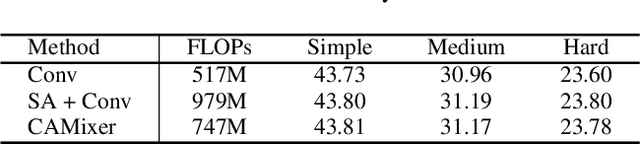
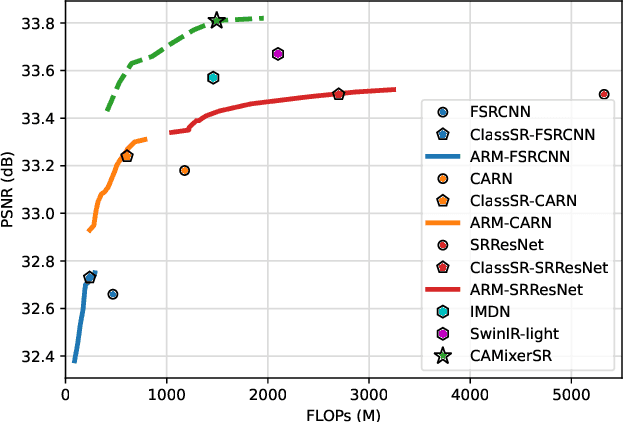
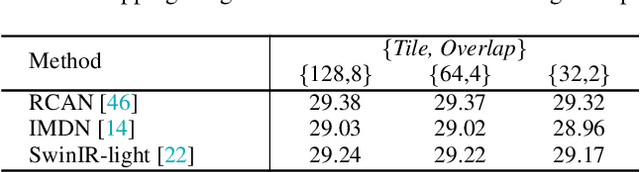
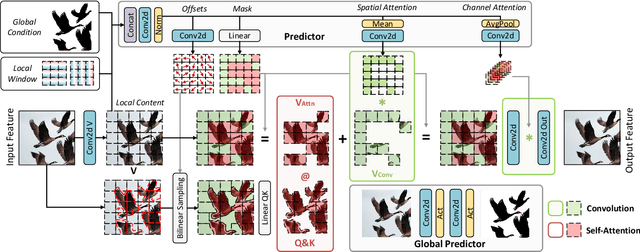
To satisfy the rapidly increasing demands on the large image (2K-8K) super-resolution (SR), prevailing methods follow two independent tracks: 1) accelerate existing networks by content-aware routing, and 2) design better super-resolution networks via token mixer refining. Despite directness, they encounter unavoidable defects (e.g., inflexible route or non-discriminative processing) limiting further improvements of quality-complexity trade-off. To erase the drawbacks, we integrate these schemes by proposing a content-aware mixer (CAMixer), which assigns convolution for simple contexts and additional deformable window-attention for sparse textures. Specifically, the CAMixer uses a learnable predictor to generate multiple bootstraps, including offsets for windows warping, a mask for classifying windows, and convolutional attentions for endowing convolution with the dynamic property, which modulates attention to include more useful textures self-adaptively and improves the representation capability of convolution. We further introduce a global classification loss to improve the accuracy of predictors. By simply stacking CAMixers, we obtain CAMixerSR which achieves superior performance on large-image SR, lightweight SR, and omnidirectional-image SR.
Modular Blind Video Quality Assessment
Mar 13, 2024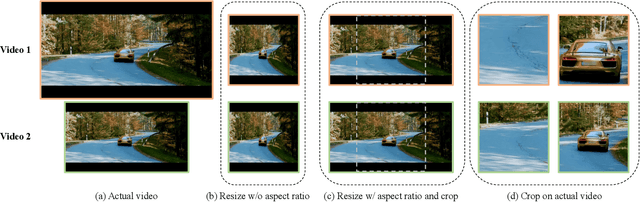
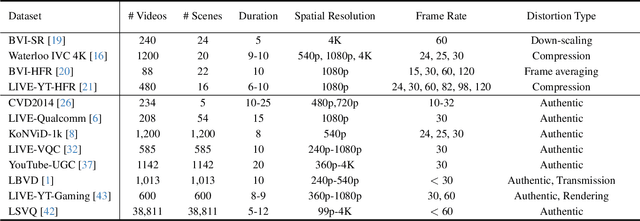

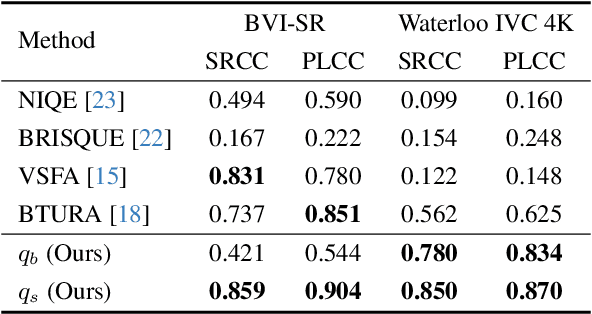
Blind video quality assessment (BVQA) plays a pivotal role in evaluating and improving the viewing experience of end-users across a wide range of video-based platforms and services. Contemporary deep learning-based models primarily analyze the video content in its aggressively downsampled format, while being blind to the impact of actual spatial resolution and frame rate on video quality. In this paper, we propose a modular BVQA model, and a method of training it to improve its modularity. Specifically, our model comprises a base quality predictor, a spatial rectifier, and a temporal rectifier, responding to the visual content and distortion, spatial resolution, and frame rate changes on video quality, respectively. During training, spatial and temporal rectifiers are dropped out with some probabilities so as to make the base quality predictor a standalone BVQA model, which should work better with the rectifiers. Extensive experiments on both professionally-generated content and user generated content video databases show that our quality model achieves superior or comparable performance to current methods. Furthermore, the modularity of our model offers a great opportunity to analyze existing video quality databases in terms of their spatial and temporal complexities. Last, our BVQA model is cost-effective to add other quality-relevant video attributes such as dynamic range and color gamut as additional rectifiers.
Data Interpreter: An LLM Agent For Data Science
Mar 12, 2024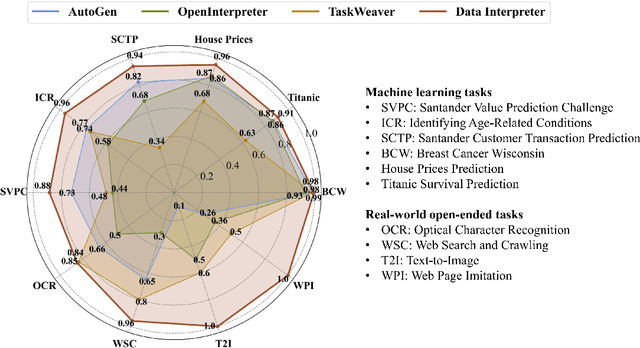


Large Language Model (LLM)-based agents have demonstrated remarkable effectiveness. However, their performance can be compromised in data science scenarios that require real-time data adjustment, expertise in optimization due to complex dependencies among various tasks, and the ability to identify logical errors for precise reasoning. In this study, we introduce the Data Interpreter, a solution designed to solve with code that emphasizes three pivotal techniques to augment problem-solving in data science: 1) dynamic planning with hierarchical graph structures for real-time data adaptability;2) tool integration dynamically to enhance code proficiency during execution, enriching the requisite expertise;3) logical inconsistency identification in feedback, and efficiency enhancement through experience recording. We evaluate the Data Interpreter on various data science and real-world tasks. Compared to open-source baselines, it demonstrated superior performance, exhibiting significant improvements in machine learning tasks, increasing from 0.86 to 0.95. Additionally, it showed a 26% increase in the MATH dataset and a remarkable 112% improvement in open-ended tasks. The solution will be released at https://github.com/geekan/MetaGPT.
BLO-SAM: Bi-level Optimization Based Overfitting-Preventing Finetuning of SAM
Mar 11, 2024The Segment Anything Model (SAM), a foundation model pretrained on millions of images and segmentation masks, has significantly advanced semantic segmentation, a fundamental task in computer vision. Despite its strengths, SAM encounters two major challenges. Firstly, it struggles with segmenting specific objects autonomously, as it relies on users to manually input prompts like points or bounding boxes to identify targeted objects. Secondly, SAM faces challenges in excelling at specific downstream tasks, like medical imaging, due to a disparity between the distribution of its pretraining data, which predominantly consists of general-domain images, and the data used in downstream tasks. Current solutions to these problems, which involve finetuning SAM, often lead to overfitting, a notable issue in scenarios with very limited data, like in medical imaging. To overcome these limitations, we introduce BLO-SAM, which finetunes SAM based on bi-level optimization (BLO). Our approach allows for automatic image segmentation without the need for manual prompts, by optimizing a learnable prompt embedding. Furthermore, it significantly reduces the risk of overfitting by training the model's weight parameters and the prompt embedding on two separate subsets of the training dataset, each at a different level of optimization. We apply BLO-SAM to diverse semantic segmentation tasks in general and medical domains. The results demonstrate BLO-SAM's superior performance over various state-of-the-art image semantic segmentation methods.
Implicit Image-to-Image Schrodinger Bridge for CT Super-Resolution and Denoising
Mar 10, 2024Conditional diffusion models have gained recognition for their effectiveness in image restoration tasks, yet their iterative denoising process, starting from Gaussian noise, often leads to slow inference speeds. As a promising alternative, the Image-to-Image Schr\"odinger Bridge (I2SB) initializes the generative process from corrupted images and integrates training techniques from conditional diffusion models. In this study, we extended the I2SB method by introducing the Implicit Image-to-Image Schrodinger Bridge (I3SB), transitioning its generative process to a non-Markovian process by incorporating corrupted images in each generative step. This enhancement empowers I3SB to generate images with better texture restoration using a small number of generative steps. The proposed method was validated on CT super-resolution and denoising tasks and outperformed existing methods, including the conditional denoising diffusion probabilistic model (cDDPM) and I2SB, in both visual quality and quantitative metrics. These findings underscore the potential of I3SB in improving medical image restoration by providing fast and accurate generative modeling.