 Add to Chrome
 Add to Firefox
 Add to Edge
NTIRE 2026 Challenge on Video Saliency Prediction: Methods and Results
Apr 16, 2026
This paper presents an overview of the NTIRE 2026 Challenge on Video Saliency Prediction. The goal of the challenge participants was to develop automatic saliency map prediction methods for the provided video sequences. The novel dataset of 2,000 diverse videos with an open license was prepared for this challenge. The fixations and corresponding saliency maps were collected using crowdsourced mouse tracking and contain viewing data from over 5,000 assessors. Evaluation was performed on a subset of 800 test videos using generally accepted quality metrics. The challenge attracted over 20 teams making submissions, and 7 teams passed the final phase with code review. All data used in this challenge is made publicly available - https://github.com/msu-video-group/NTIRE26_Saliency_Prediction.

LoViF 2026 Challenge on Human-oriented Semantic Image Quality Assessment: Methods and Results
Apr 13, 2026This paper reviews the LoViF 2026 Challenge on Human-oriented Semantic Image Quality Assessment. This challenge aims to raise a new direction, i.e., how to evaluate the loss of semantic information from the human perspective, intending to promote the development of some new directions, like semantic coding, processing, and semantic-oriented optimization, etc. Unlike existing datasets of quality assessment, we form a dataset of human-oriented semantic quality assessment, termed the SeIQA dataset. This dataset is divided into three parts for this competition: (i) training data: 510 pairs of degraded images and their corresponding ground truth references; (ii) validation data: 80 pairs of degraded images and their corresponding ground-truth references; (iii) testing data: 160 pairs of degraded images and their corresponding ground-truth references. The primary objective of this challenge is to establish a new and powerful benchmark for human-oriented semantic image quality assessment. There are a total of 58 teams registered in this competition, and 6 teams submitted valid solutions and fact sheets for the final testing phase. These submissions achieved state-of-the-art (SOTA) performance on the SeIQA dataset.
A Reasoning-Enabled Vision-Language Foundation Model for Chest X-ray Interpretation
Apr 01, 2026Chest X-rays (CXRs) are among the most frequently performed imaging examinations worldwide, yet rising imaging volumes increase radiologist workload and the risk of diagnostic errors. Although artificial intelligence (AI) systems have shown promise for CXR interpretation, most generate only final predictions, without making explicit how visual evidence is translated into radiographic findings and diagnostic predictions. We present CheXOne, a reasoning-enabled vision-language model for CXR interpretation. CheXOne jointly generates diagnostic predictions and explicit, clinically grounded reasoning traces that connect visual evidence, radiographic findings, and these predictions. The model is trained on 14.7 million instruction and reasoning samples curated from 30 public datasets spanning 36 CXR interpretation tasks, using a two-stage framework that combines instruction tuning with reinforcement learning to improve reasoning quality. We evaluate CheXOne in zero-shot settings across visual question answering, report generation, visual grounding and reasoning assessment, covering 17 evaluation settings. CheXOne outperforms existing medical and general-domain foundation models and achieves strong performance on independent public benchmarks. A clinical reader study demonstrates that CheXOne-drafted reports are comparable to or better than resident-written reports in 55% of cases, while effectively addressing clinical indications and enhancing both report writing and CXR interpretation efficiency. Further analyses involving radiologists reveal that the generated reasoning traces show high clinical factuality and provide causal support for the final predictions, offering a plausible explanation for the performance gains. These results suggest that explicit reasoning can improve model performance, interpretability and clinical utility in AI-assisted CXR interpretation.
Activation Matters: Test-time Activated Negative Labels for OOD Detection with Vision-Language Models
Mar 26, 2026Out-of-distribution (OOD) detection aims to identify samples that deviate from in-distribution (ID). One popular pipeline addresses this by introducing negative labels distant from ID classes and detecting OOD based on their distance to these labels. However, such labels may present poor activation on OOD samples, failing to capture the OOD characteristics. To address this, we propose \underline{T}est-time \underline{A}ctivated \underline{N}egative \underline{L}abels (TANL) by dynamically evaluating activation levels across the corpus dataset and mining candidate labels with high activation responses during the testing process. Specifically, TANL identifies high-confidence test images online and accumulates their assignment probabilities over the corpus to construct a label activation metric. Such a metric leverages historical test samples to adaptively align with the test distribution, enabling the selection of distribution-adaptive activated negative labels. By further exploring the activation information within the current testing batch, we introduce a more fine-grained, batch-adaptive variant. To fully utilize label activation knowledge, we propose an activation-aware score function that emphasizes negative labels with stronger activations, boosting performance and enhancing its robustness to the label number. Our TANL is training-free, test-efficient, and grounded in theoretical justification. Experiments on diverse backbones and wide task settings validate its effectiveness. Notably, on the large-scale ImageNet benchmark, TANL significantly reduces the FPR95 from 17.5\% to 9.8\%. Codes are available at \href{https://github.com/YBZh/OpenOOD-VLM}{YBZh/OpenOOD-VLM}.
ME-IQA: Memory-Enhanced Image Quality Assessment via Re-Ranking
Mar 21, 2026Reasoning-induced vision-language models (VLMs) advance image quality assessment (IQA) with textual reasoning, yet their scalar scores often lack sensitivity and collapse to a few values, so-called discrete collapse. We introduce ME-IQA, a plug-and-play, test-time memory-enhanced re-ranking framework. It (i) builds a memory bank and retrieves semantically and perceptually aligned neighbors using reasoning summaries, (ii) reframes the VLM as a probabilistic comparator to obtain pairwise preference probabilities and fuse this ordinal evidence with the initial score under Thurstone's Case V model, and (iii) performs gated reflection and consolidates memory to improve future decisions. This yields denser, distortion-sensitive predictions and mitigates discrete collapse. Experiments across multiple IQA benchmarks show consistent gains over strong reasoning-induced VLM baselines, existing non-reasoning IQA methods, and test-time scaling alternatives.
Learning Generalizable 3D Medical Image Representations from Mask-Guided Self-Supervision
Mar 14, 2026Foundation models have transformed vision and language by learning general-purpose representations from large-scale unlabeled data, yet 3D medical imaging lacks analogous approaches. Existing self-supervised methods rely on low-level reconstruction or contrastive objectives that fail to capture the anatomical semantics critical for medical image analysis, limiting transfer to downstream tasks. We present MASS (MAsk-guided Self-Supervised learning), which treats in-context segmentation as the pretext task for learning general-purpose medical imaging representations. MASS's key insight is that automatically generated class-agnostic masks provide sufficient structural supervision for learning semantically rich representations. By training on thousands of diverse mask proposals spanning anatomical structures and pathological findings, MASS learns what semantically defines medical structures: the holistic combination of appearance, shape, spatial context, and anatomical relationships. We demonstrate effectiveness across data regimes: from small-scale pretraining on individual datasets (20-200 scans) to large-scale multi-modal pretraining on 5K CT, MRI, and PET volumes, all without annotations. MASS demonstrates: (i) few-shot segmentation on novel structures, (ii) matching full supervision with only 20-40\% labeled data while outperforming self-supervised baselines by over 20 in Dice score in low-data regimes, and (iii) frozen-encoder classification on unseen pathologies that matches full supervised training with thousands of samples. Mask-guided self-supervised pretraining captures broadly generalizable knowledge, opening a path toward 3D medical imaging foundation models without expert annotations. Code is available: https://github.com/Stanford-AIMI/MASS.
A data- and compute-efficient chest X-ray foundation model beyond aggressive scaling
Feb 26, 2026Foundation models for medical imaging are typically pretrained on increasingly large datasets, following a "scale-at-all-costs" paradigm. However, this strategy faces two critical challenges: large-scale medical datasets often contain substantial redundancy and severe class imbalance that bias representation learning toward over-represented patterns, and indiscriminate training regardless of heterogeneity in data quality incurs considerable computational inefficiency. Here we demonstrate that active, principled data curation during pretraining can serve as a viable, cost-effective alternative to brute-force dataset enlargement. We introduce CheXficient, a chest X-ray (CXR) foundation model that selectively prioritizes informative training samples. CheXficient is pretrained on only 22.7% of 1,235,004 paired CXR images and reports while consuming under 27.3% of the total compute budget, yet achieving comparable or superior performance to its full-data counterpart and other large-scale pretrained models. We assess CheXficient across 20 individual benchmarks spanning 5 task types, including non-adapted off-the-shelf evaluations (zero-shot findings classification and crossmodal retrieval) and adapted downstream tasks (disease prediction, semantic segmentation, and radiology report generation). Further analyses show that CheXficient systematically prioritizes under-represented training samples, improving generalizability on long-tailed or rare conditions. Overall, our work offers practical insights into the data and computation demands for efficient pretraining and downstream adaptation of medical vision-language foundation models.
Unpaired Image-to-Image Translation via a Self-Supervised Semantic Bridge
Feb 18, 2026Adversarial diffusion and diffusion-inversion methods have advanced unpaired image-to-image translation, but each faces key limitations. Adversarial approaches require target-domain adversarial loss during training, which can limit generalization to unseen data, while diffusion-inversion methods often produce low-fidelity translations due to imperfect inversion into noise-latent representations. In this work, we propose the Self-Supervised Semantic Bridge (SSB), a versatile framework that integrates external semantic priors into diffusion bridge models to enable spatially faithful translation without cross-domain supervision. Our key idea is to leverage self-supervised visual encoders to learn representations that are invariant to appearance changes but capture geometric structure, forming a shared latent space that conditions the diffusion bridges. Extensive experiments show that SSB outperforms strong prior methods for challenging medical image synthesis in both in-domain and out-of-domain settings, and extends easily to high-quality text-guided editing.
Attention Head Entropy of LLMs Predicts Answer Correctness
Feb 14, 2026Large language models (LLMs) often generate plausible yet incorrect answers, posing risks in safety-critical settings such as medicine. Human evaluation is expensive, and LLM-as-judge approaches risk introducing hidden errors. Recent white-box methods detect contextual hallucinations using model internals, focusing on the localization of the attention mass, but two questions remain open: do these approaches extend to predicting answer correctness, and do they generalize out-of-domains? We introduce Head Entropy, a method that predicts answer correctness from attention entropy patterns, specifically measuring the spread of the attention mass. Using sparse logistic regression on per-head 2-Renyi entropies, Head Entropy matches or exceeds baselines in-distribution and generalizes substantially better on out-of-domains, it outperforms the closest baseline on average by +8.5% AUROC. We further show that attention patterns over the question/context alone, before answer generation, already carry predictive signal using Head Entropy with on average +17.7% AUROC over the closest baseline. We evaluate across 5 instruction-tuned LLMs and 3 QA datasets spanning general knowledge, multi-hop reasoning, and medicine.
Q-Insight: Understanding Image Quality via Visual Reinforcement Learning
Mar 28, 2025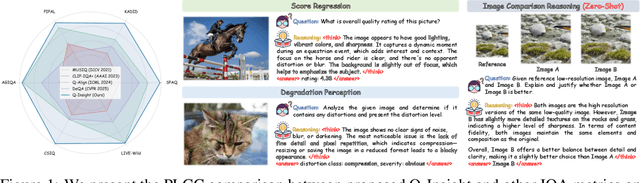
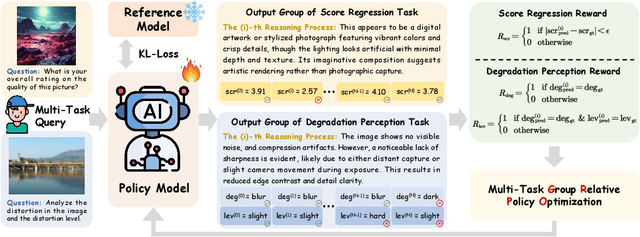
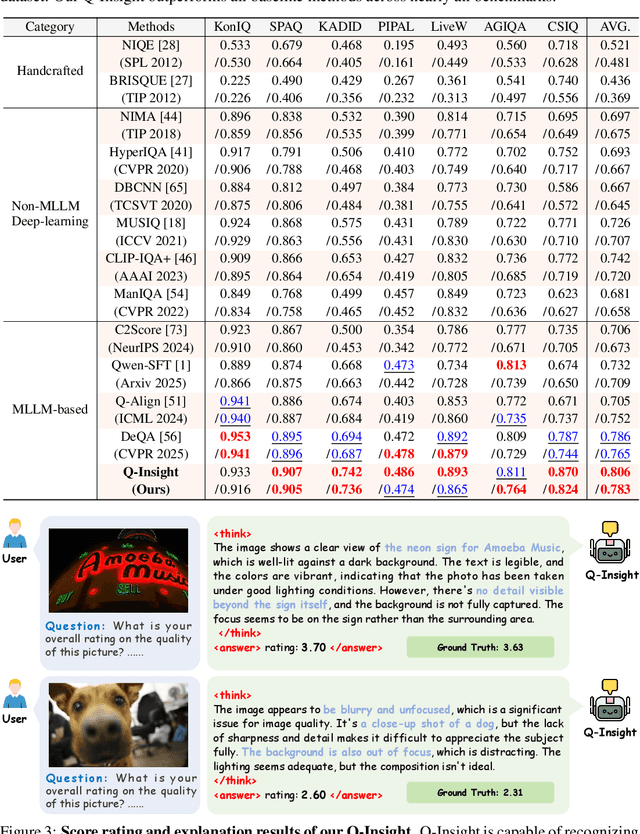
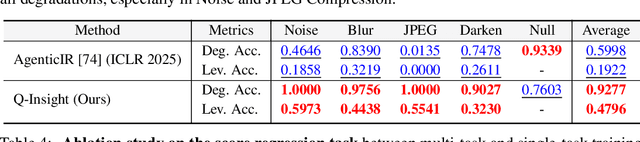
Image quality assessment (IQA) focuses on the perceptual visual quality of images, playing a crucial role in downstream tasks such as image reconstruction, compression, and generation. The rapid advancement of multi-modal large language models (MLLMs) has significantly broadened the scope of IQA, moving toward comprehensive image quality understanding that incorporates content analysis, degradation perception, and comparison reasoning beyond mere numerical scoring. Previous MLLM-based methods typically either generate numerical scores lacking interpretability or heavily rely on supervised fine-tuning (SFT) using large-scale annotated datasets to provide descriptive assessments, limiting their flexibility and applicability. In this paper, we propose Q-Insight, a reinforcement learning-based model built upon group relative policy optimization (GRPO), which demonstrates strong visual reasoning capability for image quality understanding while requiring only a limited amount of rating scores and degradation labels. By jointly optimizing score regression and degradation perception tasks with carefully designed reward functions, our approach effectively exploits their mutual benefits for enhanced performance. Extensive experiments demonstrate that Q-Insight substantially outperforms existing state-of-the-art methods in both score regression and degradation perception tasks, while exhibiting impressive zero-shot generalization to comparison reasoning tasks. Code will be available at https://github.com/lwq20020127/Q-Insight.