 Add to Chrome
 Add to Firefox
 Add to Edge
Mulberry: Empowering MLLM with o1-like Reasoning and Reflection via Collective Monte Carlo Tree Search
Dec 24, 2024


In this work, we aim to develop an MLLM that understands and solves questions by learning to create each intermediate step of the reasoning involved till the final answer. To this end, we propose Collective Monte Carlo Tree Search (CoMCTS), a new learning-to-reason method for MLLMs, which introduces the concept of collective learning into ``tree search'' for effective and efficient reasoning-path searching and learning. The core idea of CoMCTS is to leverage collective knowledge from multiple models to collaboratively conjecture, search and identify effective reasoning paths toward correct answers via four iterative operations including Expansion, Simulation and Error Positioning, Backpropagation, and Selection. Using CoMCTS, we construct Mulberry-260k, a multimodal dataset with a tree of rich, explicit and well-defined reasoning nodes for each question. With Mulberry-260k, we perform collective SFT to train our model, Mulberry, a series of MLLMs with o1-like step-by-step Reasoning and Reflection capabilities. Extensive experiments demonstrate the superiority of our proposed methods on various benchmarks. Code will be available at https://github.com/HJYao00/Mulberry

DynamicKV: Task-Aware Adaptive KV Cache Compression for Long Context LLMs
Dec 19, 2024Efficient KV cache management in LLMs is crucial for long-context tasks like RAG and summarization. Existing KV cache compression methods enforce a fixed pattern, neglecting task-specific characteristics and reducing the retention of essential information. However, we observe distinct activation patterns across layers in various tasks, highlighting the need for adaptive strategies tailored to each task's unique demands. Based on this insight, we propose DynamicKV, a method that dynamically optimizes token retention by adjusting the number of tokens retained at each layer to adapt to the specific task. DynamicKV establishes global and per-layer maximum KV cache budgets, temporarily retaining the maximum budget for the current layer, and periodically updating the KV cache sizes of all preceding layers during inference. Our method retains only 1.7% of the KV cache size while achieving ~85% of the Full KV cache performance on LongBench. Notably, even under extreme compression (0.9%), DynamicKV surpasses state-of-the-art (SOTA) methods by 11% in the Needle-in-a-Haystack test using Mistral-7B-Instruct-v0.2. The code will be released.
Unlocking Tuning-Free Few-Shot Adaptability in Visual Foundation Models by Recycling Pre-Tuned LoRAs
Dec 03, 2024


Large Language Models (LLMs) such as ChatGPT demonstrate strong few-shot adaptability without requiring fine-tuning, positioning them ideal for data-limited and real-time applications. However, this adaptability has not yet been replicated in current Visual Foundation Models (VFMs), which require explicit fine-tuning with sufficient tuning data. Besides, the pretraining-finetuning paradigm has led to the surge of numerous task-specific modular components, such as Low-Rank Adaptation (LoRA). For the first time, we explore the potential of reusing diverse pre-tuned LoRAs without accessing their original training data, to achieve tuning-free few-shot adaptation in VFMs. Our framework, LoRA Recycle, distills a meta-LoRA from diverse pre-tuned LoRAs with a meta-learning objective, using surrogate data generated inversely from pre-tuned LoRAs themselves. The VFM, once equipped with the meta-LoRA, is empowered to solve new few-shot tasks in a single forward pass, akin to the in-context learning of LLMs. Additionally, we incorporate a double-efficient mechanism tailored to our framework, significantly accelerating the meta-training process while maintaining or even improving performance. Extensive experiments across various few-shot classification benchmarks across both in- and cross-domain scenarios demonstrate the superiority of our framework.
Integrating Social Determinants of Health into Knowledge Graphs: Evaluating Prediction Bias and Fairness in Healthcare
Nov 29, 2024


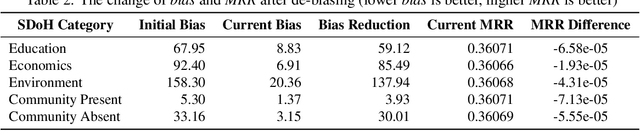
Social determinants of health (SDoH) play a crucial role in patient health outcomes, yet their integration into biomedical knowledge graphs remains underexplored. This study addresses this gap by constructing an SDoH-enriched knowledge graph using the MIMIC-III dataset and PrimeKG. We introduce a novel fairness formulation for graph embeddings, focusing on invariance with respect to sensitive SDoH information. Via employing a heterogeneous-GCN model for drug-disease link prediction, we detect biases related to various SDoH factors. To mitigate these biases, we propose a post-processing method that strategically reweights edges connected to SDoHs, balancing their influence on graph representations. This approach represents one of the first comprehensive investigations into fairness issues within biomedical knowledge graphs incorporating SDoH. Our work not only highlights the importance of considering SDoH in medical informatics but also provides a concrete method for reducing SDoH-related biases in link prediction tasks, paving the way for more equitable healthcare recommendations. Our code is available at \url{https://github.com/hwq0726/SDoH-KG}.
Exploring the Generalization Capabilities of AID-based Bi-level Optimization
Nov 25, 2024Bi-level optimization has achieved considerable success in contemporary machine learning applications, especially for given proper hyperparameters. However, due to the two-level optimization structure, commonly, researchers focus on two types of bi-level optimization methods: approximate implicit differentiation (AID)-based and iterative differentiation (ITD)-based approaches. ITD-based methods can be readily transformed into single-level optimization problems, facilitating the study of their generalization capabilities. In contrast, AID-based methods cannot be easily transformed similarly but must stay in the two-level structure, leaving their generalization properties enigmatic. In this paper, although the outer-level function is nonconvex, we ascertain the uniform stability of AID-based methods, which achieves similar results to a single-level nonconvex problem. We conduct a convergence analysis for a carefully chosen step size to maintain stability. Combining the convergence and stability results, we give the generalization ability of AID-based bi-level optimization methods. Furthermore, we carry out an ablation study of the parameters and assess the performance of these methods on real-world tasks. Our experimental results corroborate the theoretical findings, demonstrating the effectiveness and potential applications of these methods.
A Unified Analysis for Finite Weight Averaging
Nov 20, 2024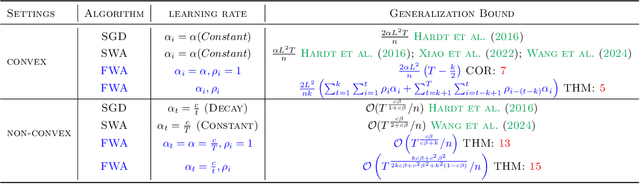


Averaging iterations of Stochastic Gradient Descent (SGD) have achieved empirical success in training deep learning models, such as Stochastic Weight Averaging (SWA), Exponential Moving Average (EMA), and LAtest Weight Averaging (LAWA). Especially, with a finite weight averaging method, LAWA can attain faster convergence and better generalization. However, its theoretical explanation is still less explored since there are fundamental differences between finite and infinite settings. In this work, we first generalize SGD and LAWA as Finite Weight Averaging (FWA) and explain their advantages compared to SGD from the perspective of optimization and generalization. A key challenge is the inapplicability of traditional methods in the sense of expectation or optimal values for infinite-dimensional settings in analyzing FWA's convergence. Second, the cumulative gradients introduced by FWA introduce additional confusion to the generalization analysis, especially making it more difficult to discuss them under different assumptions. Extending the final iteration convergence analysis to the FWA, this paper, under a convexity assumption, establishes a convergence bound $\mathcal{O}(\log\left(\frac{T}{k}\right)/\sqrt{T})$, where $k\in[1, T/2]$ is a constant representing the last $k$ iterations. Compared to SGD with $\mathcal{O}(\log(T)/\sqrt{T})$, we prove theoretically that FWA has a faster convergence rate and explain the effect of the number of average points. In the generalization analysis, we find a recursive representation for bounding the cumulative gradient using mathematical induction. We provide bounds for constant and decay learning rates and the convex and non-convex cases to show the good generalization performance of FWA. Finally, experimental results on several benchmarks verify our theoretical results.
AGLP: A Graph Learning Perspective for Semi-supervised Domain Adaptation
Nov 20, 2024In semi-supervised domain adaptation (SSDA), the model aims to leverage partially labeled target domain data along with a large amount of labeled source domain data to enhance its generalization capability for the target domain. A key advantage of SSDA is its ability to significantly reduce reliance on labeled data, thereby lowering the costs and time associated with data preparation. Most existing SSDA methods utilize information from domain labels and class labels but overlook the structural information of the data. To address this issue, this paper proposes a graph learning perspective (AGLP) for semi-supervised domain adaptation. We apply the graph convolutional network to the instance graph which allows structural information to propagate along the weighted graph edges. The proposed AGLP model has several advantages. First, to the best of our knowledge, this is the first work to model structural information in SSDA. Second, the proposed model can effectively learn domain-invariant and semantic representations, reducing domain discrepancies in SSDA. Extensive experimental results on multiple standard benchmarks demonstrate that the proposed AGLP algorithm outperforms state-of-the-art semi-supervised domain adaptation methods.
DiM: $f$-Divergence Minimization Guided Sharpness-Aware Optimization for Semi-supervised Medical Image Segmentation
Nov 19, 2024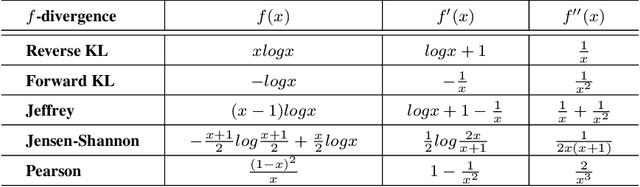
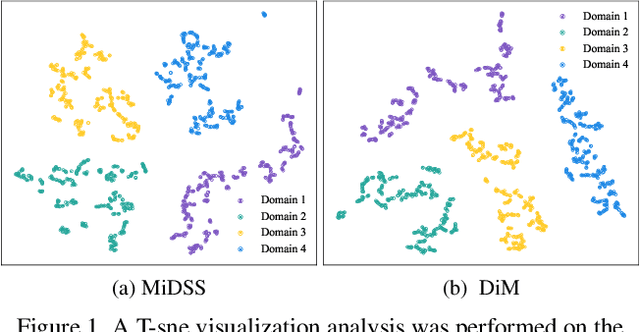
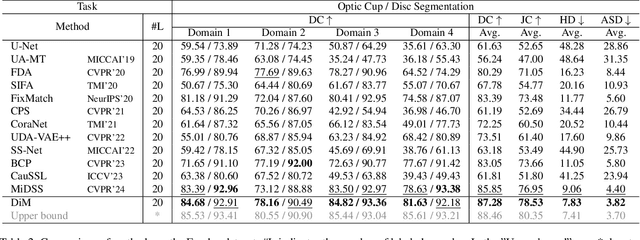
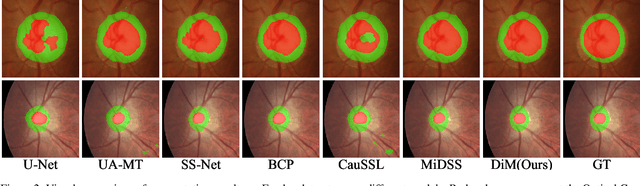
As a technique to alleviate the pressure of data annotation, semi-supervised learning (SSL) has attracted widespread attention. In the specific domain of medical image segmentation, semi-supervised methods (SSMIS) have become a research hotspot due to their ability to reduce the need for large amounts of precisely annotated data. SSMIS focuses on enhancing the model's generalization performance by leveraging a small number of labeled samples and a large number of unlabeled samples. The latest sharpness-aware optimization (SAM) technique, which optimizes the model by reducing the sharpness of the loss function, has shown significant success in SSMIS. However, SAM and its variants may not fully account for the distribution differences between different datasets. To address this issue, we propose a sharpness-aware optimization method based on $f$-divergence minimization (DiM) for semi-supervised medical image segmentation. This method enhances the model's stability by fine-tuning the sensitivity of model parameters and improves the model's adaptability to different datasets through the introduction of $f$-divergence. By reducing $f$-divergence, the DiM method not only improves the performance balance between the source and target datasets but also prevents performance degradation due to overfitting on the source dataset.
Continual Task Learning through Adaptive Policy Self-Composition
Nov 18, 2024
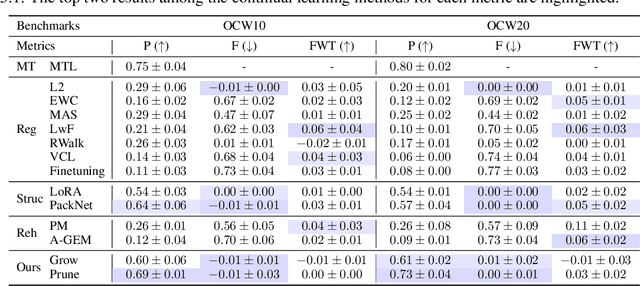
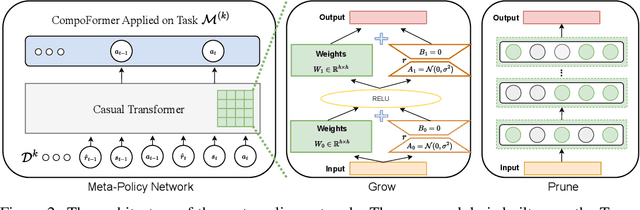
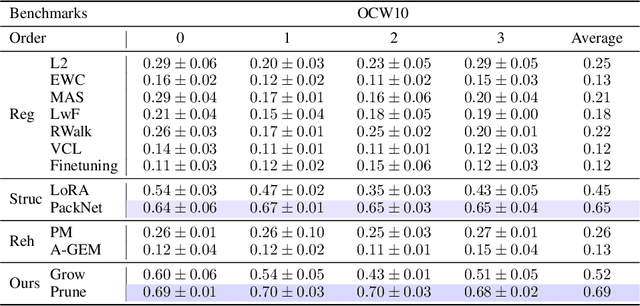
Training a generalizable agent to continually learn a sequence of tasks from offline trajectories is a natural requirement for long-lived agents, yet remains a significant challenge for current offline reinforcement learning (RL) algorithms. Specifically, an agent must be able to rapidly adapt to new tasks using newly collected trajectories (plasticity), while retaining knowledge from previously learned tasks (stability). However, systematic analyses of this setting are scarce, and it remains unclear whether conventional continual learning (CL) methods are effective in continual offline RL (CORL) scenarios. In this study, we develop the Offline Continual World benchmark and demonstrate that traditional CL methods struggle with catastrophic forgetting, primarily due to the unique distribution shifts inherent to CORL scenarios. To address this challenge, we introduce CompoFormer, a structure-based continual transformer model that adaptively composes previous policies via a meta-policy network. Upon encountering a new task, CompoFormer leverages semantic correlations to selectively integrate relevant prior policies alongside newly trained parameters, thereby enhancing knowledge sharing and accelerating the learning process. Our experiments reveal that CompoFormer outperforms conventional CL methods, particularly in longer task sequences, showcasing a promising balance between plasticity and stability.
Aligning Few-Step Diffusion Models with Dense Reward Difference Learning
Nov 18, 2024


Aligning diffusion models with downstream objectives is essential for their practical applications. However, standard alignment methods often struggle with step generalization when directly applied to few-step diffusion models, leading to inconsistent performance across different denoising step scenarios. To address this, we introduce Stepwise Diffusion Policy Optimization (SDPO), a novel alignment method tailored for few-step diffusion models. Unlike prior approaches that rely on a single sparse reward from only the final step of each denoising trajectory for trajectory-level optimization, SDPO incorporates dense reward feedback at every intermediate step. By learning the differences in dense rewards between paired samples, SDPO facilitates stepwise optimization of few-step diffusion models, ensuring consistent alignment across all denoising steps. To promote stable and efficient training, SDPO introduces an online reinforcement learning framework featuring several novel strategies designed to effectively exploit the stepwise granularity of dense rewards. Experimental results demonstrate that SDPO consistently outperforms prior methods in reward-based alignment across diverse step configurations, underscoring its robust step generalization capabilities. Code is avaliable at https://github.com/ZiyiZhang27/sdpo.