 Add to Chrome
 Add to Firefox
 Add to Edge
Beyond Isolation: Unlocking Reinforcement Learning Component Synergy for Sample-Efficient Continuous Control
Aug 07, 2026
Reinforcement learning systems are significantly more complex than other machine learning paradigms due to inherent properties, causing RL system design to jointly account for many tightly coupled factors. Despite advances in individual algorithmic components, their functional interdependencies remain underexplored: do they exhibit mutual synergy or counterproductive interference? To bridge this gap, we conduct a systematic investigation and find that the efficacy of different components exhibits significant task-dependency, and naively stacking state-of-the-art techniques does not necessarily yield performance gains; instead, it often triggers emergent challenges, such as compounded non-stationarity. Building upon these findings, we distill a suite of actionable insights into the principled coordination of these components. Guided by these insights, we propose ROSER, an RL framework that coordinates three critical dimensions: Model-based Representation, Optimization Stability, and Experience Replay. Across diverse continuous-control benchmarks, ROSER consistently outperforms vanilla baselines and achieves 17.60% gains over naive stack. Our findings underscore the necessity of a holistic perspective in RL system design and paves the way for developing sample-efficient agents.

Exploration Matters for Escaping the Blur Trap in 3D Gaussian Splatting
Jul 20, 20263D Gaussian Splatting (3DGS) employs Gaussian primitives for explicit scene representation, facilitating real-time, high-fidelity reconstruction and novel view synthesis of complex scenes. However, the explicit modeling inherent in 3DGS introduces a gradient bias during optimization, rendering its non-convex optimization process highly susceptible to convergence toward local suboptimal solutions. This constitutes a fundamental limitation in 3DGS optimization, which we term the Blur Trap. To address this limitation, we integrate simple explicit exploration into the 3DGS optimization framework. First, through rigorous mathematical analysis of the 3DGS optimization formulation, we identify the underlying optimization bias responsible for the Blur Trap and categorize it into two distinct subtypes: the Far-Side Blur Trap and the Near-Side Blur Trap. Subsequently, we propose two highly straightforward exploration strategies (Random Seeding and Random Splitting) to mitigate the far-side and near-side blur traps, respectively. Experimental validation demonstrates that the incorporation of these exploration operators effectively and complementarily overcome the Blur Trap, achieving high-quality rendering performance across multiple datasets. Project page: https://chengbo-wang.github.io/ExploreGS/
ExToken: Structured Exploration for Efficient Vision-Language-Action Reinforcement Fine-tuning
Jul 14, 2026Reinforcement Learning (RL) has demonstrated significant potential for improving Vision-Language-Action (VLA) models on complex manipulation tasks. However, its practical scalability remains severely limited by the substantial cost of environmental interactions. In this work, we first investigate the exploration stagnation bottleneck in current VLA-RL frameworks and reveal that trajectory diversity is fundamentally more important to sample efficiency than the sheer quantity of collected rollouts. Motivated by these insights, we introduce RL Exploration Token (ExToken), a simple yet general framework that condition VLA policies on discrete behavioral priors derived from offline demonstrations for structured exploration. By conditioning the policy on different tokens during rollout collection, ExToken encourages the agent to explore diverse behavioral modes, substantially improving state-action coverage and exploration efficiency. To bridge exploration during training with deterministic inference at deployment, ExToken further incorporates a state-conditioned token selector that adaptively predicts effective behavioral modes for unseen scenarios. Extensive experiments across simulated and real-world robotic manipulation tasks demonstrate that ExToken consistently accelerates convergence, improves task performance, and exhibits strong robustness under highly constrained interaction budgets.
Beyond One-Size-Fits-All: Diagnosis-Driven Online Reinforcement Learning with Offline Priors
Jun 24, 2026Online reinforcement learning (RL) agents increasingly depend on knowledge acquired offline to achieve practical efficiency. Originally studied in offline-to-online RL, this paradigm now spans foundation model post-training and embodied intelligence, with prior types expanding from offline datasets and pre-trained policies to increasingly diverse knowledge sources such as multimodal foundation models and generative world models. Offline priors have become central to how deep RL is developed and deployed. However, this reliance introduces a challenge that the prevailing benchmark-driven paradigm cannot resolve: because prior validity varies across deployments and shifts during training, no single approach to managing it is universally optimal, and benchmark rankings offer limited guidance for real-world deployments. Rather than pursuing universal solutions, we argue that the field should shift to diagnosis-driven tension management, in which deployment-specific evidence guides how the learner relates to its priors throughout training, enabling both flexible and adaptive deployment. We support this position with a framework characterizing how priors reshape online optimization through three functional roles, controlled experiments demonstrating help-or-hurt reversals, cross-domain evidence from foundation model post-training to embodied intelligence, and engagement with five substantive counterarguments.
What Makes Value Learning Efficient in Residual Reinforcement Learning?
Feb 11, 2026Residual reinforcement learning (RL) enables stable online refinement of expressive pretrained policies by freezing the base and learning only bounded corrections. However, value learning in residual RL poses unique challenges that remain poorly understood. In this work, we identify two key bottlenecks: cold start pathology, where the critic lacks knowledge of the value landscape around the base policy, and structural scale mismatch, where the residual contribution is dwarfed by the base action. Through systematic investigation, we uncover the mechanisms underlying these bottlenecks, revealing that simple yet principled solutions suffice: base-policy transitions serve as an essential value anchor for implicit warmup, and critic normalization effectively restores representation sensitivity for discerning value differences. Based on these insights, we propose DAWN (Data-Anchored Warmup and Normalization), a minimal approach targeting efficient value learning in residual RL. By addressing these bottlenecks, DAWN demonstrates substantial efficiency gains across diverse benchmarks, policy architectures, and observation modalities.
Language-based Trial and Error Falls Behind in the Era of Experience
Jan 29, 2026While Large Language Models (LLMs) excel in language-based agentic tasks, their applicability to unseen, nonlinguistic environments (e.g., symbolic or spatial tasks) remains limited. Previous work attributes this performance gap to the mismatch between the pretraining distribution and the testing distribution. In this work, we demonstrate the primary bottleneck is the prohibitive cost of exploration: mastering these tasks requires extensive trial-and-error, which is computationally unsustainable for parameter-heavy LLMs operating in a high dimensional semantic space. To address this, we propose SCOUT (Sub-Scale Collaboration On Unseen Tasks), a novel framework that decouples exploration from exploitation. We employ lightweight "scouts" (e.g., small MLPs) to probe environmental dynamics at a speed and scale far exceeding LLMs. The collected trajectories are utilized to bootstrap the LLM via Supervised Fine-Tuning (SFT), followed by multi-turn Reinforcement Learning (RL) to activate its latent world knowledge. Empirically, SCOUT enables a Qwen2.5-3B-Instruct model to achieve an average score of 0.86, significantly outperforming proprietary models, including Gemini-2.5-Pro (0.60), while saving about 60% GPU hours consumption.
Towards Reliable Medical LLMs: Benchmarking and Enhancing Confidence Estimation of Large Language Models in Medical Consultation
Jan 22, 2026Large-scale language models (LLMs) often offer clinical judgments based on incomplete information, increasing the risk of misdiagnosis. Existing studies have primarily evaluated confidence in single-turn, static settings, overlooking the coupling between confidence and correctness as clinical evidence accumulates during real consultations, which limits their support for reliable decision-making. We propose the first benchmark for assessing confidence in multi-turn interaction during realistic medical consultations. Our benchmark unifies three types of medical data for open-ended diagnostic generation and introduces an information sufficiency gradient to characterize the confidence-correctness dynamics as evidence increases. We implement and compare 27 representative methods on this benchmark; two key insights emerge: (1) medical data amplifies the inherent limitations of token-level and consistency-level confidence methods, and (2) medical reasoning must be evaluated for both diagnostic accuracy and information completeness. Based on these insights, we present MedConf, an evidence-grounded linguistic self-assessment framework that constructs symptom profiles via retrieval-augmented generation, aligns patient information with supporting, missing, and contradictory relations, and aggregates them into an interpretable confidence estimate through weighted integration. Across two LLMs and three medical datasets, MedConf consistently outperforms state-of-the-art methods on both AUROC and Pearson correlation coefficient metrics, maintaining stable performance under conditions of information insufficiency and multimorbidity. These results demonstrate that information adequacy is a key determinant of credible medical confidence modeling, providing a new pathway toward building more reliable and interpretable large medical models.
Mastering Massive Multi-Task Reinforcement Learning via Mixture-of-Expert Decision Transformer
May 30, 2025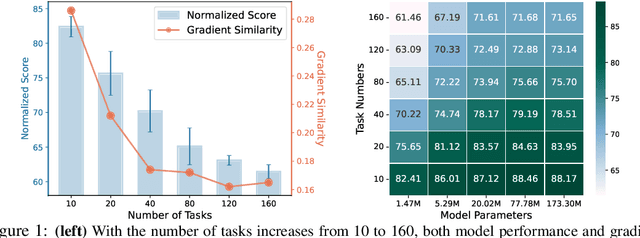

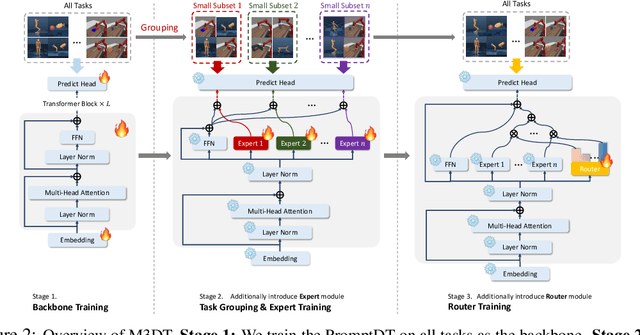

Despite recent advancements in offline multi-task reinforcement learning (MTRL) have harnessed the powerful capabilities of the Transformer architecture, most approaches focus on a limited number of tasks, with scaling to extremely massive tasks remaining a formidable challenge. In this paper, we first revisit the key impact of task numbers on current MTRL method, and further reveal that naively expanding the parameters proves insufficient to counteract the performance degradation as the number of tasks escalates. Building upon these insights, we propose M3DT, a novel mixture-of-experts (MoE) framework that tackles task scalability by further unlocking the model's parameter scalability. Specifically, we enhance both the architecture and the optimization of the agent, where we strengthen the Decision Transformer (DT) backbone with MoE to reduce task load on parameter subsets, and introduce a three-stage training mechanism to facilitate efficient training with optimal performance. Experimental results show that, by increasing the number of experts, M3DT not only consistently enhances its performance as model expansion on the fixed task numbers, but also exhibits remarkable task scalability, successfully extending to 160 tasks with superior performance.
Plasticine: Accelerating Research in Plasticity-Motivated Deep Reinforcement Learning
Apr 24, 2025Developing lifelong learning agents is crucial for artificial general intelligence. However, deep reinforcement learning (RL) systems often suffer from plasticity loss, where neural networks gradually lose their ability to adapt during training. Despite its significance, this field lacks unified benchmarks and evaluation protocols. We introduce Plasticine, the first open-source framework for benchmarking plasticity optimization in deep RL. Plasticine provides single-file implementations of over 13 mitigation methods, 10 evaluation metrics, and learning scenarios with increasing non-stationarity levels from standard to open-ended environments. This framework enables researchers to systematically quantify plasticity loss, evaluate mitigation strategies, and analyze plasticity dynamics across different contexts. Our documentation, examples, and source code are available at https://github.com/RLE-Foundation/Plasticine.
Faster and Better 3D Splatting via Group Training
Dec 10, 2024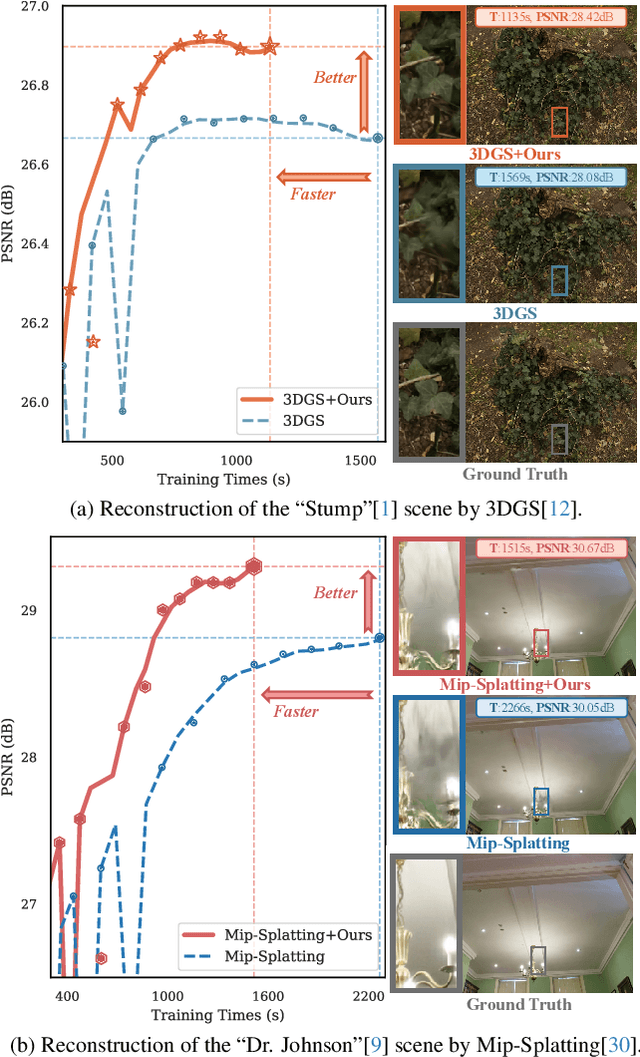
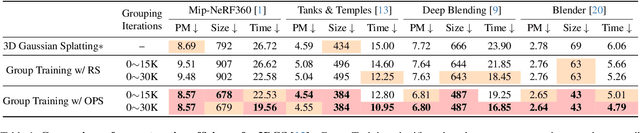
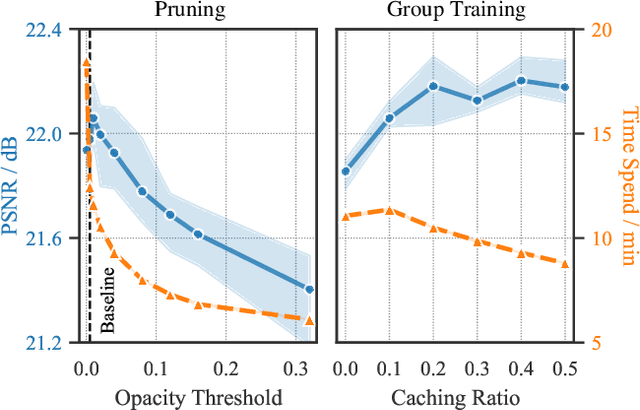

3D Gaussian Splatting (3DGS) has emerged as a powerful technique for novel view synthesis, demonstrating remarkable capability in high-fidelity scene reconstruction through its Gaussian primitive representations. However, the computational overhead induced by the massive number of primitives poses a significant bottleneck to training efficiency. To overcome this challenge, we propose Group Training, a simple yet effective strategy that organizes Gaussian primitives into manageable groups, optimizing training efficiency and improving rendering quality. This approach shows universal compatibility with existing 3DGS frameworks, including vanilla 3DGS and Mip-Splatting, consistently achieving accelerated training while maintaining superior synthesis quality. Extensive experiments reveal that our straightforward Group Training strategy achieves up to 30% faster convergence and improved rendering quality across diverse scenarios.