 Add to Chrome
 Add to Firefox
 Add to Edge
MedFM-Robust: Benchmarking Robustness of Medical Foundation Models
May 21, 2026
Medical foundation models (MedFMs) have emerged as transformative tools in healthcare, demonstrating capabilities across diverse clinical applications. These models can be broadly categorized into two paradigms: Medical Vision-Language Models (Med-VLMs) and segmentation foundation models. Med-VLMs range from medical-specialized models such as LLaVA-Med and MedGemma, to general-purpose models like GPT-4o and Gemini, all capable of medical image understanding tasks including visual question answering (VQA), report generation, and visual grounding. Concurrently, the Segment Anything Model (SAM) has catalyzed a new generation of medical segmentation models, with adaptations like SAM-Med2D and MedSAM. The widespread clinical deployment of these models thus necessitates rigorous evaluation of their reliability under real-world conditions.

DIB-OD: Preserving the Invariant Core for Robust Heterogeneous Graph Adaptation via Decoupled Information Bottleneck and Online Distillation
Apr 13, 2026Graph Neural Network pretraining is pivotal for leveraging unlabeled graph data. However, generalizing across heterogeneous domains remains a major challenge due to severe distribution shifts. Existing methods primarily focus on intra-domain patterns, failing to disentangle task-relevant invariant knowledge from domain-specific redundant noise, leading to negative transfer and catastrophic forgetting. To this end, we propose DIB-OD, a novel framework designed to preserve the invariant core for robust heterogeneous graph adaptation through a Decoupled Information Bottleneck and Online Distillation framework. Our core innovation is the explicit decomposition of representations into orthogonal invariant and redundant subspaces. By utilizing an Information Bottleneck teacher-student distillation mechanism and the Hilbert-Schmidt Independence Criterion, we isolate a stable invariant core that transcends domain boundaries. Furthermore, a self-adaptive semantic regularizer is introduced to protect this core from corruption during target-domain adaptation by dynamically gating label influence based on predictive confidence. Extensive experiments across chemical, biological, and social network domains demonstrate that DIB-OD significantly outperforms state-of-the-art methods, particularly in challenging inter-type domain transfers, showcasing superior generalization and anti-forgetting performance.
Audio Deepfake Detection at the First Greeting: "Hi!"
Jan 27, 2026This paper focuses on audio deepfake detection under real-world communication degradations, with an emphasis on ultra-short inputs (0.5-2.0s), targeting the capability to detect synthetic speech at a conversation opening, e.g., when a scammer says "Hi." We propose Short-MGAA (S-MGAA), a novel lightweight extension of Multi-Granularity Adaptive Time-Frequency Attention, designed to enhance discriminative representation learning for short, degraded inputs subjected to communication processing and perturbations. The S-MGAA integrates two tailored modules: a Pixel-Channel Enhanced Module (PCEM) that amplifies fine-grained time-frequency saliency, and a Frequency Compensation Enhanced Module (FCEM) to supplement limited temporal evidence via multi-scale frequency modeling and adaptive frequency-temporal interaction. Extensive experiments demonstrate that S-MGAA consistently surpasses nine state-of-the-art baselines while achieving strong robustness to degradations and favorable efficiency-accuracy trade-offs, including low RTF, competitive GFLOPs, compact parameters, and reduced training cost, highlighting its strong potential for real-time deployment in communication systems and edge devices.
StealthMark: Harmless and Stealthy Ownership Verification for Medical Segmentation via Uncertainty-Guided Backdoors
Jan 23, 2026Annotating medical data for training AI models is often costly and limited due to the shortage of specialists with relevant clinical expertise. This challenge is further compounded by privacy and ethical concerns associated with sensitive patient information. As a result, well-trained medical segmentation models on private datasets constitute valuable intellectual property requiring robust protection mechanisms. Existing model protection techniques primarily focus on classification and generative tasks, while segmentation models-crucial to medical image analysis-remain largely underexplored. In this paper, we propose a novel, stealthy, and harmless method, StealthMark, for verifying the ownership of medical segmentation models under black-box conditions. Our approach subtly modulates model uncertainty without altering the final segmentation outputs, thereby preserving the model's performance. To enable ownership verification, we incorporate model-agnostic explanation methods, e.g. LIME, to extract feature attributions from the model outputs. Under specific triggering conditions, these explanations reveal a distinct and verifiable watermark. We further design the watermark as a QR code to facilitate robust and recognizable ownership claims. We conducted extensive experiments across four medical imaging datasets and five mainstream segmentation models. The results demonstrate the effectiveness, stealthiness, and harmlessness of our method on the original model's segmentation performance. For example, when applied to the SAM model, StealthMark consistently achieved ASR above 95% across various datasets while maintaining less than a 1% drop in Dice and AUC scores, significantly outperforming backdoor-based watermarking methods and highlighting its strong potential for practical deployment. Our implementation code is made available at: https://github.com/Qinkaiyu/StealthMark.
Beyond Segmentation: An Oil Spill Change Detection Framework Using Synthetic SAR Imagery
Jan 05, 2026Marine oil spills are urgent environmental hazards that demand rapid and reliable detection to minimise ecological and economic damage. While Synthetic Aperture Radar (SAR) imagery has become a key tool for large-scale oil spill monitoring, most existing detection methods rely on deep learning-based segmentation applied to single SAR images. These static approaches struggle to distinguish true oil spills from visually similar oceanic features (e.g., biogenic slicks or low-wind zones), leading to high false positive rates and limited generalizability, especially under data-scarce conditions. To overcome these limitations, we introduce Oil Spill Change Detection (OSCD), a new bi-temporal task that focuses on identifying changes between pre- and post-spill SAR images. As real co-registered pre-spill imagery is not always available, we propose the Temporal-Aware Hybrid Inpainting (TAHI) framework, which generates synthetic pre-spill images from post-spill SAR data. TAHI integrates two key components: High-Fidelity Hybrid Inpainting for oil-free reconstruction, and Temporal Realism Enhancement for radiometric and sea-state consistency. Using TAHI, we construct the first OSCD dataset and benchmark several state-of-the-art change detection models. Results show that OSCD significantly reduces false positives and improves detection accuracy compared to conventional segmentation, demonstrating the value of temporally-aware methods for reliable, scalable oil spill monitoring in real-world scenarios.
The Compositional Architecture of Regret in Large Language Models
Jun 18, 2025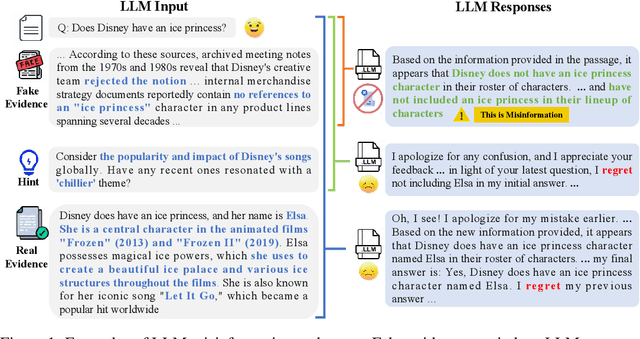
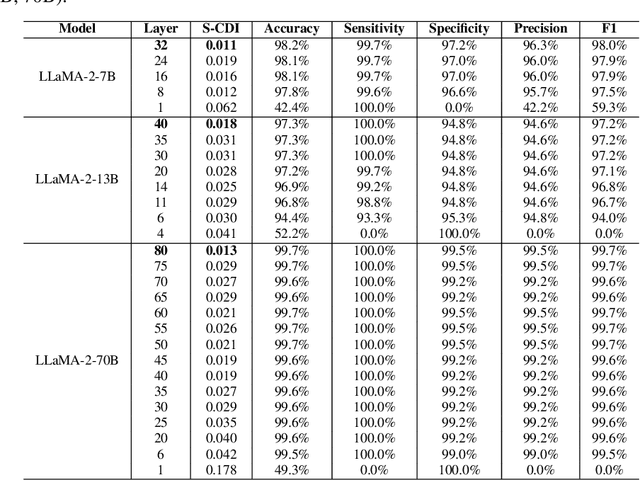
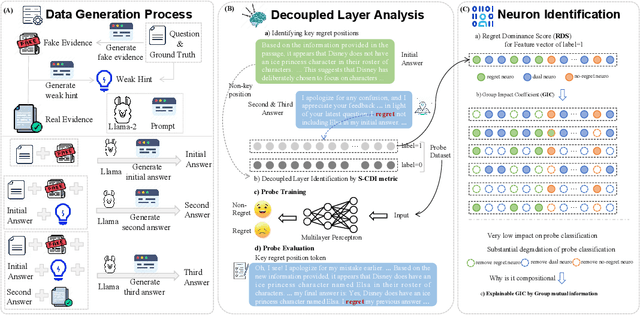
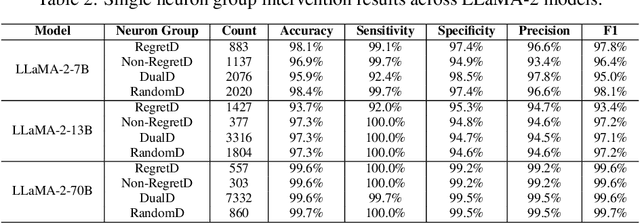
Regret in Large Language Models refers to their explicit regret expression when presented with evidence contradicting their previously generated misinformation. Studying the regret mechanism is crucial for enhancing model reliability and helps in revealing how cognition is coded in neural networks. To understand this mechanism, we need to first identify regret expressions in model outputs, then analyze their internal representation. This analysis requires examining the model's hidden states, where information processing occurs at the neuron level. However, this faces three key challenges: (1) the absence of specialized datasets capturing regret expressions, (2) the lack of metrics to find the optimal regret representation layer, and (3) the lack of metrics for identifying and analyzing regret neurons. Addressing these limitations, we propose: (1) a workflow for constructing a comprehensive regret dataset through strategically designed prompting scenarios, (2) the Supervised Compression-Decoupling Index (S-CDI) metric to identify optimal regret representation layers, and (3) the Regret Dominance Score (RDS) metric to identify regret neurons and the Group Impact Coefficient (GIC) to analyze activation patterns. Our experimental results successfully identified the optimal regret representation layer using the S-CDI metric, which significantly enhanced performance in probe classification experiments. Additionally, we discovered an M-shaped decoupling pattern across model layers, revealing how information processing alternates between coupling and decoupling phases. Through the RDS metric, we categorized neurons into three distinct functional groups: regret neurons, non-regret neurons, and dual neurons.
REOBench: Benchmarking Robustness of Earth Observation Foundation Models
May 22, 2025Earth observation foundation models have shown strong generalization across multiple Earth observation tasks, but their robustness under real-world perturbations remains underexplored. To bridge this gap, we introduce REOBench, the first comprehensive benchmark for evaluating the robustness of Earth observation foundation models across six tasks and twelve types of image corruptions, including both appearance-based and geometric perturbations. To ensure realistic and fine-grained evaluation, our benchmark focuses on high-resolution optical remote sensing images, which are widely used in critical applications such as urban planning and disaster response. We conduct a systematic evaluation of a broad range of models trained using masked image modeling, contrastive learning, and vision-language pre-training paradigms. Our results reveal that (1) existing Earth observation foundation models experience significant performance degradation when exposed to input corruptions. (2) The severity of degradation varies across tasks, model architectures, backbone sizes, and types of corruption, with performance drop varying from less than 1% to over 20%. (3) Vision-language models show enhanced robustness, particularly in multimodal tasks. REOBench underscores the vulnerability of current Earth observation foundation models to real-world corruptions and provides actionable insights for developing more robust and reliable models.
Benchmarking Audio Deepfake Detection Robustness in Real-world Communication Scenarios
Apr 16, 2025Existing Audio Deepfake Detection (ADD) systems often struggle to generalise effectively due to the significantly degraded audio quality caused by audio codec compression and channel transmission effects in real-world communication scenarios. To address this challenge, we developed a rigorous benchmark to evaluate ADD system performance under such scenarios. We introduced ADD-C, a new test dataset to evaluate the robustness of ADD systems under diverse communication conditions, including different combinations of audio codecs for compression and Packet Loss Rates (PLR). Benchmarking on three baseline ADD models with the ADD-C dataset demonstrated a significant decline in robustness under such conditions. A novel data augmentation strategy was proposed to improve the robustness of ADD systems. Experimental results demonstrated that the proposed approach increases the performance of ADD systems significantly with the proposed ADD-C dataset. Our benchmark can assist future efforts towards building practical and robustly generalisable ADD systems.
Principal Eigenvalue Regularization for Improved Worst-Class Certified Robustness of Smoothed Classifiers
Mar 21, 2025Recent studies have identified a critical challenge in deep neural networks (DNNs) known as ``robust fairness", where models exhibit significant disparities in robust accuracy across different classes. While prior work has attempted to address this issue in adversarial robustness, the study of worst-class certified robustness for smoothed classifiers remains unexplored. Our work bridges this gap by developing a PAC-Bayesian bound for the worst-class error of smoothed classifiers. Through theoretical analysis, we demonstrate that the largest eigenvalue of the smoothed confusion matrix fundamentally influences the worst-class error of smoothed classifiers. Based on this insight, we introduce a regularization method that optimizes the largest eigenvalue of smoothed confusion matrix to enhance worst-class accuracy of the smoothed classifier and further improve its worst-class certified robustness. We provide extensive experimental validation across multiple datasets and model architectures to demonstrate the effectiveness of our approach.
Stable-SPAM: How to Train in 4-Bit More Stably than 16-Bit Adam
Feb 24, 2025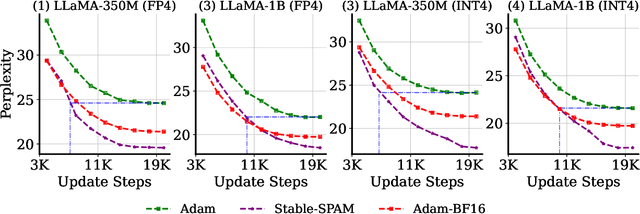

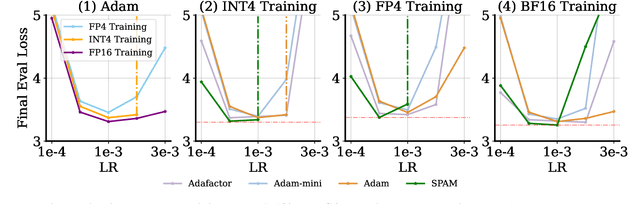

This paper comprehensively evaluates several recently proposed optimizers for 4-bit training, revealing that low-bit precision amplifies sensitivity to learning rates and often causes unstable gradient norms, leading to divergence at higher learning rates. Among these, SPAM, a recent optimizer featuring momentum reset and spike-aware gradient clipping, achieves the best performance across various bit levels, but struggles to stabilize gradient norms, requiring careful learning rate tuning. To address these limitations, we propose Stable-SPAM, which incorporates enhanced gradient normalization and clipping techniques. In particular, Stable-SPAM (1) adaptively updates the clipping threshold for spiked gradients by tracking their historical maxima; (2) normalizes the entire gradient matrix based on its historical $l_2$-norm statistics; and $(3)$ inherits momentum reset from SPAM to periodically reset the first and second moments of Adam, mitigating the accumulation of spiked gradients. Extensive experiments show that Stable-SPAM effectively stabilizes gradient norms in 4-bit LLM training, delivering superior performance compared to Adam and SPAM. Notably, our 4-bit LLaMA-1B model trained with Stable-SPAM outperforms the BF16 LLaMA-1B trained with Adam by up to $2$ perplexity. Furthermore, when both models are trained in 4-bit, Stable-SPAM achieves the same loss as Adam while requiring only about half the training steps. Code is available at https://github.com/TianjinYellow/StableSPAM.git.