 Add to Chrome
 Add to Firefox
 Add to Edge
UI-Mate: Advancing Open-Weight Foundation GUI Agents with In-Context Demonstrations
Aug 16, 2026
Foundation GUI agents can automate complex digital tasks, but deployment is hindered by scarce and biased training data, ambiguous prompts, and unreliable execution. Routine workflows rely on user-specific tools and tacit conventions, so unstated instructions can produce arbitrary variations across runs. We present UI-Mate, a foundation GUI agent that integrates an environment-grounded training stack with in-context demonstration learning. UI-Mate makes three contributions: A Scalable Environment-Grounded Training Stack: A closed-loop data engine automates task generation, environment construction, rollout, filtering, capability balancing, SFT, and online RL across massively parallel environments via unified task-verifier bundles. In-Context Demonstration Learning: A mechanism that transforms multimodal demonstrations into flexible subtask-level workflows, follows relevant demonstrated steps, and re-plans from the live interface. OSWorkerBench Benchmark and Insights: A benchmark of 100 long-horizon office tasks across 41 applications that supports instruction-only and demonstration-guided evaluation. Its demonstration resources separate a 33-task self-demo setting, built from successful strong-agent rollouts of the same targets, from a 45-task variant-demo setting, built from human recordings of related but non-identical tasks. Experiments show that UI-Mate-27B sets a new open-weight state of the art on general computer-use benchmarks, scoring 77.0% on OSWorld-Verified and 66.2% on WindowsAgentArena. On OSWorkerBench, it reaches 41.0% strict success and 76.9% progress, outperforming its Qwen3.6-27B base by 17.7 and 24.5 points. On the 33-task self-demo subset, one demonstration raises strict success from 17.2% to 35.4% and progress from 67.9% to 81.1%, substantially improving long-horizon reliability. Project page: https://ui-mate.github.io.

HELP: HyperNode Expansion and Logical Path-Guided Evidence Localization for Accurate and Efficient GraphRAG
Feb 24, 2026Large Language Models (LLMs) often struggle with inherent knowledge boundaries and hallucinations, limiting their reliability in knowledge-intensive tasks. While Retrieval-Augmented Generation (RAG) mitigates these issues, it frequently overlooks structural interdependencies essential for multi-hop reasoning. Graph-based RAG approaches attempt to bridge this gap, yet they typically face trade-offs between accuracy and efficiency due to challenges such as costly graph traversals and semantic noise in LLM-generated summaries. In this paper, we propose HyperNode Expansion and Logical Path-Guided Evidence Localization strategies for GraphRAG (HELP), a novel framework designed to balance accuracy with practical efficiency through two core strategies: 1) HyperNode Expansion, which iteratively chains knowledge triplets into coherent reasoning paths abstracted as HyperNodes to capture complex structural dependencies and ensure retrieval accuracy; and 2) Logical Path-Guided Evidence Localization, which leverages precomputed graph-text correlations to map these paths directly to the corpus for superior efficiency. HELP avoids expensive random walks and semantic distortion, preserving knowledge integrity while drastically reducing retrieval latency. Extensive experiments demonstrate that HELP achieves competitive performance across multiple simple and multi-hop QA benchmarks and up to a 28.8$\times$ speedup over leading Graph-based RAG baselines.
REDSearcher: A Scalable and Cost-Efficient Framework for Long-Horizon Search Agents
Feb 15, 2026Large language models are transitioning from generalpurpose knowledge engines to realworld problem solvers, yet optimizing them for deep search tasks remains challenging. The central bottleneck lies in the extreme sparsity of highquality search trajectories and reward signals, arising from the difficulty of scalable longhorizon task construction and the high cost of interactionheavy rollouts involving external tool calls. To address these challenges, we propose REDSearcher, a unified framework that codesigns complex task synthesis, midtraining, and posttraining for scalable searchagent optimization. Specifically, REDSearcher introduces the following improvements: (1) We frame task synthesis as a dualconstrained optimization, where task difficulty is precisely governed by graph topology and evidence dispersion, allowing scalable generation of complex, highquality tasks. (2) We introduce toolaugmented queries to encourage proactive tool use rather than passive recall.(3) During midtraining, we strengthen core atomic capabilities knowledge, planning, and function calling substantially reducing the cost of collecting highquality trajectories for downstream training. (4) We build a local simulated environment that enables rapid, lowcost algorithmic iteration for reinforcement learning experiments. Across both textonly and multimodal searchagent benchmarks, our approach achieves stateoftheart performance. To facilitate future research on longhorizon search agents, we will release 10K highquality complex text search trajectories, 5K multimodal trajectories and 1K text RL query set, and together with code and model checkpoints.
Why Self-Rewarding Works: Theoretical Guarantees for Iterative Alignment of Language Models
Jan 30, 2026Self-Rewarding Language Models (SRLMs) achieve notable success in iteratively improving alignment without external feedback. Yet, despite their striking empirical progress, the core mechanisms driving their capabilities remain unelucidated, leaving a critical gap in theoretical understanding. This paper provides the first rigorous theoretical guarantees for SRLMs. We first establish a lower bound that characterizes the fundamental limits of a single update step, revealing a critical dependence on the quality of the initial model. We then derive finite-sample error bounds for the full iterative paradigm, showing that performance improves at a rate of $\widetilde{\mathcal{O}}\left(1/\sqrt{n}\right)$ with sample size $n$. Crucially, our analysis reveals that the dependence on the initial model decays exponentially with the number of iterations $T$. This provides a formal explanation for why self-rewarding succeeds: it robustly overcomes poor initialization by steering the dynamics toward internal stability and consistency. Finally, we instantiate our theoretical framework for the linear softmax model class, yielding tailored guarantees that connect our high-level insights to practical model architectures.
Analytic Energy-Guided Policy Optimization for Offline Reinforcement Learning
May 03, 2025Conditional decision generation with diffusion models has shown powerful competitiveness in reinforcement learning (RL). Recent studies reveal the relation between energy-function-guidance diffusion models and constrained RL problems. The main challenge lies in estimating the intermediate energy, which is intractable due to the log-expectation formulation during the generation process. To address this issue, we propose the Analytic Energy-guided Policy Optimization (AEPO). Specifically, we first provide a theoretical analysis and the closed-form solution of the intermediate guidance when the diffusion model obeys the conditional Gaussian transformation. Then, we analyze the posterior Gaussian distribution in the log-expectation formulation and obtain the target estimation of the log-expectation under mild assumptions. Finally, we train an intermediate energy neural network to approach the target estimation of log-expectation formulation. We apply our method in 30+ offline RL tasks to demonstrate the effectiveness of our method. Extensive experiments illustrate that our method surpasses numerous representative baselines in D4RL offline reinforcement learning benchmarks.
Combatting Dimensional Collapse in LLM Pre-Training Data via Diversified File Selection
Apr 29, 2025Selecting high-quality pre-training data for large language models (LLMs) is crucial for enhancing their overall performance under limited computation budget, improving both training and sample efficiency. Recent advancements in file selection primarily rely on using an existing or trained proxy model to assess the similarity of samples to a target domain, such as high quality sources BookCorpus and Wikipedia. However, upon revisiting these methods, the domain-similarity selection criteria demonstrates a diversity dilemma, i.e.dimensional collapse in the feature space, improving performance on the domain-related tasks but causing severe degradation on generic performance. To prevent collapse and enhance diversity, we propose a DiverSified File selection algorithm (DiSF), which selects the most decorrelated text files in the feature space. We approach this with a classical greedy algorithm to achieve more uniform eigenvalues in the feature covariance matrix of the selected texts, analyzing its approximation to the optimal solution under a formulation of $\gamma$-weakly submodular optimization problem. Empirically, we establish a benchmark and conduct extensive experiments on the TinyLlama architecture with models from 120M to 1.1B parameters. Evaluating across nine tasks from the Harness framework, DiSF demonstrates a significant improvement on overall performance. Specifically, DiSF saves 98.5% of 590M training files in SlimPajama, outperforming the full-data pre-training within a 50B training budget, and achieving about 1.5x training efficiency and 5x data efficiency.
Squeeze Out Tokens from Sample for Finer-Grained Data Governance
Mar 18, 2025Widely observed data scaling laws, in which error falls off as a power of the training size, demonstrate the diminishing returns of unselective data expansion. Hence, data governance is proposed to downsize datasets through pruning non-informative samples. Yet, isolating the impact of a specific sample on overall model performance is challenging, due to the vast computation required for tryout all sample combinations. Current data governors circumvent this complexity by estimating sample contributions through heuristic-derived scalar scores, thereby discarding low-value ones. Despite thorough sample sieving, retained samples contain substantial undesired tokens intrinsically, underscoring the potential for further compression and purification. In this work, we upgrade data governance from a 'sieving' approach to a 'juicing' one. Instead of scanning for least-flawed samples, our dual-branch DataJuicer applies finer-grained intra-sample governance. It squeezes out informative tokens and boosts image-text alignments. Specifically, the vision branch retains salient image patches and extracts relevant object classes, while the text branch incorporates these classes to enhance captions. Consequently, DataJuicer yields more refined datasets through finer-grained governance. Extensive experiments across datasets demonstrate that DataJuicer significantly outperforms existing DataSieve in image-text retrieval, classification, and dense visual reasoning.
Continual Task Learning through Adaptive Policy Self-Composition
Nov 18, 2024
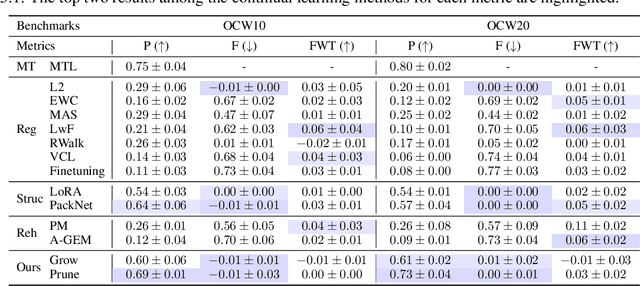
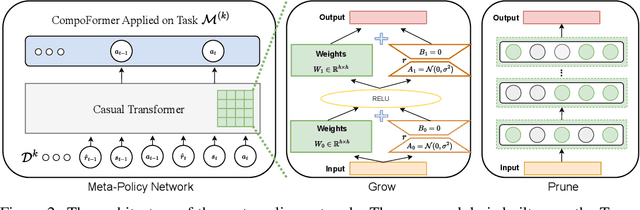
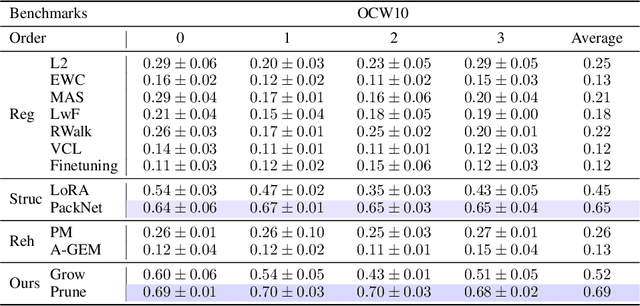
Training a generalizable agent to continually learn a sequence of tasks from offline trajectories is a natural requirement for long-lived agents, yet remains a significant challenge for current offline reinforcement learning (RL) algorithms. Specifically, an agent must be able to rapidly adapt to new tasks using newly collected trajectories (plasticity), while retaining knowledge from previously learned tasks (stability). However, systematic analyses of this setting are scarce, and it remains unclear whether conventional continual learning (CL) methods are effective in continual offline RL (CORL) scenarios. In this study, we develop the Offline Continual World benchmark and demonstrate that traditional CL methods struggle with catastrophic forgetting, primarily due to the unique distribution shifts inherent to CORL scenarios. To address this challenge, we introduce CompoFormer, a structure-based continual transformer model that adaptively composes previous policies via a meta-policy network. Upon encountering a new task, CompoFormer leverages semantic correlations to selectively integrate relevant prior policies alongside newly trained parameters, thereby enhancing knowledge sharing and accelerating the learning process. Our experiments reveal that CompoFormer outperforms conventional CL methods, particularly in longer task sequences, showcasing a promising balance between plasticity and stability.
Task-Aware Harmony Multi-Task Decision Transformer for Offline Reinforcement Learning
Nov 02, 2024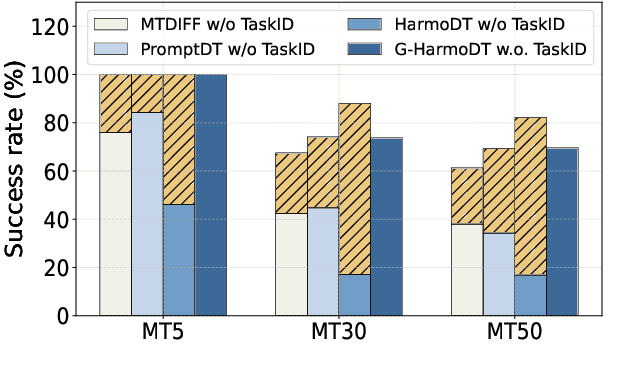
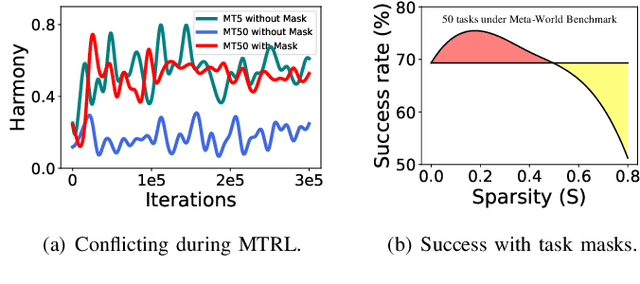
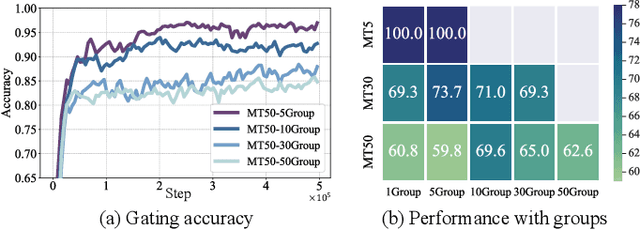
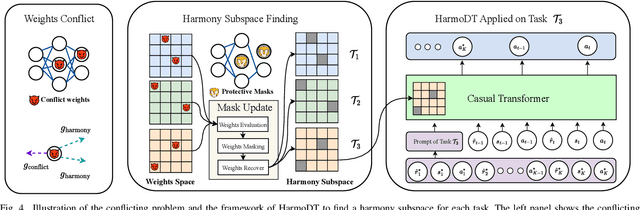
The purpose of offline multi-task reinforcement learning (MTRL) is to develop a unified policy applicable to diverse tasks without the need for online environmental interaction. Recent advancements approach this through sequence modeling, leveraging the Transformer architecture's scalability and the benefits of parameter sharing to exploit task similarities. However, variations in task content and complexity pose significant challenges in policy formulation, necessitating judicious parameter sharing and management of conflicting gradients for optimal policy performance. Furthermore, identifying the optimal parameter subspace for each task often necessitates prior knowledge of the task identifier during inference, limiting applicability in real-world scenarios with variable task content and unknown current tasks. In this work, we introduce the Harmony Multi-Task Decision Transformer (HarmoDT), a novel solution designed to identify an optimal harmony subspace of parameters for each task. We formulate this as a bi-level optimization problem within a meta-learning framework, where the upper level learns masks to define the harmony subspace, while the inner level focuses on updating parameters to improve the overall performance of the unified policy. To eliminate the need for task identifiers, we further design a group-wise variant (G-HarmoDT) that clusters tasks into coherent groups based on gradient information, and utilizes a gating network to determine task identifiers during inference. Empirical evaluations across various benchmarks highlight the superiority of our approach, demonstrating its effectiveness in the multi-task context with specific improvements of 8% gain in task-provided settings, 5% in task-agnostic settings, and 10% in unseen settings.
Prompt Tuning with Diffusion for Few-Shot Pre-trained Policy Generalization
Nov 02, 2024
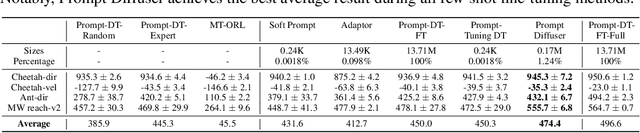
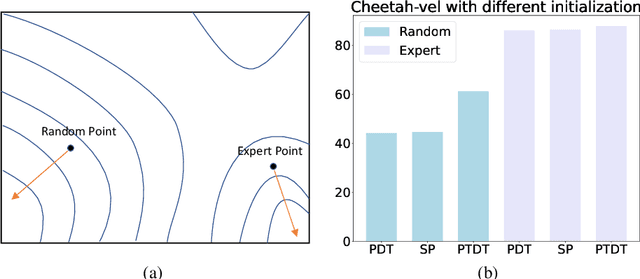

Offline reinforcement learning (RL) methods harness previous experiences to derive an optimal policy, forming the foundation for pre-trained large-scale models (PLMs). When encountering tasks not seen before, PLMs often utilize several expert trajectories as prompts to expedite their adaptation to new requirements. Though a range of prompt-tuning methods have been proposed to enhance the quality of prompts, these methods often face optimization restrictions due to prompt initialization, which can significantly constrain the exploration domain and potentially lead to suboptimal solutions. To eliminate the reliance on the initial prompt, we shift our perspective towards the generative model, framing the prompt-tuning process as a form of conditional generative modeling, where prompts are generated from random noise. Our innovation, the Prompt Diffuser, leverages a conditional diffusion model to produce prompts of exceptional quality. Central to our framework is the approach to trajectory reconstruction and the meticulous integration of downstream task guidance during the training phase. Further experimental results underscore the potency of the Prompt Diffuser as a robust and effective tool for the prompt-tuning process, demonstrating strong performance in the meta-RL tasks.