 Add to Chrome
 Add to Firefox
 Add to Edge
Fine-structure Preserved Real-world Image Super-resolution via Transfer VAE Training
Jul 27, 2025
Impressive results on real-world image super-resolution (Real-ISR) have been achieved by employing pre-trained stable diffusion (SD) models. However, one critical issue of such methods lies in their poor reconstruction of image fine structures, such as small characters and textures, due to the aggressive resolution reduction of the VAE (eg., 8$\times$ downsampling) in the SD model. One solution is to employ a VAE with a lower downsampling rate for diffusion; however, adapting its latent features with the pre-trained UNet while mitigating the increased computational cost poses new challenges. To address these issues, we propose a Transfer VAE Training (TVT) strategy to transfer the 8$\times$ downsampled VAE into a 4$\times$ one while adapting to the pre-trained UNet. Specifically, we first train a 4$\times$ decoder based on the output features of the original VAE encoder, then train a 4$\times$ encoder while keeping the newly trained decoder fixed. Such a TVT strategy aligns the new encoder-decoder pair with the original VAE latent space while enhancing image fine details. Additionally, we introduce a compact VAE and compute-efficient UNet by optimizing their network architectures, reducing the computational cost while capturing high-resolution fine-scale features. Experimental results demonstrate that our TVT method significantly improves fine-structure preservation, which is often compromised by other SD-based methods, while requiring fewer FLOPs than state-of-the-art one-step diffusion models. The official code can be found at https://github.com/Joyies/TVT.

UNICE: Training A Universal Image Contrast Enhancer
Jul 23, 2025Existing image contrast enhancement methods are typically designed for specific tasks such as under-/over-exposure correction, low-light and backlit image enhancement, etc. The learned models, however, exhibit poor generalization performance across different tasks, even across different datasets of a specific task. It is important to explore whether we can learn a universal and generalized model for various contrast enhancement tasks. In this work, we observe that the common key factor of these tasks lies in the need of exposure and contrast adjustment, which can be well-addressed if high-dynamic range (HDR) inputs are available. We hence collect 46,928 HDR raw images from public sources, and render 328,496 sRGB images to build multi-exposure sequences (MES) and the corresponding pseudo sRGB ground-truths via multi-exposure fusion. Consequently, we train a network to generate an MES from a single sRGB image, followed by training another network to fuse the generated MES into an enhanced image. Our proposed method, namely UNiversal Image Contrast Enhancer (UNICE), is free of costly human labeling. However, it demonstrates significantly stronger generalization performance than existing image contrast enhancement methods across and within different tasks, even outperforming manually created ground-truths in multiple no-reference image quality metrics. The dataset, code and model are available at https://github.com/BeyondHeaven/UNICE.
VideoITG: Multimodal Video Understanding with Instructed Temporal Grounding
Jul 17, 2025Recent studies have revealed that selecting informative and relevant video frames can significantly improve the performance of Video Large Language Models (Video-LLMs). Current methods, such as reducing inter-frame redundancy, employing separate models for image-text relevance assessment, or utilizing temporal video grounding for event localization, substantially adopt unsupervised learning paradigms, whereas they struggle to address the complex scenarios in long video understanding. We propose Instructed Temporal Grounding for Videos (VideoITG), featuring customized frame sampling aligned with user instructions. The core of VideoITG is the VidThinker pipeline, an automated annotation framework that explicitly mimics the human annotation process. First, it generates detailed clip-level captions conditioned on the instruction; then, it retrieves relevant video segments through instruction-guided reasoning; finally, it performs fine-grained frame selection to pinpoint the most informative visual evidence. Leveraging VidThinker, we construct the VideoITG-40K dataset, containing 40K videos and 500K instructed temporal grounding annotations. We then design a plug-and-play VideoITG model, which takes advantage of visual language alignment and reasoning capabilities of Video-LLMs, for effective frame selection in a discriminative manner. Coupled with Video-LLMs, VideoITG achieves consistent performance improvements across multiple multimodal video understanding benchmarks, showing its superiority and great potentials for video understanding.
RTR-GS: 3D Gaussian Splatting for Inverse Rendering with Radiance Transfer and Reflection
Jul 10, 2025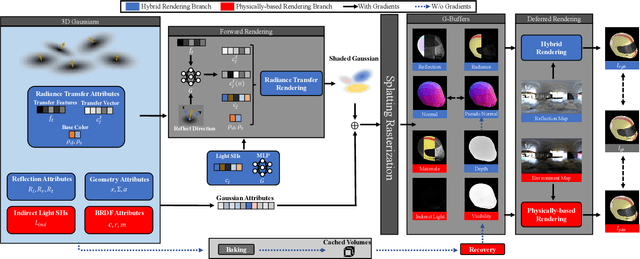
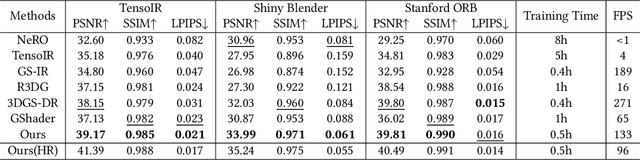
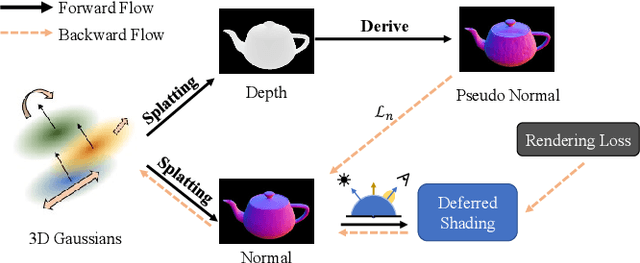
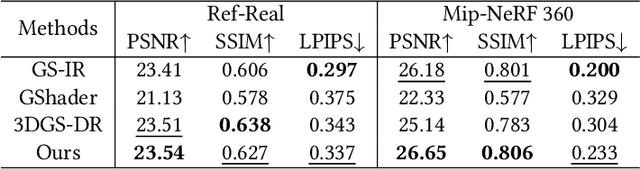
3D Gaussian Splatting (3DGS) has demonstrated impressive capabilities in novel view synthesis. However, rendering reflective objects remains a significant challenge, particularly in inverse rendering and relighting. We introduce RTR-GS, a novel inverse rendering framework capable of robustly rendering objects with arbitrary reflectance properties, decomposing BRDF and lighting, and delivering credible relighting results. Given a collection of multi-view images, our method effectively recovers geometric structure through a hybrid rendering model that combines forward rendering for radiance transfer with deferred rendering for reflections. This approach successfully separates high-frequency and low-frequency appearances, mitigating floating artifacts caused by spherical harmonic overfitting when handling high-frequency details. We further refine BRDF and lighting decomposition using an additional physically-based deferred rendering branch. Experimental results show that our method enhances novel view synthesis, normal estimation, decomposition, and relighting while maintaining efficient training inference process.
Prompt-Free Conditional Diffusion for Multi-object Image Augmentation
Jul 08, 2025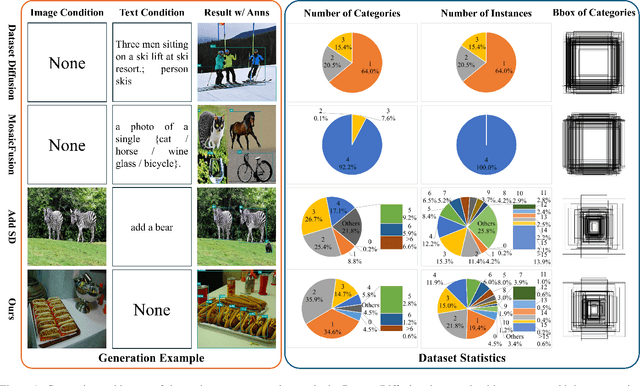
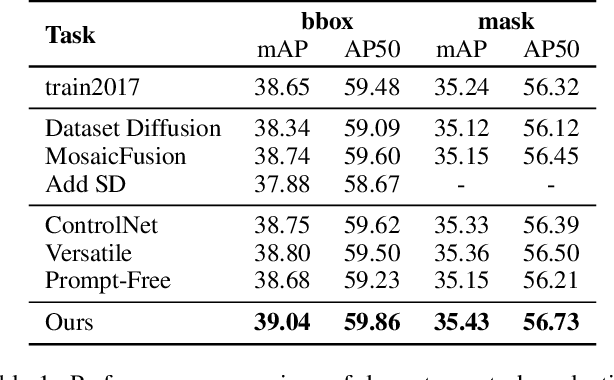
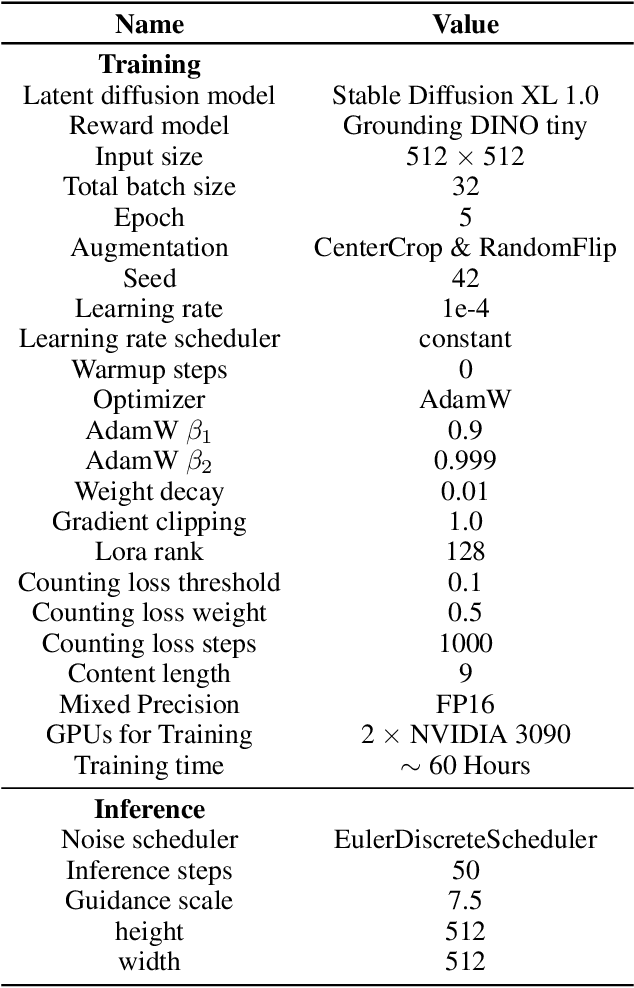
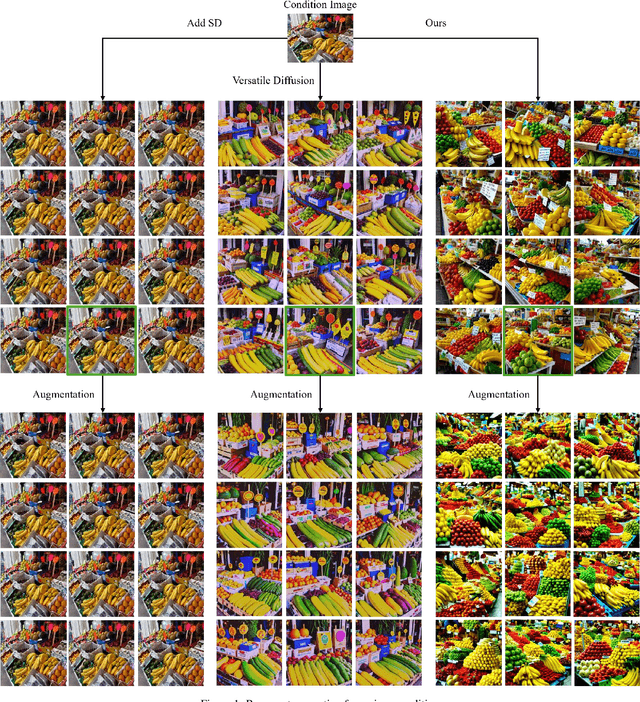
Diffusion models has underpinned much recent advances of dataset augmentation in various computer vision tasks. However, when involving generating multi-object images as real scenarios, most existing methods either rely entirely on text condition, resulting in a deviation between the generated objects and the original data, or rely too much on the original images, resulting in a lack of diversity in the generated images, which is of limited help to downstream tasks. To mitigate both problems with one stone, we propose a prompt-free conditional diffusion framework for multi-object image augmentation. Specifically, we introduce a local-global semantic fusion strategy to extract semantics from images to replace text, and inject knowledge into the diffusion model through LoRA to alleviate the category deviation between the original model and the target dataset. In addition, we design a reward model based counting loss to assist the traditional reconstruction loss for model training. By constraining the object counts of each category instead of pixel-by-pixel constraints, bridging the quantity deviation between the generated data and the original data while improving the diversity of the generated data. Experimental results demonstrate the superiority of the proposed method over several representative state-of-the-art baselines and showcase strong downstream task gain and out-of-domain generalization capabilities. Code is available at \href{https://github.com/00why00/PFCD}{here}.
One-Step Diffusion for Detail-Rich and Temporally Consistent Video Super-Resolution
Jun 18, 2025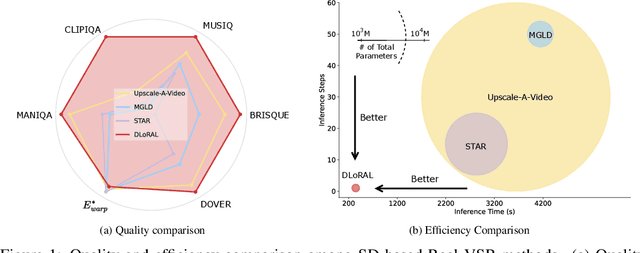
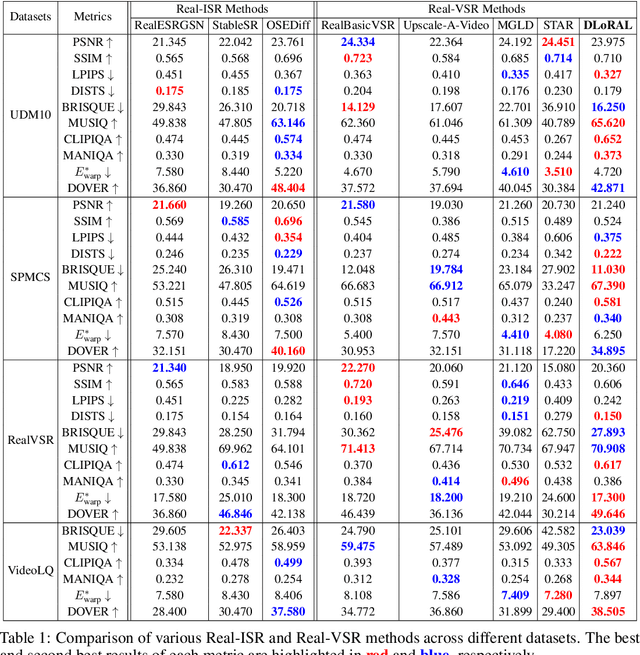
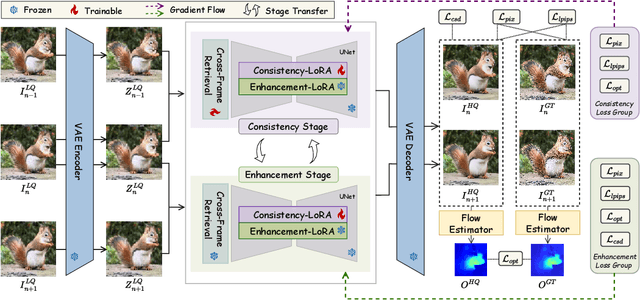

It is a challenging problem to reproduce rich spatial details while maintaining temporal consistency in real-world video super-resolution (Real-VSR), especially when we leverage pre-trained generative models such as stable diffusion (SD) for realistic details synthesis. Existing SD-based Real-VSR methods often compromise spatial details for temporal coherence, resulting in suboptimal visual quality. We argue that the key lies in how to effectively extract the degradation-robust temporal consistency priors from the low-quality (LQ) input video and enhance the video details while maintaining the extracted consistency priors. To achieve this, we propose a Dual LoRA Learning (DLoRAL) paradigm to train an effective SD-based one-step diffusion model, achieving realistic frame details and temporal consistency simultaneously. Specifically, we introduce a Cross-Frame Retrieval (CFR) module to aggregate complementary information across frames, and train a Consistency-LoRA (C-LoRA) to learn robust temporal representations from degraded inputs. After consistency learning, we fix the CFR and C-LoRA modules and train a Detail-LoRA (D-LoRA) to enhance spatial details while aligning with the temporal space defined by C-LoRA to keep temporal coherence. The two phases alternate iteratively for optimization, collaboratively delivering consistent and detail-rich outputs. During inference, the two LoRA branches are merged into the SD model, allowing efficient and high-quality video restoration in a single diffusion step. Experiments show that DLoRAL achieves strong performance in both accuracy and speed. Code and models are available at https://github.com/yjsunnn/DLoRAL.
SWE-Flow: Synthesizing Software Engineering Data in a Test-Driven Manner
Jun 11, 2025We introduce **SWE-Flow**, a novel data synthesis framework grounded in Test-Driven Development (TDD). Unlike existing software engineering data that rely on human-submitted issues, **SWE-Flow** automatically infers incremental development steps directly from unit tests, which inherently encapsulate high-level requirements. The core of **SWE-Flow** is the construction of a Runtime Dependency Graph (RDG), which precisely captures function interactions, enabling the generation of a structured, step-by-step *development schedule*. At each step, **SWE-Flow** produces a partial codebase, the corresponding unit tests, and the necessary code modifications, resulting in fully verifiable TDD tasks. With this approach, we generated 16,061 training instances and 2,020 test instances from real-world GitHub projects, creating the **SWE-Flow-Eval** benchmark. Our experiments show that fine-tuning open model on this dataset significantly improves performance in TDD-based coding. To facilitate further research, we release all code, datasets, models, and Docker images at [Github](https://github.com/Hambaobao/SWE-Flow).
Training Superior Sparse Autoencoders for Instruct Models
Jun 09, 2025As large language models (LLMs) grow in scale and capability, understanding their internal mechanisms becomes increasingly critical. Sparse autoencoders (SAEs) have emerged as a key tool in mechanistic interpretability, enabling the extraction of human-interpretable features from LLMs. However, existing SAE training methods are primarily designed for base models, resulting in reduced reconstruction quality and interpretability when applied to instruct models. To bridge this gap, we propose $\underline{\textbf{F}}$inetuning-$\underline{\textbf{a}}$ligned $\underline{\textbf{S}}$equential $\underline{\textbf{T}}$raining ($\textit{FAST}$), a novel training method specifically tailored for instruct models. $\textit{FAST}$ aligns the training process with the data distribution and activation patterns characteristic of instruct models, resulting in substantial improvements in both reconstruction and feature interpretability. On Qwen2.5-7B-Instruct, $\textit{FAST}$ achieves a mean squared error of 0.6468 in token reconstruction, significantly outperforming baseline methods with errors of 5.1985 and 1.5096. In feature interpretability, $\textit{FAST}$ yields a higher proportion of high-quality features, for Llama3.2-3B-Instruct, $21.1\%$ scored in the top range, compared to $7.0\%$ and $10.2\%$ for $\textit{BT(P)}$ and $\textit{BT(F)}$. Surprisingly, we discover that intervening on the activations of special tokens via the SAEs leads to improvements in output quality, suggesting new opportunities for fine-grained control of model behavior. Code, data, and 240 trained SAEs are available at https://github.com/Geaming2002/FAST.
MiniCPM4: Ultra-Efficient LLMs on End Devices
Jun 09, 2025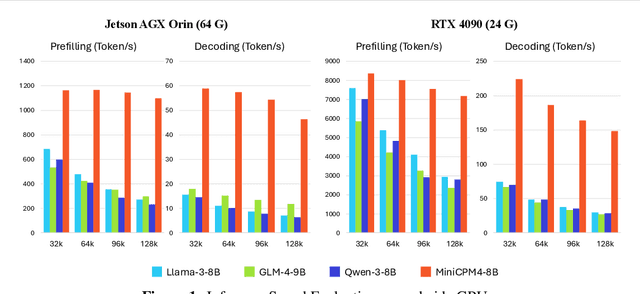

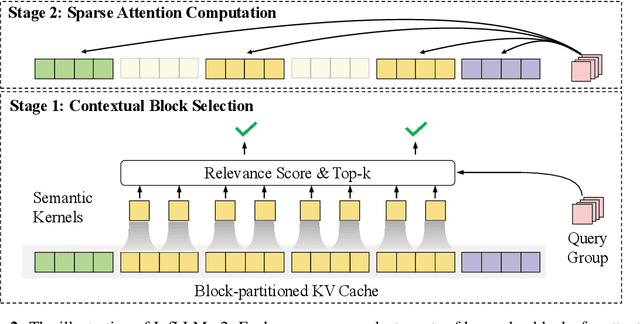
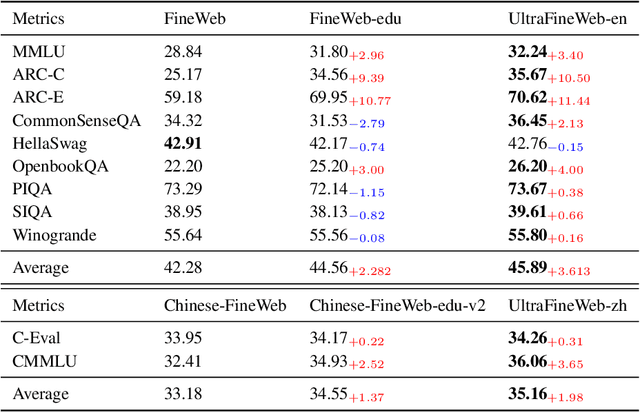
This paper introduces MiniCPM4, a highly efficient large language model (LLM) designed explicitly for end-side devices. We achieve this efficiency through systematic innovation in four key dimensions: model architecture, training data, training algorithms, and inference systems. Specifically, in terms of model architecture, we propose InfLLM v2, a trainable sparse attention mechanism that accelerates both prefilling and decoding phases for long-context processing. Regarding training data, we propose UltraClean, an efficient and accurate pre-training data filtering and generation strategy, and UltraChat v2, a comprehensive supervised fine-tuning dataset. These datasets enable satisfactory model performance to be achieved using just 8 trillion training tokens. Regarding training algorithms, we propose ModelTunnel v2 for efficient pre-training strategy search, and improve existing post-training methods by introducing chunk-wise rollout for load-balanced reinforcement learning and data-efficient tenary LLM, BitCPM. Regarding inference systems, we propose CPM.cu that integrates sparse attention, model quantization, and speculative sampling to achieve efficient prefilling and decoding. To meet diverse on-device requirements, MiniCPM4 is available in two versions, with 0.5B and 8B parameters, respectively. Sufficient evaluation results show that MiniCPM4 outperforms open-source models of similar size across multiple benchmarks, highlighting both its efficiency and effectiveness. Notably, MiniCPM4-8B demonstrates significant speed improvements over Qwen3-8B when processing long sequences. Through further adaptation, MiniCPM4 successfully powers diverse applications, including trustworthy survey generation and tool use with model context protocol, clearly showcasing its broad usability.
Representation Decomposition for Learning Similarity and Contrastness Across Modalities for Affective Computing
Jun 08, 2025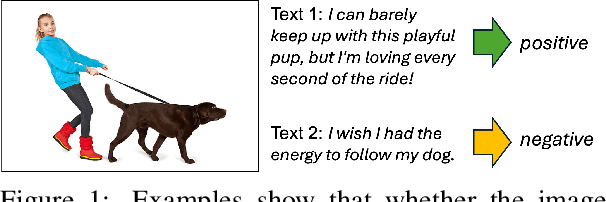
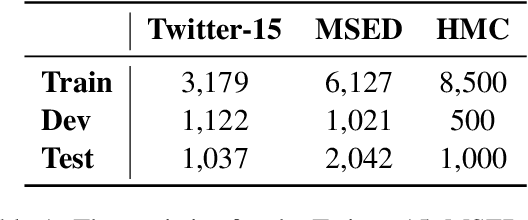
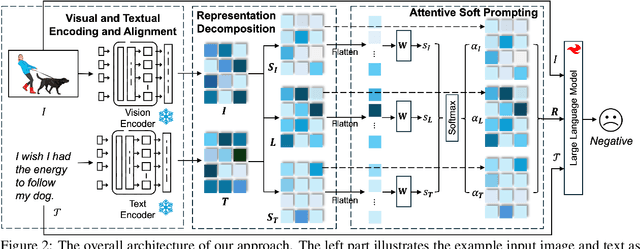
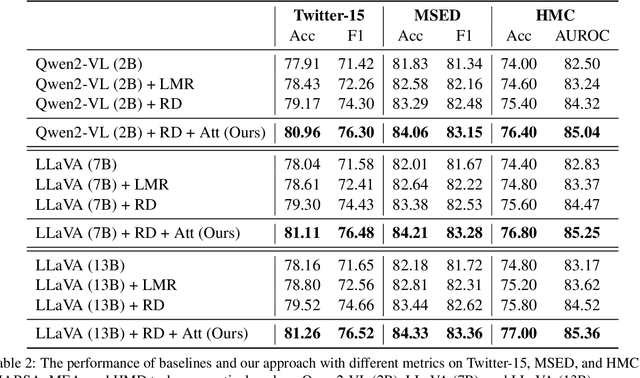
Multi-modal affective computing aims to automatically recognize and interpret human attitudes from diverse data sources such as images and text, thereby enhancing human-computer interaction and emotion understanding. Existing approaches typically rely on unimodal analysis or straightforward fusion of cross-modal information that fail to capture complex and conflicting evidence presented across different modalities. In this paper, we propose a novel LLM-based approach for affective computing that explicitly deconstructs visual and textual representations into shared (modality-invariant) and modality-specific components. Specifically, our approach firstly encodes and aligns input modalities using pre-trained multi-modal encoders, then employs a representation decomposition framework to separate common emotional content from unique cues, and finally integrates these decomposed signals via an attention mechanism to form a dynamic soft prompt for a multi-modal LLM. Extensive experiments on three representative tasks for affective computing, namely, multi-modal aspect-based sentiment analysis, multi-modal emotion analysis, and hateful meme detection, demonstrate the effectiveness of our approach, which consistently outperforms strong baselines and state-of-the-art models.