 Add to Chrome
 Add to Firefox
 Add to Edge
PixRestore: Unified Image Restoration via Pixel Diffusion Transformer
Aug 17, 2026
Unified image restoration (UIR) aims to recover high-quality (HQ) content from low-quality (LQ) images with different degradations using a single model. Most recent methods adapt large pretrained text-to-image (T2I) latent diffusion models for their strong capacity and generative priors. However, the variational autoencoder (VAE) in latent T2I models may discard restoration-sensitive details, while the open-ended synthesis prior can introduce content-inconsistent artifacts. We present PixRestore, a VAE-free pixel-space Diffusion Transformer (DiT) for UIR, where the diffusion backbone is trained entirely from scratch, without relying on T2I pretraining. PixRestore performs flow matching directly on patchified pixels, preserving fine-grained details while keeping the token sequence tractable. To adapt to different degradations, PixRestore learns to predict the reliability of layer features using LQ--HQ DINO feature similarity. Features from more reliable layers are fused as dense conditioning, while less reliable layers receive stronger HQ-feature supervision to encourage degradation removal. We train PixRestore on a large-scale corpus of diverse scenes and degradations, and further finetune it into a one-step generator using DINO-based adversarial objectives for efficient inference. Experiments on public benchmarks and real-world test sets show that, with only about 50M parameters and single-step inference, PixRestore achieves the best overall fidelity, perceptual quality, and robustness to degradations among competing UIR models while being far more efficient. Larger PixRestore variants can further boost performance, demonstrating the scalability of our pixel-space design. Code and the curated benchmark can be found at https://github.com/csslc/PixRestore.

Memorize When Needed: Decoupled Memory Control for Spatially Consistent Long-Horizon Video Generation
Apr 21, 2026Spatially consistent long-horizon video generation aims to maintain temporal and spatial consistency along predefined camera trajectories. Existing methods mostly entangle memory modeling with video generation, leading to inconsistent content during scene revisits and diminished generative capacity when exploring novel regions, even trained on extensive annotated data. To address these limitations, we propose a decoupled framework that separates memory conditioning from generation. Our approach significantly reduces training costs while simultaneously enhancing spatial consistency and preserving the generative capacity for novel scene exploration. Specifically, we employ a lightweight, independent memory branch to learn precise spatial consistency from historical observation. We first introduce a hybrid memory representation to capture complementary temporal and spatial cues from generated frames, then leverage a per-frame cross-attention mechanism to ensure each frame is conditioned exclusively on the most spatially relevant historical information, which is injected into the generative model to ensure spatial consistency. When generating new scenes, a camera-aware gating mechanism is proposed to mediate the interaction between memory and generation modules, enabling memory conditioning only when meaningful historical references exist. Compared with the existing method, our method is highly data-efficient, yet the experiments demonstrate that our approach achieves state-of-the-art performance in terms of both visual quality and spatial consistency.
VOSR: A Vision-Only Generative Model for Image Super-Resolution
Apr 03, 2026Most of the recent generative image super-resolution (SR) methods rely on adapting large text-to-image (T2I) diffusion models pretrained on web-scale text-image data. While effective, this paradigm starts from a generic T2I generator, despite that SR is fundamentally a low-resolution (LR) input-conditioned image restoration task. In this work, we investigate whether an SR model trained purely on visual data can rival T2I-based ones. To this end, we propose VOSR, a Vision-Only generative framework for SR. We first extract semantically rich and spatially grounded features from the LR input using a pretrained vision encoder as visual semantic guidance. We then revisit classifier-free guidance for training generative models and show that the standard unconditional branch is ill-suited to restoration models trained from scratch. We therefore replace it with a restoration-oriented guidance strategy that preserves weak LR anchors. Built upon these designs, we first train a multi-step VOSR model from scratch and then distill it into a one-step model for efficient inference. VOSR requires less than one-tenth of the training cost of representative T2I-based SR methods, yet in both multi-step and one-step settings, it achieves competitive or even better perceptual quality and efficiency, while producing more faithful structures with fewer hallucinations on both synthetic and real-world benchmarks. Our results, for the first time, show that high-quality generative SR can be achieved without multimodal pretraining. The code and models can be found at https://github.com/cswry/VOSR.
GDPO-SR: Group Direct Preference Optimization for One-Step Generative Image Super-Resolution
Mar 16, 2026Recently, reinforcement learning (RL) has been employed for improving generative image super-resolution (ISR) performance. However, the current efforts are focused on multi-step generative ISR, while one-step generative ISR remains underexplored due to its limited stochasticity. In addition, RL methods such as Direct Preference Optimization (DPO) require the generation of positive and negative sample pairs offline, leading to a limited number of samples, while Group Relative Policy Optimization (GRPO) only calculates the likelihood of the entire image, ignoring local details that are crucial for ISR. In this paper, we propose Group Direct Preference Optimization (GDPO), a novel approach to integrate RL into one-step generative ISR model training. First, we introduce a noise-aware one-step diffusion model that can generate diverse ISR outputs. To prevent performance degradation caused by noise injection, we introduce an unequal-timestep strategy to decouple the timestep of noise addition from that of diffusion. We then present the GDPO strategy, which integrates the principle of GRPO into DPO, to calculate the group-relative advantage of each online generated sample for model optimization. Meanwhile, an attribute-aware reward function is designed to dynamically evaluate the score of each sample based on its statistics of smooth and texture areas. Experiments demonstrate the effectiveness of GDPO in enhancing the performance of one-step generative ISR models. Code: https://github.com/Joyies/GDPO.
BinaryAttention: One-Bit QK-Attention for Vision and Diffusion Transformers
Mar 10, 2026Transformers have achieved widespread and remarkable success, while the computational complexity of their attention modules remains a major bottleneck for vision tasks. Existing methods mainly employ 8-bit or 4-bit quantization to balance efficiency and accuracy. In this paper, with theoretical justification, we indicate that binarization of attention preserves the essential similarity relationships, and propose BinaryAttention, an effective method for fast and accurate 1-bit qk-attention. Specifically, we retain only the sign of queries and keys in computing the attention, and replace the floating dot products with bit-wise operations, significantly reducing the computational cost. We mitigate the inherent information loss under 1-bit quantization by incorporating a learnable bias, and enable end-to-end acceleration. To maintain the accuracy of attention, we adopt quantization-aware training and self-distillation techniques, mitigating quantization errors while ensuring sign-aligned similarity. BinaryAttention is more than 2x faster than FlashAttention2 on A100 GPUs. Extensive experiments on vision transformer and diffusion transformer benchmarks demonstrate that BinaryAttention matches or even exceeds full-precision attention, validating its effectiveness. Our work provides a highly efficient and effective alternative to full-precision attention, pushing the frontier of low-bit vision and diffusion transformers. The codes and models can be found at https://github.com/EdwardChasel/BinaryAttention.
Beyond External Guidance: Unleashing the Semantic Richness Inside Diffusion Transformers for Improved Training
Jan 12, 2026Recent works such as REPA have shown that guiding diffusion models with external semantic features (e.g., DINO) can significantly accelerate the training of diffusion transformers (DiTs). However, this requires the use of pretrained external networks, introducing additional dependencies and reducing flexibility. In this work, we argue that DiTs actually have the power to guide the training of themselves, and propose \textbf{Self-Transcendence}, a simple yet effective method that achieves fast convergence using internal feature supervision only. It is found that the slow convergence in DiT training primarily stems from the difficulty of representation learning in shallow layers. To address this, we initially train the DiT model by aligning its shallow features with the latent representations from the pretrained VAE for a short phase (e.g., 40 epochs), then apply classifier-free guidance to the intermediate features, enhancing their discriminative capability and semantic expressiveness. These enriched internal features, learned entirely within the model, are used as supervision signals to guide a new DiT training. Compared to existing self-contained methods, our approach brings a significant performance boost. It can even surpass REPA in terms of generation quality and convergence speed, but without the need for any external pretrained models. Our method is not only more flexible for different backbones but also has the potential to be adopted for a wider range of diffusion-based generative tasks. The source code of our method can be found at https://github.com/csslc/Self-Transcendence.
DP$^2$O-SR: Direct Perceptual Preference Optimization for Real-World Image Super-Resolution
Oct 21, 2025Benefiting from pre-trained text-to-image (T2I) diffusion models, real-world image super-resolution (Real-ISR) methods can synthesize rich and realistic details. However, due to the inherent stochasticity of T2I models, different noise inputs often lead to outputs with varying perceptual quality. Although this randomness is sometimes seen as a limitation, it also introduces a wider perceptual quality range, which can be exploited to improve Real-ISR performance. To this end, we introduce Direct Perceptual Preference Optimization for Real-ISR (DP$^2$O-SR), a framework that aligns generative models with perceptual preferences without requiring costly human annotations. We construct a hybrid reward signal by combining full-reference and no-reference image quality assessment (IQA) models trained on large-scale human preference datasets. This reward encourages both structural fidelity and natural appearance. To better utilize perceptual diversity, we move beyond the standard best-vs-worst selection and construct multiple preference pairs from outputs of the same model. Our analysis reveals that the optimal selection ratio depends on model capacity: smaller models benefit from broader coverage, while larger models respond better to stronger contrast in supervision. Furthermore, we propose hierarchical preference optimization, which adaptively weights training pairs based on intra-group reward gaps and inter-group diversity, enabling more efficient and stable learning. Extensive experiments across both diffusion- and flow-based T2I backbones demonstrate that DP$^2$O-SR significantly improves perceptual quality and generalizes well to real-world benchmarks.
One-Step Diffusion for Detail-Rich and Temporally Consistent Video Super-Resolution
Jun 18, 2025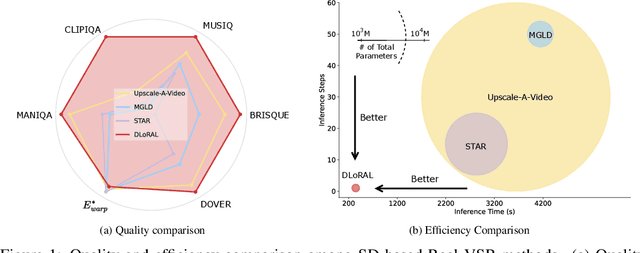
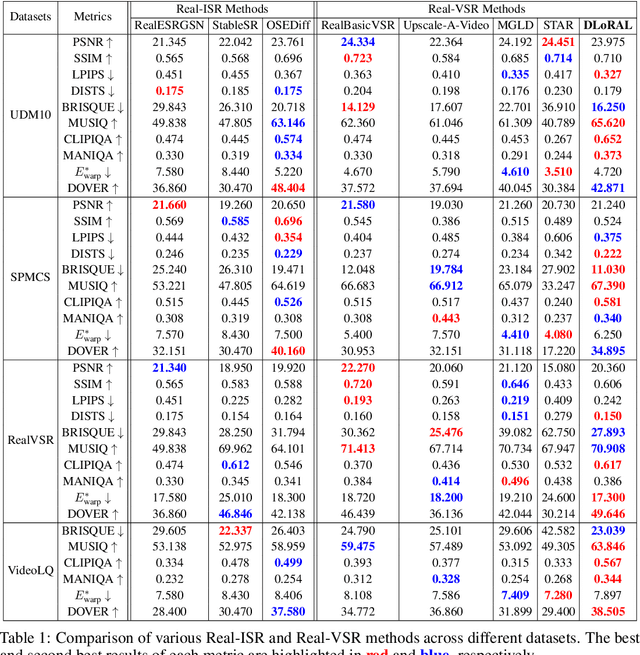
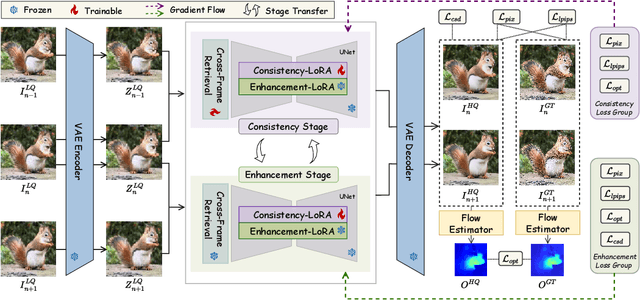

It is a challenging problem to reproduce rich spatial details while maintaining temporal consistency in real-world video super-resolution (Real-VSR), especially when we leverage pre-trained generative models such as stable diffusion (SD) for realistic details synthesis. Existing SD-based Real-VSR methods often compromise spatial details for temporal coherence, resulting in suboptimal visual quality. We argue that the key lies in how to effectively extract the degradation-robust temporal consistency priors from the low-quality (LQ) input video and enhance the video details while maintaining the extracted consistency priors. To achieve this, we propose a Dual LoRA Learning (DLoRAL) paradigm to train an effective SD-based one-step diffusion model, achieving realistic frame details and temporal consistency simultaneously. Specifically, we introduce a Cross-Frame Retrieval (CFR) module to aggregate complementary information across frames, and train a Consistency-LoRA (C-LoRA) to learn robust temporal representations from degraded inputs. After consistency learning, we fix the CFR and C-LoRA modules and train a Detail-LoRA (D-LoRA) to enhance spatial details while aligning with the temporal space defined by C-LoRA to keep temporal coherence. The two phases alternate iteratively for optimization, collaboratively delivering consistent and detail-rich outputs. During inference, the two LoRA branches are merged into the SD model, allowing efficient and high-quality video restoration in a single diffusion step. Experiments show that DLoRAL achieves strong performance in both accuracy and speed. Code and models are available at https://github.com/yjsunnn/DLoRAL.
Generalized and Efficient 2D Gaussian Splatting for Arbitrary-scale Super-Resolution
Jan 14, 2025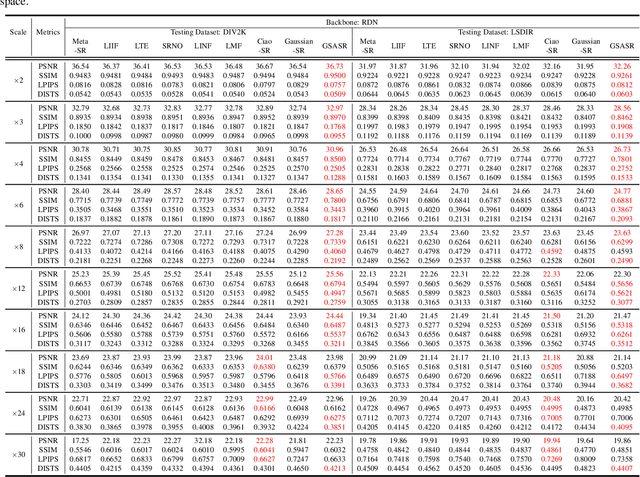
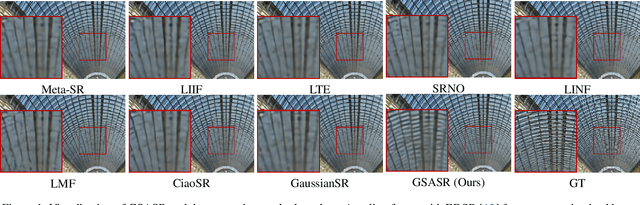
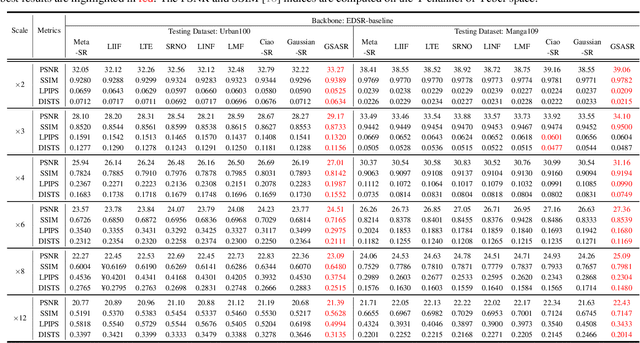
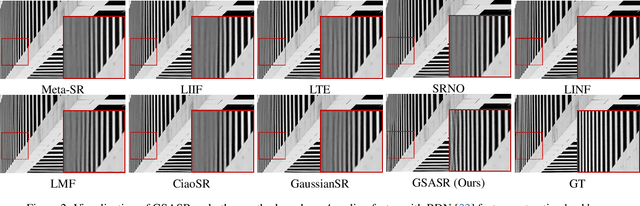
Equipped with the continuous representation capability of Multi-Layer Perceptron (MLP), Implicit Neural Representation (INR) has been successfully employed for Arbitrary-scale Super-Resolution (ASR). However, the limited receptive field of the linear layers in MLP restricts the representation capability of INR, while it is computationally expensive to query the MLP numerous times to render each pixel. Recently, Gaussian Splatting (GS) has shown its advantages over INR in both visual quality and rendering speed in 3D tasks, which motivates us to explore whether GS can be employed for the ASR task. However, directly applying GS to ASR is exceptionally challenging because the original GS is an optimization-based method through overfitting each single scene, while in ASR we aim to learn a single model that can generalize to different images and scaling factors. We overcome these challenges by developing two novel techniques. Firstly, to generalize GS for ASR, we elaborately design an architecture to predict the corresponding image-conditioned Gaussians of the input low-resolution image in a feed-forward manner. Secondly, we implement an efficient differentiable 2D GPU/CUDA-based scale-aware rasterization to render super-resolved images by sampling discrete RGB values from the predicted contiguous Gaussians. Via end-to-end training, our optimized network, namely GSASR, can perform ASR for any image and unseen scaling factors. Extensive experiments validate the effectiveness of our proposed method. The project page can be found at \url{https://mt-cly.github.io/GSASR.github.io/}.
FreCaS: Efficient Higher-Resolution Image Generation via Frequency-aware Cascaded Sampling
Oct 24, 2024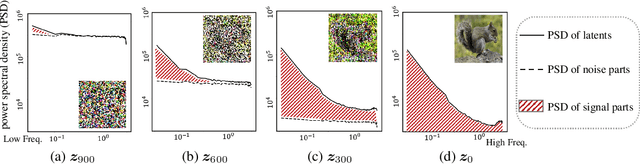
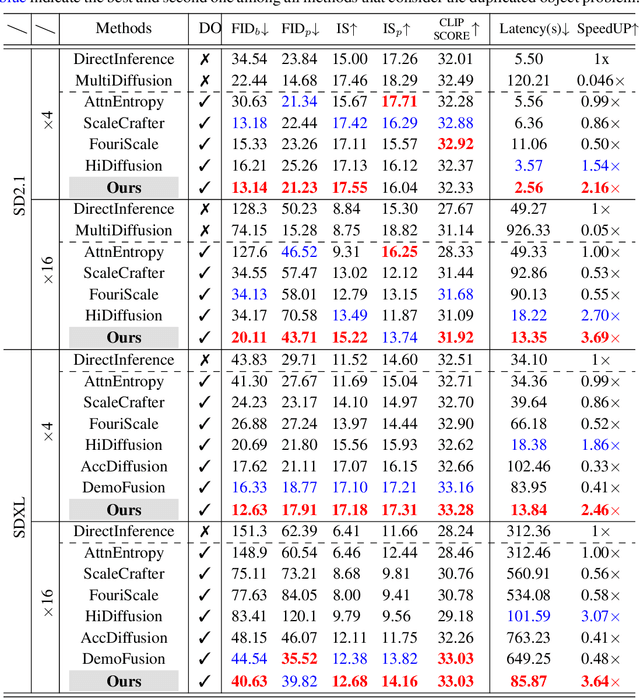
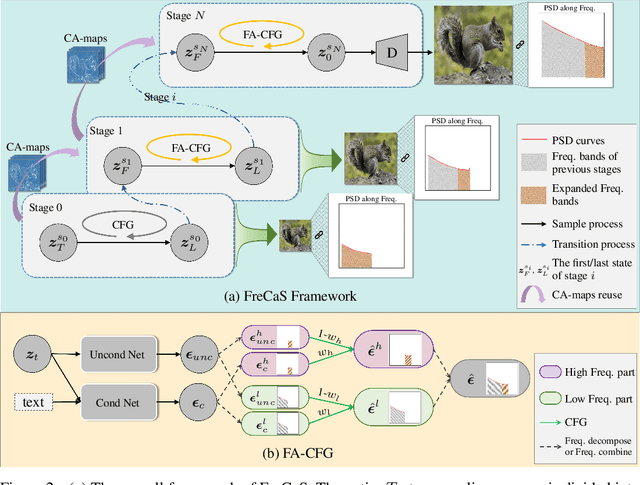
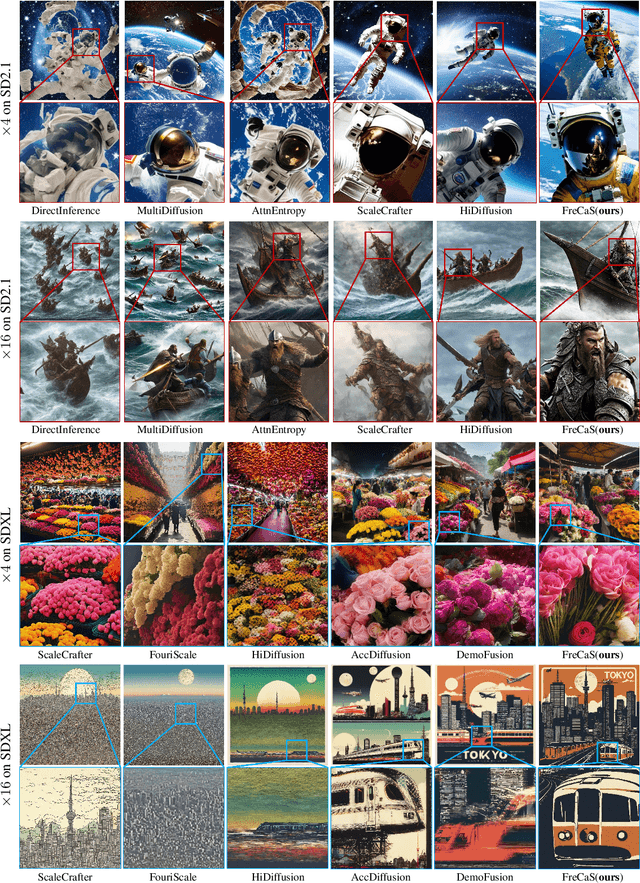
While image generation with diffusion models has achieved a great success, generating images of higher resolution than the training size remains a challenging task due to the high computational cost. Current methods typically perform the entire sampling process at full resolution and process all frequency components simultaneously, contradicting with the inherent coarse-to-fine nature of latent diffusion models and wasting computations on processing premature high-frequency details at early diffusion stages. To address this issue, we introduce an efficient $\textbf{Fre}$quency-aware $\textbf{Ca}$scaded $\textbf{S}$ampling framework, $\textbf{FreCaS}$ in short, for higher-resolution image generation. FreCaS decomposes the sampling process into cascaded stages with gradually increased resolutions, progressively expanding frequency bands and refining the corresponding details. We propose an innovative frequency-aware classifier-free guidance (FA-CFG) strategy to assign different guidance strengths for different frequency components, directing the diffusion model to add new details in the expanded frequency domain of each stage. Additionally, we fuse the cross-attention maps of previous and current stages to avoid synthesizing unfaithful layouts. Experiments demonstrate that FreCaS significantly outperforms state-of-the-art methods in image quality and generation speed. In particular, FreCaS is about 2.86$\times$ and 6.07$\times$ faster than ScaleCrafter and DemoFusion in generating a 2048$\times$2048 image using a pre-trained SDXL model and achieves an FID$_b$ improvement of 11.6 and 3.7, respectively. FreCaS can be easily extended to more complex models such as SD3. The source code of FreCaS can be found at $\href{\text{https://github.com/xtudbxk/FreCaS}}{https://github.com/xtudbxk/FreCaS}$.