 Add to Chrome
 Add to Firefox
 Add to Edge
A governance horizon for ethical-use constraints in open-weight AI models
May 23, 2026
Ethical constraints on open-weight AI models are both a reflection of societal concerns and a foundation for AI governance policy. They are expected to propagate to downstream derivatives while implemented as voluntary metadata disclosures that must be restated at each generation of reuse. We audit 2,142,823 model repositories on Hugging Face Hub to test whether this disclosure-based governance infrastructure can sustain traceability across deep model lineages. Restriction evidence decays with a half-life of 1.31 derivation steps ($R^2$=0.98), and beyond seven downstream generations at least 80% of descendant models lack sufficient public evidence for a governance determination, a depth boundary we formalize as the governance horizon. Platform-level interventions to restore missing licence metadata reveal that policy design (not enforcement alone) is the binding factor: inheritance-only designs require near-complete enforcement to move the horizon, whereas a mandatory-declaration design that explicitly resolves orphan lineage components shifts the horizon already at moderate enforcement. The structural bottleneck is lineages with no inheritable upstream intent: such orphan components remain undecidable under any inheritance-only policy regardless of enforcement rate, and unresolved upstream nodes additionally create direct downstream undecidability bottlenecks that inheritance rules alone cannot recover. Comparison with PyPI, where governance signals are carried by explicit machine-readable declarations, corroborates that the collapse is topology-specific to open-weight derivation rather than inherent to open ecosystems. These results establish that disclosure-based governance has a shallow, structurally determined reach in open-weight AI, and that achieving deep supply-chain accountability requires provenance mechanisms propagating governance signals through derivation itself.

Agent-ValueBench: A Comprehensive Benchmark for Evaluating Agent Values
May 11, 2026Autonomous agents have rapidly matured as task executors and seen widespread deployment via harnesses such as OpenClaw. Safety concerns have rightly drawn growing research attention, and beneath them lie the values silently steering agent behavior. Existing value benchmarks, however, remain confined to LLMs, leaving agent values largely uncharted. From intuitive, empirical, and theoretical vantage points, we show that an agent's values diverge from those of its underlying LLM, and the agentic modality further introduces dataset-, evaluation-, and system-level challenges absent from text-only protocols. We close this gap with Agent-ValueBench, the first benchmark dedicated to agent values. It features 394 executable environments across 16 domains, offering 4,335 value-conflict tasks that cover 28 value systems and 332 dimensions. Every instance is co-synthesized through our purpose-built end-to-end pipeline and curated per-instance by professional psychologists. Each task ships with two pole-aligned golden trajectories whose checkpoints anchor a trajectory-level rubric-based judge. Benchmarking 14 frontier proprietary and open-weights models across 4 mainstream harnesses, we uncover three concerted findings. Agent values first manifest as a Value Tide of cross-model homogeneity beneath interpretable counter-currents. This tide bends non-additively under harness pull, and yet more decisively under deliberate steering via embedded skills. Together these results signal that the agent-alignment lever is shifting from classical model alignment and prompt steering toward harness alignment and skill steering.
NeuReasoner: Towards Explainable, Controllable, and Unified Reasoning via Mixture-of-Neurons
Apr 03, 2026Large Reasoning Models (LRMs) have recently achieved remarkable success in complex reasoning tasks. However, closer scrutiny reveals persistent failure modes compromising performance and cost: I) Intra-step level, marked by calculation or derivation errors; II) Inter-step level, involving oscillation and stagnation; and III) Instance level, causing maladaptive over-thinking. Existing endeavors target isolated levels without unification, while their black-box nature and reliance on RL hinder explainability and controllability. To bridge these gaps, we conduct an in-depth white-box analysis, identifying key neurons (Mixture of Neurons, MoN) and their fluctuation patterns associated with distinct failures. Building upon these insights, we propose NeuReasoner, an explainable, controllable, and unified reasoning framework driven by MoN. Technically, NeuReasoner integrates lightweight MLPs for failure detection with a special token-triggered self-correction mechanism learned via SFT. During inference, special tokens are inserted upon failure detection to actuate controllable remedial behaviors. Extensive evaluations across six benchmarks, six backbone models (8B~70B) against nine competitive baselines, demonstrate that NeuReasoner achieves performance gains of up to 27.0% while reducing token consumption by 19.6% ~ 63.3%.
Meta Context Engineering via Agentic Skill Evolution
Jan 29, 2026The operational efficacy of large language models relies heavily on their inference-time context. This has established Context Engineering (CE) as a formal discipline for optimizing these inputs. Current CE methods rely on manually crafted harnesses, such as rigid generation-reflection workflows and predefined context schemas. They impose structural biases and restrict context optimization to a narrow, intuition-bound design space. To address this, we introduce Meta Context Engineering (MCE), a bi-level framework that supersedes static CE heuristics by co-evolving CE skills and context artifacts. In MCE iterations, a meta-level agent refines engineering skills via agentic crossover, a deliberative search over the history of skills, their executions, and evaluations. A base-level agent executes these skills, learns from training rollouts, and optimizes context as flexible files and code. We evaluate MCE across five disparate domains under offline and online settings. MCE demonstrates consistent performance gains, achieving 5.6--53.8% relative improvement over state-of-the-art agentic CE methods (mean of 16.9%), while maintaining superior context adaptability, transferability, and efficiency in both context usage and training.
VRPAgent: LLM-Driven Discovery of Heuristic Operators for Vehicle Routing Problems
Oct 08, 2025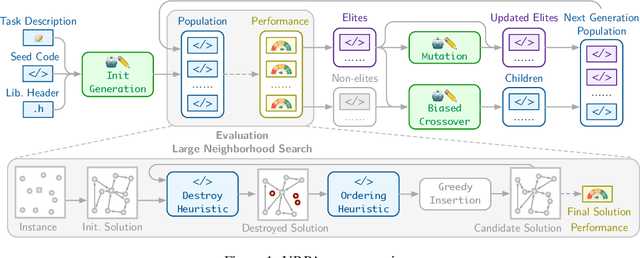
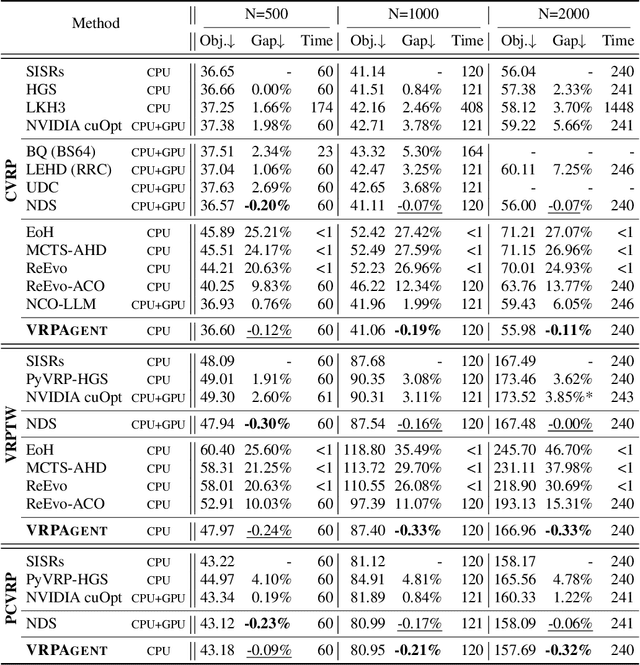
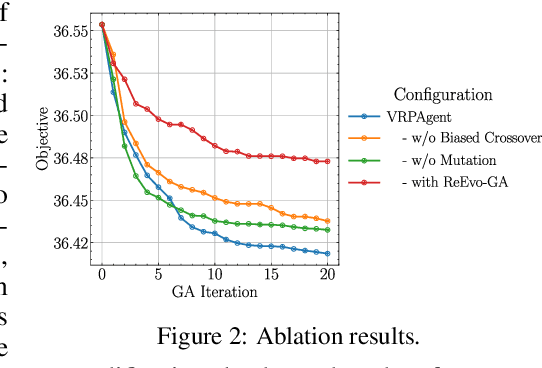
Designing high-performing heuristics for vehicle routing problems (VRPs) is a complex task that requires both intuition and deep domain knowledge. Large language model (LLM)-based code generation has recently shown promise across many domains, but it still falls short of producing heuristics that rival those crafted by human experts. In this paper, we propose VRPAgent, a framework that integrates LLM-generated components into a metaheuristic and refines them through a novel genetic search. By using the LLM to generate problem-specific operators, embedded within a generic metaheuristic framework, VRPAgent keeps tasks manageable, guarantees correctness, and still enables the discovery of novel and powerful strategies. Across multiple problems, including the capacitated VRP, the VRP with time windows, and the prize-collecting VRP, our method discovers heuristic operators that outperform handcrafted methods and recent learning-based approaches while requiring only a single CPU core. To our knowledge, \VRPAgent is the first LLM-based paradigm to advance the state-of-the-art in VRPs, highlighting a promising future for automated heuristics discovery.
Meta-R1: Empowering Large Reasoning Models with Metacognition
Aug 24, 2025Large Reasoning Models (LRMs) demonstrate remarkable capabilities on complex tasks, exhibiting emergent, human-like thinking patterns. Despite their advances, we identify a fundamental limitation: current LRMs lack a dedicated meta-level cognitive system-an essential faculty in human cognition that enables "thinking about thinking". This absence leaves their emergent abilities uncontrollable (non-adaptive reasoning), unreliable (intermediate error), and inflexible (lack of a clear methodology). To address this gap, we introduce Meta-R1, a systematic and generic framework that endows LRMs with explicit metacognitive capabilities. Drawing on principles from cognitive science, Meta-R1 decomposes the reasoning process into distinct object-level and meta-level components, orchestrating proactive planning, online regulation, and adaptive early stopping within a cascaded framework. Experiments on three challenging benchmarks and against eight competitive baselines demonstrate that Meta-R1 is: (I) high-performing, surpassing state-of-the-art methods by up to 27.3%; (II) token-efficient, reducing token consumption to 15.7% ~ 32.7% and improving efficiency by up to 14.8% when compared to its vanilla counterparts; and (III) transferable, maintaining robust performance across datasets and model backbones.
Training Superior Sparse Autoencoders for Instruct Models
Jun 09, 2025As large language models (LLMs) grow in scale and capability, understanding their internal mechanisms becomes increasingly critical. Sparse autoencoders (SAEs) have emerged as a key tool in mechanistic interpretability, enabling the extraction of human-interpretable features from LLMs. However, existing SAE training methods are primarily designed for base models, resulting in reduced reconstruction quality and interpretability when applied to instruct models. To bridge this gap, we propose $\underline{\textbf{F}}$inetuning-$\underline{\textbf{a}}$ligned $\underline{\textbf{S}}$equential $\underline{\textbf{T}}$raining ($\textit{FAST}$), a novel training method specifically tailored for instruct models. $\textit{FAST}$ aligns the training process with the data distribution and activation patterns characteristic of instruct models, resulting in substantial improvements in both reconstruction and feature interpretability. On Qwen2.5-7B-Instruct, $\textit{FAST}$ achieves a mean squared error of 0.6468 in token reconstruction, significantly outperforming baseline methods with errors of 5.1985 and 1.5096. In feature interpretability, $\textit{FAST}$ yields a higher proportion of high-quality features, for Llama3.2-3B-Instruct, $21.1\%$ scored in the top range, compared to $7.0\%$ and $10.2\%$ for $\textit{BT(P)}$ and $\textit{BT(F)}$. Surprisingly, we discover that intervening on the activations of special tokens via the SAEs leads to improvements in output quality, suggesting new opportunities for fine-grained control of model behavior. Code, data, and 240 trained SAEs are available at https://github.com/Geaming2002/FAST.
Large Language Model Psychometrics: A Systematic Review of Evaluation, Validation, and Enhancement
May 13, 2025The rapid advancement of large language models (LLMs) has outpaced traditional evaluation methodologies. It presents novel challenges, such as measuring human-like psychological constructs, navigating beyond static and task-specific benchmarks, and establishing human-centered evaluation. These challenges intersect with Psychometrics, the science of quantifying the intangible aspects of human psychology, such as personality, values, and intelligence. This survey introduces and synthesizes an emerging interdisciplinary field of LLM Psychometrics, which leverages psychometric instruments, theories, and principles to evaluate, understand, and enhance LLMs. We systematically explore the role of Psychometrics in shaping benchmarking principles, broadening evaluation scopes, refining methodologies, validating results, and advancing LLM capabilities. This paper integrates diverse perspectives to provide a structured framework for researchers across disciplines, enabling a more comprehensive understanding of this nascent field. Ultimately, we aim to provide actionable insights for developing future evaluation paradigms that align with human-level AI and promote the advancement of human-centered AI systems for societal benefit. A curated repository of LLM psychometric resources is available at https://github.com/valuebyte-ai/Awesome-LLM-Psychometrics.
Generative Psycho-Lexical Approach for Constructing Value Systems in Large Language Models
Feb 04, 2025


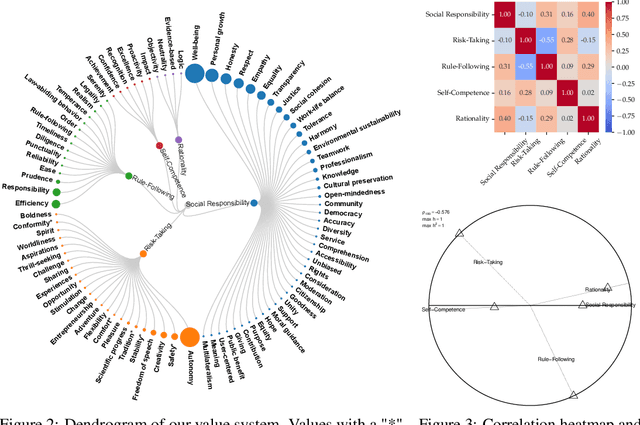
Values are core drivers of individual and collective perception, cognition, and behavior. Value systems, such as Schwartz's Theory of Basic Human Values, delineate the hierarchy and interplay among these values, enabling cross-disciplinary investigations into decision-making and societal dynamics. Recently, the rise of Large Language Models (LLMs) has raised concerns regarding their elusive intrinsic values. Despite growing efforts in evaluating, understanding, and aligning LLM values, a psychologically grounded LLM value system remains underexplored. This study addresses the gap by introducing the Generative Psycho-Lexical Approach (GPLA), a scalable, adaptable, and theoretically informed method for constructing value systems. Leveraging GPLA, we propose a psychologically grounded five-factor value system tailored for LLMs. For systematic validation, we present three benchmarking tasks that integrate psychological principles with cutting-edge AI priorities. Our results reveal that the proposed value system meets standard psychological criteria, better captures LLM values, improves LLM safety prediction, and enhances LLM alignment, when compared to the canonical Schwartz's values.
TransPlace: Transferable Circuit Global Placement via Graph Neural Network
Jan 10, 2025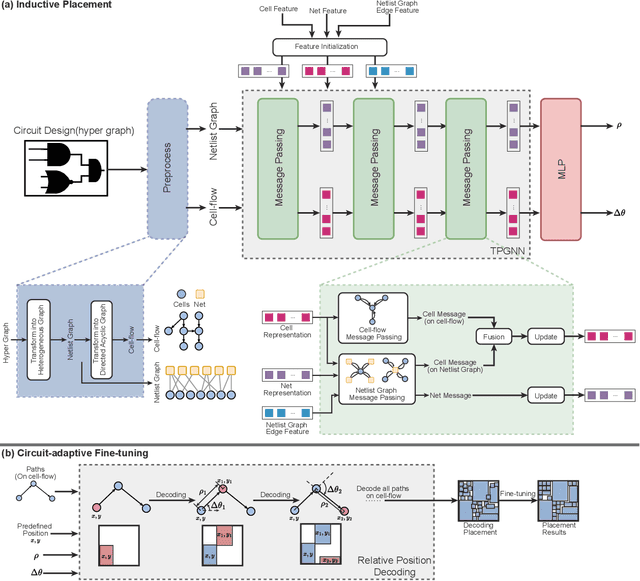
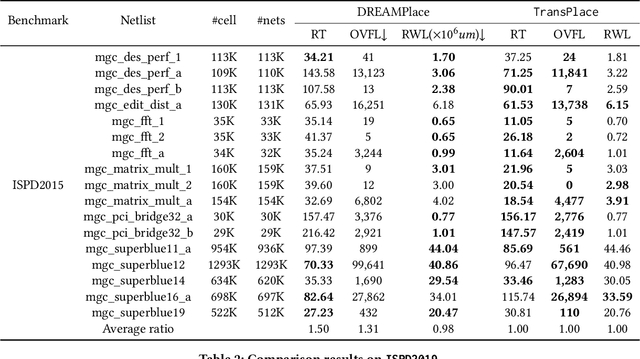
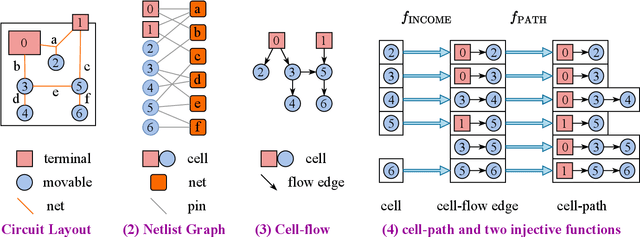
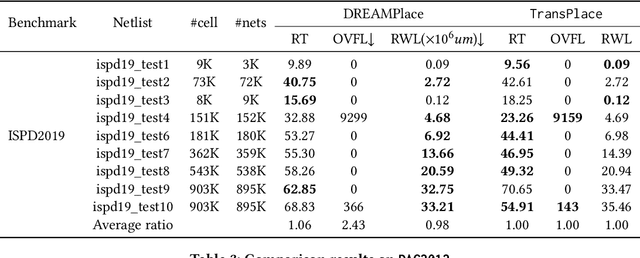
Global placement, a critical step in designing the physical layout of computer chips, is essential to optimize chip performance. Prior global placement methods optimize each circuit design individually from scratch. Their neglect of transferable knowledge limits solution efficiency and chip performance as circuit complexity drastically increases. This study presents TransPlace, a global placement framework that learns to place millions of mixed-size cells in continuous space. TransPlace introduces i) Netlist Graph to efficiently model netlist topology, ii) Cell-flow and relative position encoding to learn SE(2)-invariant representation, iii) a tailored graph neural network architecture for informed parameterization of placement knowledge, and iv) a two-stage strategy for coarse-to-fine placement. Compared to state-of-the-art placement methods, TransPlace-trained on a few high-quality placements-can place unseen circuits with 1.2x speedup while reducing congestion by 30%, timing by 9%, and wirelength by 5%.